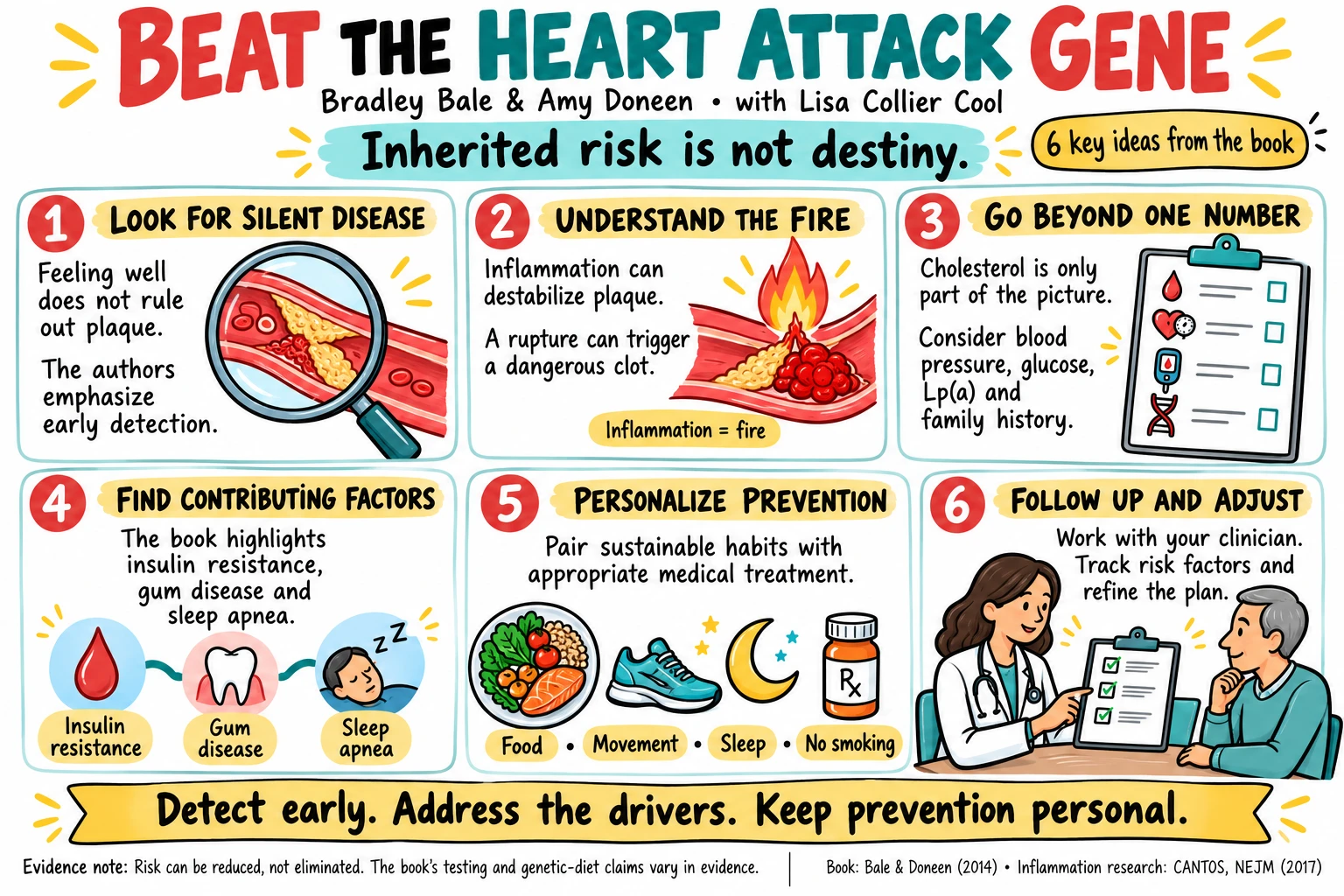
A plain-English summary of Beat the Heart Attack Gene by Bradley Bale, MD, and Amy Doneen
"If you don't have plaque in your arteries, you won't have a heart attack or stroke, even if you have lots of other risk factors."
Bradley Bale and Amy Doneen, Beat the Heart Attack Gene (reader highlights on Goodreads)
What you'll learn: how a clean checkup can miss a sick artery, and the five things Beat the Heart Attack Gene says to check instead. I'll also show where its proof runs thin.
The fit man with old arteries
David Bobbett was 51. He ran a business in Dublin. He played a lot of sport and lived well.
Then he had a scan that looks for calcium in the heart's arteries. The result floored him. His body had "the arteries of an 87-year-old man" (Irish Echo).
Now the part that should bother you. The book says David had passed a stress test (Shortform's summary). That's the treadmill walk with a heart monitor.
The treadmill said low risk. The scan said trouble.
I think we trust that treadmill far too much.
So which test was wrong? And would your checkup have caught it?
A stress test only finds blocked pipes
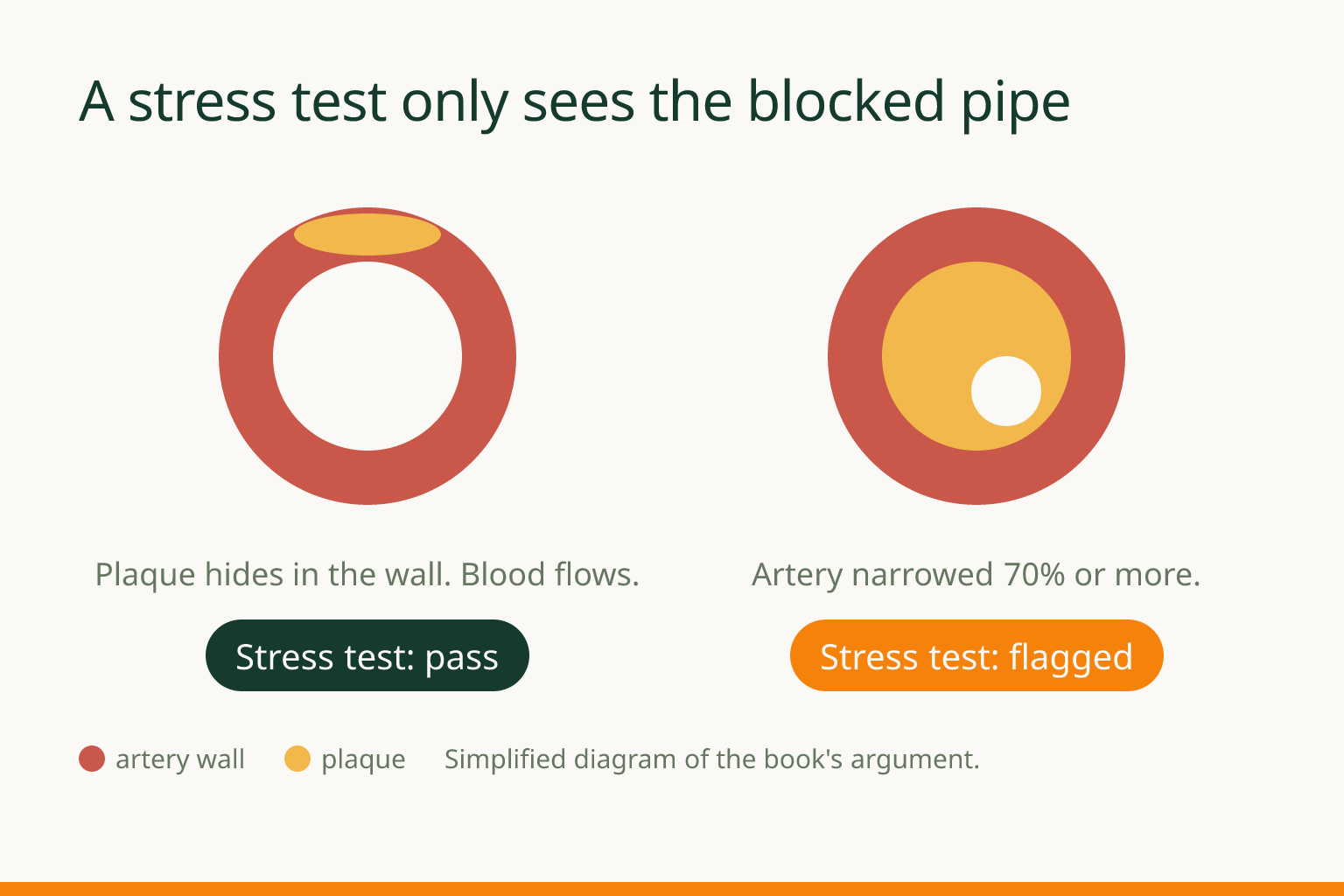
The book says a stress test only spots plaque once an artery has narrowed by 70 percent or more (Shortform's summary).
Plaque is a fatty lump inside the artery wall. It can sit there for years and block nothing.
The danger hides in the wall, not in the pipe.
 View full-size illustration
The book pictures a cat hiding in a gutter. You can't see it from the street. Then one day it jumps out.
How often does the cat hide? A Cedars-Sinai study checked 1,119 people with normal stress tests. Of those, 56 percent had real hardening in their arteries (NBC News).
So Bale and Doneen look for the disease itself, with scans of the neck and heart arteries (Dr. Greg Feinsinger, Post Independent).
Action item: At your next checkup, ask one question: "Would a heart calcium scan make sense for me?"
A scan shows the plaque. But what makes quiet plaque turn deadly?
Plaque needs a match
The book's answer is "chronic inflammation" (reader highlights).
Inflammation is your body's alarm system. It's great for a cut finger and bad when it never switches off.
The authors call this "fire in the arteries" (Post Independent). Plaque is the wood. Inflammation is the match.
Their method tests for that fire. The best-known test is hs-CRP, a cheap blood test for a body on high alert.
Action item: Before your next blood draw, ask: "Can you add an hs-CRP test?"
Fire is one cause. The book's title points at a scarier one.
The heart attack gene loads the dice
"9P21—also known as 'the heart attack gene' because it powerfully increases the threat of cardiovascular events."
Beat the Heart Attack Gene (reader highlights)
9P21 is a small stretch of DNA you get from your parents. "Cardiovascular" means your heart and blood vessels. That sounds like doom. I read it the other way.
The book says genes play a part in at least 40 percent of heart attacks (reader highlights). That leaves a lot of room for what you do.
A later study tracked about 500,000 people in the UK. Among those with high-risk genes, the fittest had 49 percent less heart disease (UK Biobank).
The heart attack gene loads the dice. You still throw them.
Action item: Tonight, text one parent or sibling: "Has anyone in our family had a heart attack or stroke? How old were they?"
You can't see your genes in a mirror. The next clue you can.
Your gums are part of your heart
Open your mouth. Do your gums bleed when you brush?
"People with periodontal disease—a bacterial infection of the gums, connective tissue, and bone supporting the teeth—have double or even triple the risk of a heart attack or stroke."
Beat the Heart Attack Gene (reader highlights)
How does a tooth problem reach your chest? In a later paper, the authors argue that gum germs slip into the blood and feed the fire (Postgraduate Medical Journal).
This is my favorite chapter. It turns a boring habit into heart care.
Action item: Floss tonight. Then book the dental cleaning you've been dodging.
One cause is left. The book calls it the biggest of all.
The sugar problem behind "normal" cholesterol
"Essentially a prediabetic condition, IR is the hidden cause of most heart attacks and most cases of cardiovascular disease."
Beat the Heart Attack Gene (reader highlights)
IR means insulin resistance, an early step toward diabetes. Insulin moves sugar out of your blood. With IR, your body stops listening to it, and your arteries pay.
Most of us only watch cholesterol. Is that enough?
A UCLA-led study looked at 136,905 hospital stays for heart disease. Almost half of the patients had LDL, the "bad" cholesterol, under 100. That's a good number (Sachdeva and others, 2009).
Cholesterol alone is a sleepy guard dog.
Action item: Find your last blood test. Look for fasting blood sugar and A1c, your three-month sugar average. If they're missing, ask for them.
That's five things to check. So what do you say in the exam room?
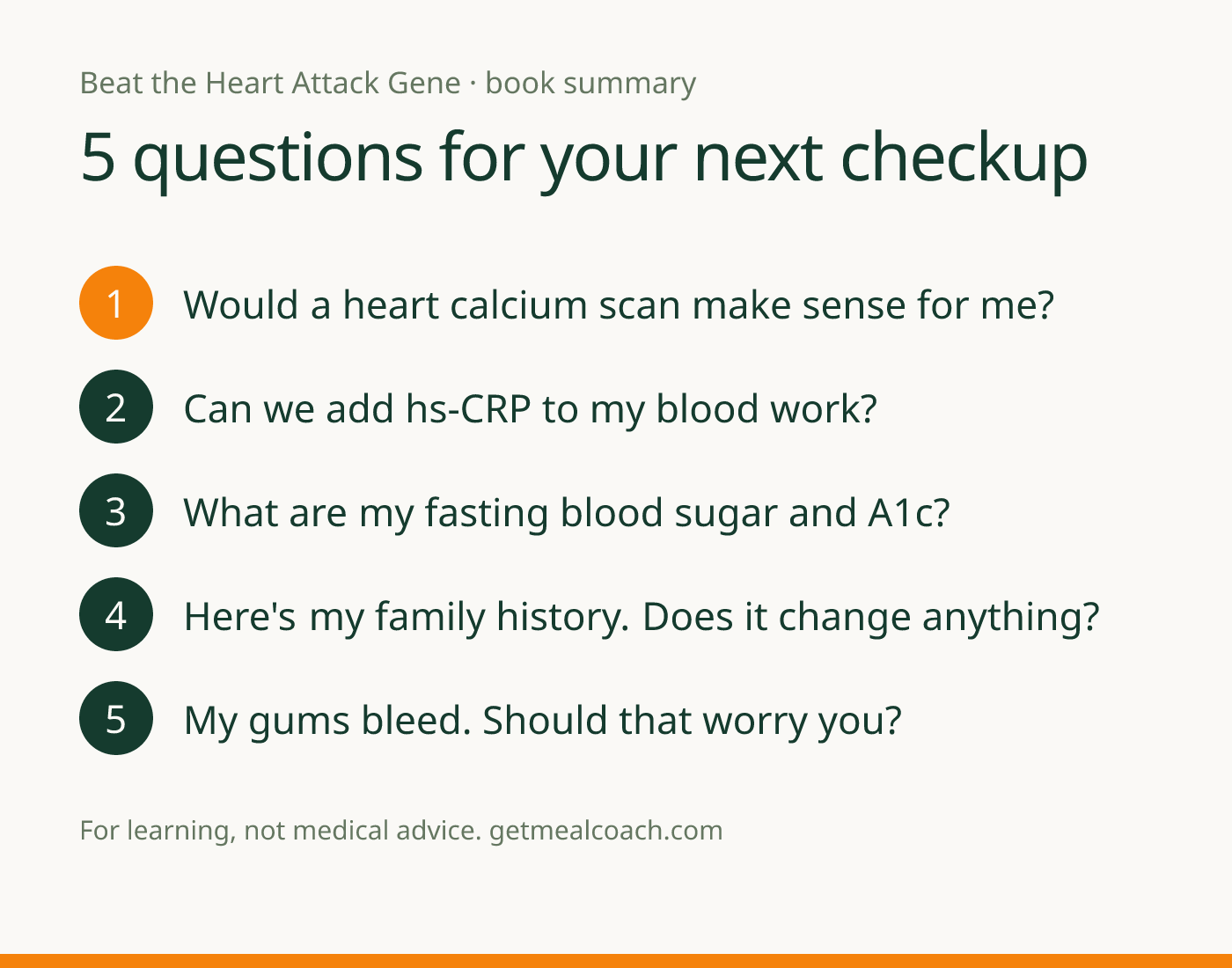
Your script for the next checkup
"Would a heart calcium scan make sense for me?"
"Can we add hs-CRP to my blood work?"
"What are my fasting blood sugar and A1c?"
"Here's my family history. Does it change anything?"
"My gums bleed. Should that worry you?"
 View full-size illustration
Then build one heart-smart day:
Morning: a brisk 25-minute walk. Heart doctors want 150 minutes of exercise a week (American College of Cardiology).
Dinner: fatty fish like salmon, two or three times a week.
Night: floss, then sleep. The book calls seven to eight hours "optimal" (reader highlights).
Action item: Paste the five questions into your notes app now.
Now the awkward part. Does the method work?
Where I think the book oversells
The cover says "revolutionary." The proof is smaller than the word.
The main study has no comparison group. It followed 324 patients at the authors' clinic. Their thickest neck artery reading fell 52.7 percent in two years (Cheng and others, 2016). But all were white volunteers, with nobody to compare against.
Gums are linked, not proven guilty. In 2012 the American Heart Association found a link, but no proof that gum disease causes heart disease (AHA statement).
One gene test flopped. The book covers a gene called KIF6. A review of 19 studies and 17,000 heart patients found no link (Assimes and others, 2010).
My take: the book's questions are better than its proof. Use it to ask more of your doctor, not to diagnose yourself.
Action item: Before you pay for any gene test, ask: "Will this result change my treatment?"
So why read a 2014 book now?
Heart doctors finally caught up on inflammation
Because the mainstream moved toward it.
In September 2025, the American College of Cardiology said the evidence on inflammation is "no longer exploratory but is compelling and clinically actionable" (ACC).
It also urged hs-CRP testing for nearly everyone who gets a heart risk check (TCTMD).
That's the "fire" idea from Beat the Heart Attack Gene, eleven years later. I think the book was early here, even if it was too sure of itself elsewhere.
So what does all this buy you?
What you get from doing this
✅ You stop trusting one "normal" number
✅ You walk into your checkup with five sharp questions
✅ You treat a gene as a warning, not a verdict
Short on time? Here's the whole post in six lines.
The 5-Minute Version
A stress test finds blocked arteries. Most danger is plaque hiding in the wall. Ask about a heart calcium scan.
Inflammation is the match that lights plaque. Ask for an hs-CRP test.
The heart attack gene, 9P21, raises risk. Fitness still cuts it.
Bleeding gums are a heart warning. Floss tonight.
Check fasting blood sugar and A1c, not only cholesterol.
The proof is thin in places. Use the book for questions, not answers.
One story ties it all together.
Conclusion
David Bobbett passed his stress test. His scan still showed the arteries of a man 36 years older.
That's the lesson of Beat the Heart Attack Gene. Normal is not the same as safe. A gene, sore gums, or high blood sugar can feed the fire for years while your checkup looks fine.
You don't need the whole method. You need one better question at your next visit.
Which of the five questions will you ask first?
This post is for learning, not medical advice. Talk to your doctor before you change tests, medicine, or diet.
 MealCoach