 MealCoach
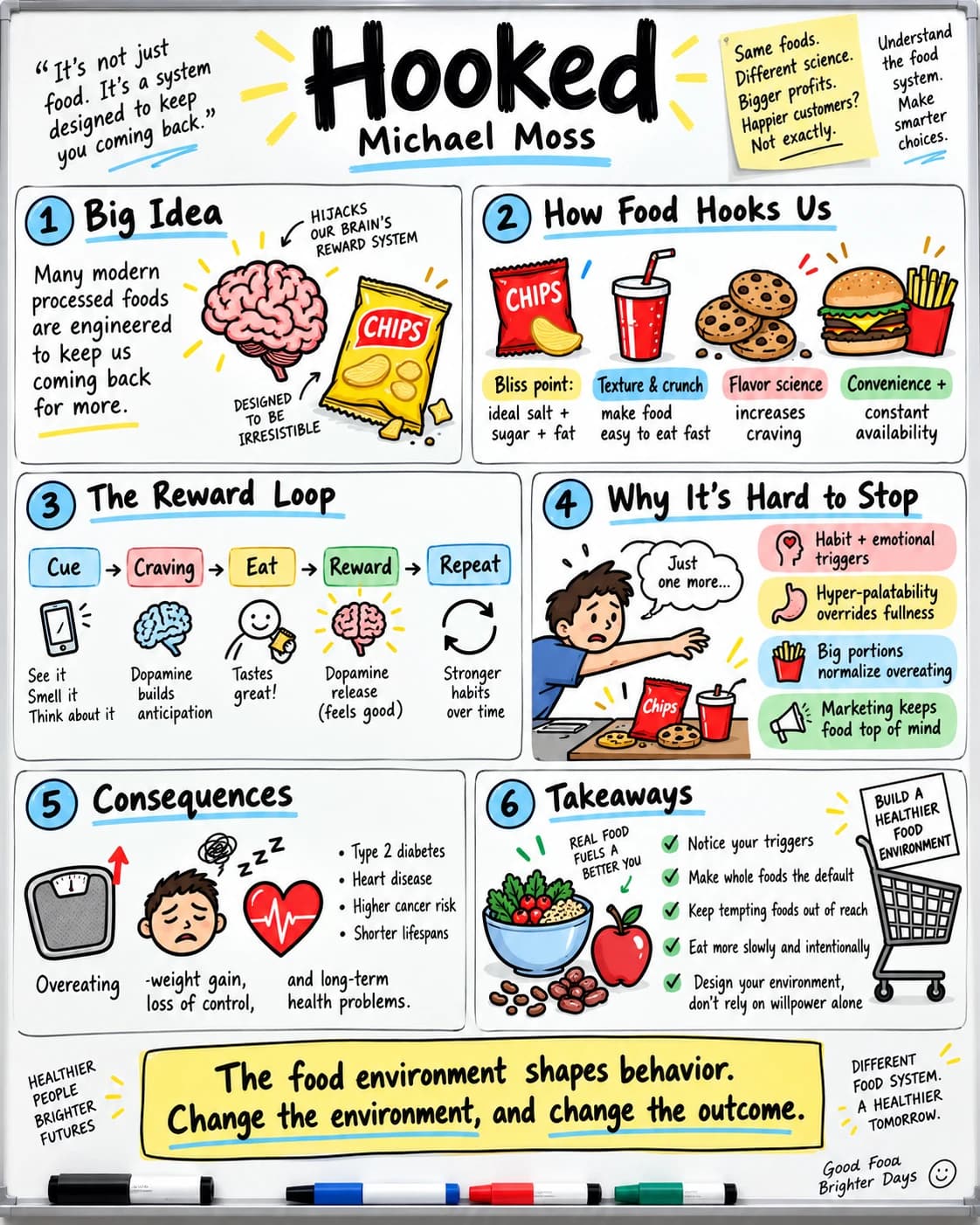
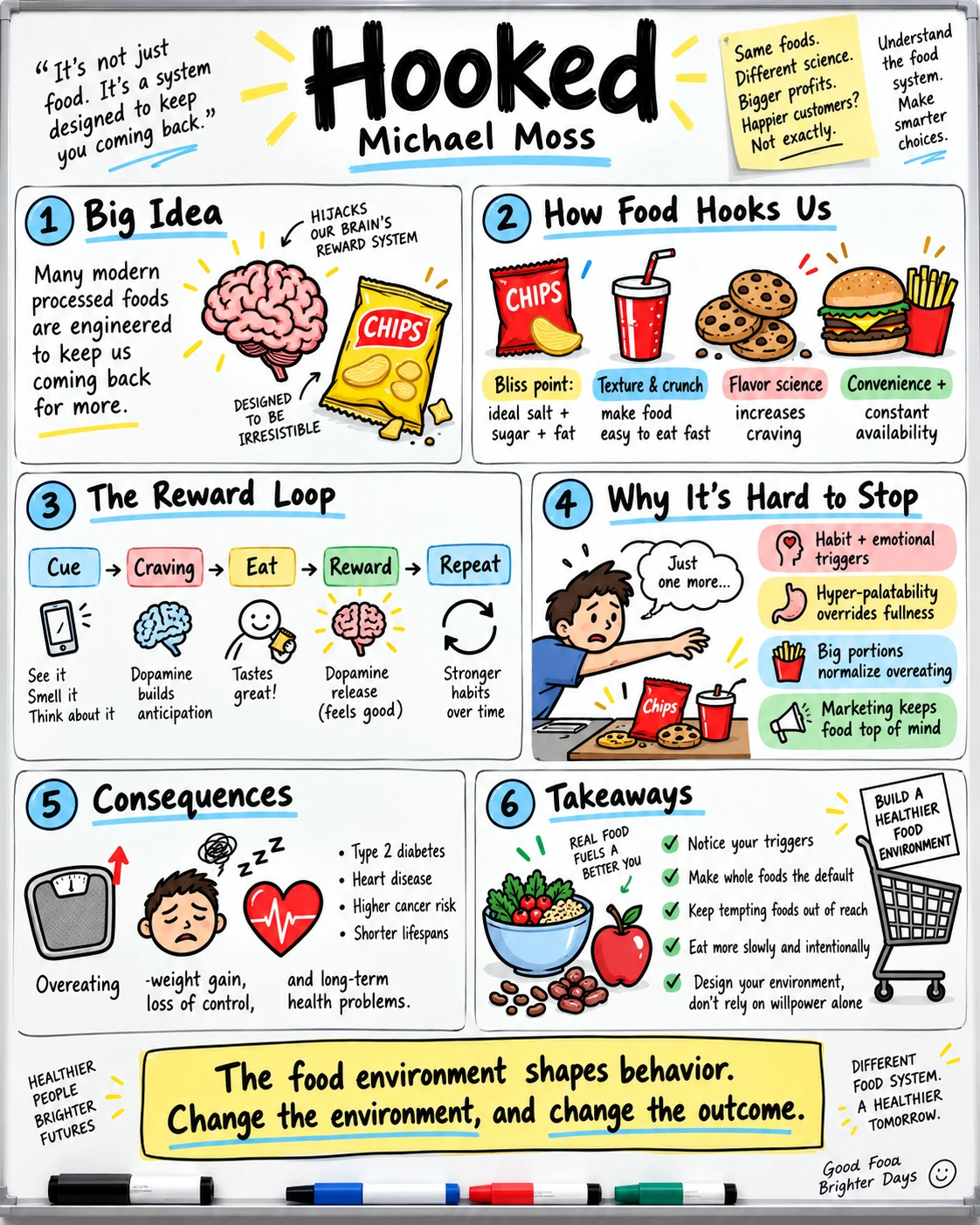
Hooked: Food, Free Will, and How the Food Giants Exploit Our Addictions by Michael Moss (2021).
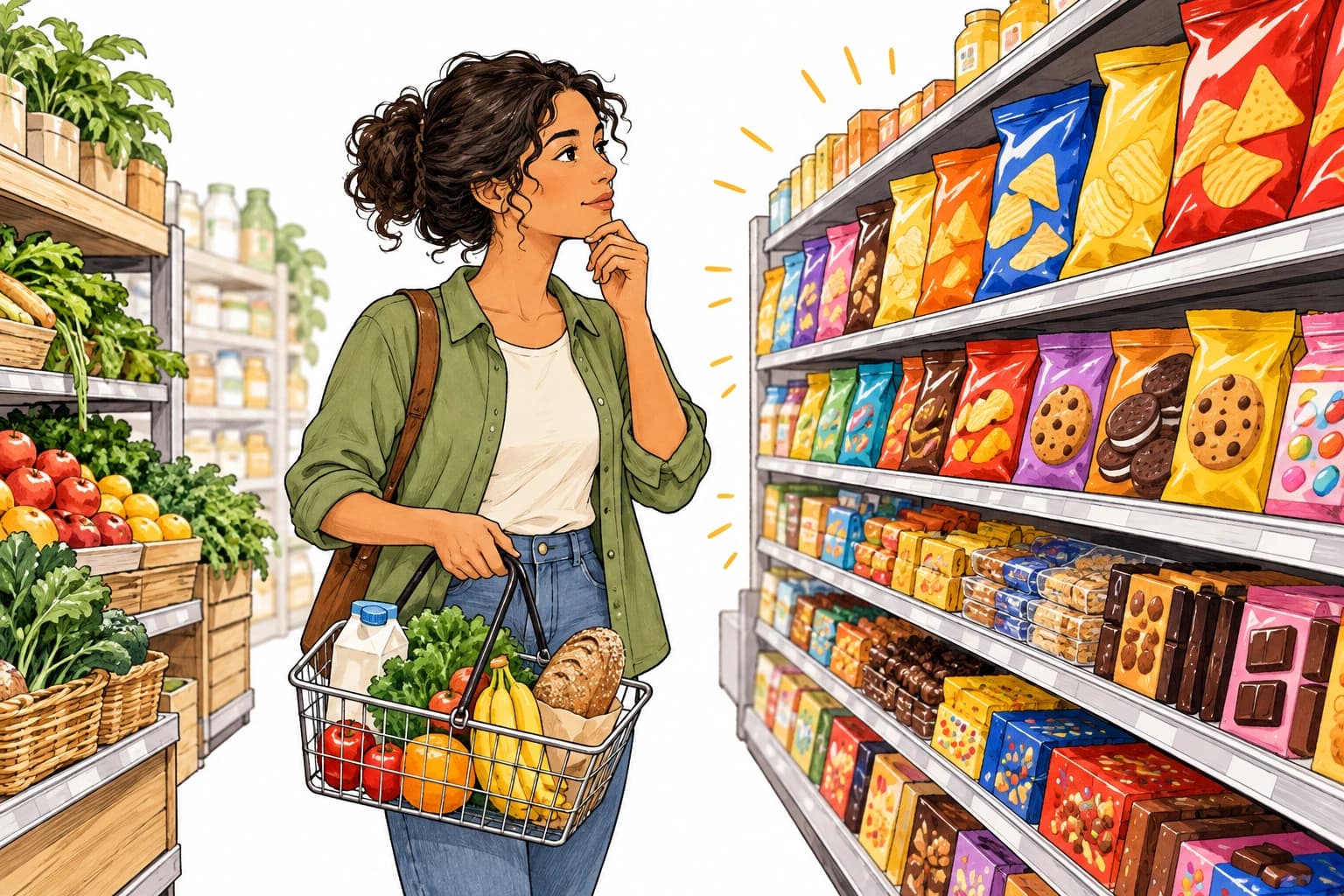
You can decide to buy one thing and leave the store with another. Michael Moss asks us to look beyond the moment of choice. The food on the shelf has been formulated, packaged, placed, and advertised to win our attention—and, often, to bring us back.
That is the force of Hooked: eating is personal, but the environment around eating is designed. Moss argues that companies understand far more about our cravings than the shopper standing in the aisle. His account is a reason to take repeated cravings seriously, not to blame people for having them.
The system behind the craving
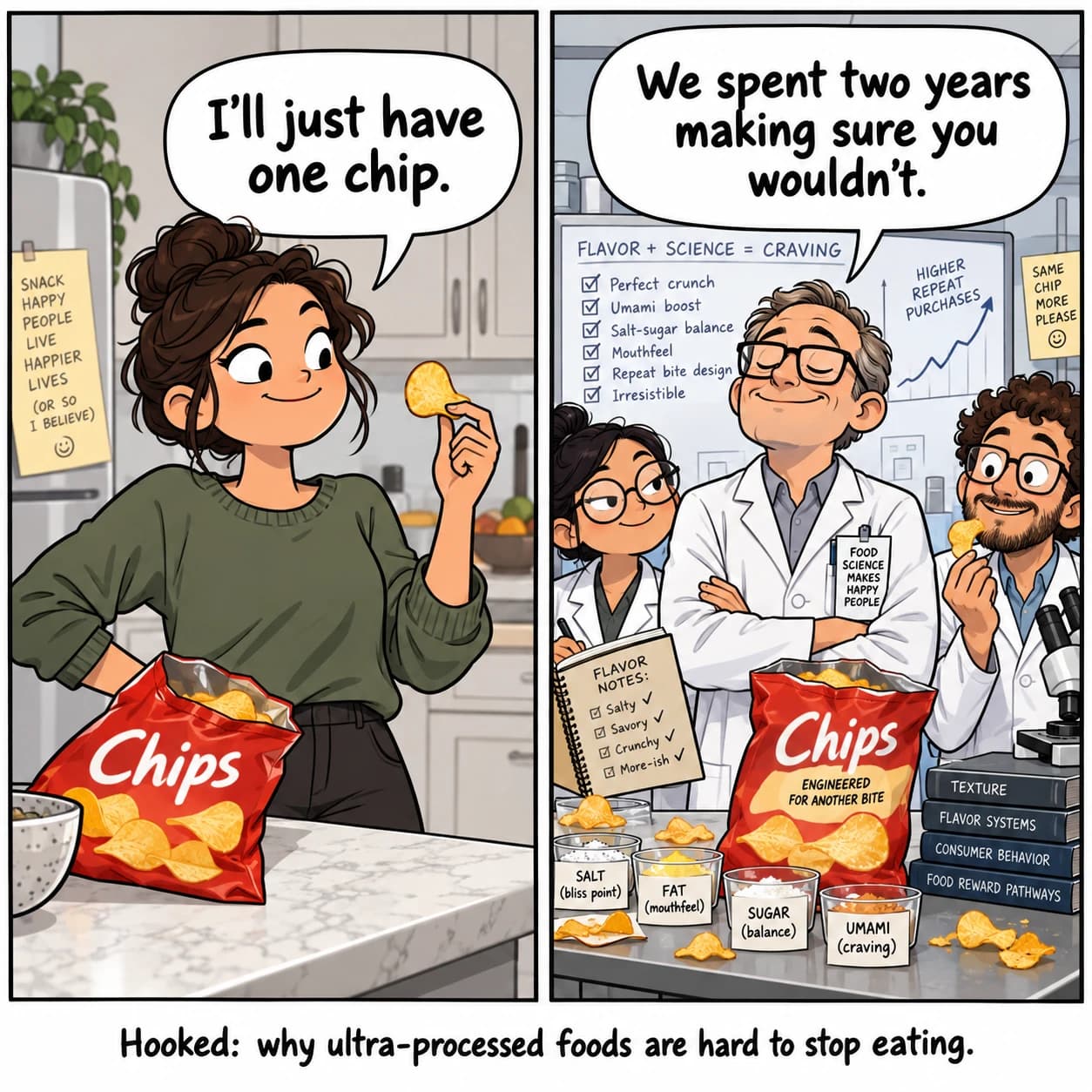
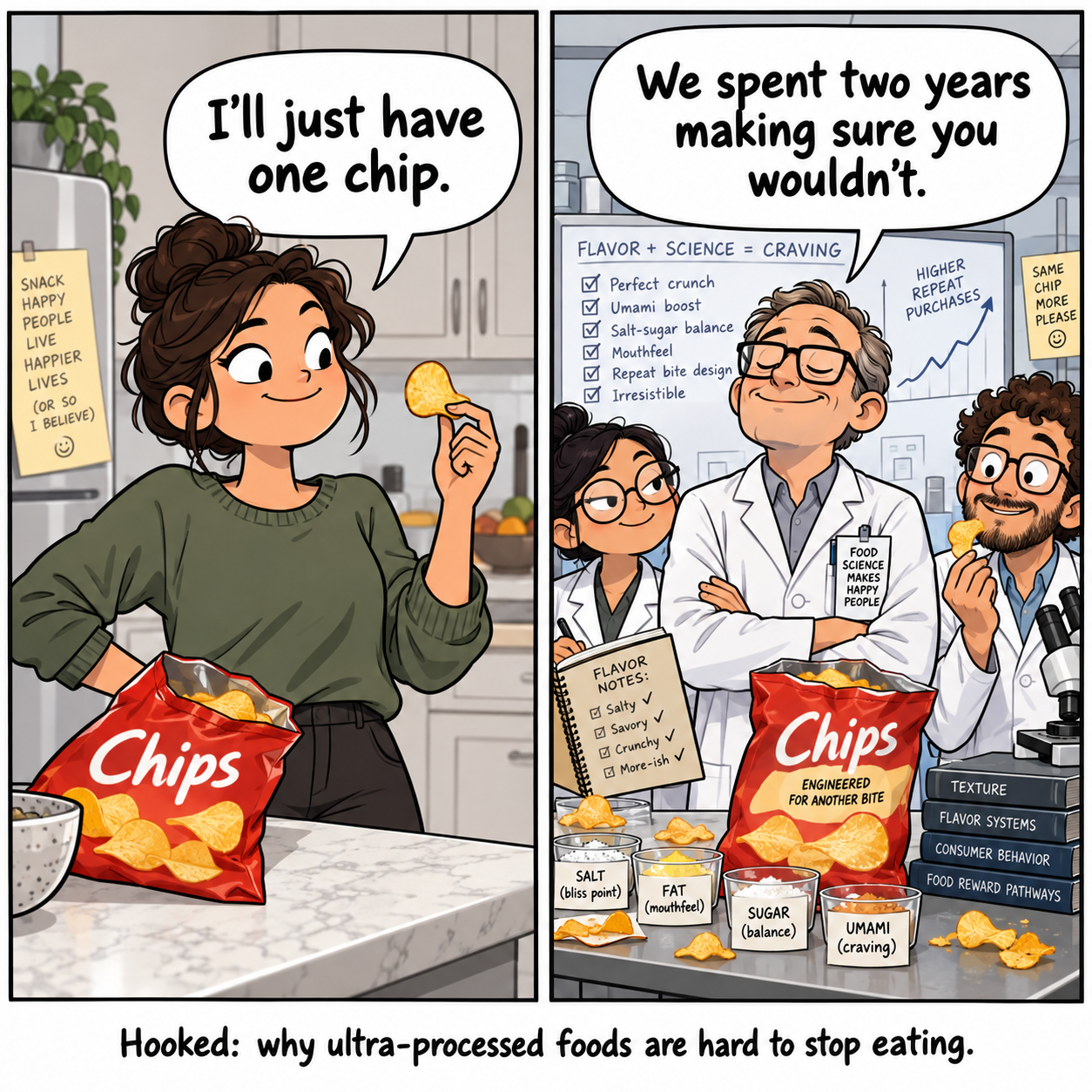
Moss is an investigative reporter. The publisher's description says his book examines product design, marketing, emotions, and the legal landscape behind processed food. He makes the case that some products are built to encourage repeated eating and that the industry benefits when the struggle is framed only as an individual's lack of willpower.
“For the vast majority of people, dieting just doesn’t work. It fails because of our physiology; the body plays a game of sabotage by lowering its metabolism or otherwise undercutting our efforts. It fails because life intervenes, with layoffs or new babies or sick parents. It fails because no amount of willpower can be sustained forever.”
That does not mean every packaged food affects everyone in the same way. It means convenience, texture, flavor, availability, and advertising are part of the decision. Recognizing that design restores some agency: you can change the setting instead of trying to win the same willpower contest every day.
What happens when researchers change the food
In a 2019 National Institutes of Health feeding trial, 20 adults lived in a clinic and ate an ultra-processed diet for two weeks and an unprocessed diet for two weeks, in random order. They could eat as much as they wanted. The offered meals were designed to be similar in calories, macronutrients, sugar, sodium, and fiber.
On the ultra-processed diet, participants ate about 500 more calories a day and gained about 0.9 kg (2 lb) on average. They lost about the same amount during the unprocessed period. The trial shows that this change in the food environment can change intake and weight over a short period; it was not an addiction diagnosis.
A 2025 randomized crossover trial offers another useful test. Fifty-five adults were assigned to two eight-week diets that both followed UK healthy-eating guidance. Both periods produced weight loss, but the minimally processed period produced a larger average loss: 2.06% of starting weight versus 1.05% on the ultra-processed period. That does not tell us what will happen to everyone over years, but it reinforces that the degree of processing can matter even when both diets meet dietary guidance.
The health evidence is broader than one trial
A 2024 umbrella review in The BMJ examined 45 pooled analyses covering nearly 10 million participants. Higher ultra-processed food exposure was associated with a higher risk across many outcomes, including type 2 diabetes and cardiovascular outcomes. Most of those underlying studies were observational, so they cannot show that one snack causes a particular disease. Still, the pattern is substantial, and the feeding trials give a direct reason to be concerned about eating behavior.
Addictive eating is a serious research topic
Moss's addiction argument should not be dismissed as a metaphor. A 2024 research review reported that measures of ultra-processed-food addiction identified roughly 14% of adults in pooled estimates, alongside early evidence of withdrawal-like symptoms and compulsive use. In a 2025 expert-consensus project, 37 of 40 participating experts agreed that there is sufficient evidence that people can use ultra-processed foods in an addictive way.
The exact diagnostic boundaries and mechanisms are still being worked out. That is a reason to study and support affected people, not a reason to wave away the experience or the evidence. Craving a food does not by itself mean someone has an addiction, and no book summary can diagnose one.
Who shapes the science?
Concern about industry influence is grounded in evidence too. In a study of 1,461 papers from 10 leading nutrition journals, 196 disclosed food-industry involvement. The researchers classified 55.6% of the industry-involved papers as favorable to industry interests, compared with 9.7% in a journal-matched sample without identified industry involvement. The study cannot establish why any individual result was favorable, but it shows why funding and research agendas deserve scrutiny.
Moss's practical lesson is to notice the system as well as the craving. Which products are easiest to reach when you are rushed? Which cues pull you toward a choice you did not plan? Making satisfying food easy to find, planning a meal you enjoy, or pausing long enough to notice hunger can change the next decision without turning eating into a test of character. If eating feels out of control or distressing, a qualified clinician can help.
Hooked makes a persuasive case that the food environment shapes behavior. The experimental, population, and addiction research gives that concern real weight. We can be precise about what each study shows without treating every open question as a reason to doubt the larger problem.