
A plain-English summary of How Not to Die by Dr. Michael Greger
“The vast majority of premature deaths can be prevented through simple changes in diet and lifestyle.” — Michael Greger, M.D., on How Not to Die
Reading time: 8 minutes. Every section ends with one thing you can do today.
In this post you’ll learn why diet overtook smoking as America’s top killer, and the 12-item checklist at the heart of How Not to Die.
You’ll also learn how to start it at your next meal for the price of a can of beans. This book made me look at chickpeas like they were a prescription.
You’re Trying to Buy Your Way Out of Dying
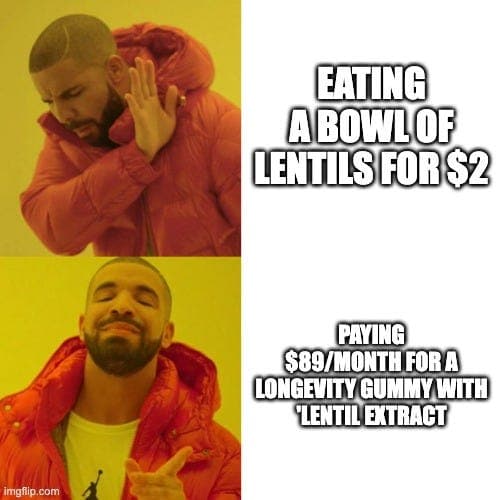
Scroll any feed and someone is selling you immortality. A 40-pill morning stack. A pricey blood panel. A cold plunge, a red-light mask, a glucose monitor on someone who’s never had a glucose problem.
Meanwhile the grocery store has a bag of lentils for a couple of bucks, and nobody’s making reels about it.
We’ve been sold a pill for every ill. Health became something you buy, bolt on, or get prescribed, instead of something you eat three times a day.
How Not to Die is Dr. Michael Greger’s big, thick argument against all of it. His claim is blunt: most of what kills us is on our plate, and most of the fix is in the produce aisle.
Action item: Add up what you spend on supplements, wellness gadgets, and “health” snacks in a month. Keep that number handy. We’ll spend a fraction of it on beans.
The Grandma Who Walked Out of Her Wheelchair
Here’s why Greger wrote the book.
His grandmother, Frances, had end-stage heart disease. She was in a wheelchair, in constant chest pain, and at 65 she was sent home to die.
Then she found Nathan Pritikin’s lifestyle program, built around whole plant foods. Within about three weeks she was out of the wheelchair. Soon she was walking ten miles a day.
“Thanks to a healthy diet, she was able to live another 31 years on this earth — until 96.” — Michael Greger
A kid watched his grandmother come back from a death sentence by changing what was on her plate. He became a doctor, and eventually wrote this book.
Action item: Think of one person in your life with a “chronic” diagnosis. Instead of forwarding them this post, cook them one bean-heavy meal this week.
Your Plate Is the #1 Killer (Yes, Ahead of Smoking)
Grandma’s story isn’t a fluke. It’s the whole book in one story.
In Greger’s words, “the #1 cause of death in the United States and the #1 cause of disability is our diet, which has since bumped tobacco smoking to killer #2.” (source)
That comes from the US Burden of Disease study in JAMA.
The researchers behind it found that bad diets did more harm to Americans in 2010 than smoking, high blood pressure, or high blood sugar. They linked poor diet to 678,282 US deaths that year.
By that measure, what’s on your fork did more damage than cigarettes.
Your Doctor Probably Wasn’t Trained for This
So why doesn’t your doctor lead with broccoli? Greger’s answer: most were barely taught about it.
A national survey of US medical schools from 2010 found students got an average of 19.6 hours of nutrition classes in all of med school. Only 27% of schools hit the recommended minimum of 25 hours.
Twenty hours. That’s half a work week, spread across four years of training.
In my opinion, this is the most eye-opening part of the book. Medicine is brilliant at treating disease and oddly quiet about not getting it. That’s not your doctor’s fault, but it is your problem.
Action item: Look at your last three meals. Count how many were mostly whole plants (beans, grains, veg, fruit, nuts) versus packaged or animal-based. No judgment, just a baseline.
How Not to Die, Part 1: 15 Killers, One Common Thread
The first half of the book walks through the 15 leading causes of death in the US, one chapter each.
They are heart disease, lung disease, brain disease, digestive cancers, infections, diabetes, high blood pressure, liver disease, blood cancers, kidney disease, breast cancer, suicidal depression, prostate cancer, Parkinson’s, and harm caused by medical care itself.
Each chapter runs the same play: here’s the killer, here’s the research, here’s the food that lowers the risk.
The plot twist is that it’s basically the same food every time. Beans, greens, berries, whole grains, nuts, flax. Different disease, same prescription.
I think this repetition is the book’s secret weapon. By chapter 8 you stop asking “what should I eat for my heart?” and realize there’s one answer for almost everything.
Action item: Pick the killer on the list that runs in your family. Read just that one chapter first. It’s the fastest way to make the book personal.
How Not to Die, Part 2: The Daily Dozen
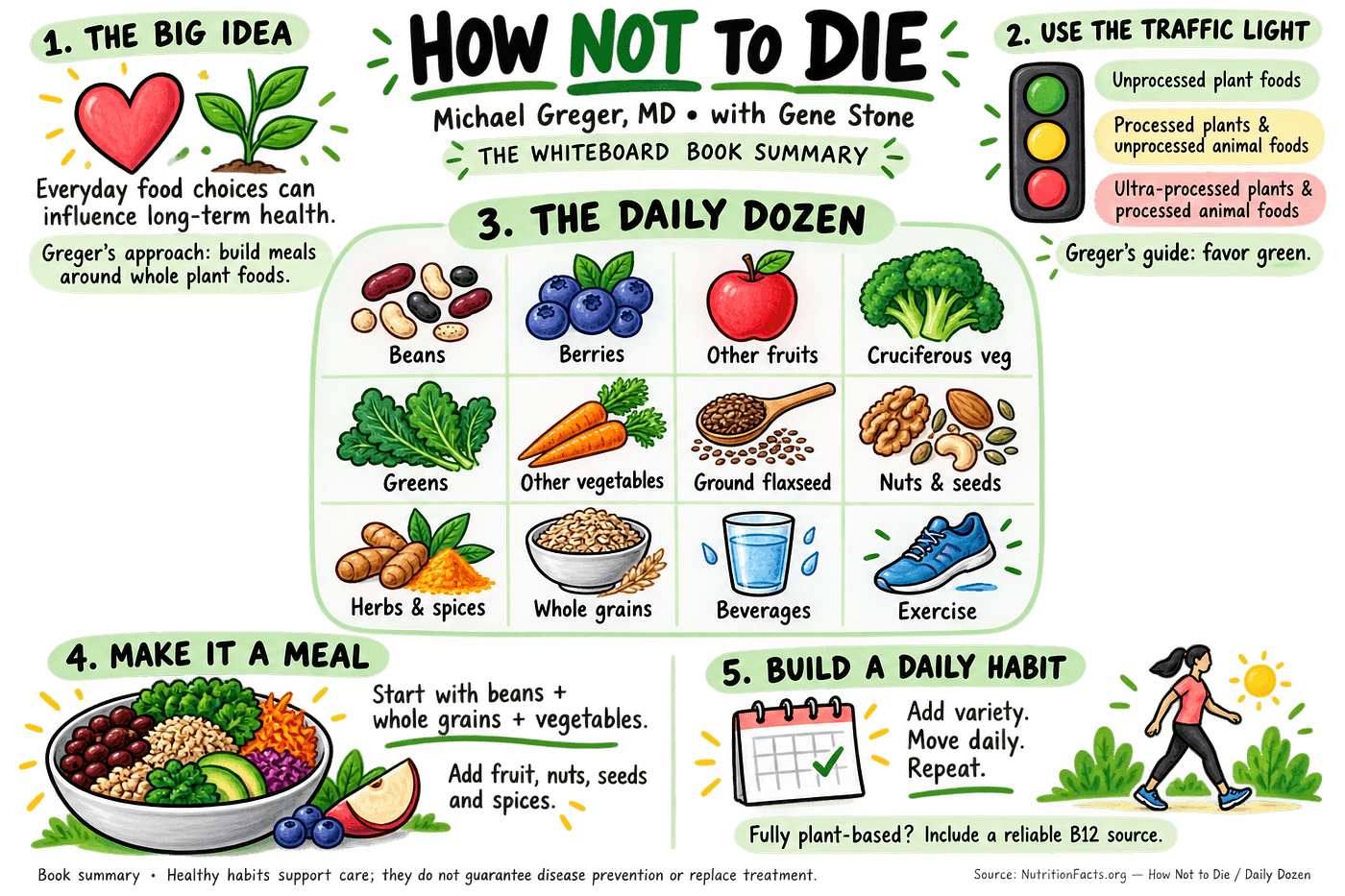
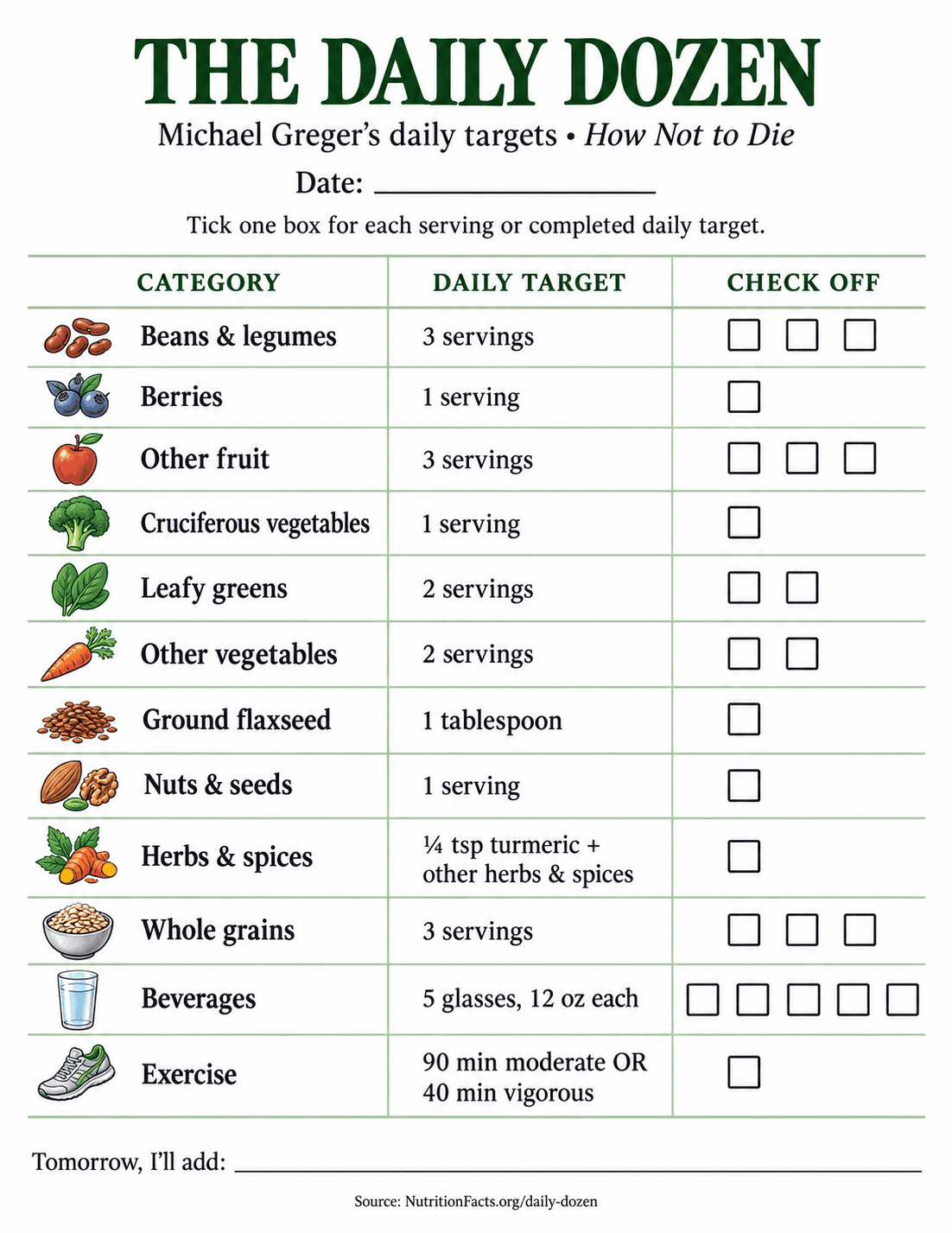
This is the part you came for. Greger boils the whole book down to 12 checkboxes a day. Here’s the list, via NutritionFacts.org:
The Daily Dozen: make variety visible
The Daily Dozen turns Greger’s approach into twelve categories, including drinks and movement. Here is a simplified overview of his daily targets. These are his recommendations, not individualized requirements. [4]
- Beans and other legumes: 3 servings
- Berries: 1 serving
- Other fruit: 3 servings
- Cruciferous vegetables: 1 serving
- Leafy greens: 2 servings
- Other vegetables: 2 servings
- Ground flaxseed: 1 tablespoon
- Nuts and seeds: 1 serving
- Herbs and spices: ¼ teaspoon turmeric, plus other herbs and spices
- Whole grains: 3 servings
- Beverages: 5 glasses, 12 ounces each
- Exercise: 90 minutes moderate or 40 minutes vigorous activity
“All plant foods are not created equal.” — Michael Greger
That’s why flax, berries, and cruciferous veg (the broccoli and cabbage family) get their own boxes instead of hiding under “eat your vegetables.”
Action item: Download the free Daily Dozen app (or print the table above) and just track tomorrow. Change nothing. See how many boxes you hit by accident.
What a Daily Dozen Day Actually Looks Like
The table looks like homework. It isn’t. Here’s one ordinary day, box by box:
- Breakfast: 1 cup cooked oatmeal, ½ cup blueberries, 1 tbsp ground flax, ¼ cup walnuts, a banana. 7 servings (2 grains, berries, flax, nuts, fruit, plus coffee or tea as a drink).
- Lunch: 2 cups spinach salad with ½ cup chickpeas, ½ cup shredded carrots, an apple on the side. 5 servings (2 greens, 1 bean, 1 other veg, 1 fruit).
- Snack: ¼ cup hummus with ½ cup sliced peppers, an orange. 3 servings (1 bean, 1 other veg, 1 fruit).
- Dinner: Lentil curry (½ cup lentils) with turmeric over ½ cup brown rice, ½ cup broccoli on the side. 4 servings (1 bean, 1 spice, 1 grain, 1 cruciferous).
- All day: Water, tea, or coffee to reach 5 glasses, plus a brisk walk.
That’s 11 of 12 boxes filled with zero weird ingredients. Exercise is the one that takes real effort, and we’ll get to that.
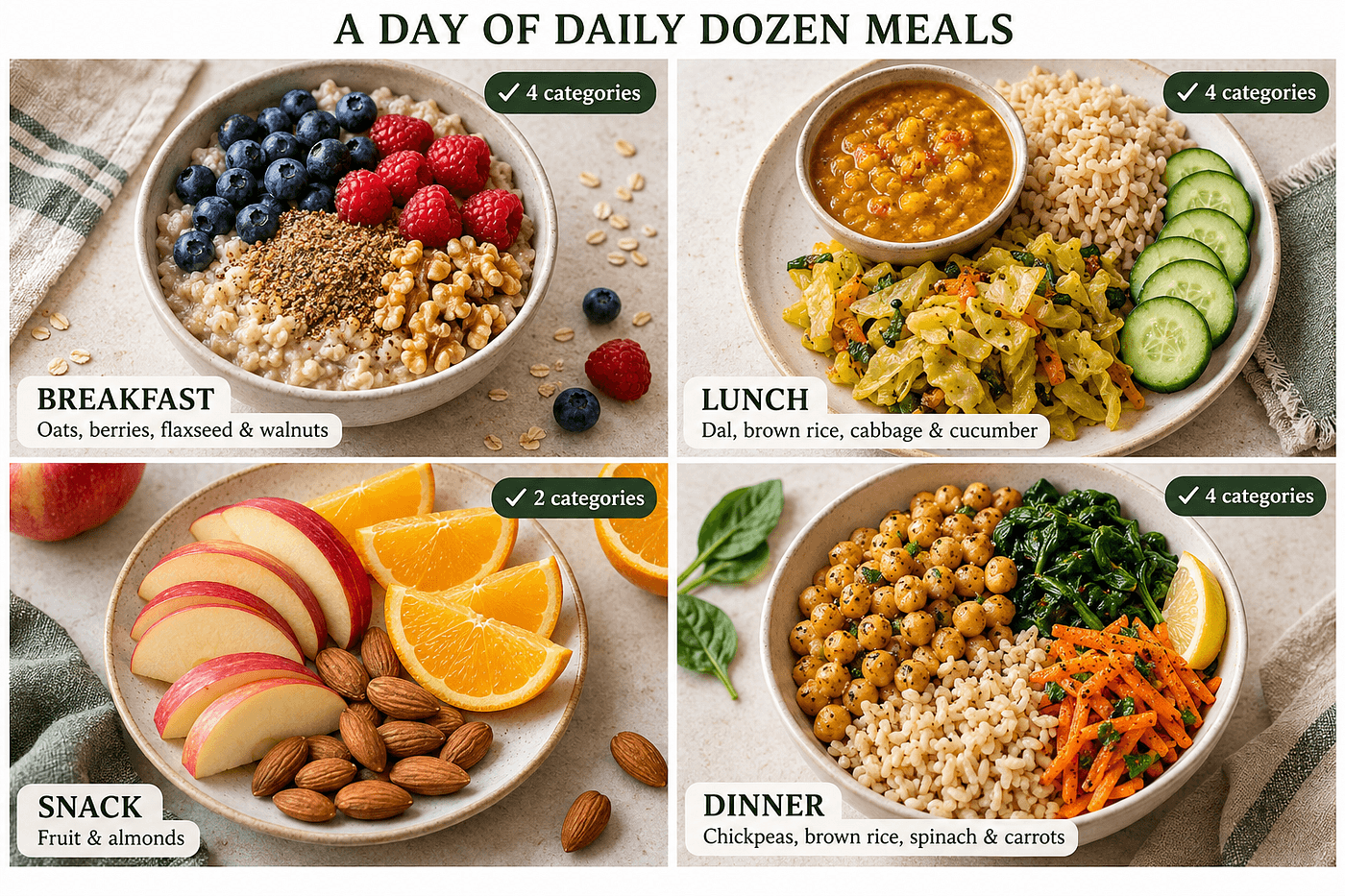
Action item: Steal just the breakfast. Oatmeal, berries, flax, walnuts, sliced banana. Five food categories, one bowl, and your streak starts tomorrow morning.
Beans Are the Most Underrated Longevity Drug
If you take one food from this book, make it beans. Greger comes back to them again and again, and the numbers are wild.
“Legume intake may be the most important dietary predictor of survival in older people from around the globe, with an 8% reduction in risk of premature death for every one ounce increase in daily intake.” — Michael Greger, via Animal Outlook
In plain English: for older adults, every extra ounce of beans a day (a couple of spoonfuls) was linked to an 8% lower chance of dying early.
Yet by his count, “96% of Americans don’t even reach the minimum recommended intake of three servings a week.” A week. The Daily Dozen asks for three a day.
Here’s my take: the cheapest food in the store might be the best longevity supplement on earth, and almost nobody is taking it.
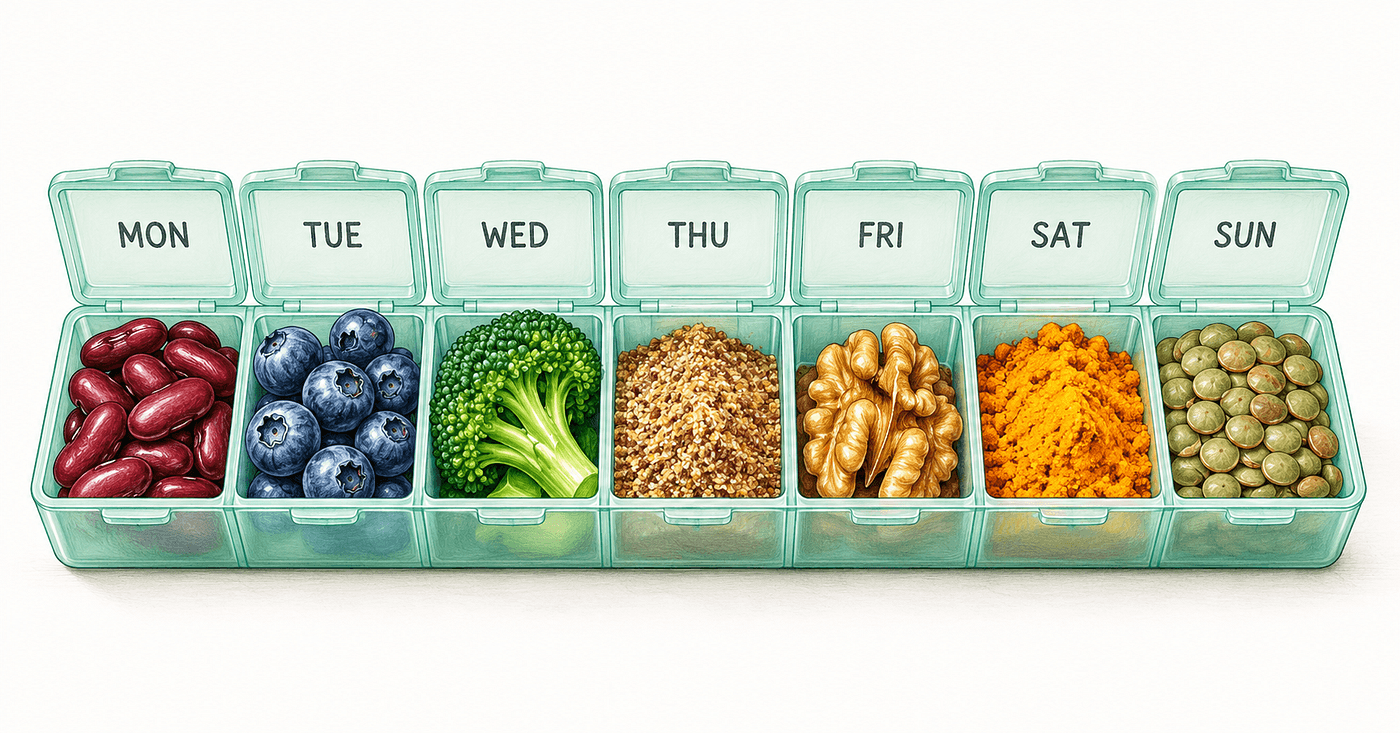
Action item: Buy one can of chickpeas or black beans today. Rinse it and stir half into whatever you’re already cooking for dinner. That’s 2 of your 3 bean boxes, done.
The Fair Criticism (and the One Pill Worth Taking)
I’d be a bad summarizer if I pretended this book is flawless. Here are the honest caveats.
- It’s an advocacy book. Greger is openly pro plant-based. Read it as a strong, well-cited argument, not a neutral textbook.
- A lot of it is based on watching large groups of people. “People who eat X live longer” doesn’t always prove “X makes you live longer.” The overall pattern holds up, but some claims are stronger than others.
- Key warnings come late. A review by The Health Sciences Academy put it plainly: “Something as important as B12 deficiency, particularly for pregnant women, should be raised earlier in the book.” The same review flags iodine and protein for older adults.
- 90 minutes of daily exercise is a big ask. Start with whatever you’ll actually do, and build.
None of that sinks the core advice. “Eat more beans, greens, and berries” is about as safe a bet as nutrition gets.
Action item: If you’re shifting toward plant-based eating, ask your doctor about vitamin B12 (and iodine) at your next checkup. B12 is the one pill Greger himself says not to skip.
Life After the Daily Dozen
✅ You stop needing a nutrition influencer to tell you what to eat today
✅ Your grocery cart gets cheaper: beans, oats, and frozen berries aren’t luxury goods
✅ You’re full after meals and snack less out of boredom
✅ You walk into checkups with a plan, not just a prescription
✅ One checklist covers 15 different ways to die
The 5-Minute Version (Steal This)
- Diet is the #1 killer in America, ahead of smoking.
- Doctors average under 20 hours of nutrition training, so don’t wait for yours to bring it up.
- 15 leading causes of death, one shared answer: whole plant foods.
- The Daily Dozen is the whole book in 12 daily checkboxes.
- Beans are the MVP. Aim for 3 servings a day. Take B12 if you go fully plant-based.
Conclusion
How Not to Die isn’t really a diet book. It’s a book about where your biggest health win is hiding. It’s on your plate three times a day, and it costs about as much as a can of beans.
This is a book summary, not medical advice. Talk to your doctor before making major diet changes, especially if you take medication for blood pressure or blood sugar.
 MealCoach