
“The fastest meal is the one you barely remember eating.”— An original MealCam maxim
You take the first bite. You answer one message. You look down. The plate has apparently completed a disappearing act worthy of a small Las Vegas residency.
If you are searching for how to stop eating too fast, the usual advice is technically simple: put down your fork, count your chews, remove every distraction, savor each texture, wait, breathe, contemplate the raisin. Useful for some people. Also a suspicious amount of project management for lunch.
We reviewed recurring conversations from Reddit, public health forums, YouTube, and current research. The central problem was not a shortage of rules. It was a shortage of feedback at the moment people needed it. That is the problem we built MealCam to address.
The opponent
Autopilot is fast. Awareness is late.
Across the conversations, people rarely described fast eating as a deliberate choice. They described a habit trained by short breaks, shift work, parenting, screens, stress, or years of simply doing it that way. One firefighter and former EMT wrote that eating whenever possible had carried into home life; the plate was empty while everyone else was halfway through. A new-parent thread was full of people saying they still “inhale” meals even when the baby was asleep. Another person removed Netflix and YouTube to be more mindful— and then ate even faster without the distraction.
Those are anecdotes, not clinical evidence. But together they reveal the product problem: “eat slower” is an instruction. It is not a feedback loop.
The problem list
Eight ways a meal goes missing
Not every fast eater has every problem. These are the patterns that repeated most often—and the honest fit for a real-time pace coach.
You notice only after the plate is empty
People described looking down to find half the food gone, finishing before fullness felt obvious, or continuing until they felt uncomfortable. A Reddit discussion about mindful eating captured the problem: awareness arrived, but only after half the plate had disappeared.
Where MealCam helps
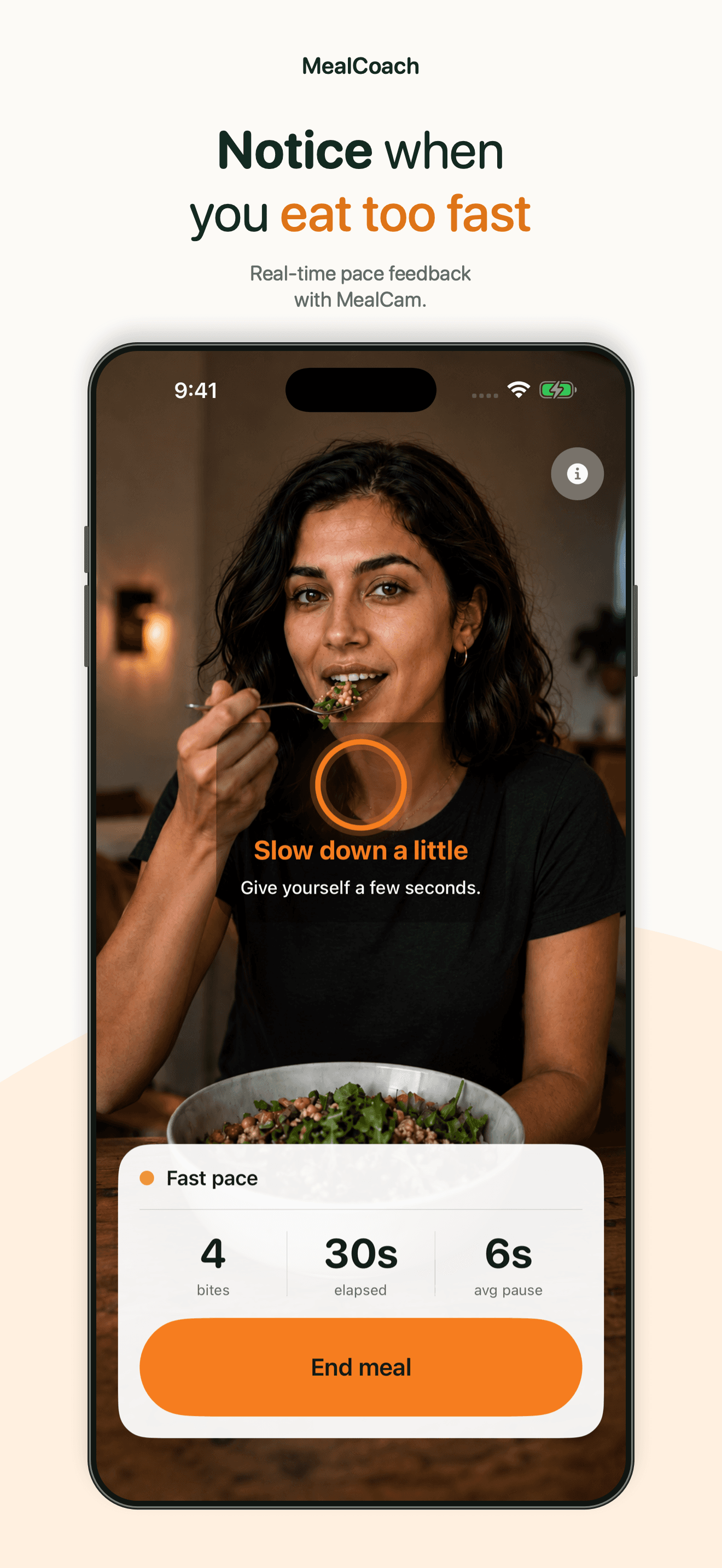
The live pace state moves feedback into the meal. The useful moment is not a score at 8:47 p.m.; it is the pause you can take before the next bite.
Your schedule trained you to rush
Firefighters, healthcare workers, parents, and people with short breaks learn to eat when there is an opening. The emergency ends. The eating speed stays. That is not a character defect; it is practiced efficiency showing up in the wrong room. Long gaps, restrictive eating, or fasting can also mean arriving at a meal extremely hungry and eating quickly. MealCam can show the pace; it cannot tell you whether the eating schedule itself is serving you.
Where MealCam helps
It asks for one small setup action—position the phone—then lets you eat. It does not demand a new menu, recipe, journal, or thirty-minute pre-meal ritual.
Screens swallow the meal with you
Phones, television, work, and YouTube split attention. Harvard’s Nutrition Source notes that work calls and phone use can detract from the eating experience, while social conversation can enhance it. The enemy is not pleasure or company. It is disappearing into a second task and missing the first one.
Where MealCam helps
MealCam makes the phone part of the feedback instead of another feed. The camera view and pace state keep the meal itself in the foreground.
You finish first and feel weird about it
Forum posters described embarrassment, insecurity, and the awkward wait after finishing far ahead of friends. This is a social cost, not just a nutrition metric. Meals are often one of the few places where people still sit together.
Where MealCam helps
A private pace cue can help you notice the gap before you are staring at an empty plate while everybody else is still eating. It does not rank you against anyone at the table.
The advice becomes more exhausting than the habit
Smaller forks. Non-dominant hands. Chew thirty times. Put the utensil down after every bite. Set a timer. Each tactic can help someone. Stacked together, they turn a sandwich into quarterly planning. People also report that mindful eating can feel slow, rigid, or like hard work—especially when already stressed.
Where MealCam helps
No chew counting, calorie target, macro budget, or food logging. The app estimates timing and gives one simple cue.
Fullness and comfort show up late
Community posts often connect rushed meals with feeling stuffed, bloated, or sick afterward. Controlled research is narrower: a 2014 systematic review found that experimentally slower eating was associated with lower energy intake during a meal, while hunger outcomes were less clear. A 2015 review found an association between faster self-reported eating and obesity, but much of that evidence was observational. The 2014 review is available here. Association is not destiny, and a pace cue is not a weight-loss guarantee.
Where MealCam helps
MealCam cannot measure fullness. It can create a little more room to notice it by making short between-bite pauses visible.
Shame pretends to be a strategy
Fast eating often gets narrated as greed, laziness, or lack of discipline. In binge-eating communities, guilt and self-disgust appear again and again. Shame can make the problem louder while teaching nothing useful about the next bite. The opponent is autopilot, not you.
Where MealCam helps
The live language describes pace—“Good pace” or “Fast pace”—rather than judging the person or the food. A recovery cue says “Nice pace,” not “good eater.”
A pace problem may be part of a bigger problem
Binge-eating disorder is not simply “eating quickly.” The National Institute of Mental Health describes recurrent episodes involving loss of control and marked distress. Reddit and forum discussions also mention triggers, restriction-binge cycles, trauma, anxiety, and continuing despite pain. Those deserve qualified, human care—not a tougher notification.
Where MealCam helps
It does not. MealCam is an awareness tool, not eating-disorder treatment, a diagnostic device, or crisis support.
One signal, two states
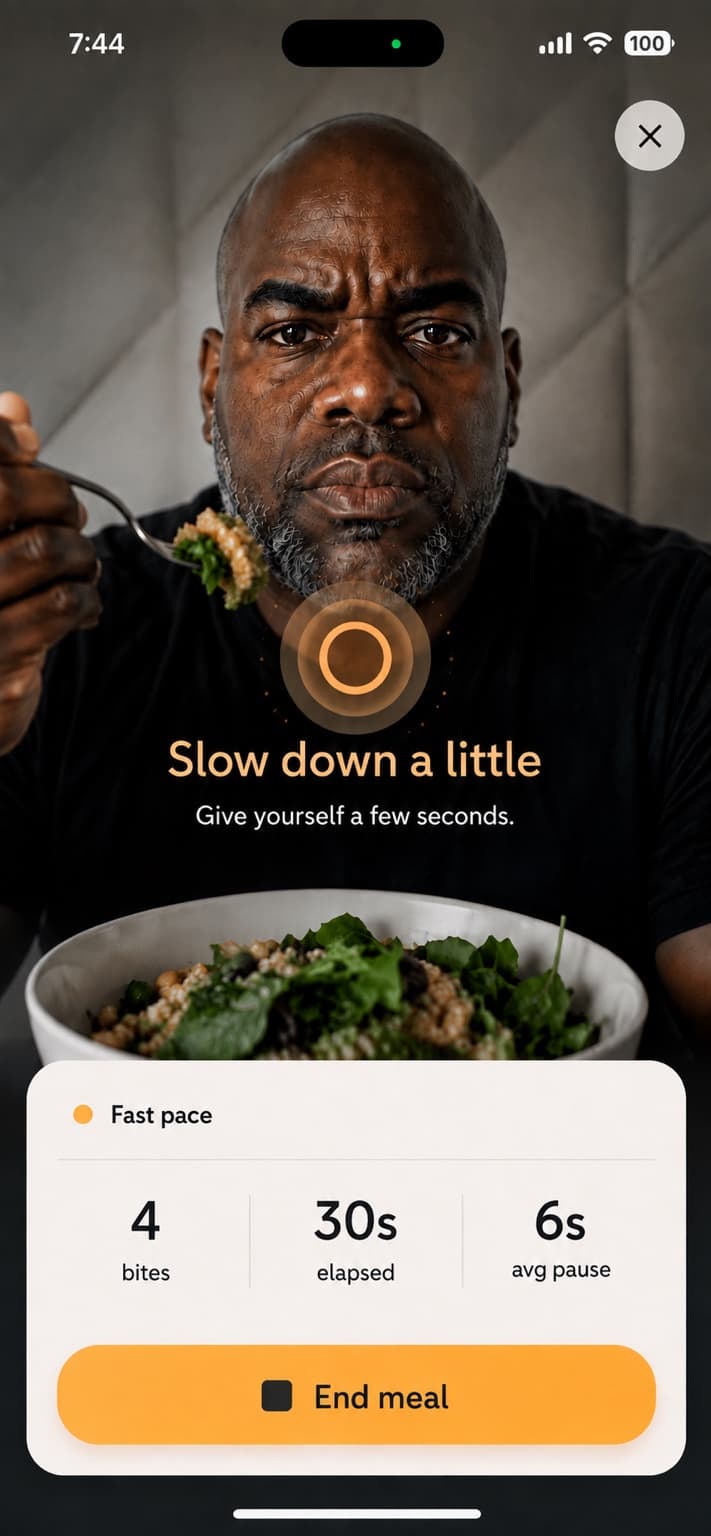
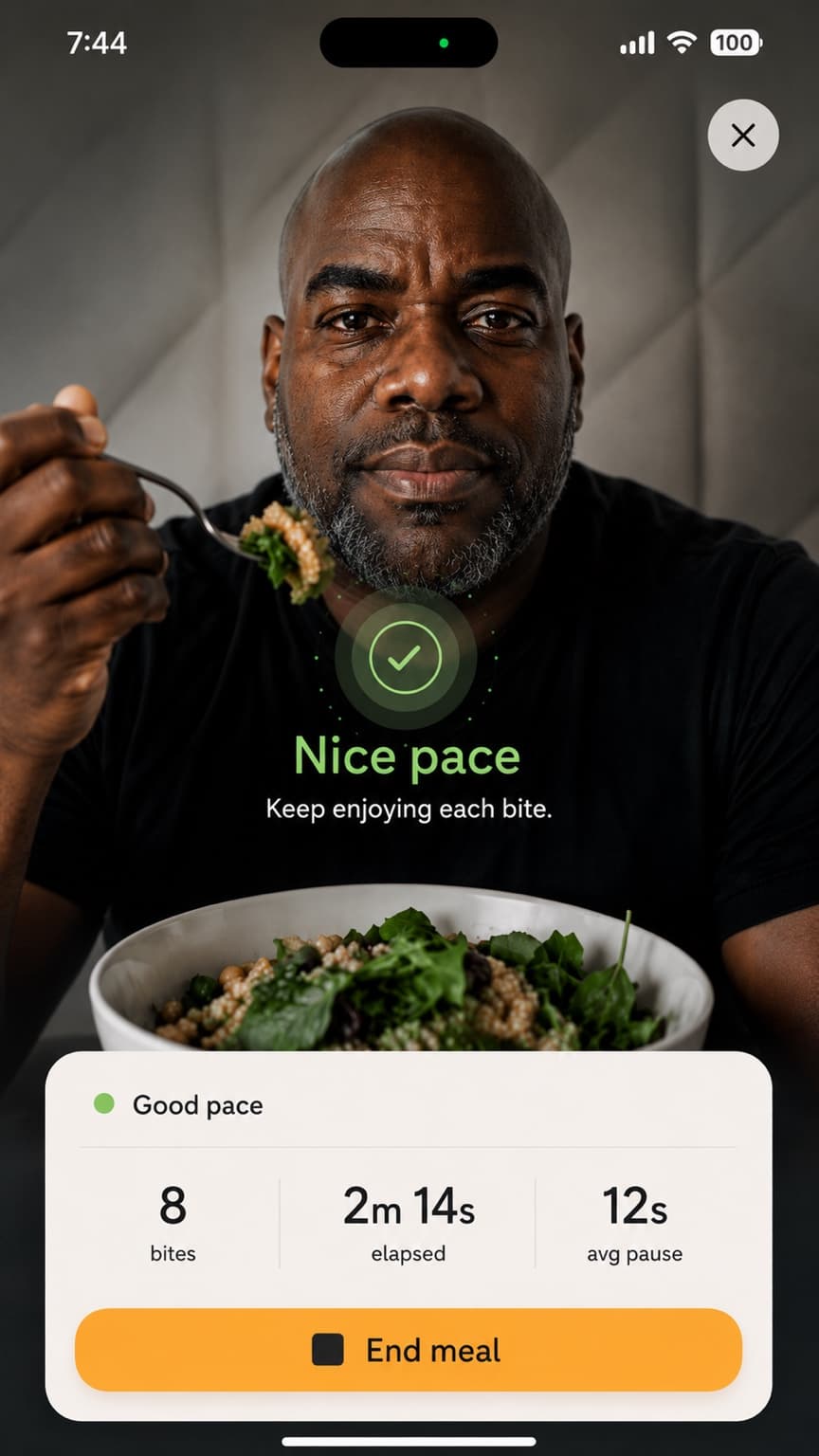
Useful feedback should be visible in one glance.
Orange says the recent pauses are fast. Green says the pace has recovered. The point is not to stare at numbers. The point is to understand what is happening and get back to the meal.
The solution
We built a speedometer, not a food judge.
MealCam uses the iPhone camera and Apple’s on-device Vision framework to estimate bite events. In plain English: it looks for a brief obstruction around the lower face from a hand, food, fork, or spoon, followed by the mouth becoming visible again. It then estimates the time between those events.
- 1
Set down the phone
Keep your face, hands, and plate comfortably visible. MealCam checks framing before the meal starts.
- 2
Eat normally
The app estimates bites, elapsed time, and average pause. You do not photograph or name the food.
- 3
Notice the cue
Three pauses under ten seconds trigger a brief slow-down reminder. Two recovery pauses can trigger a positive cue.
- 4
Review the pattern
After the meal, you can see duration, estimated bites, average pause, and recent session trends.
Why these product choices
The app should reduce effort, not add a second meal.
No calorie counting
The desired outcome is awareness of pace. A calorie database would add work and shift attention to a different problem.
Feedback during the meal
A post-meal chart is interesting. A cue before the next bite is actionable. Time-to-value is measured in bites, not weeks.
A cooldown between prompts
Constant correction becomes wallpaper—or nagging. Coaching is brief and rate-limited so the meal can stay a meal.
Private by design
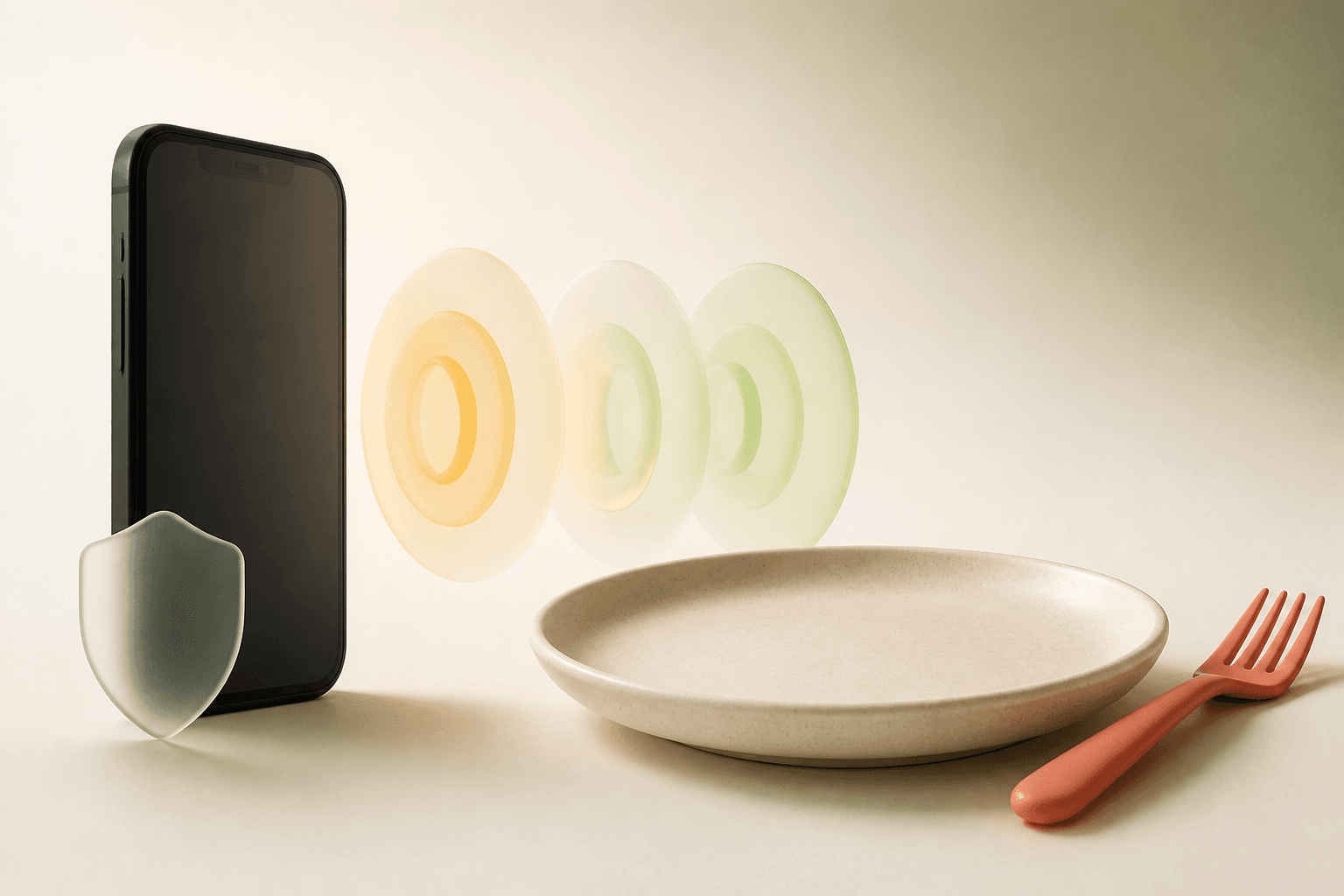
Detection runs on the iPhone and meal video is never saved. Session summaries contain estimates, not footage.
You can inspect the implementation in the public MealCoach repository. The mechanism is concrete, but it is still heuristic—not magic and not a clinically validated bite detector.
The honest boundary
MealCam will not solve every eating problem.
- It cannot know whether you are hungry, full, anxious, or experiencing loss of control.
- It cannot diagnose or treat binge-eating disorder, bulimia, anorexia, ARFID, choking risk, or digestive disease.
- Camera estimates can be incomplete or wrong when lighting, framing, occlusion, or natural movement changes.
- Ten seconds is a simple coaching guide, not a universal definition of a healthy pace.
- Some people find body- or food-focused tracking unhelpful or triggering. If that is you, do not force the tool.
If eating feels distressing, repeatedly out of control, or tied to compensatory behaviors, talk with a qualified healthcare professional or eating-disorder specialist. The right offer in that situation is care, not more persuasive app copy.
The benefit
Your next meal does not need a new personality.
You do not need to become the kind of person who meditates over a raisin for seven minutes. You do not need to log the chicken, name the dressing, estimate the oil, and then argue with a database about whether the bowl was medium or spiritually large.
You need a chance to notice. That is the modest, useful promise: make pace visible while there is still a meal in front of you.
One meal. One thing to notice.
Catch autopilot in the act.
MealCam is available in Get MealCoach: Eat Slower for iPhone. No calorie counting. No food logging. Your meal video is never saved.

Sources and research notes
What informed this article
Community posts are used to identify lived problems and language, not to prove medical outcomes. Individual X posts were searched but excluded because we could not retrieve stable, public results reliable enough to cite. YouTube informed headline patterns and common explanations; clinical claims rely on primary or expert sources below.
- Robinson et al. (2014): eating rate, energy intake, and hunger systematic review
- Ohkuma et al. (2015): eating rate and obesity systematic review
- National Institute of Mental Health: eating disorders
- Harvard T.H. Chan School of Public Health: mindful eating
- Cleveland Clinic: why people eat fast and practical cautions
- Reddit: varied experiences with mindful eating
- Reddit: mindful eating and unmet expectations
- Reddit: fast eating, hunger, and rigid rules
- Patient forum: eating speed, discomfort, and social embarrassment
- YouTube: “STOP EATING SO FAST! (Here’s Why)”
Published August 29, 2026. Educational content only; not medical advice.
 MealCoach