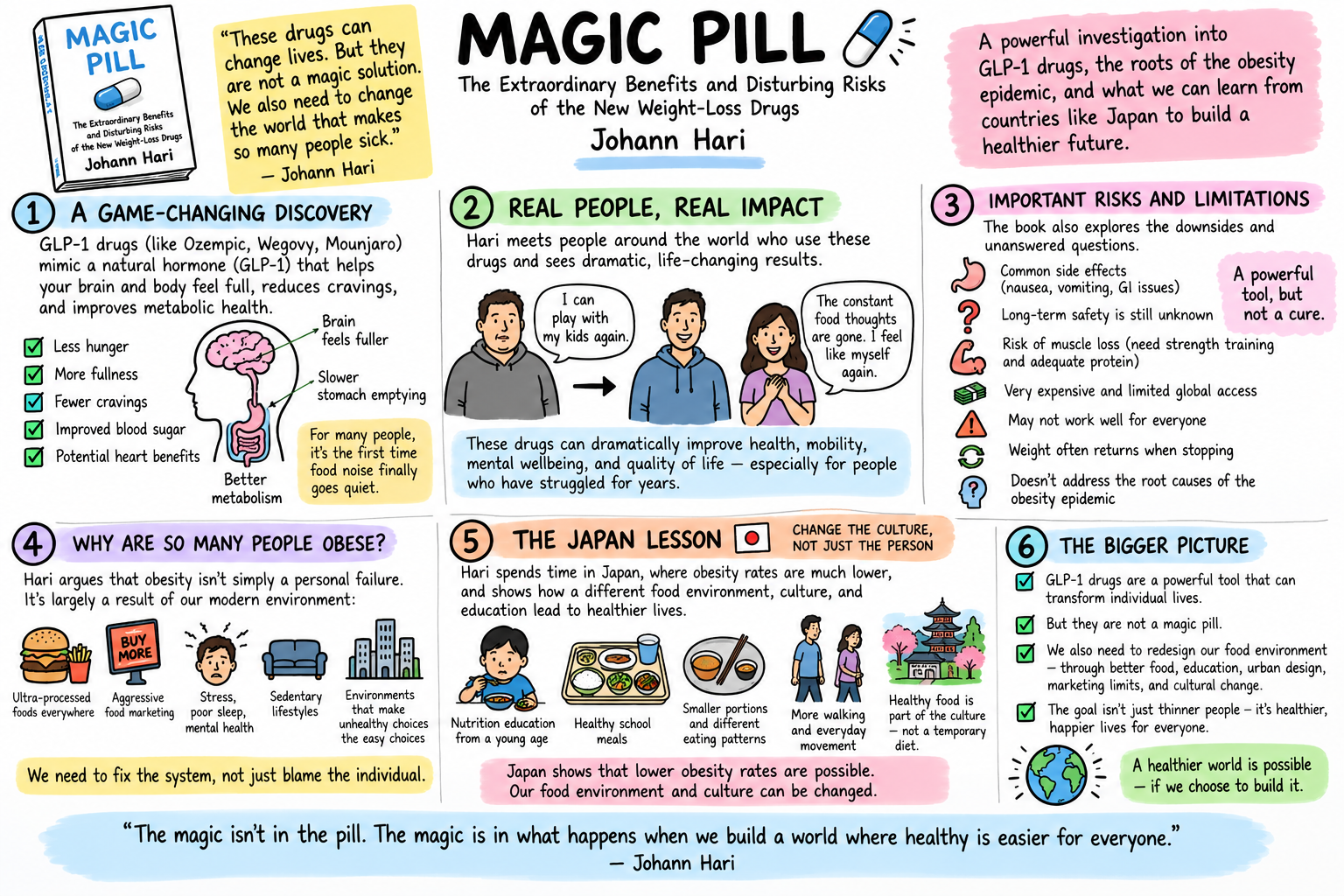
A plain-English summary of Magic Pill by Johann Hari
A fast-food shop once gave Johann Hari a Christmas card. Years later he was on a weight-loss drug, trying to work out what the drug was doing to his body and mind. This summary walks through his book and checks his big claims against the research.
How to read the evidence labels in this post:
A (strong): many good trials, or official reviews and guidelines
B (moderate): one good trial, or large studies that agree
C (early): small studies, or animal and lab work
D (story or idea): one person's experience, or a theory
A Christmas card from the chicken shop
It's Christmas Eve, 2009, in east London. Hari walks into his local KFC and gives his usual order.
The man at the counter says they have something for him. The whole shift comes out and hands him a big Christmas card. The staff had addressed it:
"To our best customer."
The KFC staff's card, as Hari recounts it in Magic Pill (book excerpt)
It's funny. Until it isn't.
Years later, Hari starts a weight-loss drug. On his first day, he orders his usual big lunch at a Turkish cafe: lamb, rice, and bread. He manages to eat a third of it (same excerpt).
That lunch sets up the book's question. If a weekly shot can change appetite this fast, what is it doing, and what does it leave untouched? (Evidence D: the author's own story.)
How the drugs work
After you eat, your gut releases a hormone called GLP-1. It helps signal fullness and helps control blood sugar.
Your own GLP-1 is short-lived. Its active form has a half-life of about 2 minutes in your blood: roughly half is broken down in that time (Holst, Physiological Reviews, 2007). (Evidence A: well-established body science.)
The drugs are built to last much longer, so one weekly shot works for days.
Semaglutide (Ozempic, Wegovy) copies GLP-1.
Tirzepatide (Mounjaro, Zepbound) acts on GLP-1 and a second gut hormone, GIP (SURMOUNT-1).
The story also has a lizard in it. In 1992, scientist John Eng found a long-lasting GLP-1-like compound in Gila monster venom. It led to the first drug of this type, approved for diabetes in 2005 (Golden Goose Award).
So how well do they work?
What the trials show
The weight loss is large. In the SURMOUNT-1 trial, 2,539 adults with obesity or overweight and no diabetes took tirzepatide or a dummy shot for 72 weeks. On the highest dose, average weight fell by 20.9%, versus 3.1% on the dummy shot (Jastreboff et al., NEJM, 2022). (Evidence B: one large, good trial. Funded by the drug maker, Eli Lilly.)
Stopping can mean regain. In an extension of one semaglutide trial, a subgroup stopped both the drug and the structured lifestyle support. A year later, they had regained on average about two-thirds of the weight they'd lost (Wilding et al., 2022). (Evidence B. Funded by Novo Nordisk.)
Hari's takeaway is that these drugs often work more like a long-term treatment than a one-time fix. That trial fits his view.
“This means that for the medication to work, you have to take it forever. It’s not like taking a drug to treat malaria, where you take a course, and then it’s done and you’re cured. It’s like taking statins to lower your cholesterol levels, or blood pressure tablets—you have to keep using it, or lose the effect. This drug, in other words, isn’t a holiday fling. It’s a lifelong marriage.”
— Johann Hari, Magic Pill
Hari uses this metaphor to describe ongoing treatment. The withdrawal study above shows average regain after stopping; it does not establish that every individual must take medication forever.
But why did so many people end up needing them? That's the most debated part of the book.
Hari's interpretation: our food world changed
Why did so many people gain weight over the past few decades? Hari's answer is the food environment: cheap, heavily processed food, built to be easy to eat a lot of.
This is his interpretation, not a settled mechanism. Weight is shaped by many things, including genes, sleep, stress, income, and some medicines. But part of his case has solid support.
In a 2019 US government study, 20 adults lived in a lab for a month. For two weeks they ate ultra-processed meals (factory-made foods like packaged snacks and ready meals). For two weeks they ate minimally processed meals. They could eat as much as they wanted.
On the ultra-processed diet, they ate about 500 more calories a day and gained about 2 pounds. They also ate faster (Hall et al., Cell Metabolism, 2019). (Evidence B: one careful but small, short trial.) The scientists still don't know which part of the food caused it.
Hari also describes a rat study. Rats fed cheesecake, bacon, and sausage kept eating even when a light warned of a small shock (Johnson and Kenny, Nature Neuroscience, 2010). (Evidence C: animal study.) It's a vivid image. It isn't proof of what happens in people.
So if food matters this much, why not just diet?
Why diets so often disappoint
If you've lost weight and watched it come back, you're far from alone.
Psychologist Traci Mann's team reviewed 31 long-term diet studies. The review found that maintaining weight loss was difficult, with substantial regain in many studies. The studies varied in quality and concerned calorie-restricting diets; this is not evidence that every approach fails (Mann et al., American Psychologist, 2007). (Evidence B.)
Hari explains why with biology. After weight loss, the body pushes back: hunger tends to rise and energy use tends to drop. That's biology, not a character flaw.
This is the core of his case for the drugs. They work with that biology instead of asking willpower to fight it every day.
The benefits go beyond the scale
Hari doesn't treat these drugs as a scam, and the evidence supports him.
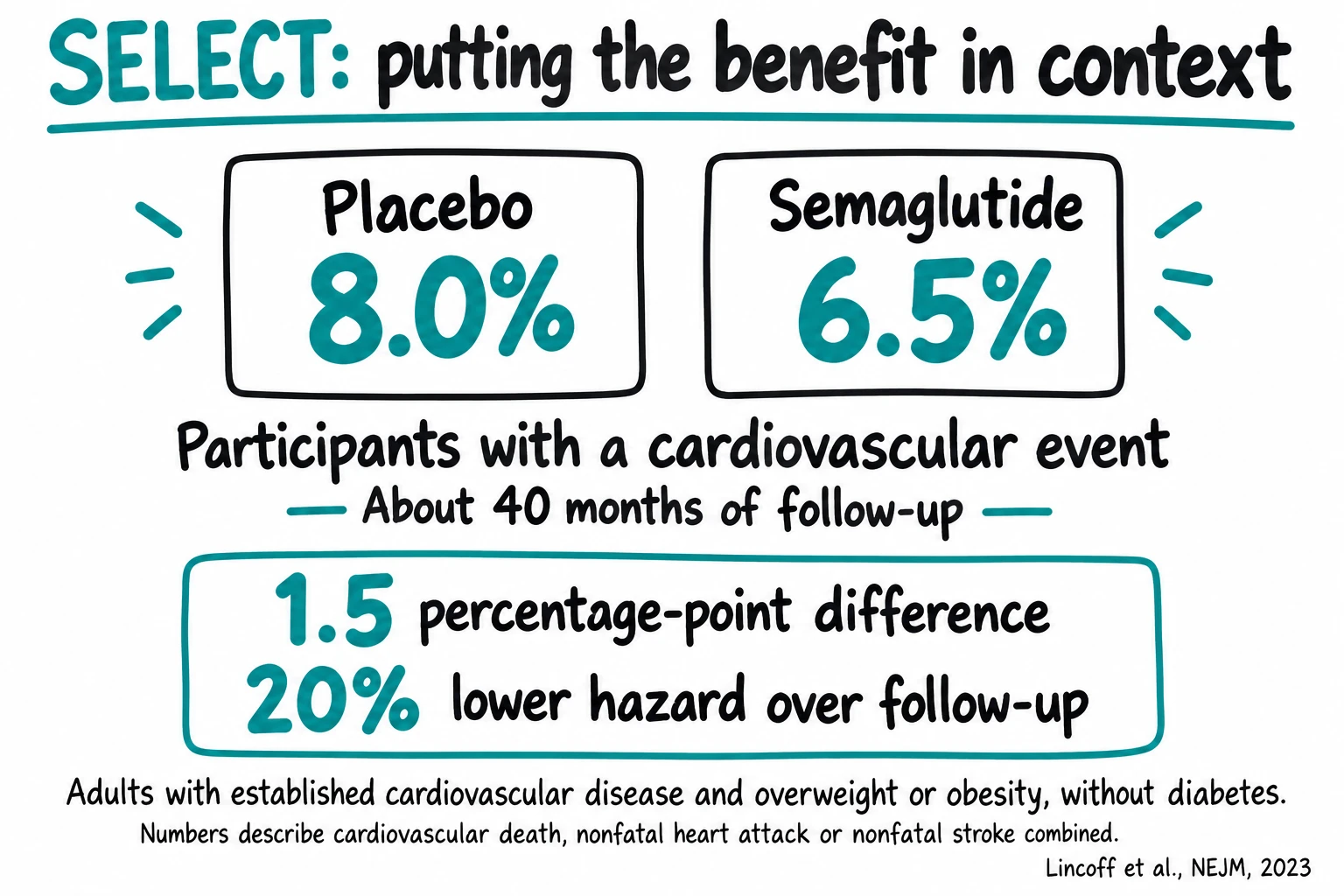
The SELECT trial followed 17,604 adults with heart disease and overweight or obesity, but no diabetes. It measured a combined outcome: heart-related death, nonfatal heart attack, or nonfatal stroke (Lincoff et al., NEJM, 2023). (Evidence B: one large, good trial. Funded by Novo Nordisk.)
Over an average of about 40 months (39.8):
6.5% of people on semaglutide had one of those events
8.0% of people on the dummy shot did
The trial reported a 20% lower hazard of the combined outcome over follow-up. The observed percentages differ by 1.5 percentage points—about 1.5 fewer people per 100. Those are two ways of describing the result; they are not a guarantee for an individual or evidence of the same benefit in people without established cardiovascular disease.
 View full-size illustration
Benefits are only half the ledger, though.
The risks, and what's still uncertain
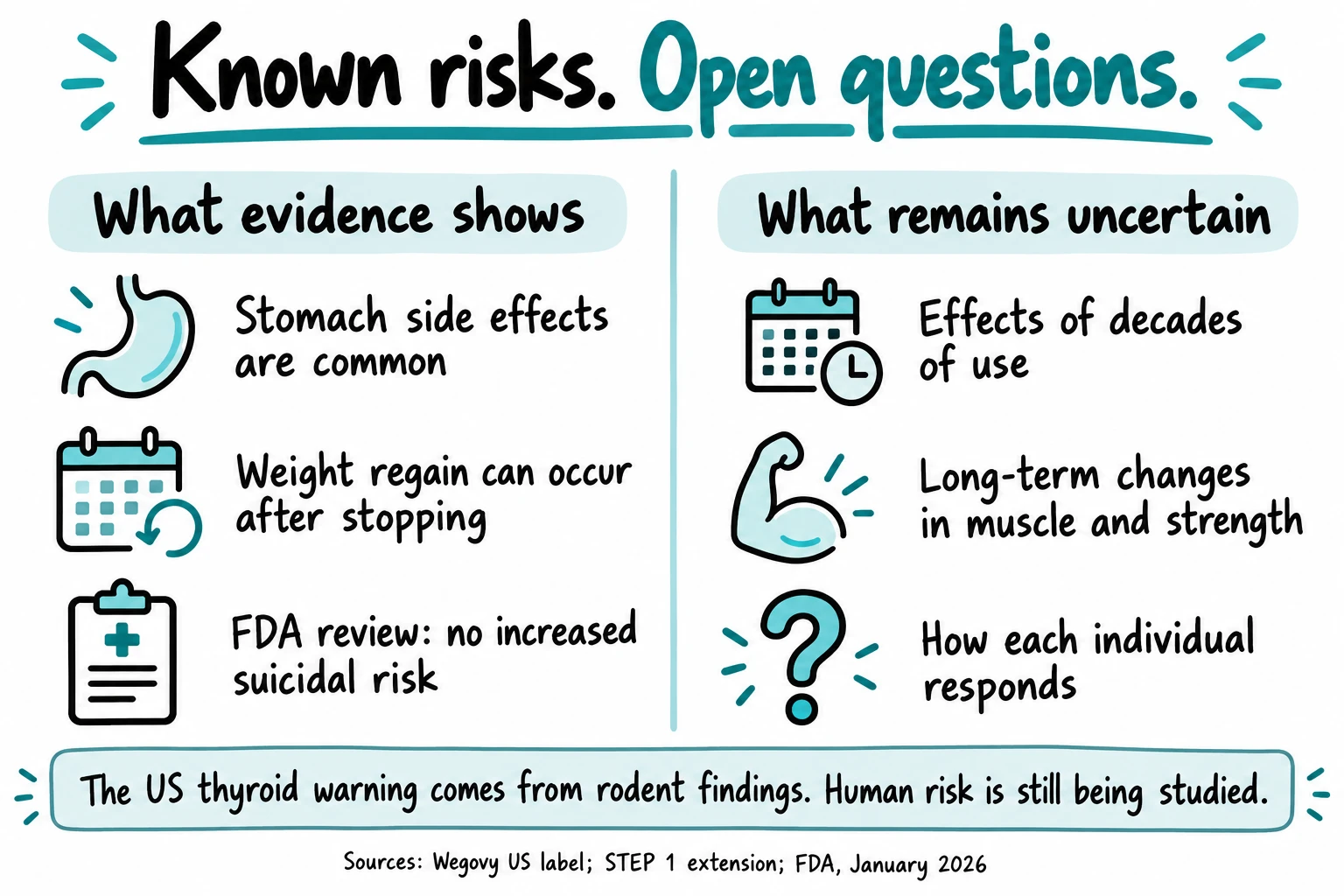
This drug class isn't new. The first one was approved for diabetes in 2005, so doctors have years of data. Here are the general risks listed in the official US label for Wegovy (Wegovy prescribing information):
Common: nausea, vomiting, diarrhea, constipation, and stomach pain
Less common but serious: pancreatitis (a painful, swollen pancreas), gallbladder problems, kidney injury from dehydration, and severe stomach side effects
Thyroid cancer: two different questions. In rodents, semaglutide causes thyroid tumors, so the US label carries a boxed warning (its strongest kind). Whether that happens in humans is unclear. A Scandinavian study followed about 145,000 GLP-1 users. It found no clear rise in thyroid cancer compared with users of another diabetes drug (Pasternak et al., BMJ, 2024;385:e078225). (Rodent finding: C. Human data: B, still being studied.)
Mood: newer evidence than the book. Hari writes that he felt emotionally flat on the drug. (Evidence D.) In early 2026, the FDA reviewed 91 trials with over 100,000 people, plus data on about 2.2 million users. It found no increased risk of suicidal thoughts or behavior, and asked for that warning to be removed from the labels (FDA). (Evidence A: review of many trials.)
What we still don't know well:
Effects of staying on the drugs for decades, not years
How weight loss on the drugs changes muscle and strength over time
What repeated stopping and restarting does
How the drugs affect the mood and eating habits of individual users, beyond averages
 View full-size illustration
What food does for us besides fuel
This is the most human part of the book. Hari argues that we eat for pleasure, comfort, and connection. Food carries family memories and holiday rituals.
In his view, a drug can quiet appetite, but it can't do the other jobs food was doing. (Evidence D: the author's interpretation.)
So he raises a gentle question: if food gets quieter, where else will comfort and connection come from?
Shame doesn't help
Weight stigma gets its own chapter, and the research agrees with Hari.
A 2020 international expert consensus statement described evidence linking weight stigma to stress, avoidance of medical care, and disordered eating (Rubino et al., Nature Medicine, 2020). (Evidence A: expert consensus.)
Whatever someone chooses, with or without medicine, respect works better than shame.
Changing the world around us
The book's last big idea: change the food environment, not just the person.
“Japan is the only country in the world that got rich without getting fat. It’s strange that sumo wrestlers are one of the most recognizable symbols of the country, because expecting other Japanese people to look like them is like expecting Americans to look like a bald eagle.”
— Johann Hari, Magic Pill
Hari then uses a comparison with Japanese-Hawaiians to explore the role of environment:
“It turns out that after a hundred or so years, Japanese-Hawaiians are now almost as fat as the people they live among. Some 17 percent of them are obese, compared to 25 percent of Hawaiians of other ethnic groups. Japanese-Hawaiians are more than four times more likely to be obese than people back in Japan. The fact that their obesity level is slightly lower than other Hawaiian groups suggests Japanese people’s genes may make them a bit less likely to gain weight—but only a bit.”
— Johann Hari, Magic Pill
These figures are reported in the book, rather than presented here as current population estimates. The comparison alone cannot separate the effects of genes, environment, and differences in how obesity is measured.
He visits Japan and describes school lunches treated as a daily lesson in food. He also notes that people there often stop eating before they feel stuffed. (Evidence D: his reporting and observations.) He doesn't prove these habits explain Japan's health. He uses them to show that a different food culture is possible.
Where the book is weaker
Hari is a gripping storyteller. That's the strength and the risk.
Some of his most vivid points rest on rat studies and single stories. And the book came out in 2024, before the FDA's 2026 mood review. Read it for the questions it raises. Then check the newest evidence.
If you'd like to try one thing
None of this replaces medical care. If you're thinking about these drugs, a clinician is the right person to talk to.
But one idea from the book is easy to try at any meal: notice your meal. Take a comfortable pause or two. Enjoy food that satisfies you. A meal-pace app such as MealCoach can help you notice how fast you eat. It's a tool for awareness, not a treatment.
The 5-Minute Version
How they work: semaglutide copies the gut hormone GLP-1. Tirzepatide acts on GLP-1 and GIP. Both last far longer than the body's own hormone.
Weight loss: large in trials (20.9% vs 3.1% at 72 weeks for top-dose tirzepatide). In one trial, people who stopped the drug and its lifestyle support regained about two-thirds of the loss within a year, on average.
Heart benefit: among adults with established cardiovascular disease and overweight or obesity, without diabetes, 6.5% vs 8.0% had cardiovascular death, nonfatal heart attack, or nonfatal stroke over about 40 months.
Risks: stomach side effects are common. Pancreatitis and gallbladder problems are rarer. The thyroid warning comes from rodents. Human risk remains uncertain.
Mood: the FDA found no increased risk of suicidal thoughts in 2026.
Hari's view: our food environment matters, food meets emotional needs, and shame makes things worse.
Conclusion
Hari's story starts with a Christmas card from a fried-chicken shop. It ends with him asking how we could build a world where good food is the easy choice for everyone.
That's why Magic Pill is worth reading. It takes the drugs seriously without treating them as magic. The benefits are real, the risks are specific, and the food world around us still matters.
Have you noticed how the people around you talk about these drugs: with hope, worry, or judgment?
This post is for education only and isn't medical advice. Talk to a qualified clinician about any medicine.
 MealCoach