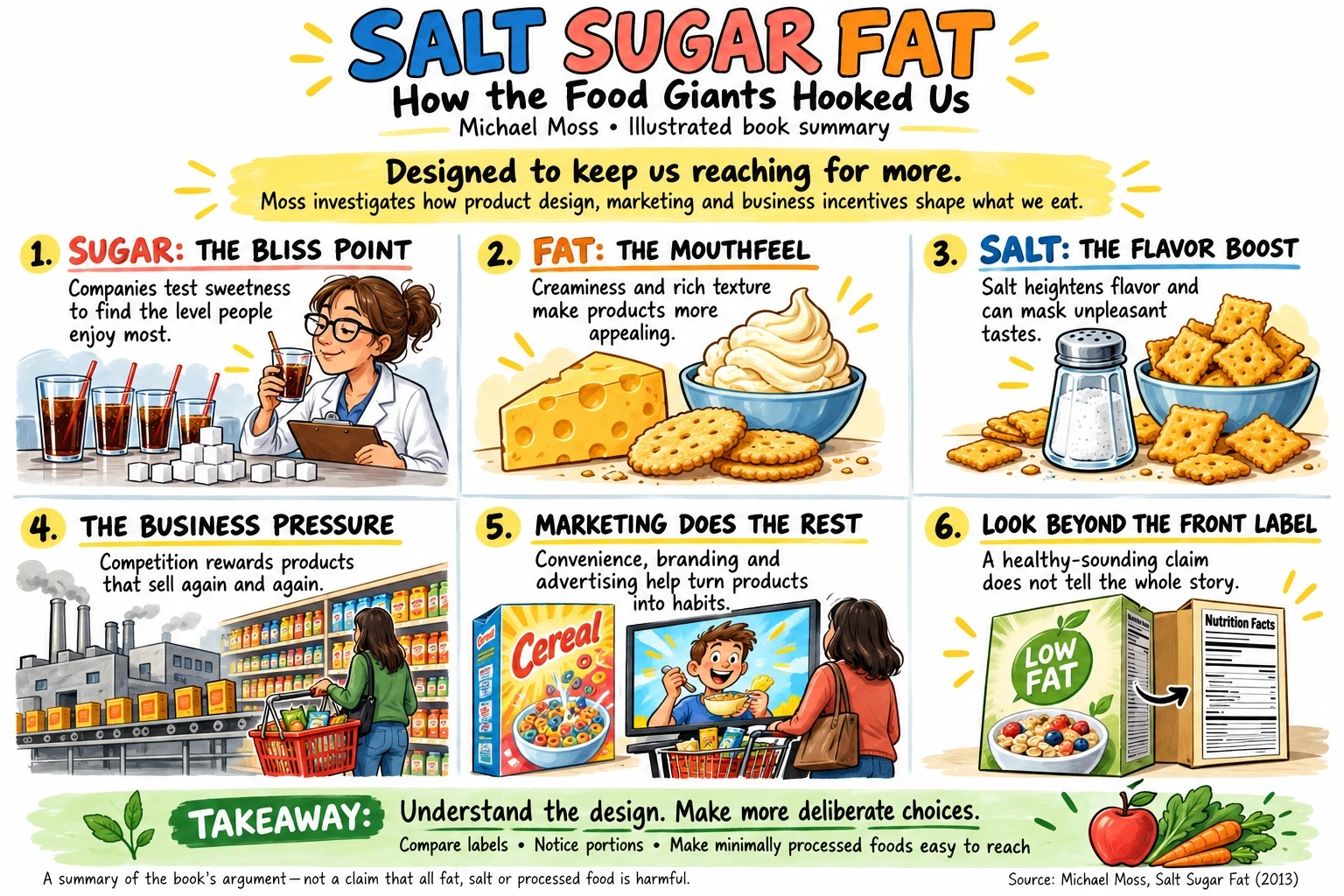
A plain-English summary of Salt Sugar Fat by Michael Moss
"Knowledge is empowering. Once you know the tricks of these companies and learn to look behind the labels, you will feel an incredible sense of power."
Michael Moss, author of Salt Sugar Fat (Yale News)
What you'll learn: how food companies tune salt, sugar, and fat so you keep eating, and a three-minute shelf test to fight back. I'll also say where Salt Sugar Fat lets the reader down.
The meeting that changed nothing
It's April 8, 1999, in Minneapolis. The bosses of America's biggest food companies are in one room (City of San Francisco).
Two insiders called it: James Behnke of Pillsbury and Michael Mudd, a vice president at Kraft. They've come to warn their own industry that it has gone too far.
The head of General Mills answers. As Moss tells it:
"we need to ensure that our products taste good, because our accountability is also to our shareholders."
As recounted by Michael Moss on NPR's Fresh Air (WAMC)
Taste came first.
So what were they guarding? Three cheap ingredients, tuned like a race car.
Sugar has a bliss point
Food companies don't say "recipe." They say "engineering."
To build one soda flavor, a researcher named Howard Moskowitz tested 61 versions in 3,904 tastings (Michael Moss in Publishers Weekly).
He was hunting the "bliss point." That's the exact level of sweetness you like most: not too little, not too much.
And it isn't only soda. In Salt Sugar Fat, Moss says bliss points exist for pasta sauce, bread, and frozen pizza too.
The average American eats 70 pounds of sugar a year, about 22 teaspoons a day (Moss, quoted by Farnam Street).
Action item: Pick up your pasta sauce tonight. Read the sugar line on the label.
Sugar was the easy one. The next ingredient is sneakier.
Fat hides in plain sight
Fat packs twice the calories of sugar. The industry's word for its pull is "mouthfeel," like warm melted cheese (Publishers Weekly).
Cheese is my favorite story in Salt Sugar Fat, because it's so sly.
In the 1960s, people switched to low-fat milk. So where did all that leftover milk fat go? Back into our food, as cheese.
We now eat 33 pounds of cheese a year each, triple what we ate in 1970 (Moss, quoted by Farnam Street).
We thought we'd cut the fat. It came back in disguise.
Action item: For one day, count how many foods you eat have cheese added.
Two down. The companies need the third one more than you do.
Salt is the fix for bad food
In industry talk, salt gives a "flavor burst". Companies even change the shape of the grain so it works faster on your tongue (Publishers Weekly).
Salt also covers up bad tastes. Kellogg made Moss some favorites with no salt. The Cheez-Its stuck to the roof of his mouth. The waffles tasted like straw. And the Corn Flakes?
"hugely, awfully metallic. It was almost like a filling had come out of my mouth and it was sloshing around."
Michael Moss on Fresh Air (WAMC)
Take the salt out, and the food falls apart. Americans eat 8,500 milligrams of salt a day, double the advised amount (Penguin Random House).
Action item: Compare the sodium on two brands of the same soup. Buy the lower one this week.
But tuning alone won't make you finish the bag. For that, they needed a trick.
The snack that tells your brain it's nothing
Have you ever eaten half a bag of Cheetos and felt like you'd eaten air?
That's by design. Food scientist Steven Witherly called Cheetos "one of the most marvelously constructed foods on the planet, in terms of pure pleasure" (Popular Science).
The trick is called vanishing caloric density. The food melts so fast your brain loses count:
"If something melts down quickly, your brain thinks that there's no calories in it…you can just keep eating it forever."
Steven Witherly, quoted in Salt Sugar Fat (Popular Science)
Your willpower isn't broken. The snack was built to slip past it.
Action item: Never eat from the bag. Pour one bowl, close the bag, and put it away.
The food is half the story. The other half is how they sell it.
You're not a customer, you're a "heavy user"
Inside Coca-Cola, the best customers had a name. Moss says they "became known as 'heavy users'" (WAMC).
A small group drinks most of the product. Some drank up to 1,000 cans a year, so that's who the ads chased (WAMC).
They chased kids too. Moss says a child who picks a soda at 13 or 14 tends to keep it for life.
I find the phrase "heavy user" chilling. It's the language of a habit, not a treat.
One twist I love: Jeffrey Dunn spent 20 years at Coca-Cola. Later he used the same tricks to sell baby carrots. His slogan was "Eat 'Em Like Junk Food" (Grist).
The tools work on vegetables too. They're pointed the wrong way.
Action item: Name the one product you buy on autopilot. Skip it for a week and see what you miss.
So how do you shop in a store built by these people?
The three-minute shelf test
Moss gives three rules (Publishers Weekly).
Walk the edges first. Fresh food sits around the outside of the store.
Look up and down. In the middle aisles, the saltiest, sweetest, fattiest items sit at eye level.
Flip it over. Skip the front of the box. Read the back.
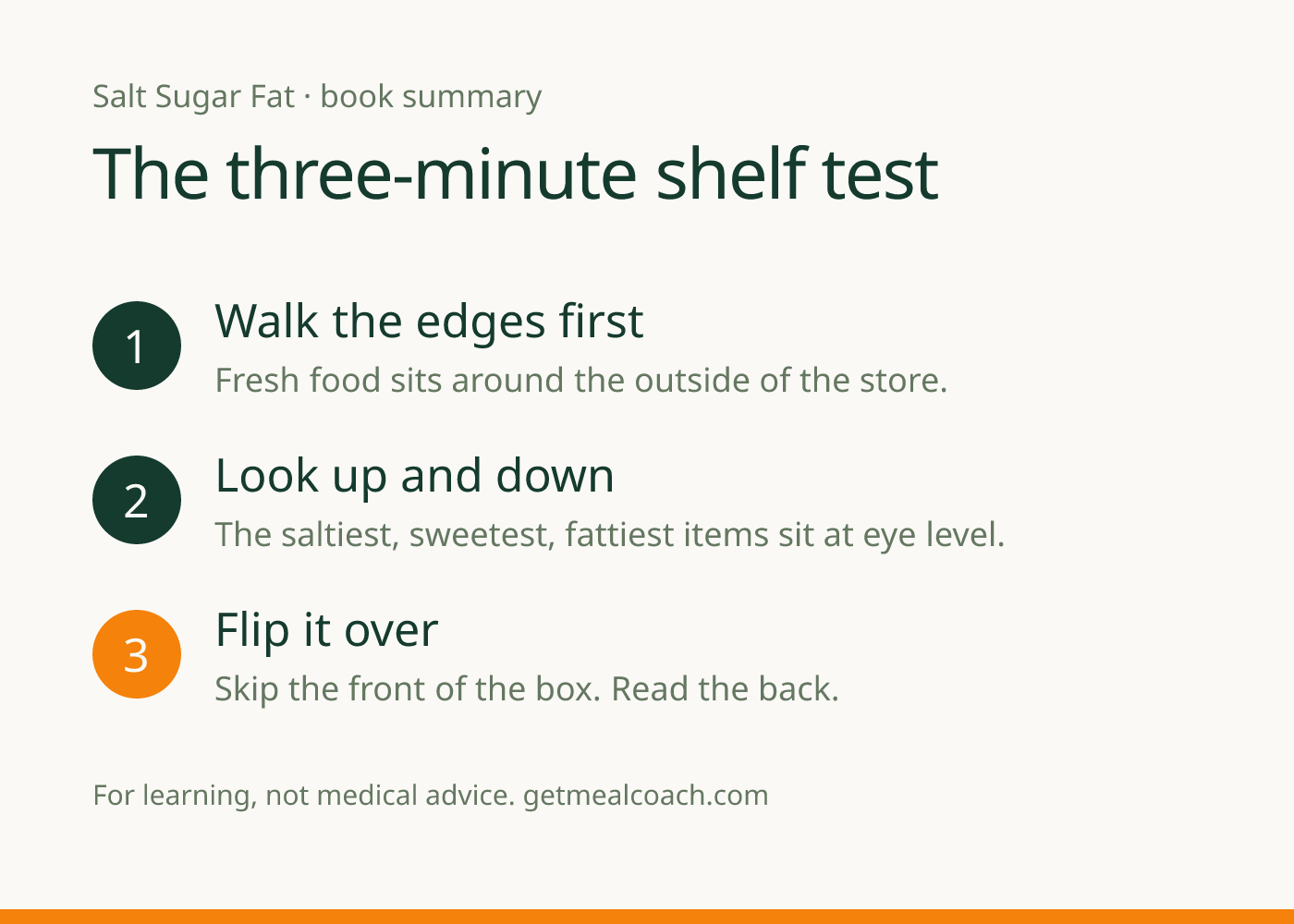 View full-size illustration
Test it on a "low fat" yogurt. Check the sugar. Moss warns it can match ice cream.
Action item: On your next shop, flip over three things you always buy. Put back the one that shocks you most.
Now for where I think Salt Sugar Fat comes up short.
Where the book lets you down
The reporting is great. The ending is weaker.
The fix falls on you. One public health reviewer called the book's answer a "blame the victim" idea about making better choices (Corporations and Health Watch). I half agree. Three shopping rules are a small shield.
It's polite. Moss says so himself: "These companies are not evil" (Yale News). Some readers will want more anger.
The numbers are old. It came out in 2013, so treat its figures as a snapshot.
My take: read it for the "how," not the "what now."
So is a 2013 book still worth your time? A courtroom says yes.
Why Salt Sugar Fat is back in the news
On December 2, 2025, San Francisco sued ten of the biggest food makers. Kraft Heinz, Coca-Cola, and General Mills are among them (City of San Francisco).
And what does the city's announcement point to? That same meeting in Minneapolis, on April 8, 1999.
The city's lawyer, David Chiu, put it this way: "These companies created a public health crisis with the engineering and marketing of ultra-processed foods" (City of San Francisco).
The warning that died in that room is now evidence.
Salt Sugar Fat told this story twelve years before the lawsuit. That's why I'd still read it.
What you get from this
✅ You stop blaming your willpower
✅ You know what "bliss point" and "heavy user" mean
✅ You read the back of the box, not the front
Short on time? Here's the whole post in six lines.
The 5-Minute Version
In 1999, insiders warned food bosses they'd gone too far. Taste won.
Sugar is tuned to a "bliss point," even in pasta sauce and bread.
Fat came back as cheese. We eat triple what we did in 1970.
Salt hides bad flavors. Without it, the food falls apart.
Snacks like Cheetos melt fast so your brain loses count.
Shop the edges, look past eye level, and read the back label.
One scene sums it all up.
Conclusion
In 1999, insiders told the food giants they'd gone too far. Taste won.
That's the heart of Salt Sugar Fat. The food isn't hard to resist by accident. It was built that way.
You can't out-engineer a lab. But you can flip the box over.
Do that with three items on your next shop.
Which food can you never stop eating once you start?
This post is for learning, not medical advice. Talk to your doctor before you change your diet for a health condition.
 MealCoach