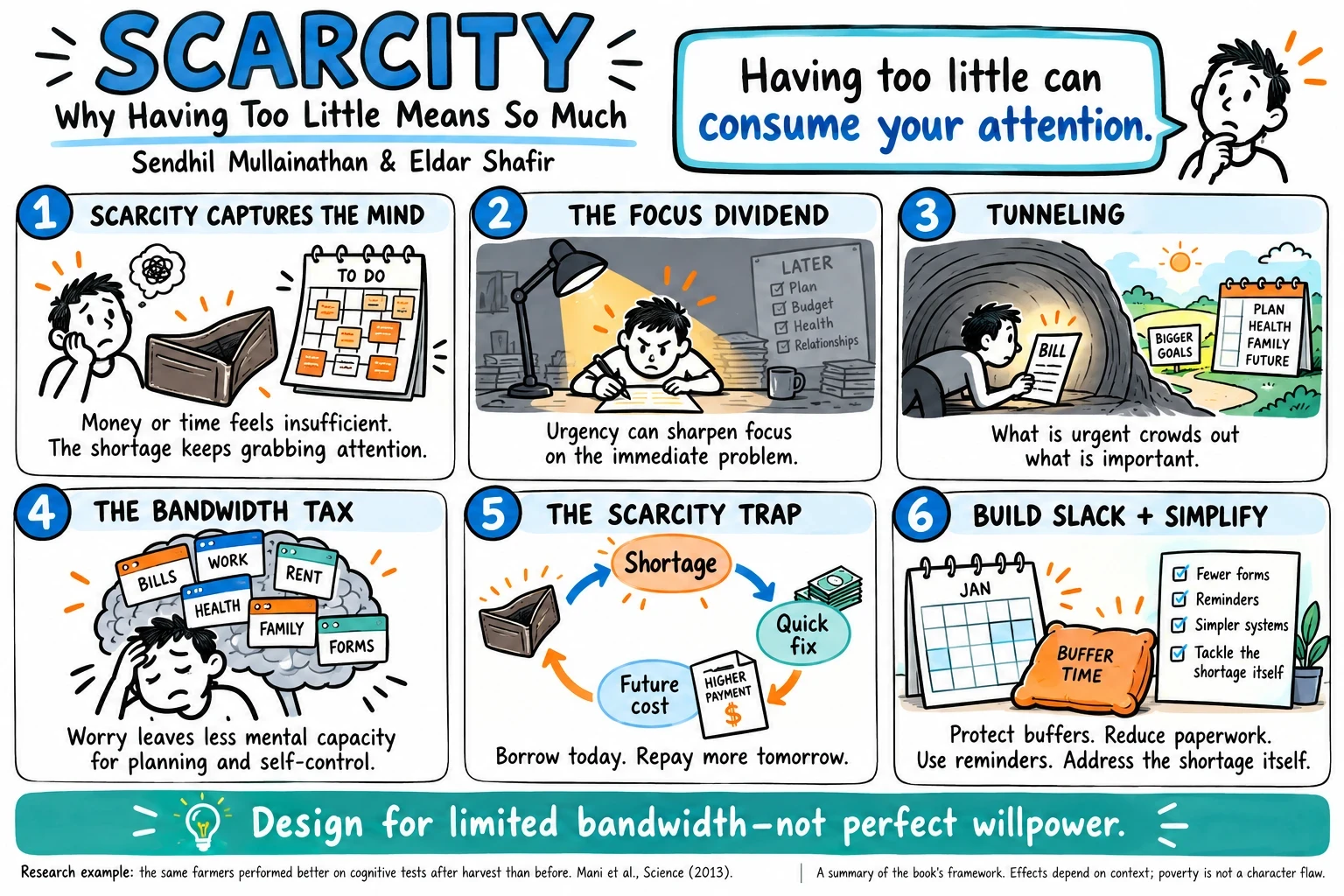
A plain-English summary of Scarcity by Sendhil Mullainathan and Eldar Shafir
"The poor stay poor, the lonely stay lonely, the busy stay busy, and diets fail."
Sendhil Mullainathan and Eldar Shafir, Scarcity (Goodreads quotes)
What you'll learn: why a packed day makes a diet harder long before dinner, and four small fixes that don't need more willpower. I'll also say where the science behind Scarcity is shaky.
It's 7:40 p.m. and the plan is gone
You had a plan this morning. Grilled chicken and a salad. You even bought the lettuce.
Then a meeting ran over, your inbox filled up, and you got home late.
Now you're at the open fridge. The lettuce is right there. You close the door and order a pizza.
Later you tell yourself you have no willpower.
But what if the choice was made hours ago?
That's the big idea in Scarcity. And it starts with a group of hungry men.
The men who watched a movie and saw only the food
In the 1940s, a group of volunteers agreed to eat far too little for months.
They lost weight, as expected. Something stranger happened to their minds.
They began to talk about cookbooks. They recited restaurant menus. After watching a movie, many couldn't recall the plot. They remembered what each character ate (Science News).
This is the book's first lesson: what you lack takes over your mind. The authors call this lack "scarcity." It means having less than you feel you need.
And it isn't only food. The authors say it works the same way with money and with time.
Action item: Name the one thing you feel shortest on this week. Time, money, sleep, or food. Write it down.
So what does a mind do when it's short on time? It digs a tunnel.
Busy people live in a tunnel
When you're short on something, you focus hard on it. The book calls this "tunneling." You see what's inside the tunnel and miss what's outside.
Sometimes that helps. A deadline makes you sharp. But the tunnel has a price.
Firefighters race to a fire, running through checklists in their heads. Between 1984 and 2000, up to a quarter of firefighters who died on duty were killed in vehicle crashes, not fires. Most of those who died on the way weren't wearing seat belts (Science News).
They weren't careless. The seat belt was outside the tunnel.
On a busy day, dinner is your seat belt. It matters, but it isn't urgent at 2 p.m. So it stays outside the tunnel until you're starving.
Action item: Tomorrow at lunch, decide what dinner will be. Put it in your calendar like a meeting.
The tunnel explains what you forget. The next idea explains why you choose badly anyway.
A packed day leaves you less mind for dinner
"Bandwidth" is the book's word for how much thinking power you have free right now.
The authors tested it in a New Jersey mall. About 400 shoppers were asked to imagine a car repair. For some it cost $150. For others, $1,500. Then everyone took thinking tests (Princeton, via ScienceDaily).
With the cheap repair, rich and poor scored the same. With the costly one, poorer shoppers scored much worse. The drop was like losing 13 IQ points, or a full night's sleep (Princeton, via ScienceDaily).
Same people, same brains. A worry was running in the background, eating their bandwidth.
"Scarcity in one walk of life means we have less attention, less mind, in the rest of life."
Scarcity (Goodreads quotes)
To be fair, that study was about money, not time. The book argues a crowded schedule taxes you the same way. I believe it, but it's an argument, not a proven fact.
Here's my take: at 7:40 p.m. you aren't weak. You're out of bandwidth.
Action item: Make food choices when your mind is fresh. Pack tomorrow's lunch right after dinner, not at 7 a.m.
Now the part that surprised me. The diet itself makes this worse.
A diet is its own kind of scarcity
Remember the hungry men? A diet does a small version of that to you.
"Diets prove difficult precisely because they focus us on that which we are trying to avoid."
Scarcity (Goodreads quotes)
The more foods you ban, the more room they take up in your head. The authors use a dieter as an example of a taxed mind (Princeton Alumni Weekly).
So a busy dieter pays twice: once for the schedule, once for the diet.
Food research backs the time part. A review in the journal Appetite looked at people who feel short on time. It linked that feeling to less home cooking, more fast food, and fewer family meals (Devine and Jabs, 2006).
So the answer to the title is yes. Being short on time can sink a diet before you open the fridge.
Action item: Swap one "never" rule for a "usually" rule. "No sweets ever" becomes "fruit after dinner on weekdays."
So what's the fix? The authors borrow it from traffic.
The fix is slack, not willpower
"Slack" is the book's word for spare room: a gap in the schedule, a little extra in the budget.
"Roadways operate best below 70 percent capacity; traffic jams are caused by lack of slack."
Scarcity (Goodreads quotes)
A full road jams at the first small bump. So does a full day. One late meeting, and dinner is gone.
I think this is the most useful idea in the book: plan for the bad day, not the good one.
Action item: Build one "slack meal." Keep a healthy dinner in the freezer that takes ten minutes. It's for the night the plan falls apart.
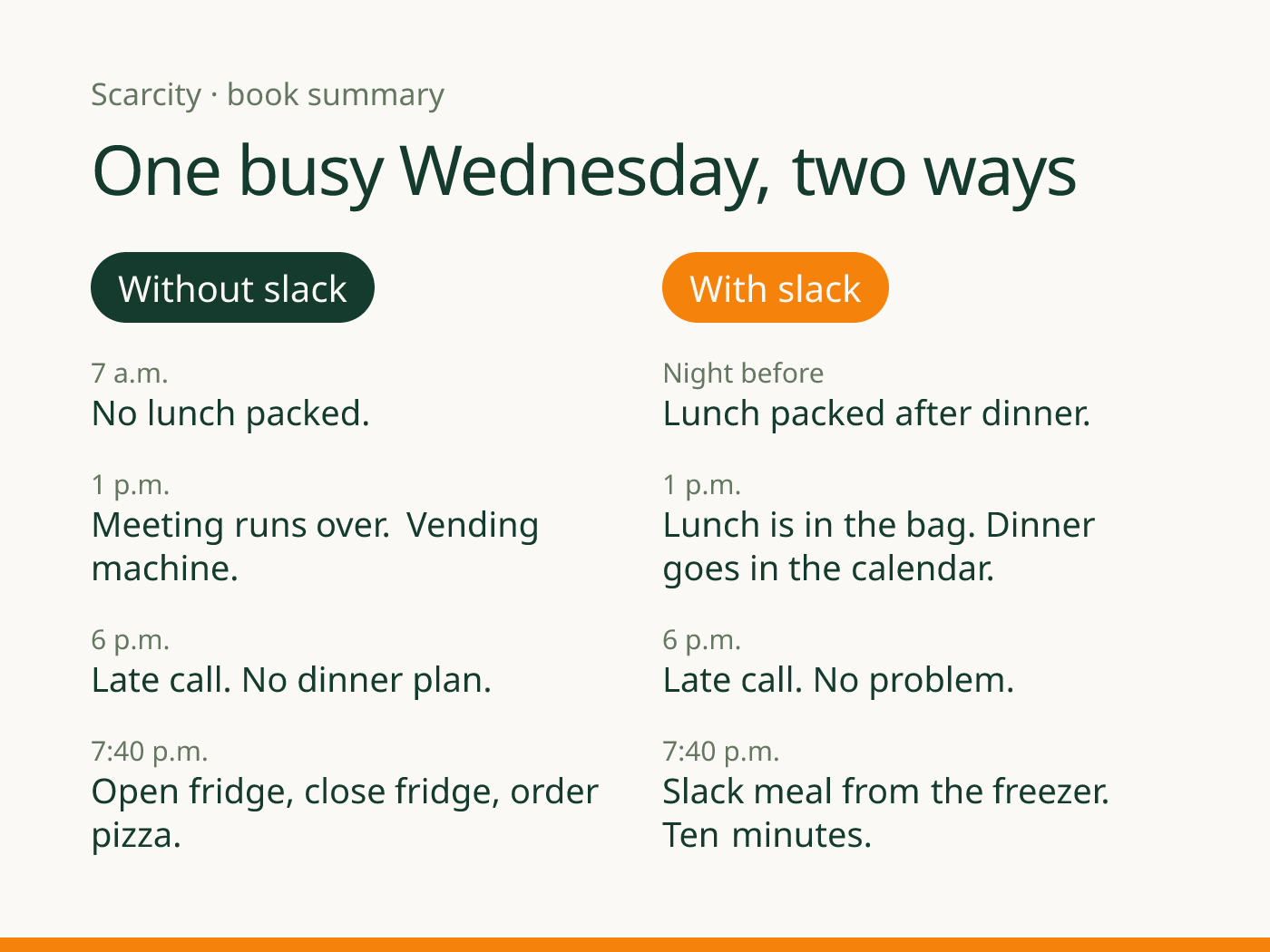
Here's all of it on one busy day.
One busy Wednesday, two ways
Without slack
7 a.m.: No lunch packed.
1 p.m.: Meeting runs over. Vending machine.
6 p.m.: Late call. No dinner plan.
7:40 p.m.: Open fridge, close fridge, order pizza.
With slack
Night before: Lunch packed after dinner.
1 p.m.: Meeting runs over. Lunch is in the bag, and dinner goes in the calendar.
6 p.m.: Late call. No problem.
7:40 p.m.: Slack meal from the freezer. Ten minutes.
 View full-size illustration
Same job, same meetings, same person. The second one didn't try harder.
Action item: Pick your busiest day this week. Set up all three for that day only.
Now the honest part.
Where the book is shaky
I like this book. I'd also hold it loosely.
It's light on fixes. The Science News reviewer said the authors don't offer enough solutions to the traps they describe (Science News). Most tips in this post are my own use of their ideas.
Some of the science didn't hold up. In 2021, researchers re-ran 20 studies from this field. Some results held. Some plainly failed (O'Donnell and others, 2021).
The diet part is the thinnest. The strongest studies are about money. I think the dieting claims rest on much less.
My take: treat Scarcity as a useful lens, not a law of nature.
So why read a 2013 book now?
Why Scarcity fits this moment
Because we finally have a word for what it describes.
People now talk about "food noise": nagging thoughts about food that won't switch off. Researchers started defining it in 2023 (a 2023 paper).
That's the hungry men and their cookbooks. Scarcity said it ten years earlier: a mind short on food fills up with food.
What you get from this
✅ You stop calling yourself weak at 7:40 p.m.
✅ You decide dinner while your mind is fresh
✅ You keep one slack meal for the bad night
Short on time? Here's the whole post in six lines.
The 5-Minute Version
Scarcity means having less than you feel you need. It takes over your mind.
Busy people tunnel. Dinner falls outside the tunnel until it's too late.
Worry and hurry eat your bandwidth, so evening choices get worse.
A strict diet adds its own scarcity. Banned foods get louder.
The fix is slack: decide early and keep a ten-minute backup meal.
Some of the science is shaky. Use the book as a lens.
One line from the book ties it together.
Conclusion
"The present presses automatically on you. The future does not."
Scarcity (Goodreads quotes)
That's why the pizza wins. The meeting and the hunger press on you now. Your diet is a promise to the future, and the future doesn't shout.
You don't need more willpower. You need more slack. That's what Scarcity taught me.
So don't fight at 7:40 p.m. Decide at lunch, and stock one backup meal.
What would your slack meal be?
This post is for learning, not medical advice. Talk to your doctor before you change your diet for a health condition.
 MealCoach