A plain-English summary of The Secret Life of Fat by Sylvia Tara
"Fat is vital to life, and because fat is so important, nature tries to protect it."
Sylvia Tara, author of The Secret Life of Fat, on NPR's Here & Now (WFAE)
What you'll learn: why your body fights to keep its fat, the four ways it does it, and a one-day plan that works with it. I'll also say where The Secret Life of Fat worries me.
The dinner that didn't add up
Picture two friends at one table. One orders dessert and stays slim. The other skips it and still can't zip her jeans.
Sylvia Tara was the second friend. She'd lose weight on a starvation diet, then gain it back "just by eating dinner," as one review put it (Kirkus).
Most of us would blame ourselves. Tara had a PhD in biochemistry, so she got curious (People's Pharmacy).
She spent five years reading about a thousand studies (Scientific American).
What she found flips the usual story. Your fat isn't lazy padding. It's alive, and it has a plan.
One man in the book learned that the hard way. It started with a chicken.
The boy and the chicken
Randy grew up on a farm. At 11, a chicken scratched him.
After that, his appetite shot up. He worked hard on the farm every day and still gained weight fast. His family stayed slim (Mother Jones).
For fifty years, nobody could tell him why.
Then, at 62, a blood test found a virus called Ad-36. A scientist named Nikhil Dhurandhar had spent years tying it to weight gain in animals.
The human numbers, from the same Mother Jones report: in a study of over 500 people, 30 percent of obese people carried signs of it. Only 11 percent of the others did.
Randy now eats about 1,500 calories a day, mostly salad (Mother Jones). His doctor's verdict:
"a remarkable person, with more discipline than anyone I have ever met."
Dr. Richard Atkinson, quoted from The Secret Life of Fat (Mother Jones)
Fifty years of blame, and he may have been the most disciplined man in the room.
Action item: Write down one thing you blame yourself for about your weight. Keep it. You'll want it at the end.
So if it isn't weakness, what is fat doing?
Fat is an organ, and it talks
Here's the big idea in The Secret Life of Fat. In Tara's words: "Fat is actually an endocrine organ" (WFAE).
An endocrine organ is a body part that makes hormones. Hormones are chemical text messages.
Fat's main message is leptin. Leptin tells your brain, "We have enough stored. You can stop eating."
What happens with no leptin at all? In 1999, doctors wrote up a nine-year-old girl whose body made none. She was hungry all day, every day. After a year of leptin shots, her hunger and her body fat both dropped sharply (New England Journal of Medicine).
She had no willpower problem. She had a missing message.
Action item: Next time you call your fat "gross," swap the word for "busy." Silly, yes. Try it once.
Now the bad news. That same message system turns on you when you diet.
Lose weight, and your fat sends a bill
Lose fat, and you make less leptin. Your brain reads that as danger.
Tara says your appetite goes "through the roof" and your body burns less (Scientific American).
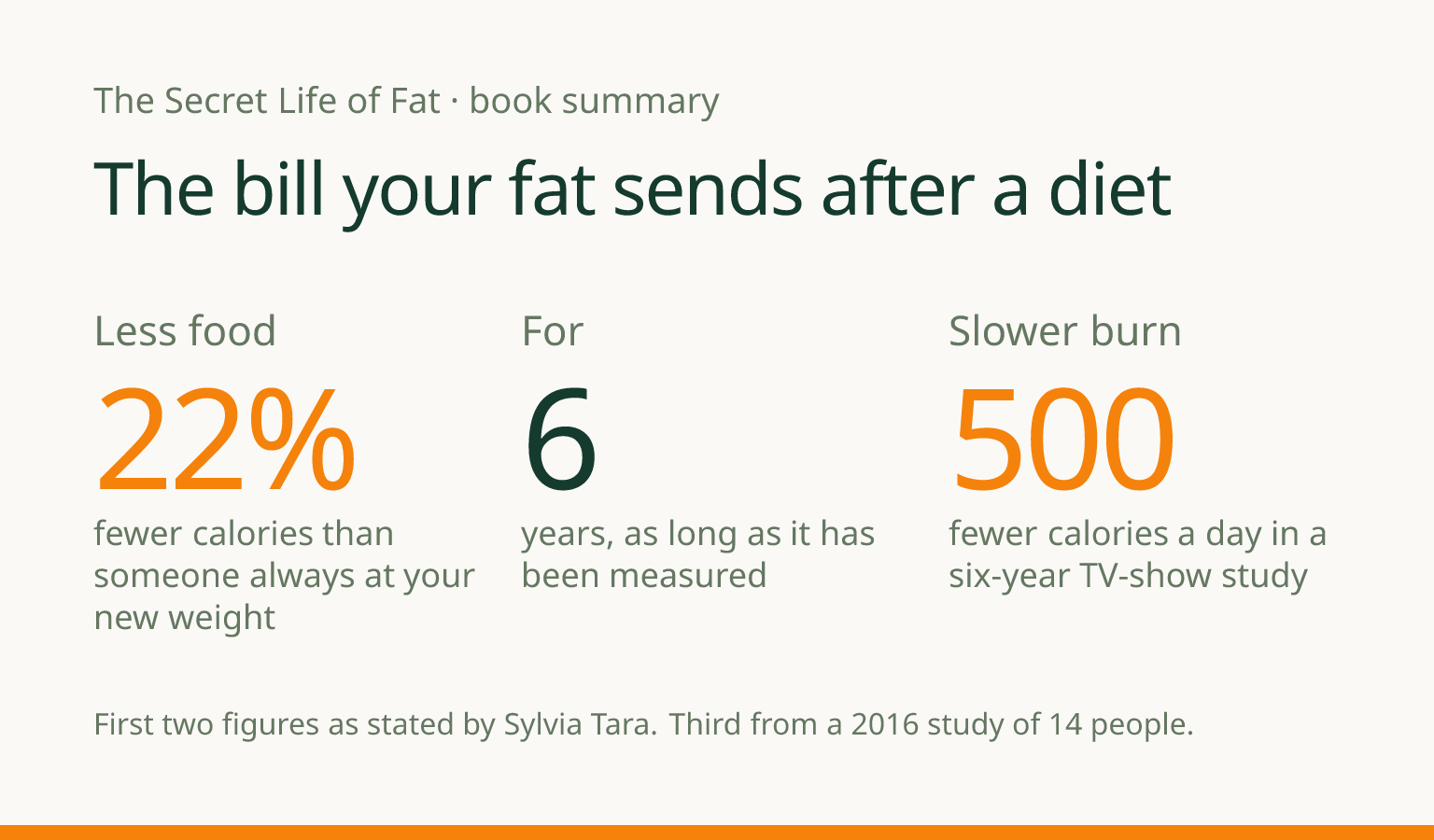
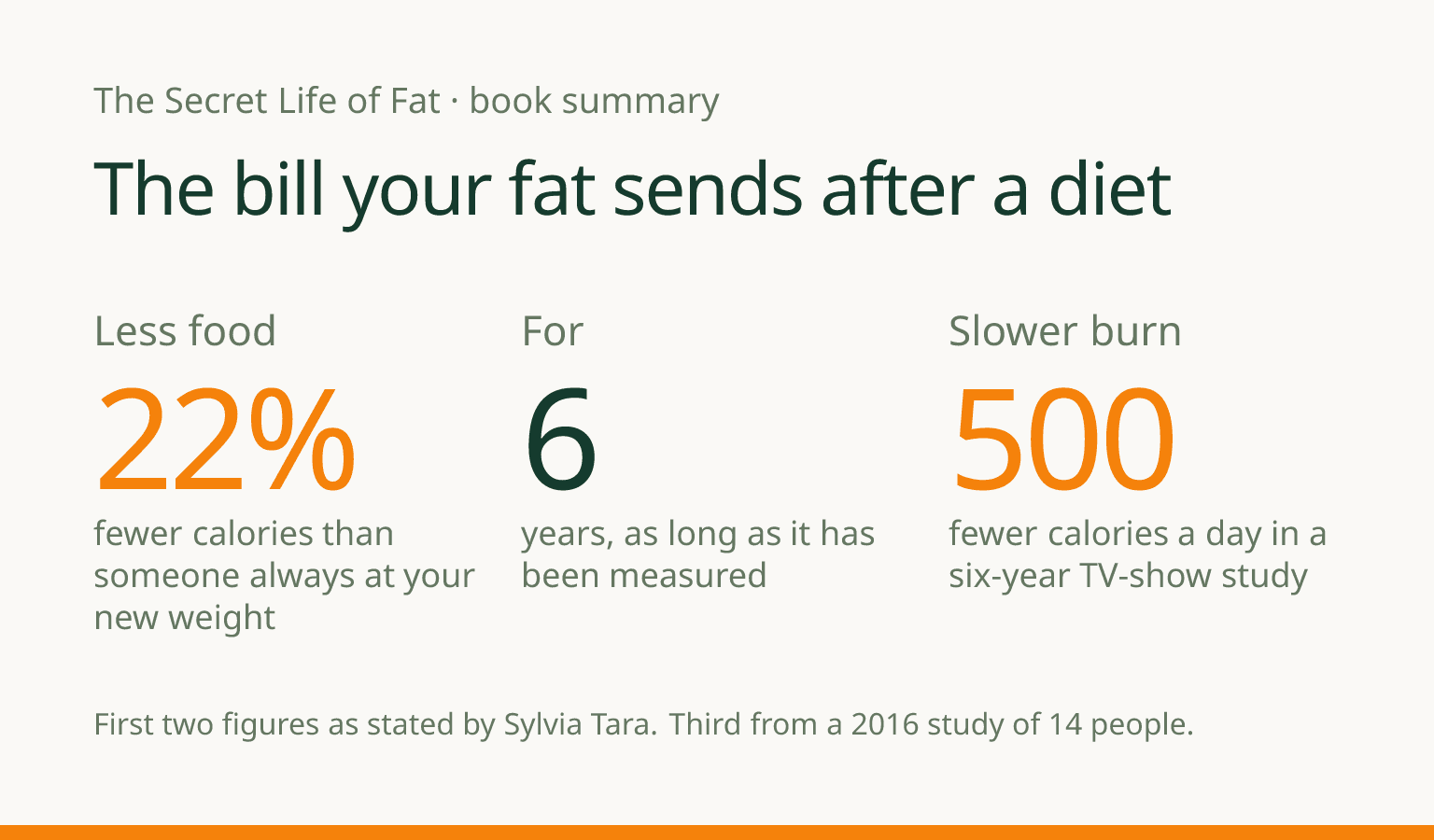
Her example stopped me cold. Take someone who diets from 170 pounds to 150. They must eat 22 percent fewer calories than someone who was always 150 (Scientific American).
Same weight, smaller plate. For how long?
"This persists for up to six years. It's been studied for up to six years. It might even be permanent."
Sylvia Tara (Scientific American)
A study outside the book agrees. Scientists tracked 14 people from the TV show The Biggest Loser for six years. Their bodies still burned about 500 fewer calories a day than expected (Medical Xpress).
You didn't fail the diet. The diet came with a bill nobody showed you.
Action item: If you've lost weight before, plan for a smaller plate after the diet too. Decide now what that plate looks like.
Leptin is one trick. Fat has more.
Why your friend can eat more than you
Two people can eat the same and weigh wildly different amounts. Tara's list of reasons: genes, viruses, gut bacteria, sex, and hormones (WFAE).
She watched her own man eat ice cream every night and still fit his college jeans (Scientific American).
You can't pick your genes. One item on the list you can change tonight: sleep. Goodreads readers saved this line from The Secret Life of Fat:
"Lack of sleep is associated with low leptin and high ghrelin levels, a combination that increases hunger, reduces satiation, and leads to obesity."
Sylvia Tara, The Secret Life of Fat (Goodreads)
Ghrelin is the hunger hormone. So a short night turns hunger up and fullness down.
Action item: Set a bedtime alarm tonight, 30 minutes earlier than usual.
So is fat the enemy after all? Not quite.
The fat that helps you
Being heavy raises your risk of heart disease. Yet after heart failure, heavier people tend to survive longer (Kirkus). Tara calls this the obesity paradox.
Then there's this line, also saved by Goodreads readers:
"Apparently, it is healthier to be overweight and fit than simply to be thin."
Sylvia Tara, The Secret Life of Fat (Goodreads)
That's her reading of the studies, not a free pass. My take: how fit you are matters as much as what the scale says.
Hard exercise gets special praise:
"once we enter a specific range of strenuous exercise, the body kicks in to lose fat no matter what our genes want."
Sylvia Tara, The Secret Life of Fat (Goodreads)
Action item: Add one short, hard burst to your day. Climb stairs fast for two minutes. Check with your doctor first if you have a health condition.
Fine. But what does a normal day look like if you take all this in?
A day that works with your fat
Tara lost 30 pounds and kept it off for years. She stretches her overnight fast to 16 or 17 hours and does hard interval workouts (Scientific American).
It's strict, and I wouldn't copy it. Here's my gentler version:
 View full-size illustration
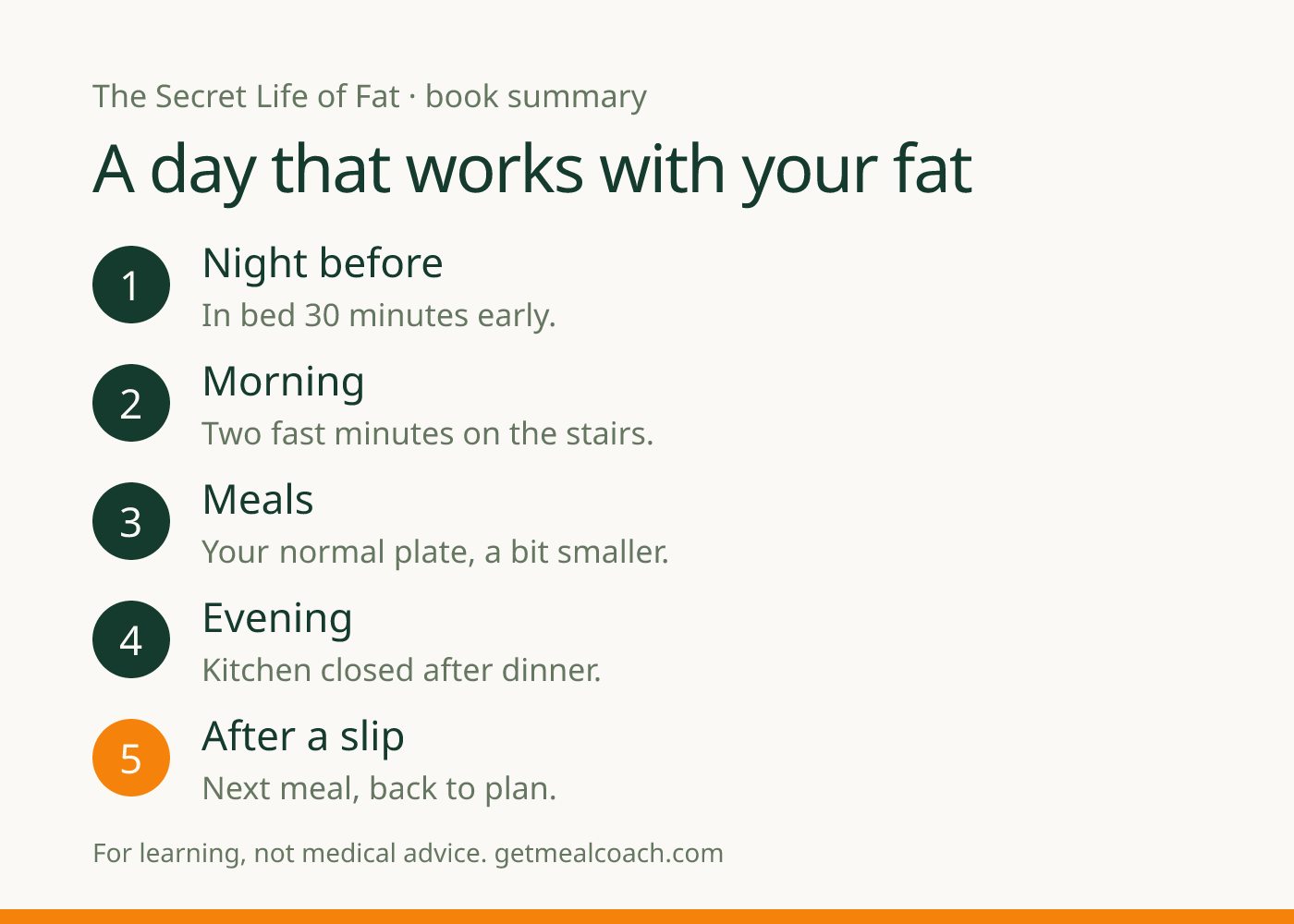
Night before: in bed 30 minutes early. Sleep keeps hunger hormones calm.
Morning: two fast minutes on the stairs. Hard exercise beats your genes.
Meals: your normal plate, a bit smaller. Your body burns less after a diet.
Evening: kitchen closed after dinner. A longer overnight gap, gently.
After a slip: next meal, back to plan.
That last step is Tara's best advice. People who keep weight off still slip. In her words: "Really, successful dieters, they just get back on" (Scientific American).
Action item: Pick one step from the list and do it today. One, not five.
Now for the part of the book I can't cheer for.
Where the book worries me
The book is kind for 200 pages. Then the ending gets harsh.
Her own routine is extreme. Goodreads readers report she eats under 1,000 calories in a short daily window. One reader noted this comes after the book says "you can't out-eat genetics" (Goodreads reviews). I agree. It's what worked for one person, and it's no guide for you.
The virus isn't proven in people. A review of 10 studies and 2,870 people did link Ad-36 to obesity. But its authors said obese people may simply catch it more easily (PLoS One). So Randy's chicken is a clue, not a verdict.
It's from 2016. It came out before today's weight-loss shots. Read it for how fat works, not for the latest treatment.
My take: trust the biology chapters. Be careful with the last one.
Does a 2016 book still matter? Doctors caught up with it last year.
Why The Secret Life of Fat fits right now
In January 2025, a group of 56 experts asked doctors to change how they define obesity. More than 75 medical groups backed them (Pennington Biomedical).
Their point sounds like Tara's. Weight alone tells you little. What counts is whether the fat is harming your organs.
They also said BMI, the weight-for-height number on your chart, "is not a direct measure of fat."
Medicine now asks the question this book asked nine years ago. What is your fat doing?
What you get from this
✅ You stop reading the scale as a grade on your character
✅ You know why weight comes back, so it doesn't shock you
✅ You have levers that aren't "eat less": sleep, hard exercise, and getting back on
Short on time? Here's the whole post in six lines.
The 5-Minute Version
Fat is an organ. It sends a hormone called leptin that tells your brain you're full.
Lose weight and leptin drops. You get hungrier and burn less, maybe for years.
After a diet, you may need about a fifth less food than someone who was always your size.
Genes, sex, age, sleep, gut bugs and maybe a virus all change how much fat you carry.
Fit and heavier can beat thin and unfit. Sleep and hard exercise help most.
Slips are normal. The people who keep weight off get back on at the next meal.
One story sums it up.
Conclusion
A boy got scratched by a chicken and spent fifty years thinking he was weak. His doctor called him the most disciplined person he'd ever met.
That's the heart of The Secret Life of Fat. Your fat isn't a failure. It's an organ doing its job a little too well.
You can't order it around. You can work with it.
Go back to the thing you wrote down at the start. Cross it out. Then go to bed 30 minutes early tonight.
What's the one thing about your weight you've blamed yourself for the longest?
This post is for learning, not medical advice. Talk to your doctor before you change your diet, fasting, or exercise for a health condition.
 MealCoach