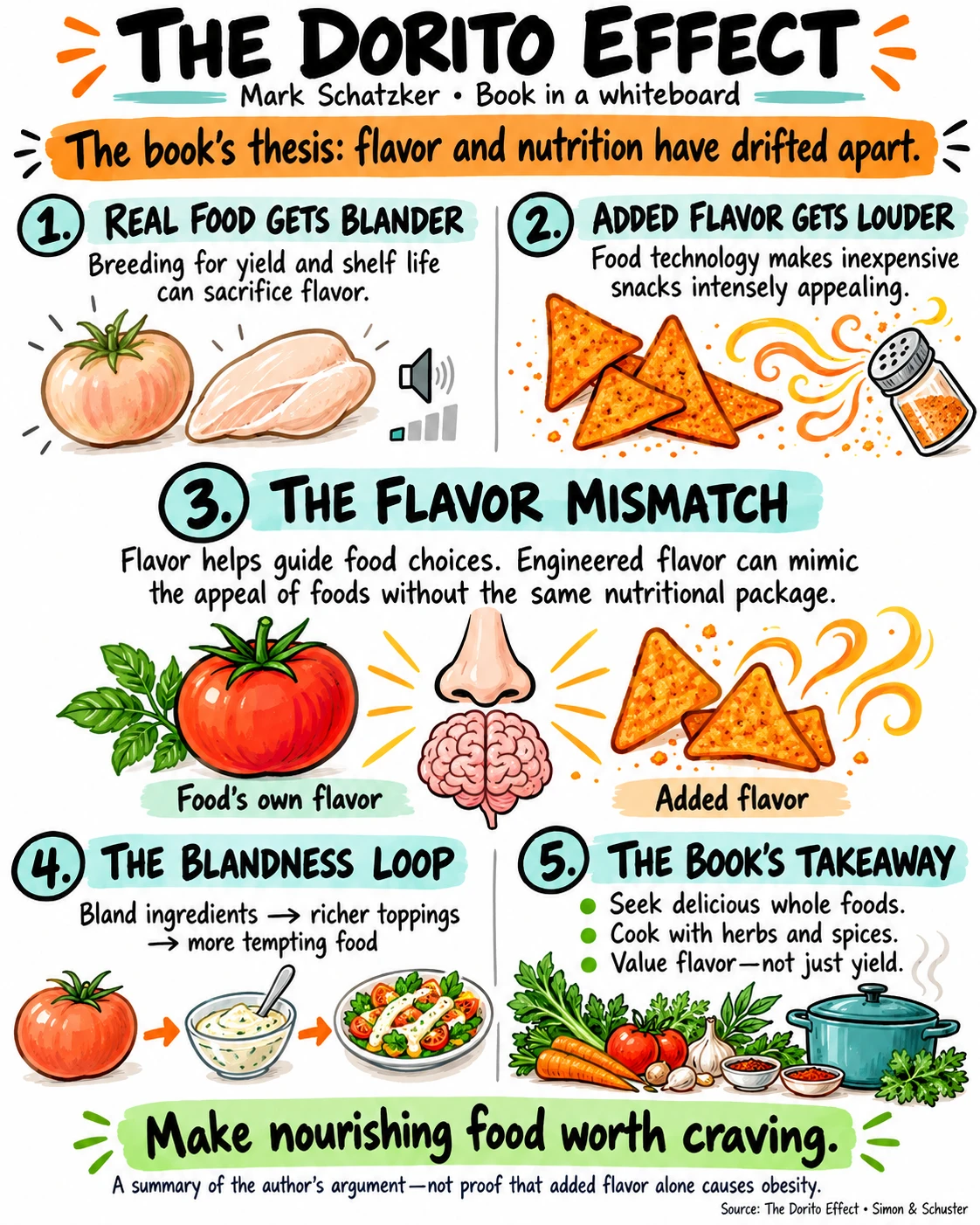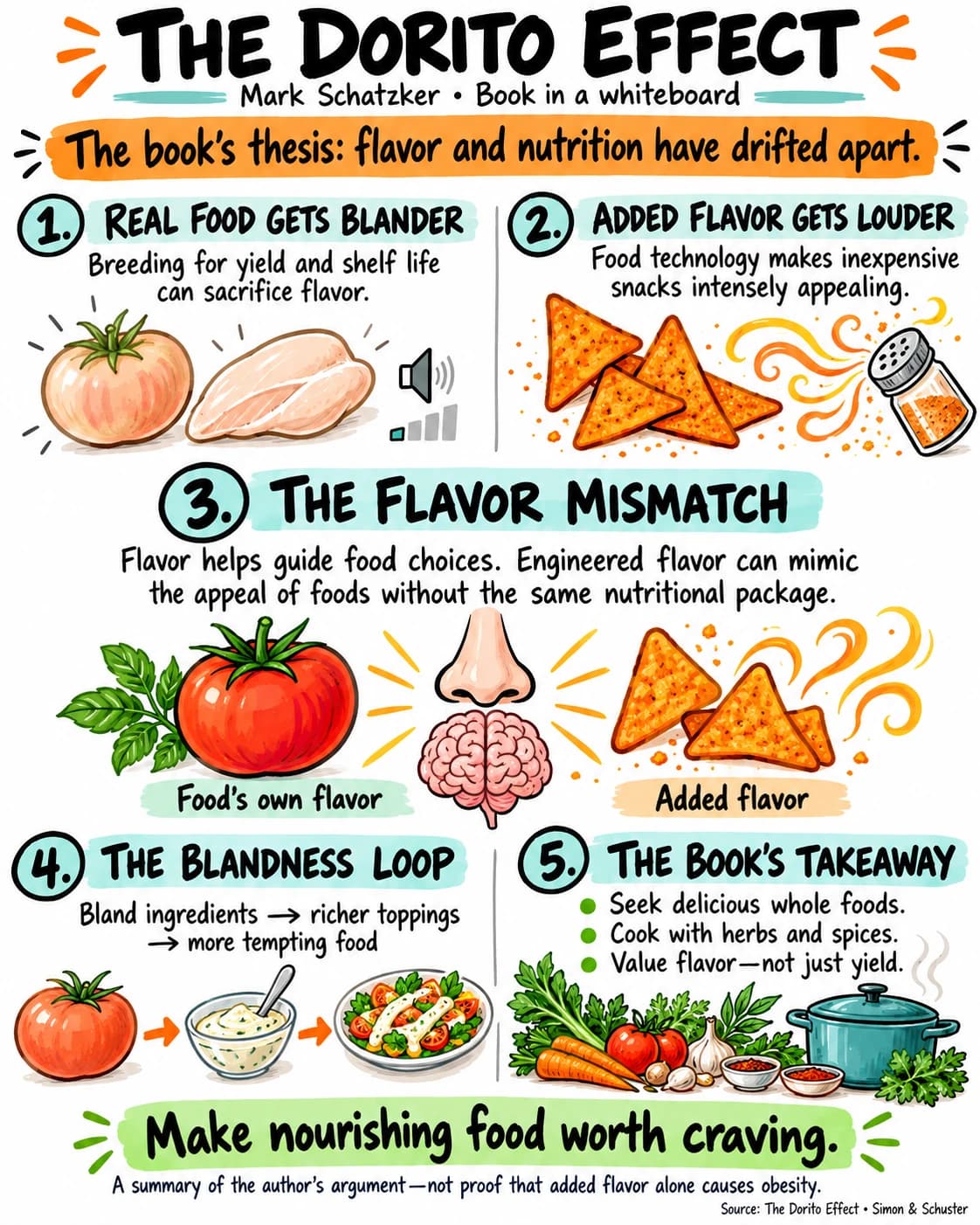
A plain-English summary of The Dorito Effect by Mark Schatzker
"The food problem is a flavor problem. For half a century, we've been making the stuff people should eat—fruits, vegetables, whole grains, unprocessed meats—incrementally less delicious."
Mark Schatzker, The Dorito Effect (Goodreads)
What you'll learn: why real food got bland, how fake flavor filled the gap, and one question to ask before you eat anything.
The shack near San Diego
In 1961, a snack company man named Arch West took his family on a trip to California.
His daughter told the story years later:
"we were near San Diego and he stumbled on some little shack where they were making some interesting kind of chip."
Jana Hacker, Arch West's daughter (Philadelphia Inquirer)
West loved it. His bosses at Frito-Lay didn't.
So he paid for the research with money that, in his daughter's words, "the bigwigs didn't know about." The result was Doritos, the first tortilla chip sold across America.
Then came the dust: taco flavor on a chip with no taco in it.
For the first time, a food could taste like anything, no matter what it was made of. Mark Schatzker thinks that moment explains your kitchen today.
What the Dorito Effect is
Schatzker is a food writer, not a scientist. His definition fits in one line:
"The Dorito Effect, very simply, is what happens when food gets blander and flavor technology gets better."
Mark Schatzker, The Dorito Effect (Goodreads)
Farm food lost its taste. Factory food gained one.
I think this is the kindest idea in the book. We didn't start craving junk because we got weak. The good stuff stopped tasting good.
Action item: Tonight, eat one bite of your chicken or tomato with nothing on it. No salt, no sauce. What does it taste like?
If the answer is "not much," here's why.
The chicken that grew up too fast
In 1925, a meat chicken took 112 days to reach market. By 1995 it took 47. Today's bird also weighs more than twice as much (National Chicken Council).
That's a win for price. I think Schatzker is right that it's a loss for your tongue. In one interview he said modern chickens "taste like cardboard" (Boston Globe).
So we bread it, brine it, and drown it in sauce.
The seasoning isn't there to improve the chicken. It's there to replace it.
Action item: Next time you buy chicken, ask the farmer or butcher how old the bird was. Schatzker's tip: "Look for anything older than ten weeks old" (Technoskeptic).
Chicken wasn't the only thing that got watered down.
The tomato that forgot how to taste
Tomatoes were bred to give big harvests, fight disease, and last on a truck. Nobody picked them for taste.
Schatzker sums it up: "by not selecting flavor, we've lost flavor" (Technoskeptic).
Did the nutrients drop too? One study compared 43 garden crops in 1950 and 1999. Six nutrients fell as a group. The drops ran from 6 percent for protein to 38 percent for riboflavin, a B vitamin (Davis and colleagues).
A fair warning: the same study says the numbers for any single vegetable are shaky. The trend is the story.
A big, pretty, bland tomato is mostly a red water balloon.
Action item: Buy one tomato from a farm stand and one from the supermarket. Taste them side by side.
Bland food is a hard sell. Then help arrived.
The lab that filled the gap
In 1955, a new machine went on sale. It could take a food apart and list the chemicals behind its taste and smell (Boston Globe).
With that list, you can make the taste without the food.
Schatzker again: "Almost overnight, flavor was determined by the folks who were working in marketing" (Boston Globe).
The first Doritos had 11 ingredients. One newer flavor lists 34 (Wall Street Journal review, via Washington Examiner).
And "natural flavors" on a label? Schatzker says they're often the same chemicals as the fake ones. Only the way they're made differs.
Flavor used to be a promise from the food. Now it's a coat of paint.
Action item: Read the label on your favorite snack. Count the ingredients. Circle the word "flavor" every time it shows up.
Why does this matter beyond taste? Ask a goat.
What goats know that we forgot
A scientist named Fred Provenza spent years watching goats and sheep pick their food.
In one test, goats ate pellets laced with a harsh plant chemical. The next day they refused them. Their bodies had sent a message: that one made us feel bad (Cornell Small Farms).
It works the other way too. Lambs learned to like flavors that came with real energy.
So flavor is a label the body learns to read. This taste means this food did me good. Schatzker's rule:
"In nature, flavor never appears without nutrition."
Mark Schatzker, The Dorito Effect (Goodreads)
Now break that link. Put a taco label on corn and oil. What happens to an animal that trusts its tongue?
"Are humans nutritional idiots? Our palates aren't just out of tune with our bodily needs. Our palates are out to kill us."
Mark Schatzker, The Dorito Effect (Goodreads)
We're not idiots. We're goats reading forged labels.
Action item: Notice the next food you can't stop eating. Ask if you feel full after, or only done.
You can't check every chemical. You can ask one question.
The one-question test
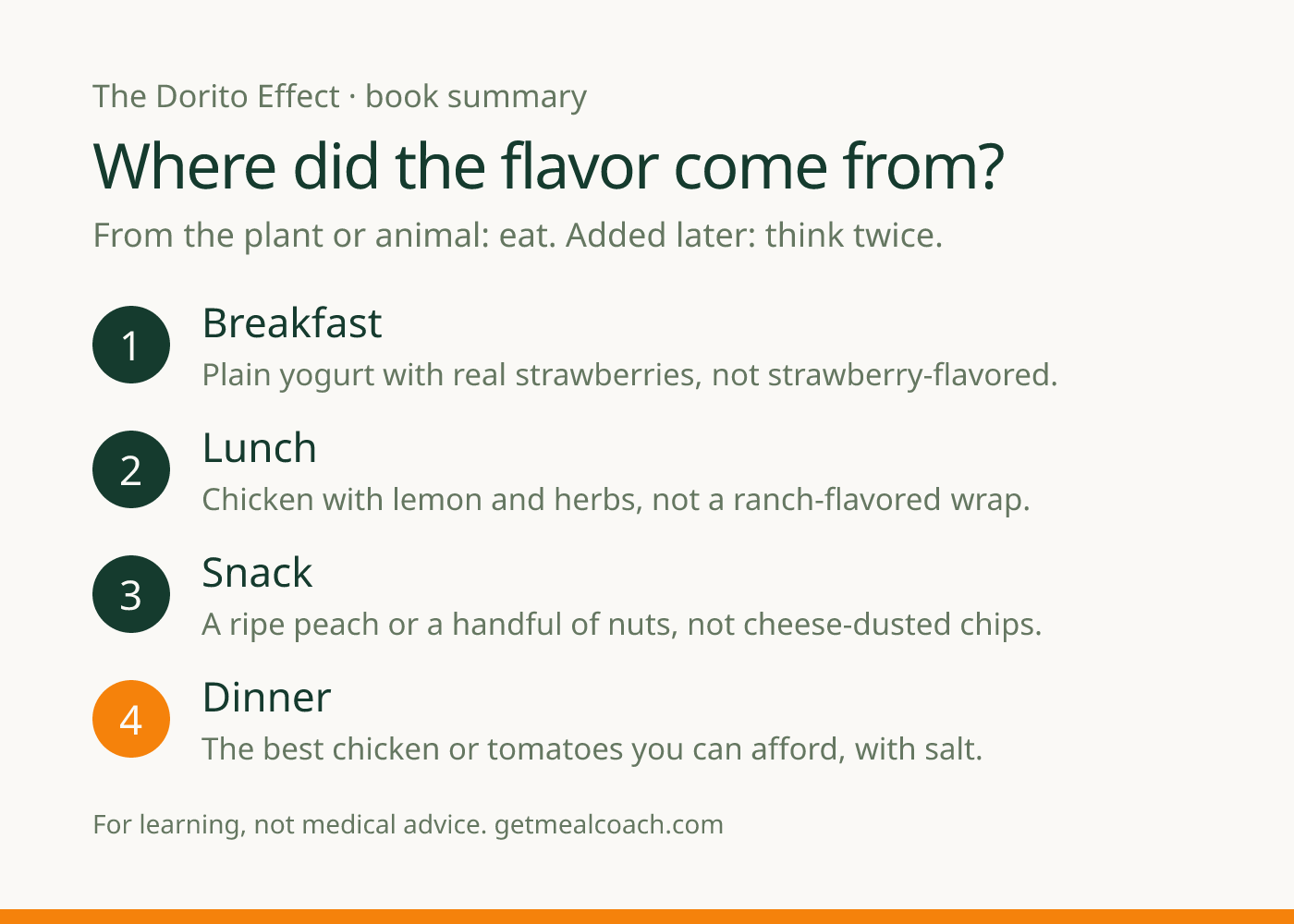
Before you eat, ask the book's question: "Where did the flavor come from?" (Goodreads)
If it came from the plant or the animal, eat. If someone added it later, think twice. Here's how that plays out on a normal day.
 View full-size illustration
Breakfast. Strawberry yogurt gets its taste from added flavor. Plain yogurt with real strawberries gets it from the fruit.
Lunch. A ranch-flavored wrap fails. Chicken with lemon and herbs passes. Herbs are plants.
Snack. Cheese-dusted chips fail. A ripe peach or a handful of nuts passes.
Dinner. Buy the best chicken or tomatoes you can afford. Cook them with salt and little else.
I like that this test bans nothing by name. It makes you look.
On labels, watch for "natural flavor." The book lists it among the words that mean the smell was added (Goodreads).
Action item: Run the test on three things in your fridge right now. Move the ones that fail to a back shelf.
It isn't always that simple, and the book doesn't admit it enough.
Where the book falls short
I enjoyed The Dorito Effect. It still has holes.
It's light on fixes. One fact-checker found the book's claims "extremely trustworthy." She also warned it's "light on solutions, so you might just freak yourself out to no purpose" (Epistemic Spot Check).
Good food costs more. Schatzker's own advice on pastured meat starts with the words "It costs more" (Goodreads). A slow-grown chicken isn't in everyone's budget.
"Blander" is hard to prove. You can measure a chicken's age. You can't easily measure how a 1950 tomato tasted.
Flavor isn't the only cause. I'd add price, ads, stress and sleep. They push us to overeat too.
My take: read it for the idea, then do the cheap parts first.
Is a 2015 book about chips still worth it? A 2025 trial says the idea aged well.
Why the Dorito Effect matters now
In August 2025, researchers in London published a diet trial in Nature Medicine. They gave 55 adults two diets, eight weeks each (ScienceDaily).
One diet was factory-made food, the other home-style. Both followed the same healthy-eating rules, and people ate as much as they liked.
On the home-style diet, people lost 2.06 percent of their weight. On the factory diet, 1.05 percent. Their control over cravings improved about twice as much (ScienceDaily).
The trial didn't test flavor alone, so it's no proof of the book. But same nutrients, different food, different result is what Schatzker would have bet on.
What you get from this
✅ You know why your chicken needs so much sauce
✅ You can spot added flavor on a label in five seconds
✅ You have one question that works in any store
Short on time? Here's the whole post in six lines.
The 5-Minute Version
The Dorito Effect: real food got blander while fake flavor got better.
Chickens reach market in under half the time they did in 1925. Faster birds taste of less.
Crops bred for size and shelf life lost taste, and some nutrients too.
Labs learned to copy flavors, so corn and oil can taste like a taco.
Goats learn which flavors mean good food. Fake flavor forges that signal.
Before you eat, ask where the flavor came from.
One man's chip sums it up.
Conclusion
Arch West found a chip in a shack and fought his bosses to sell it. He wasn't a villain. He made something tasty.
But his chip proved a point that changed everything. Flavor could be cut loose from food. Once that happened, our tongues stopped being a guide we could trust.
That's the Dorito Effect. You can't fix the whole food system. You can ask one question at your own table.
Tonight, taste one plain bite before you season it.
What's a food from your childhood that doesn't taste the way it used to?
This post is for learning, not medical advice. Talk to your doctor before you change your diet for a health condition.
 MealCoach