A plain-English summary of The Every-Other-Day Diet by Krista Varady, PhD, with Bill Gottlieb (2013)
Reading time: about 6 minutes
What you'll get: the book's rules on one page, what the best later research found, and a quick way to tell if the plan fits your life.
The promise: half the days on, half the days off
Most diets ask for willpower every single day. By day ten, the cookie in the break room feels personal.
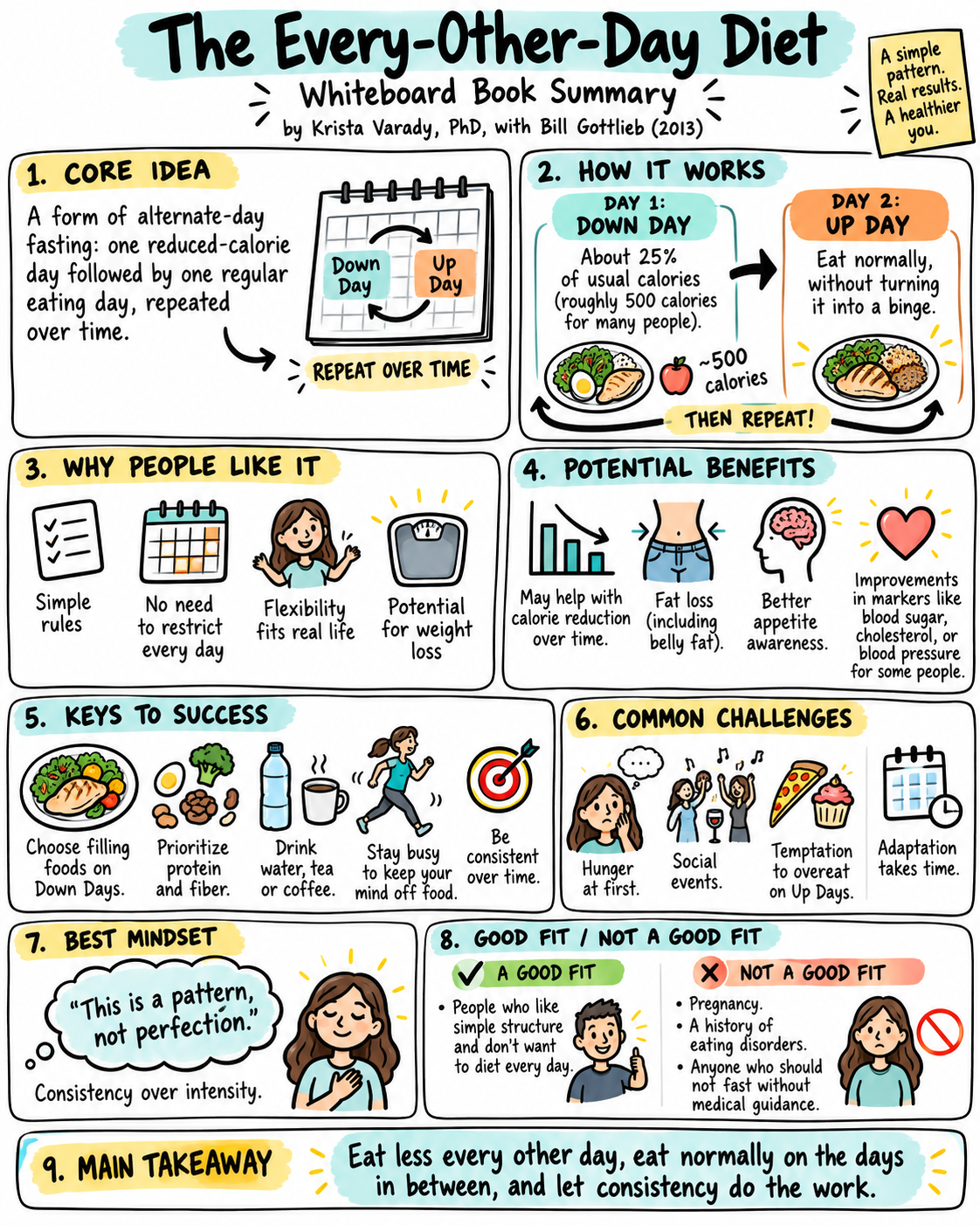
The Every-Other-Day Diet offers a different deal. Eat very little one day. The next day, the publisher says, "eat anything you want and as much as you want" (Apple Books listing). Repeat.
It sounds too good to be true. So what happened when scientists tested it for a full year?
It started with a new mom who found dieting hard
Krista Varady is a nutrition scientist at the University of Illinois Chicago.
After she had a baby, she tried a standard diet that cut calories every day.
“A calorie restriction diet was really hard,”
— Krista Varady, UIC Today in 2013.
At the time, she was a postdoctoral researcher (a scientist in training) at UC Berkeley, where a strict fasting plan had been tested. People didn't like it. So she asked a practical question. What if the fast day still had one small meal?
That change became the core of her research and this book. In an interview, she said that after about a week, eating 500 calories every other day stopped being hard for her (interview transcript).
But one person's week isn't proof.
The Every-Other-Day Diet rules fit on a sticky note
- Diet Day: about 500 calories, eaten as one meal, at lunch or dinner. Varady has said splitting it into small snacks works worse (interview transcript).
- Feast Day: eat what you want. No counting.
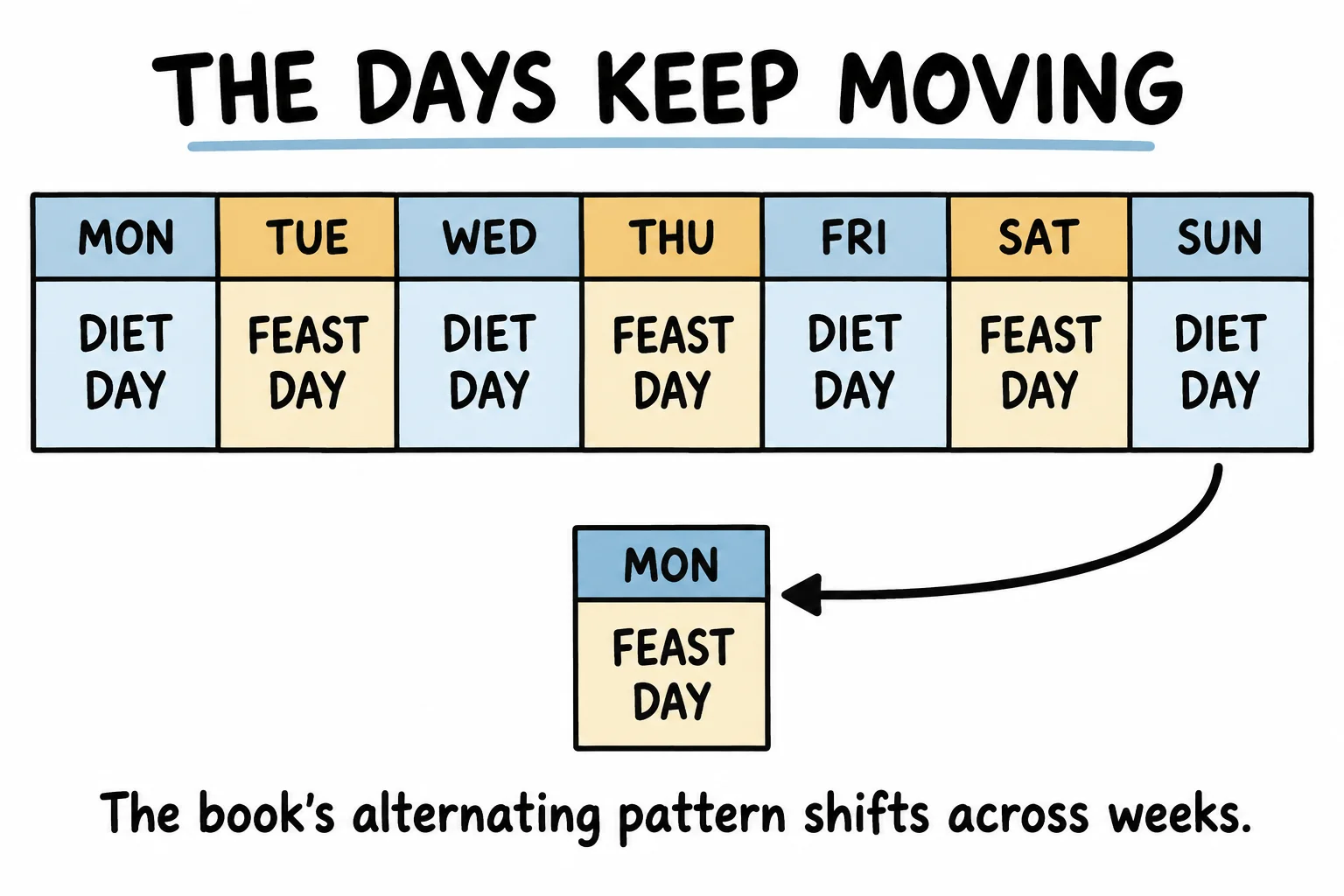
- Repeat: you alternate, so Diet Days move around the week.
- After you lose the weight: a maintenance phase, the "Success Plan," eases the Diet Days (publisher description).
The book adds more than 80 Diet Day recipes and tips for hunger, exercise and social events.
The whole plan rests on one bet: that a Feast Day won't cancel out a Diet Day.
Try this: before you change anything, write down what you ate yesterday. You'll need a normal day to compare against.
The surprising part: people didn't binge
You'd expect a free day after a 500-calorie day to become a pizza marathon. Varady says it mostly doesn't. In her studies, people ate only about 10% more than usual on Feast Days (interview transcript).
In one 2013 study, 32 adults of normal weight or overweight were randomized for 12 weeks. On fast days, they ate one lunch with a quarter of their daily calorie needs.
- They lost about 5 kg (11 pounds) more than a control group.
- Most of the loss was fat. Their lean mass, like muscle, held steady.
- Hunger didn't rise, and they felt fuller.
But 32 people for three months is a small, short test. What happens with more people, for longer, against a normal diet?
The big test: a full year, head to head
In 2017, a team including Varady ran that test, published in JAMA Internal Medicine.
They split 100 adults with obesity into three groups for a year:
- Alternate-day fasting: one lunch with 25% of their calorie needs on fast days.
- Daily dieting: 75% of their calorie needs every day.
- No diet: a comparison group.
This wasn't quite the book's plan. Feast Days weren't "eat anything": people aimed for about 125% of their needs. After six months, fast days rose to half their needs and feast days to 150%. In the second half, dieters also met monthly with dietitians.
Did the fasting group win?
What the year showed: a tie, and more quitters
Here are the results from the full paper:
|
|
Fasting every other day |
Daily dieting |
|
Weight lost after 1 year (versus control) |
6.0% |
5.3% |
|
Quit the study |
38% |
29% |
The weight gap was too small to count.
The fasting group ate more than planned on fast days and less than planned on feast days. To me, that starts to look a lot like plain daily dieting. Their "bad" (LDL) cholesterol also rose compared with the daily dieters by the end.
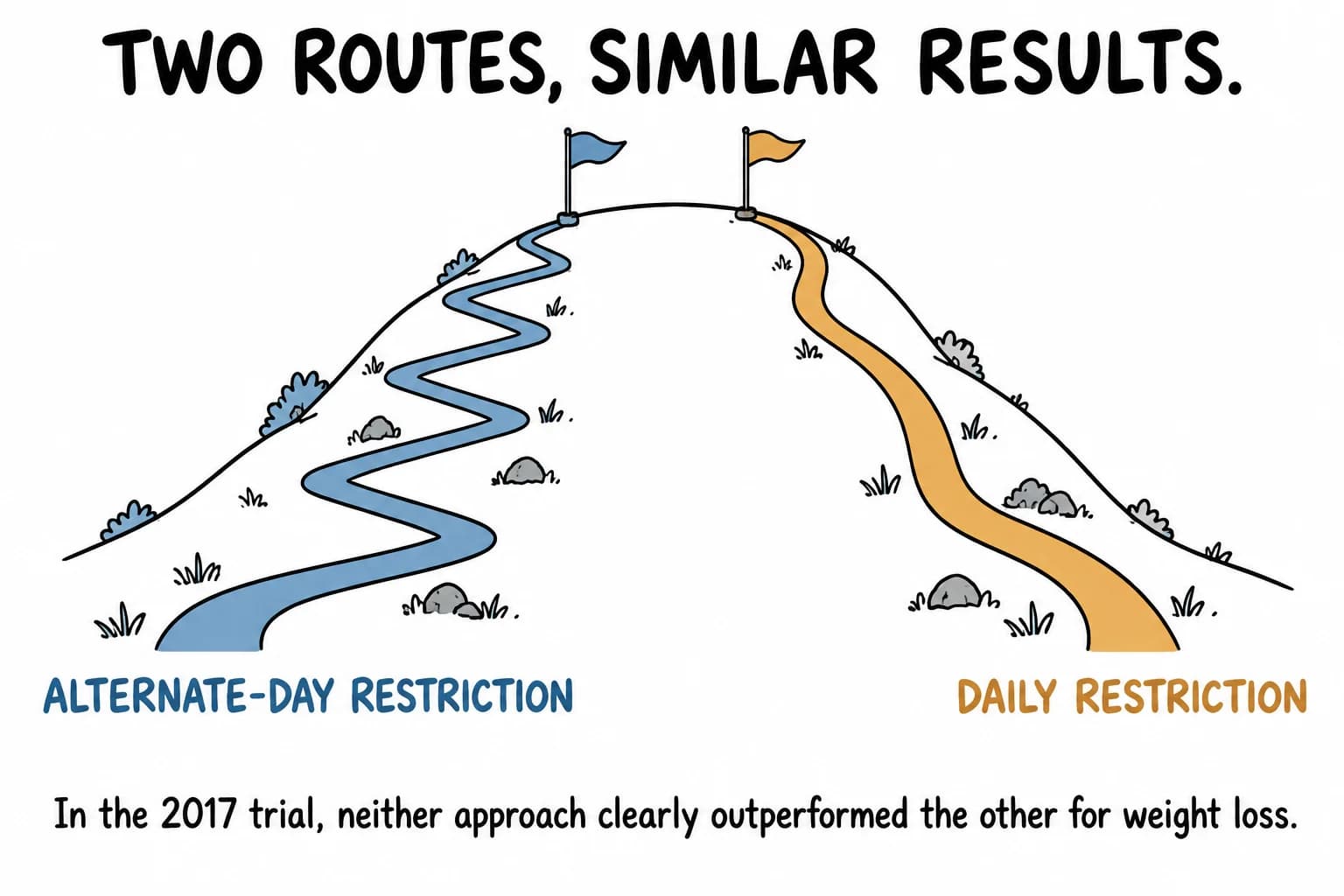
The fasting plan didn't beat a normal diet. It tied, and more people gave up.
Varady disclosed in the paper that she got an advance for this book. She still published a result that didn't flatter it. I respect that.
Try this: ask which is harder for you, one very small day or a little less every day. Your answer matters more than any average.
What the newest research adds
A 2025 review in The BMJ pooled 99 trials with 6,582 adults. Most trials were short, a median of 12 weeks.
Every-other-day fasting was the only fasting style that beat daily calorie cutting. But the edge was about 1.3 kg (under 3 pounds). That's below the 2 kg the researchers set as a meaningful difference, per the BMJ press release. It showed up mainly in shorter trials. The authors' bottom line: fasting diets have similar benefits to steady dieting.
A second 2025 trial, in the Annals of Internal Medicine, tested a cousin of this plan. Its 165 adults cut calories by about 80% on three days a week, never back to back. After a year, they'd lost 7.6% of their weight, versus 5% for daily dieters.
Both groups got gym memberships, exercise goals and group coaching. And it wasn't the book's plan.
The newer evidence agrees with 2017, with more data: this is a good tool, not a magic one.
Who should talk to a doctor first
In an NIDDK interview, Varady herself names groups who should be careful:
- Pregnant women. The 2024 interview notes that this group had not been studied.
- Anyone with a history of eating disorders. She says they shouldn't do fasting plans.
- People on insulin or certain diabetes pills. A doctor may need to adjust doses.
- Older adults. Weight loss can take muscle with it.
If that's you, don't start this alone.
My take: what the book gets right and what it oversells
What it gets right. It treats willpower like a daily budget. For some people, one hard day and one easy day beat seven medium days. And a one-meal Diet Day is simple to plan.
What it oversells. The publisher calls the diet "science-proven." The early studies were small and short. The best long test found a tie with ordinary dieting and more dropouts.
The book isn't wrong. It's early. The long trial came later and found no clear advantage.
A sample week on paper
|
Mon |
Tue |
Wed |
Thu |
Fri |
Sat |
Sun |
|
Diet Day |
Feast Day |
Diet Day |
Feast Day |
Diet Day |
Feast Day |
Diet Day |
The next week starts with a Feast Day, so your weekends keep changing.
Try this: hold that grid next to your real calendar. Circle every dinner out, birthday or work trip that lands on a Diet Day. My rule of thumb: if you circle three or more, this plan will fight your life.
The short version
- The plan: one meal of about 500 calories on Diet Days, normal eating on Feast Days, alternating.
- Early studies: small and short, but people lost weight and didn't binge.
- The year-long test: about the same weight loss as daily dieting, and more quitters.
- The 2025 review: a small edge, mostly in short trials.
- Be careful if: you're pregnant, have had an eating disorder, take diabetes medicine, or are older.
Is the Every-Other-Day Diet worth it?
It won't hand you a shortcut. It hands you a choice of rhythm. Some people find one hard day easier than seven so-so days. Others quit, like more than a third of the 2017 fasting group.
The best diet is the one you'll still be doing next spring. So take one step today: count the clashes on your calendar grid. That number will tell you more than the book's promise.
Which would you rather face: one hard day, or a little less every day?
This is a book summary, not medical advice. Talk to your doctor before you change how you eat.
 MealCoach