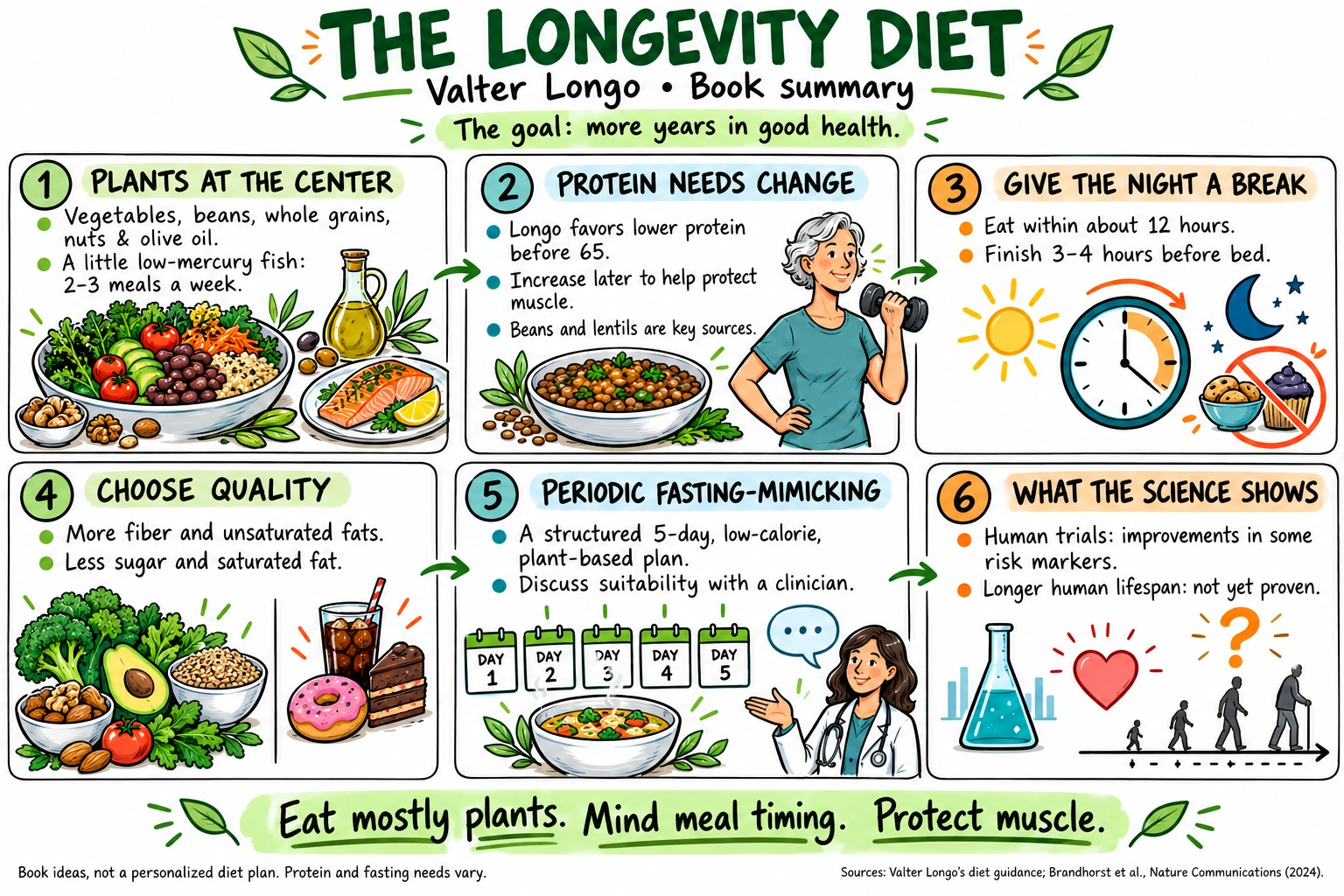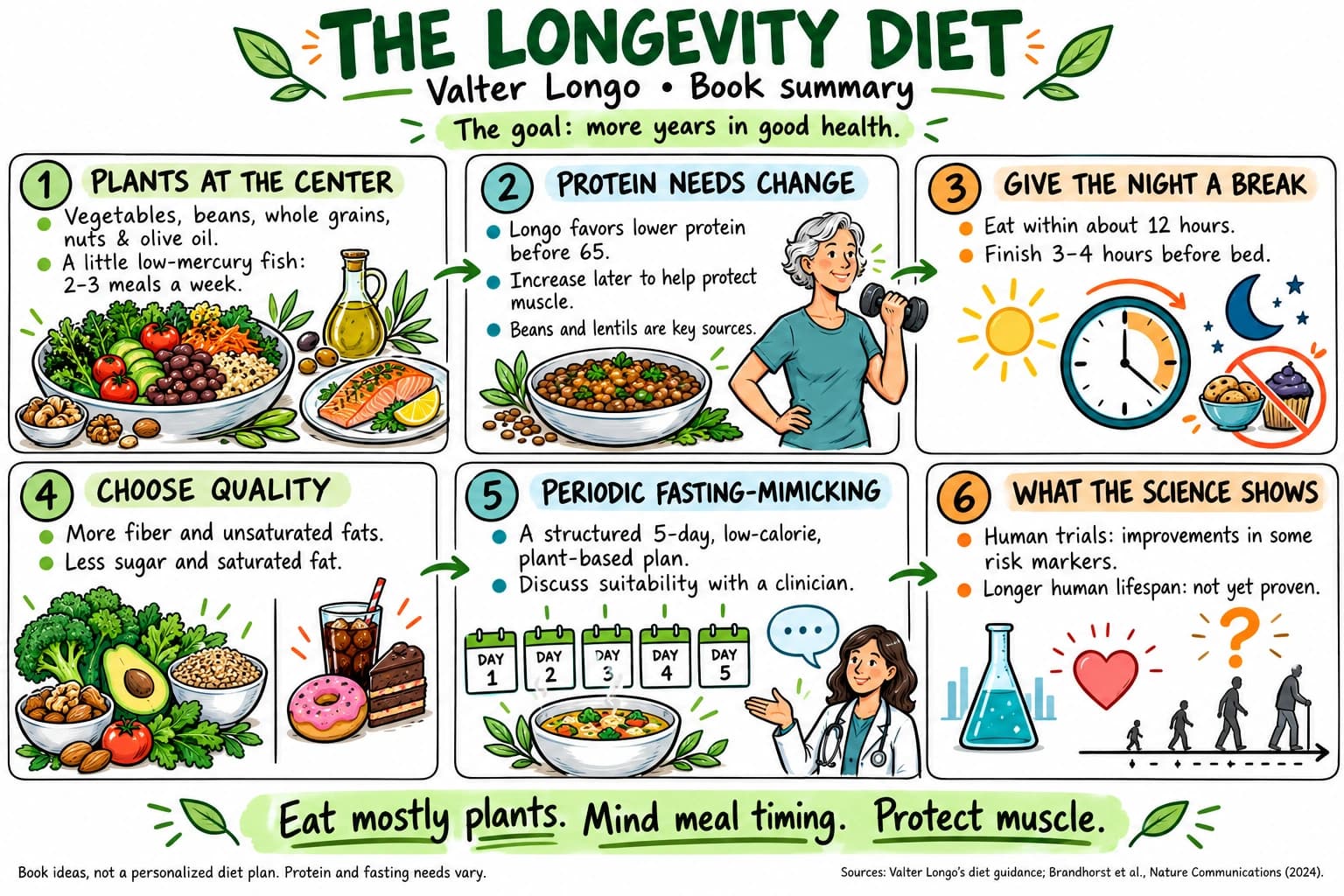
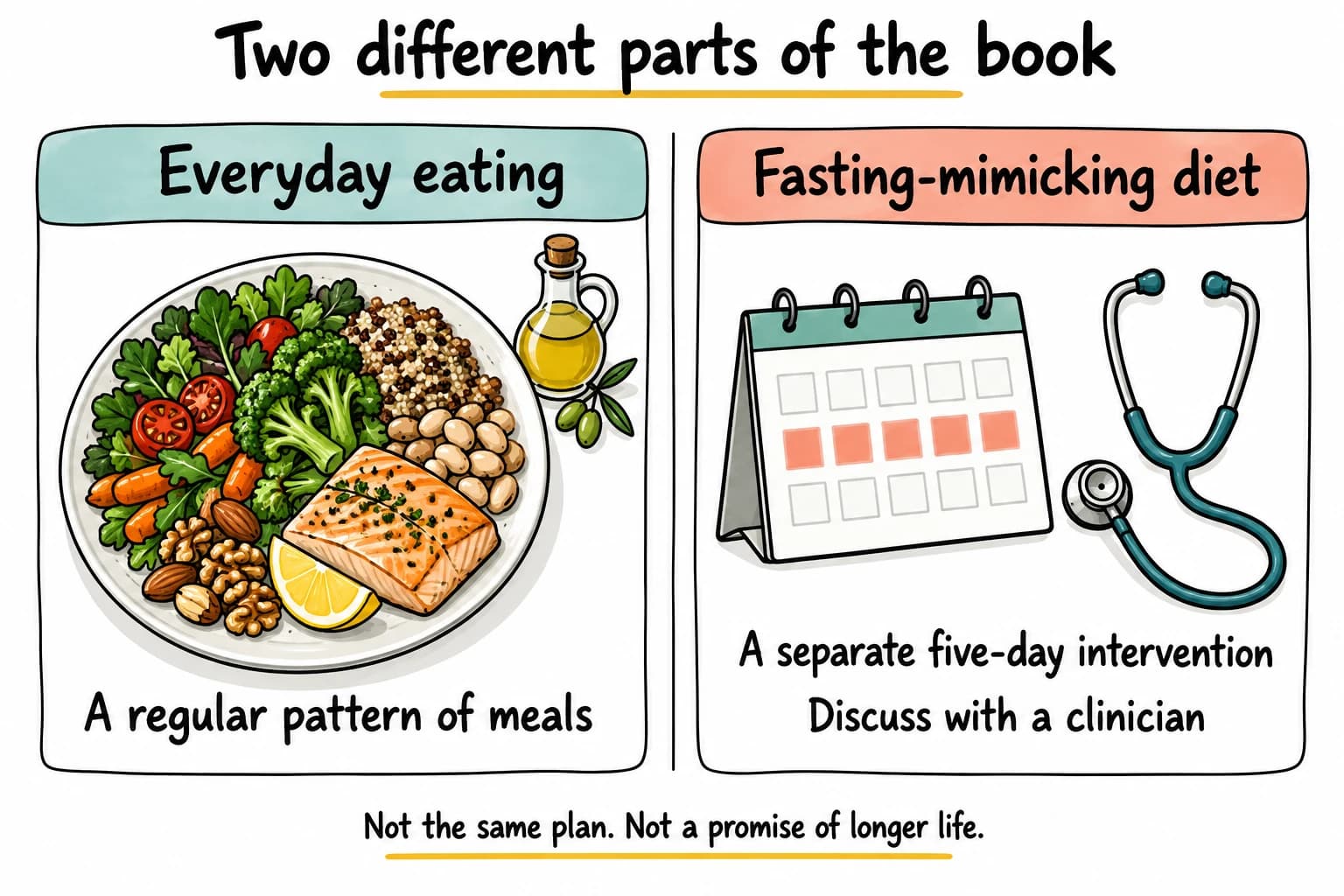
The five-day fasting plan grabs your attention. But there's more to The Longevity Diet than what happens during those five days. The other part is about the meals you eat the rest of the year.
Valter Longo's 2018 book brings those two ideas together. Here's what each one means, where the evidence is useful, and where the headlines get ahead of it. Research published after the book is included below.
1. The idea started in a small Italian town
Longo grew up in Italy and spent childhood summers in Molochio. It's a southern town with an unusual number of people who lived past 100, as STAT reported. That's where his interest in aging began. He went on to direct the Longevity Institute at the University of Southern California.
In the book, he proposes five lenses for judging a food idea. They are lab research, population studies, clinical trials, studies of very old people, and models of how the body works as a system.
These are his ways of weighing evidence, not five guarantees that a diet works. A result in a lab and a result in a person answer different questions.
“Having interviewed centenarians all over the world, I think the common denominator is not spirituality per se, but a sense of purpose, a will to live.”
From yeast to people
Longo's research asks a bigger question than “Which foods are healthy?” He wants to know how nutrients affect the signals that tell cells to grow, protect themselves and repair damage.
In early yeast experiments, his team found that changing certain growth-signaling genes made cells more resistant to stress and extended their lives. Later, he helped study people in Ecuador with growth hormone receptor deficiency. They had very low levels of IGF-1, a growth-related hormone, and unusually low rates of cancer and diabetes during follow-up.
Those findings helped shape his work on food and fasting. But a lifelong genetic condition isn't the same as changing your diet for five days. The connection is a research clue, not proof that a meal plan produces the same protection.
2. The everyday diet: mostly plants, a little fish
Here's the daily plan, in Longo's own summary. Eat mostly plants, with fish a couple of times a week. Build meals on vegetables, beans and whole grains. Use olive oil and nuts as your main fats. Go easy on sugar, meat and cheese. And favor foods your family has traditionally eaten.
Think lentil soup, vegetables with olive oil, or a bowl of beans and whole grains. This part doesn't require a special meal kit.
3. Protein needs change with age
One idea may surprise you: Longo doesn't suggest the same protein intake throughout adulthood. He favors a fairly modest amount in middle age and somewhat more after about 65, to help protect muscle.
A lot of this rests on a 2014 study Longo co-authored. It looked at US adults aged 50 and older and followed them for 18 years. Among people aged 50 to 65, higher protein intake went with higher death rates. After 65, the pattern flipped. The link was weaker when protein came from plants.
But this was observational. It tracked what people said they ate and what happened later. That shows a link, not a cause, and other experts pushed back when it came out.
Getting enough protein and nutrients matters at every age. Children, pregnant women, active people, older adults and anyone recovering from illness can need quite different amounts. This is one book's age-based view, not a target for everyone.
4. When you eat matters too
Longo suggests fitting your meals into about 12 hours a day, like 8 a.m. to 8 p.m. That leaves a 12-hour overnight fast. It's a daily routine, not a multi-day fast. He also says:
"Don’t eat anything within three to four hours of bedtime."
Valter Longo, Fondazione Valter Longo
That's Longo's suggested routine, not a rule that fits every life. Shift work, diabetes, and other health needs can change what's practical. If a clinician has given you a meal schedule, don't replace it with a rule from a book.
5. The fasting-mimicking diet is a separate, occasional tool
Now for the famous part. The fasting-mimicking diet (FMD) is a five-day, low-calorie, plant-based meal plan. It's designed to make your body respond as if it's fasting while you still eat some food. The book presents it as something done a few times a year, on top of the everyday diet. It's not a way to eat all the time.
“Mimicking” has a specific meaning here. The researchers designed the food to produce some of the blood changes seen during fasting: lower glucose and IGF-1, higher ketones, and changes in proteins that regulate growth signals. Ketones are fuel your body makes from fat. Providing some food and nutrients is meant to make the intervention more manageable than water-only fasting. It doesn't make the two identical.
“Reducing abdominal and liver fat. FMD pushes the body into a high fat-burning mode, mainly using abdominal/visceral fat but also liver fat, which are central to the promotion of diabetes and other diseases”
Where ProLon fits in
ProLon is L-Nutra's commercial five-day FMD kit, developed from this research. FMD is the dietary approach; ProLon is a branded way to deliver it. The kits contain measured portions of plant-based soups, bars, snacks, teas and supplements, rather than five days of ordinary meals with a few foods removed.
Buying ProLon isn't a requirement for following the book's everyday eating pattern. And an improvised low-calorie menu isn't automatically equivalent to the formula used in a trial.
What was the actual protocol?
Here are the numbers from the 2015 human pilot study. These describe a studied intervention, not a personal calorie prescription:
- Day 1: about 1,090 calories, with 10% of energy from protein, 56% from fat and 34% from carbohydrate.
- Days 2–5: 725 calories each day, with 9% from protein, 44% from fat and 47% from carbohydrate. These percentages describe calories, not food weight.
- After day 5: the restricted phase ends. ProLon's day-six guidance calls for a light transition back to food. Refeeding means returning to regular eating, not extending the fast or celebrating with a huge meal.
- Between cycles: participants in the 2017 trial returned to their usual diet for the rest of the month. They repeated the five-day phase monthly for three months. That was the trial schedule, not proof everyone needs monthly cycles indefinitely.
The formula has varied between studies. The 2017 paper reported about 4,600 kJ on day 1 and 3,000 kJ on days 2–5, with a different day-one nutrient split. Current products can differ too. So there isn't one calorie chart that describes every version of FMD or every ProLon kit.
Talk with a clinician before trying a multi-day fasting diet. It isn't a replacement for treatment. Fasting can be risky during pregnancy, with an eating-disorder history, or when taking medicines that lower blood sugar. The NIDDK explains why medical review matters; don't adjust medicines yourself to make a fasting plan fit.
6. Cell renewal is the idea. What does the research show?
Autophagy and regeneration aren't the same thing
Autophagy is a cell's recycling process. It breaks down worn-out or unneeded components so their materials can be reused. Regeneration means making replacement cells or restoring tissue. Stem cells, which can develop into specialized cells, can play a part in that second process.
The idea behind Longo's fasting-and-refeeding research is that a temporary shortage of nutrients changes growth and repair signals, then eating again supports rebuilding. Both phases matter. This isn't a claim that going without food for longer must work better.
In a 2014 study, Longo and colleagues linked prolonged fasting to changes in IGF-1 and PKA, a protein involved in cell signaling. They observed protection and renewal of blood-forming stem cells in mice. This was prolonged-fasting research, not proof that a retail ProLon kit rebuilds a person's immune system.
The 2015 FMD experiments reported signs of regeneration in mice and an increase in median lifespan from 25.5 to 28.3 months, about 11%. Maximum lifespan didn't increase. The mouse regimen also differed from the human five-day plan. That's important context for the book's phrase “cellular rejuvenation”: the animal findings are interesting, but don't establish whole-body rejuvenation in people.
Has anyone measured autophagy in people?
Yes, but the evidence is still early. A 2025 pilot trial assigned 30 healthy adults to ProLon, another FMD formula, or a control group. Researchers tested certain blood cells for autophagic flux, meaning how actively the recycling process was running.
The ProLon group showed results consistent with increased recycling activity after the intervention. The findings weren't consistent across every measurement and time point. This was a small, short trial sponsored by L-Nutra, and it wasn't led by Longo. It supports further research; it doesn't show that every organ was rejuvenated, or that people lived longer. There's no universal “autophagy starts now” clock established by this study.
What did Longo's human trials find?
In a 2017 trial, 100 generally healthy adults were randomly assigned to three monthly FMD cycles or to their usual diet. People in the usual-diet group were later offered the FMD too. The researchers reported reductions in weight, body fat, blood pressure and IGF-1, a growth-related hormone. More people dropped out of the FMD, though, and the study lasted only months.
A 2024 paper went further. It turned seven routine measures, like blood sugar, cholesterol and blood pressure, into a "biological age" score. In the 52 people who finished three cycles, the median score fell by about 2.5 years.
That's an estimate calculated from health markers, not 2.5 extra years of life. The authors caution against treating short-term changes as evidence of lifelong effects.
Longo also co-authored a 12-month trial in 100 adults with type 2 diabetes. Participants started with diet alone or metformin for blood-sugar control, and monthly FMD cycles were added to usual primary care. Compared with usual care alone, the FMD group had lower HbA1c, lower body weight and a lower medication-use score. L-Nutra helped fund the study. Participants were managed in medical care; this isn't a reason to reduce diabetes medicine yourself.
The broader results are mixed. A 2023 trial in adults with high blood pressure found similar weight loss with FMD cycles and a Mediterranean diet. A 2025 review of 11 trials found reductions in blood pressure and HbA1c, a measure of longer-term blood sugar, but no clear overall weight benefit. The studies varied, and longer-term clinical effects remain uncertain.
The book also asks us to look beyond body weight to where fat is stored:
“Having a waist circumference of more than 40 inches in men and 35 inches in women doubled the risk of premature death, compared with having a waist circumference of less than 33 inches in men and 27 inches in women.”
That's a comparison between groups, not a prediction for an individual. Observational research on waist size links larger waists with higher mortality; it doesn't establish that FMD prevents premature death.
7. Know who has a stake
L-Nutra supplied the fasting diet used in the 2017 and 2024 studies. Longo has disclosed financial ties to the company.
The 2024 paper's competing-interests statement says Longo and one co-author held shares, but didn't collect or analyze the data. USC could receive royalties from licensed intellectual property. It also says Longo's shares would be assigned to charities.
A 2025 correction to the Mediterranean-diet trial clarified that L-Nutra sponsored that study and disclosed Longo's equity and patents. These are dated disclosures, not a claim about his current holdings.
That doesn't make the research wrong. But it's worth knowing when you weigh the fasting chapters.
What I'd take from this book
The most useful starting point is the ordinary food: beans, vegetables, whole grains, and meals you can keep making. You don't have to sign up for a five-day intervention to explore that part of the book.
The harder question is whether the fasting plan extends human life. The research here doesn't answer that yet. You can find the ideas interesting without treating every promise as settled science.
If you want to try something this week, pick one of these:
- Cook one dinner built on beans, vegetables and olive oil.
- Notice when you usually finish eating at night, and whether late snacks are a habit you'd like to change.
- Next time a diet headline grabs you, ask: was this tested in people, and who paid for it?
Which one would you start with?
 MealCoach