 MealCoach
“The real culprits in most modern-day health problems are excesses, not deficiencies.”
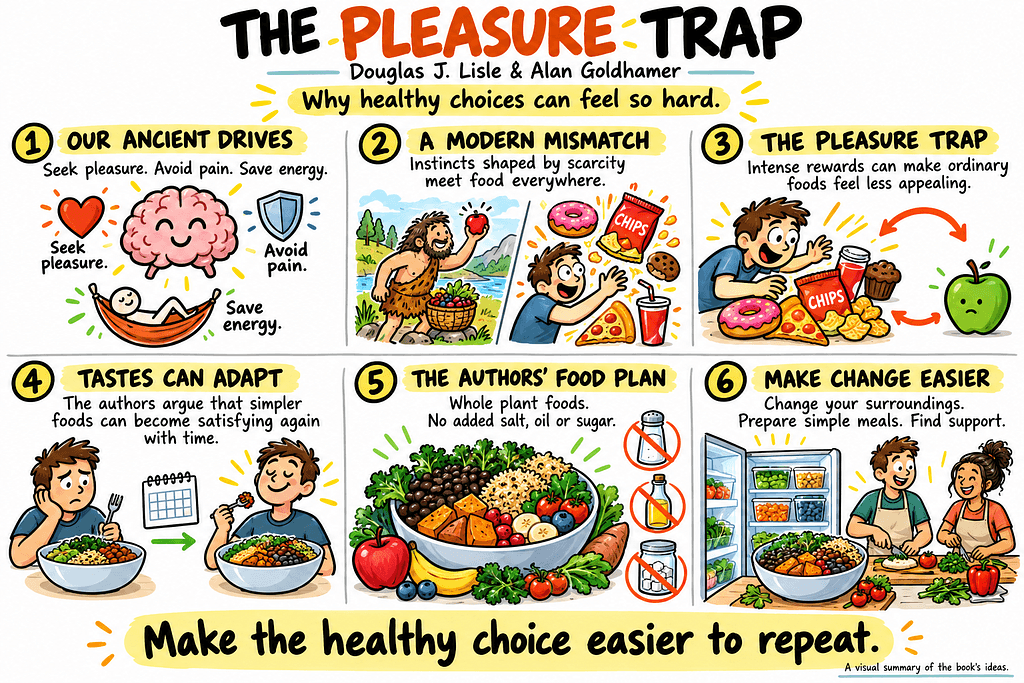
In this post you’ll learn why salad feels like punishment, why you’re still hungry after “being good,” and the 3-week reset that makes real food taste good again. This is my summary of The Pleasure Trap, the book that finally explained my cravings without blaming me for them.
You’re Not Lazy. You’re Outgunned.
Monday: you meal-prep kale. Tuesday: you eat it with the joy of someone doing their taxes. Wednesday: you’re standing in the pantry at 10pm, holding a sleeve of crackers, and you don’t know how you got there.
Thursday: you decide you “just don’t have the discipline.”
My opponent in this post is the willpower myth, the idea that you eat badly because something is wrong with you.
It’s wrong. The Pleasure Trap argues that your instincts are working perfectly. They’re just working in a world they were never built for. You’re bringing a caveman’s appetite to a food fight with engineered snacks.
Lesson 1: The Motivational Triad Runs Your Life
In The Pleasure Trap, Lisle and Goldhamer boil every animal down to three instincts, which they call the motivational triad:
- Seek pleasure (food, sex, status)
- Avoid pain (danger, rejection)
- Conserve energy (don’t move unless you must)
For most of history, this was a brilliant operating system. As the authors put it, “We come from ancestors who foraged, hunted, and sometimes even scavenged.” Calories were rare, so wanting them desperately kept you alive.
Now the calories are free, everywhere, and delivered to your couch. Your triad is a guard dog trained to bark at wolves, and now the doorbell rings every five minutes.
Action item: The next time a craving hits, name which part of the triad is talking: pleasure, pain, or energy. Naming it takes 3 seconds and breaks autopilot.
Lesson 2: Your “Full” Gauge Is Being Hacked
This is the most useful part of the book for me. Your body decides you’ve eaten enough using two sensors:
- Stretch receptors: “How much is in the stomach?”
- Nutrient receptors: “How many calories came in?”
Whole foods keep the two in sync. A big bowl of potatoes, beans, and vegetables fills you up before it overloads you on calories.
Processed food smuggles calories past the checkpoint. Oil, sugar, and refined flour pack a lot of fuel into very little volume. Think of it as a fuel gauge built for a Honda Civic that someone keeps filling with rocket fuel.
The authors’ takeaway: “The secret lies in what we eat, not in how much.”
Action item: At your next meal, fill half the plate with something bulky and water-rich (vegetables, fruit, potatoes, beans) before anything else goes on it.
Lesson 3: The Actual Trap, or Why Healthy Food Tastes Like Cardboard
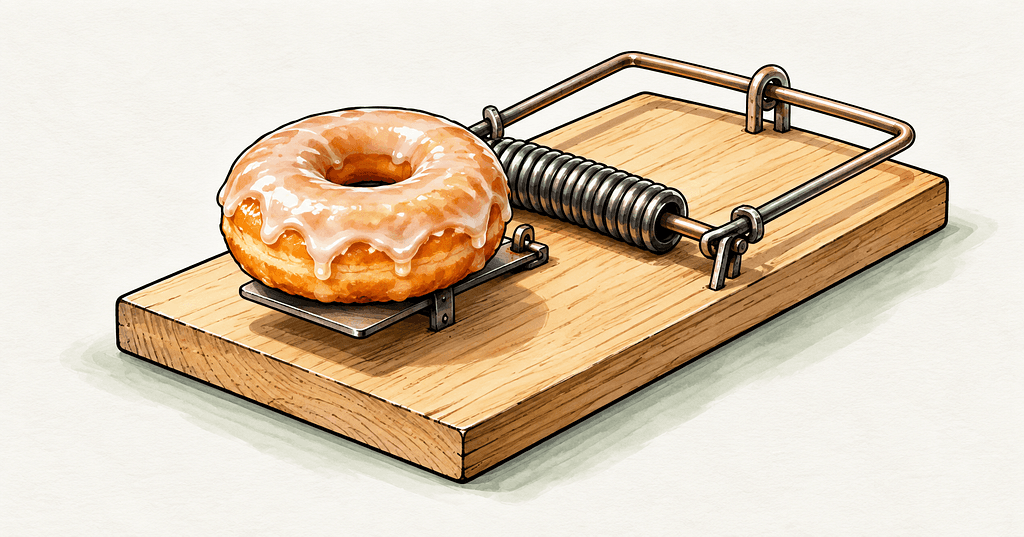
Here’s the idea the book is named after, and it’s brutal.
Your pleasure meter recalibrates. Eat intensely salty, sweet, and oily food often enough and that becomes “normal.” Against that baseline, an apple tastes like a wet sponge’s opinion of an apple.
So when you switch to healthy food, you get hit twice:
- The good food tastes flat.
- You still crave the old stuff.
That’s the trap: the discomfort feels like proof that healthy eating “doesn’t work for you.” It’s not proof. It’s withdrawal.
Action item: Stop judging a new way of eating in week one. Write “Taste resets take weeks, not days” on a sticky note and put it on the fridge.
Lesson 4: How to Escape the Pleasure Trap (It’s Boring, and It Works)
Good news: adaptation runs both ways. Pull back on the hyper-stimulating stuff and your palate slowly re-tunes. Given a few weeks, fruit starts tasting like dessert again.
The book’s approach, in brief:
- Eat whole foods (vegetables, fruit, whole grains, legumes)
- Cut added salt, oil, and sugar, the three main levers pushing your baseline up
- Ride out the adjustment dip instead of reading it as failure
“Your health is largely in your own hands and no one else’s.”
The authors run TrueNorth Health Center, which also uses medically supervised water fasting as a faster reset. That part is strictly doctor-supervised territory. Don’t freestyle it.
Action item: Pick one of salt, oil, or sugar and cut the added version for the next 7 days. Just one. You’re testing the idea, not taking a vow.
Lesson 5: The Pleasure Trap Isn’t Just on Your Plate
Once you see the motivational triad, you can’t unsee it.
Anything that artificially spikes pleasure raises your baseline and makes normal life feel dull: doomscrolling, notifications, stimulants, endless autoplay. Your phone is a snack drawer that never closes.
In my opinion, this is why the book has aged so well. It was written in 2003 about food, and it reads like a manual for the attention economy. It also lands right in the middle of today’s ultra-processed food debate, and it explains why appetite drugs like GLP-1s feel like a revelation to so many people.
Action item: Pick one high-stimulation habit (not food) and give it a 24-hour break. Notice whether ordinary things feel a little brighter by tomorrow.
The Benefit: Life Outside the Pleasure Trap
✅ Fruit tastes sweet, like it’s supposed to
✅ You’re full after meals, not fighting your stomach an hour later
✅ Cravings get quieter instead of louder
✅ You stop blaming yourself and start adjusting your environment
✅ You spot the same trap in your phone, your inbox, and your pantry
The 5-Minute Version (Steal This)
- Your instincts aren’t broken: they’re built for scarcity, and you live in abundance.
- Processed food sneaks calories past your “full” sensors. Eat bulky whole foods first.
- Your taste buds adapt. Healthy food tastes bland at first because your baseline is inflated.
- Cut added salt, oil, or sugar and give it a few weeks. The dip is temporary.
- Same trap, different bait: it applies to screens and stimulants too.