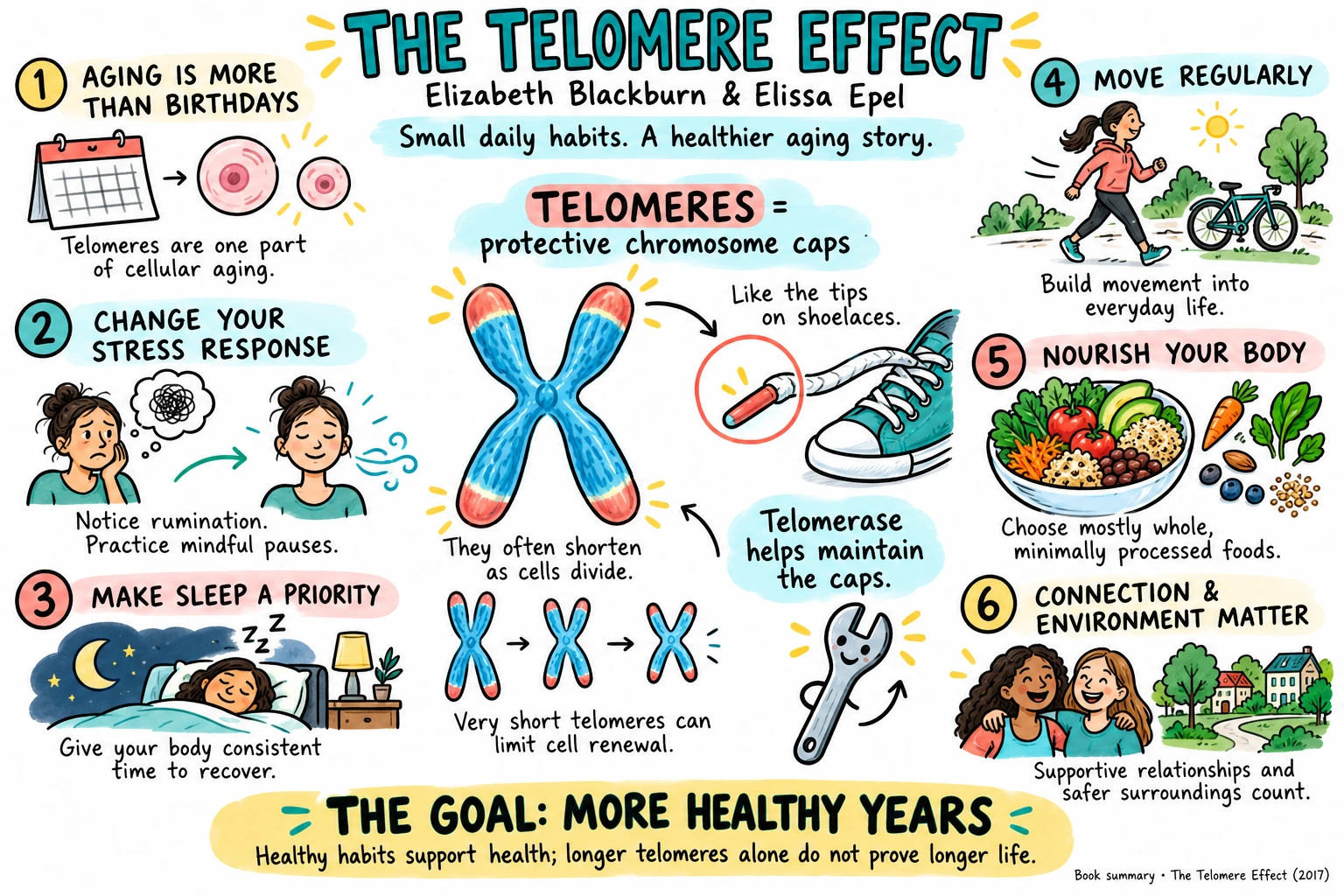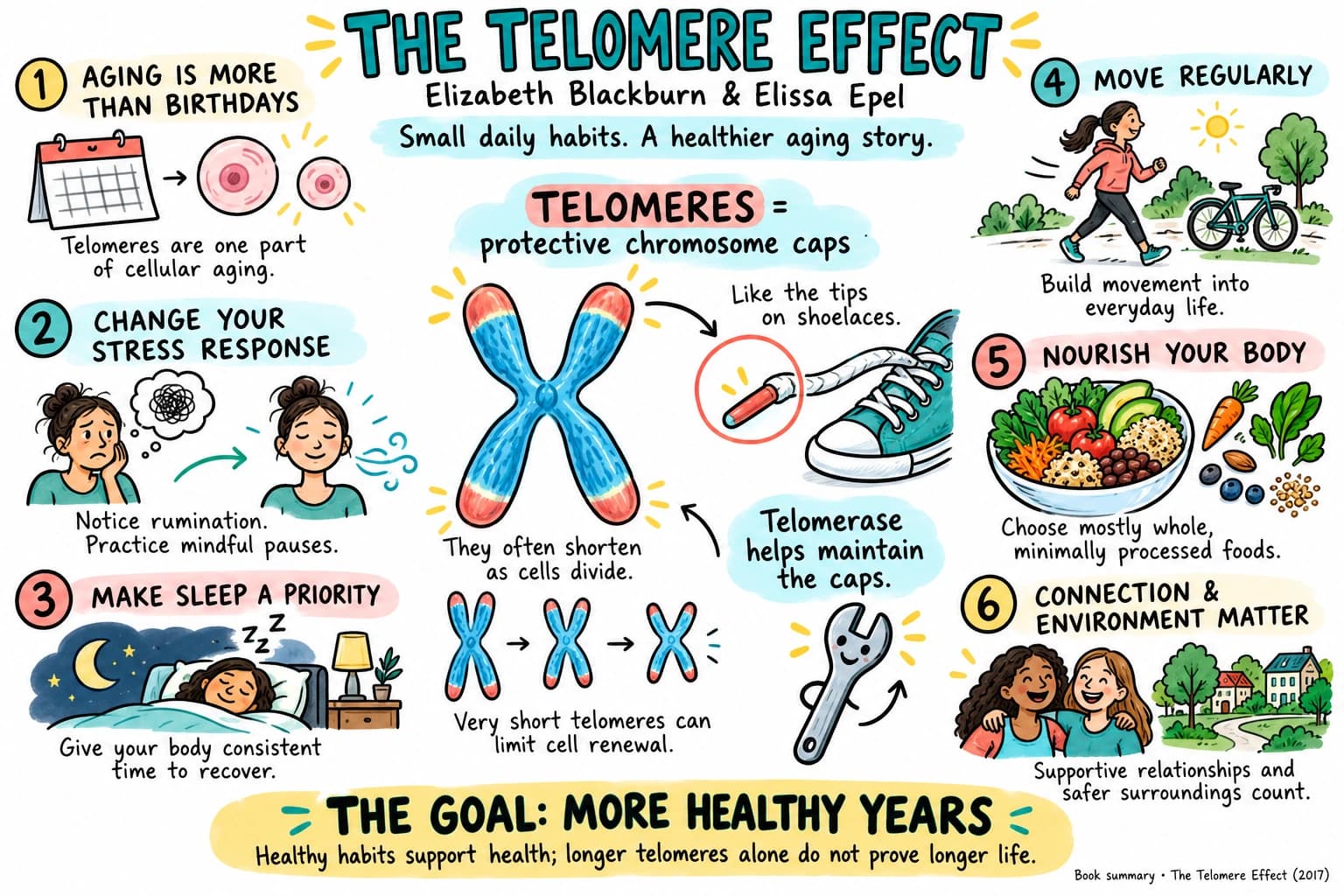
Why do people of the same age seem to age differently? That question drives The Telomere Effect, published in 2017. The authors explore tiny caps at the ends of your chromosomes. But those caps are only part of the story, and there's a twist in lesson 6.
1. Telomeres are the caps that protect your DNA
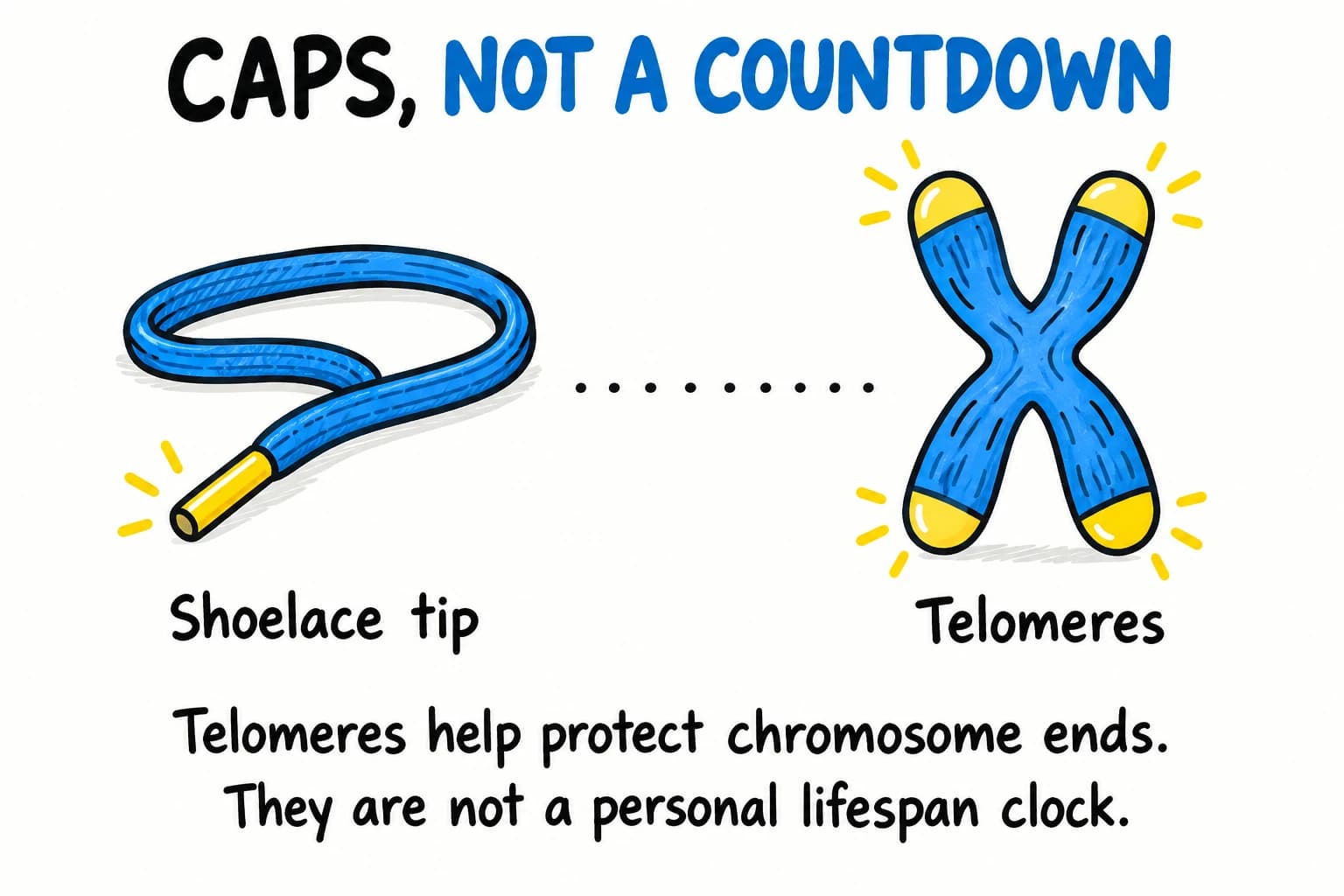
Think of the plastic tip on a shoelace. Without it, the lace frays.
Your chromosomes (the tightly packed bundles that hold your DNA) have tips like that. They're called telomeres. Each time many of your cells divide, those tips can get a little shorter. When they get too short, the cell stops dividing or stops working well.
Your body also makes a helper enzyme called telomerase. It can add length back to the tips.
Blackburn shared the 2009 Nobel Prize in medicine for discovering how telomeres and telomerase protect chromosomes. Epel is a health psychologist who studies stress.
Together, they make the book's big argument: how you live may be linked to what happens at the tips of your chromosomes.
Try this: Write down one habit you want to protect this week. Keep it in mind as you read.
2. The mothers study: what it found, and what it didn't
One early study by Epel, Blackburn and colleagues looked at 58 healthy mothers in 2004. Thirty-nine were caring for a chronically ill child. Nineteen were not.
Here's the part that's easy to miss. As a group, the caregivers did not have shorter telomeres than the other mothers.
Two other patterns showed up instead:
- Among caregivers, more years of caregiving went with shorter telomeres.
- Across all 58 women, those who reported the most stress had shorter telomeres and lower telomerase than those who reported the least.
And the fine print belongs right here: this was a one-time snapshot. It shows a link, not proof that stress caused shorter telomeres. The authors themselves called for studies that follow people over time.
Try this: If you're caring for someone right now, the lesson isn't "stress less." It's "get backup." Ask one person to take one task off your plate this week.
3. Stress isn't a personal failing, and the link is small
Here's my take: the worst way to read this book is to feel guilty for being stressed.
A 2016 review that Epel co-authored pooled 22 studies with nearly 9,000 people. Stress and telomere length were linked, but only very weakly. The authors also warned that the link may be inflated by which studies got published.
So what helps? The book leans on recovery and on how you see a stressor.
“Several mind-body techniques, including meditation and Qigong, have been shown to reduce stress and to increase telomerase, the enzyme that replenishes telomeres.”
― Elizabeth Blackburn, The Telomere Effect
In one small study of 50 women, those who felt more threatened before a stressful lab task had shorter telomeres. It was small and a snapshot, so treat it as a clue, not a rule.
“One study has found that people who tend to focus their minds more on what they are currently doing have longer telomeres than people whose minds tend to wander more. Other studies find that taking a class that offers training in mindfulness or meditation is linked to improved telomere maintenance.”
― Elizabeth Blackburn, The Telomere Effect
Try this: Before your next hard task, ask: "What do I need to handle this?" Afterward, take two slow minutes before starting the next thing.
4. Movement: what one exercise trial actually tested
The book makes a strong case for exercise. A six-month trial published after the book put that idea to a real test.
Researchers randomly assigned 266 inactive, healthy adults to four groups. Only 124 completed the study and met the analysis criteria: 119 dropped out and 23 were excluded. That limits how confidently we can generalize the result. The three exercise groups trained three times a week:
- Endurance: 45 minutes of walking or running at a moderate effort
- Intervals: a "4 × 4" routine of four hard bursts with recovery in between
- Resistance: a circuit on eight weight machines
- Control: no new exercise
The endurance and interval groups had higher telomerase activity and longer telomeres in blood cells. The resistance group didn't show that change.
Two things to keep straight. First, this trial measured blood markers, not heart attacks or lifespan. Second, no telomere change is not the same as no benefit. Aerobic fitness went up in all three exercise groups, resistance training included.
Try this: Put a manageable walk in your calendar, and keep strength training if it suits you. You don't need to copy a research protocol to start moving.
5. Sleep and food: helpful clues, not magic
Sleep. In a study of 87 adults with obesity, worse self-rated sleep quality was associated with shorter telomeres in two types of T cells after adjustment for several factors. Sleep duration wasn't associated with telomere length in the fully adjusted analysis. This was one snapshot, not proof that improving sleep lengthens telomeres.
Food. In a US survey of 5,309 adults, people who drank more sugared soda tended to have shorter telomeres. This cross-sectional study doesn't establish cause and effect.
A 5-year pilot led by Dean Ornish, with Blackburn and Epel as coauthors, followed men with low-risk prostate cancer. Ten men changed diet, exercise, stress habits and social support all at once.
Their relative telomere length rose, while it fell slightly in 25 comparison men. But the study wasn't randomized and was tiny. It also can't tell you which change mattered.
What about pills that claim to lengthen telomeres? Blackburn has warned, as reported by STAT, that lengthening them with drugs could be dangerous. The next lesson shows why.
Try this: Swap one sugary drink for water today. At your next meal, put your fork down between bites and notice the pace. (Slower meals are what we coach at MealCoach. That's about enjoying food, not about telomeres.)
6. The twist: longer telomeres aren't always better
For most adults, telomeres shortening with age is the usual worry. But more isn't simply better.
A huge 2017 genetic study looked at people born with gene variants linked to longer telomeres. They had a lower risk of heart disease.
But they had a higher risk of several cancers, including melanoma, a common type of lung cancer, and glioma, a brain tumor.
Later research on families linked rare POT1 gene changes, unusually long telomeres, and expanding blood-cell clones associated with cancer risk. These genetic findings do not mean that ordinary healthy habits cause cancer.
One likely reason: cells that keep dividing can pile up more mistakes. Short tips may work as a safety brake.
The goal isn't the longest telomeres. It's healthy cells that renew and stop at the right time.
That's also why I'd skip consumer telomere tests. Aging researcher Matt Kaeberlein told STAT he wouldn't be comfortable advising lifestyle changes based on someone's telomere length.
Try this: If you see a supplement promising longer telomeres, don't buy it. Spend that money on walking shoes.
7. Your people and your street matter too
The book's boldest claim: telomeres reflect your surroundings, not only your choices.
A US study of 978 adults aged 45 to 84 looked at neighborhoods. People in areas rated less safe, less friendly and less pleasant had shorter telomeres. That held even after accounting for people's own social and economic status.
A later 10-year analysis from the same MESA cohort found faster telomere shortening with major discrimination in low-cohesion neighborhoods. There was no overall association with discrimination; the result depended on neighborhood context.
Again, these are links, not proof. But they point to something important: health isn't only a personal project. Safe streets, trust and green spaces are health issues too.
Try this: Send one "thinking of you" text today. Then learn one neighbor's name.
Small ways to put the ideas into practice
- Morning: a walk that fits your day, phone in your pocket.
- Work: before a tough meeting, ask "What do I need?" Afterward, two slow breaths.
- Lunch: water, not soda. Fork down between bites.
- Evening: a message to a friend, then screens off 30 minutes before bed.
No test, no pill, no perfect life required.
Fair criticism
Other aging scientists pushed back in STAT. Harvard's David Sinclair said cause and effect is very hard to prove in humans, so much of this rests on associations.
The Buck Institute's Judith Campisi put the limits bluntly:
"If all aging was due to telomeres, we would have solved the aging problem a long time ago." — Judith Campisi, interviewed by STAT (2017)
I agree. The book is strongest as a reason to move, rest and connect. It's weakest when one blood measurement gets treated like a report card.
Why this matters now
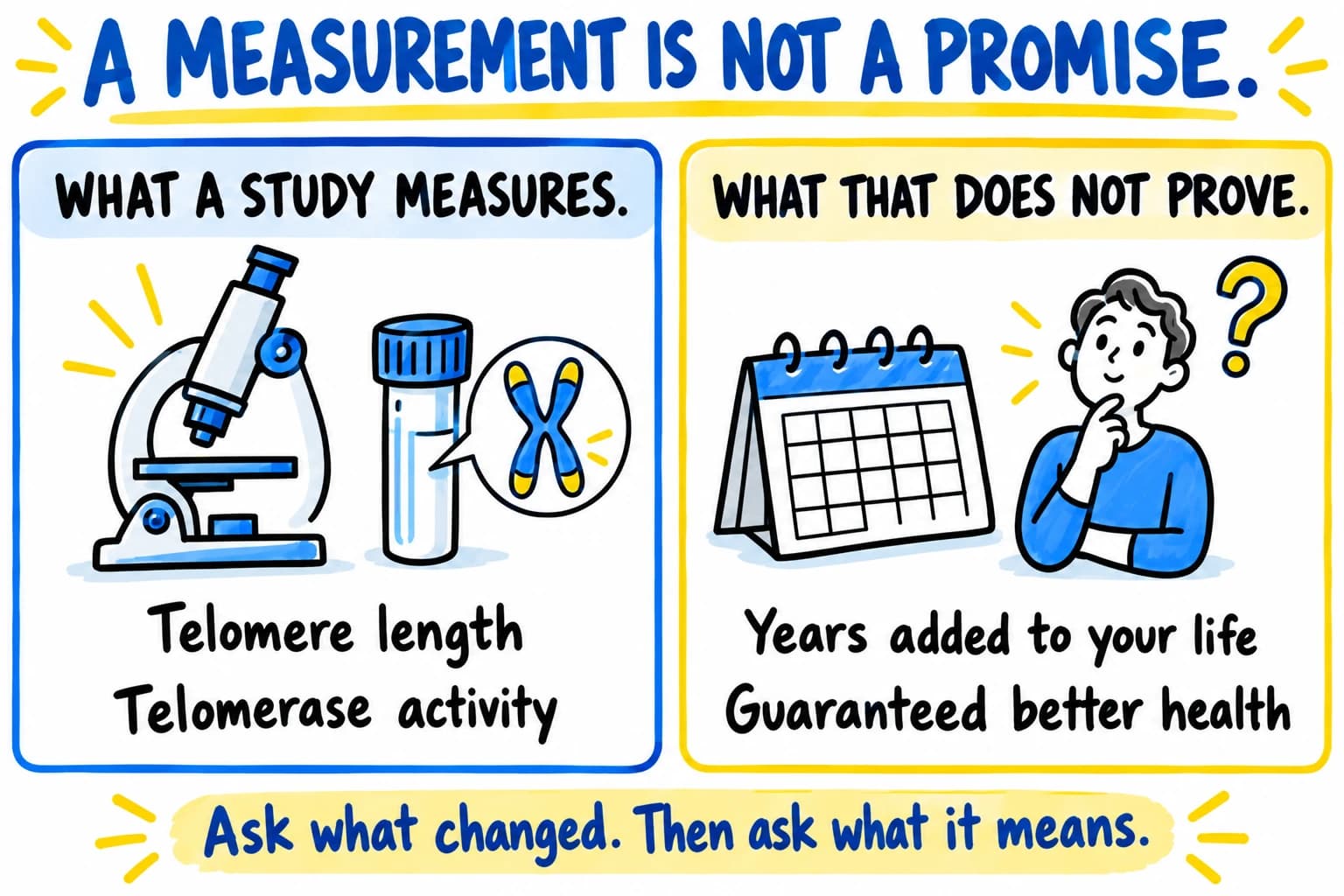
Biological-age tests and longevity products are easy to find. Use this book as a filter. Was it tested in people? Blood marker or actual health? Is "more" actually better?
The short version
- Telomeres are protective caps on your chromosomes. Telomerase can add length back.
- Stress is linked to shorter telomeres, but the link is weak. Stress isn't a personal failing.
- In one trial, endurance and interval exercise changed telomere markers. Resistance training didn't, but it still improved fitness.
- Poor sleep quality and sugared soda are linked to shorter telomeres. Links aren't causes.
- Genes for longer telomeres are linked to higher risk of some cancers. Skip telomere pills and tests.
- Safer, close-knit neighborhoods are linked to longer telomeres.
Conclusion
Here's the idea from The Telomere Effect I think is worth keeping: how and where we live may leave a trace in our cells. Don't chase a number. Move, sleep, eat slowly, and lean on your people.
Pick one action from this post and do it before bed tonight. Which one will you choose?
 MealCoach