A plain-English summary of Wheat Belly by William Davis, MD
"Aside from some extra fiber, eating two slices of whole wheat bread is really little different, and often worse, than drinking a can of sugar-sweetened soda or eating a sugary candy bar."
William Davis, Wheat Belly (Goodreads)
What you'll learn: the three big claims in Wheat Belly and which one holds up. Then a seven-day test you can run on yourself.
The surgery that didn't happen
Wendy was 36. She taught grade school and had three kids.
She'd also had ulcerative colitis for over ten years. That's a disease where the gut lining stays sore and bleeds. In the book, Davis writes:
"She endured several colonoscopies and required the use of three prescription medications to manage her disease."
William Davis, Wheat Belly (Goodreads)
Nothing worked. Her gut doctor's next step was to remove her colon.
Davis, her heart doctor, asked for one try first. No wheat.
Three months later, by his account, she'd lost 38 pounds and the colitis was almost gone. A year on, it hadn't come back (Goodreads).
It's one patient, told by the man selling the idea. Keep that in mind. But it's why this book sold. So what does Davis think wheat is doing?
Claim 1: your toast scores higher than sugar
This is the claim in the quote up top. It sounds absurd. I checked it.
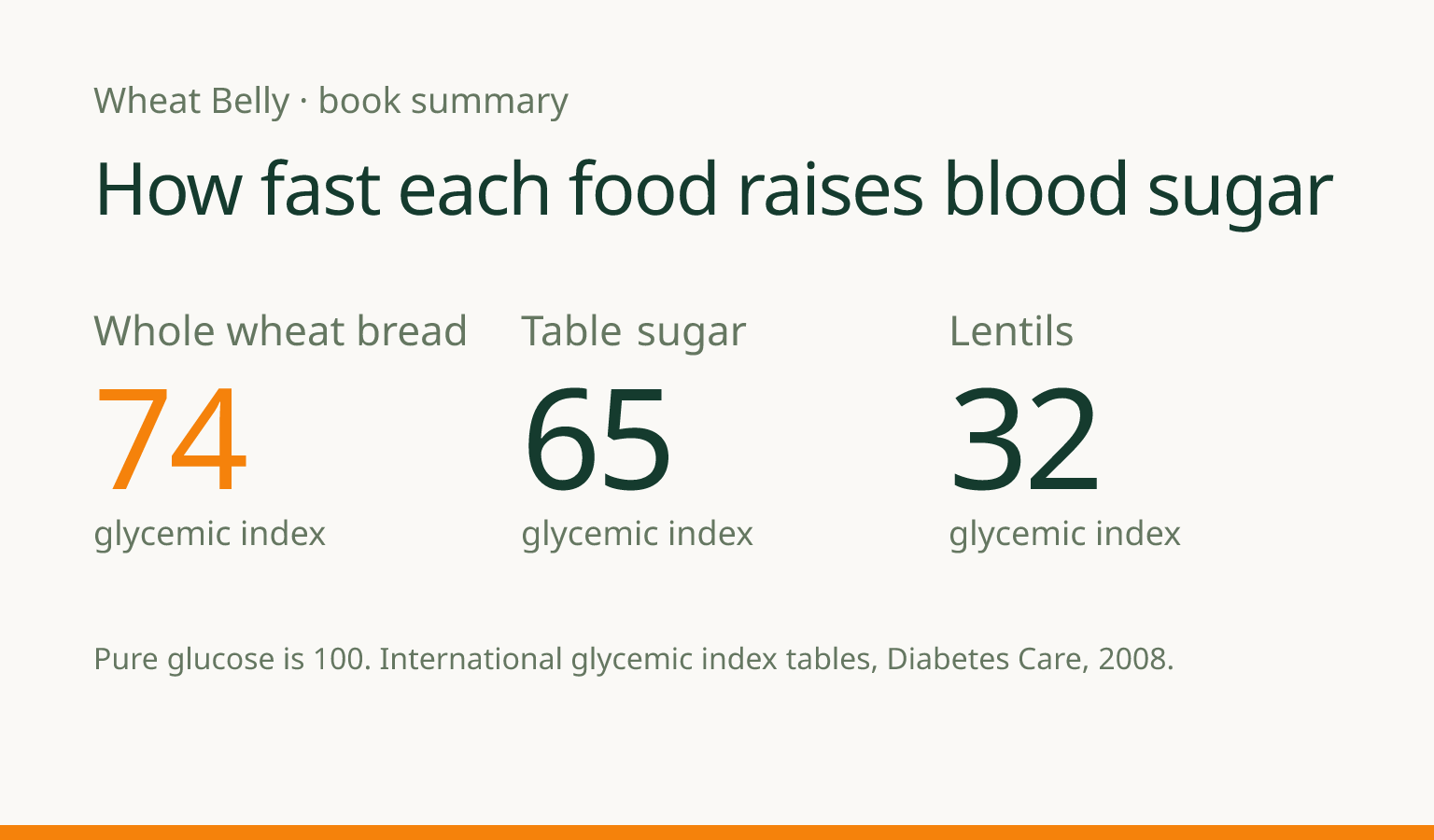
Scientists rank foods by how fast they raise blood sugar. The score is called the glycemic index. Pure glucose is 100.
Here's what the standard table says (Diabetes Care, 2008):
Whole wheat bread: 74
White bread: 75
Table sugar: 65
Soda: 59
Chocolate: 40
Lentils: 32
On this one score, Davis is right. Whole wheat bread beats table sugar.
Two cautions. The score is for a food eaten alone, and nobody eats dry toast alone. And one score isn't the whole story of a food.
Action item: Tomorrow, swap your toast for eggs or plain yogurt with nuts. Note how hungry you are at 11 a.m.
Fast sugar is step one. Davis says step two is where the belly comes from.
Claim 2: the spike becomes the belly
When blood sugar jumps, your body sends out insulin. Insulin moves sugar out of your blood. It also tells your body to store fat.
That's the book's title in one line:
"A wheat belly represents the accumulation of fat that results from years of consuming foods that trigger insulin, the hormone of fat storage."
William Davis, Wheat Belly (Goodreads)
Davis cares most about the deep fat around your organs. He blames it for diabetes and heart trouble.
Notice what that sentence says, though. "Foods that trigger insulin." That's more than wheat. Rice, soda and candy do it too. Hold on to that. It matters later.
Action item: Count the wheat in one normal day: toast, sandwich, crackers, pasta, the bun. Write the number down.
Claims 1 and 2 are about blood sugar. Claim 3 is about your head, and it's the wild one.
Claim 3: wheat works like a drug
Why is bread so hard to quit? Davis has an answer:
"So this is your brain on wheat: Digestion yields morphine-like compounds that bind to the brain's opiate receptors."
William Davis, Wheat Belly (Goodreads)
He says quitting can feel like withdrawal. He's called modern wheat a "perfect, chronic poison" and "Frankenwheat" (Wikipedia).
His case: today's wheat was bred so hard that it's a new plant, and it reached our plates with "nary a question" (Goodreads).
This is where I get off the bus. Three scientists checked these claims against published studies. Their verdict was that they "cannot be substantiated" (FoodNavigator).
Action item: If you try going wheat-free, expect cravings in week one. Plan your snacks before you start.
So what do you eat on this plan? The list has some surprises.
What's on the plate
Wheat Belly doesn't swap wheat bread for gluten-free bread. Davis bans both. Gluten-free starches spike blood sugar too.
Here's the plan, as WebMD lays it out:
Yes: vegetables, berries, nuts, olive oil, eggs, meat, full-fat cheese
No: bread, pasta, cereal, barley, rye, sugar, rice, potatoes, beans
Fat is fine. Davis says so directly:
"In terms of mitigating wheat's adverse effects, there is no need to restrict fats."
William Davis, Wheat Belly (Goodreads)
Look at the "no" list again. Rice, potatoes, sugar, beans. This isn't a wheat-free diet. It's a low-carb diet with wheat on the cover.
Action item: Open your pantry. Find the three wheat foods you eat most. Those are your swaps.
You don't need the full plan to learn something. Seven days will do.
A seven-day wheat test
I wouldn't follow the full Wheat Belly plan. I'd run a small, fair test and keep the beans.
 View full-size illustration
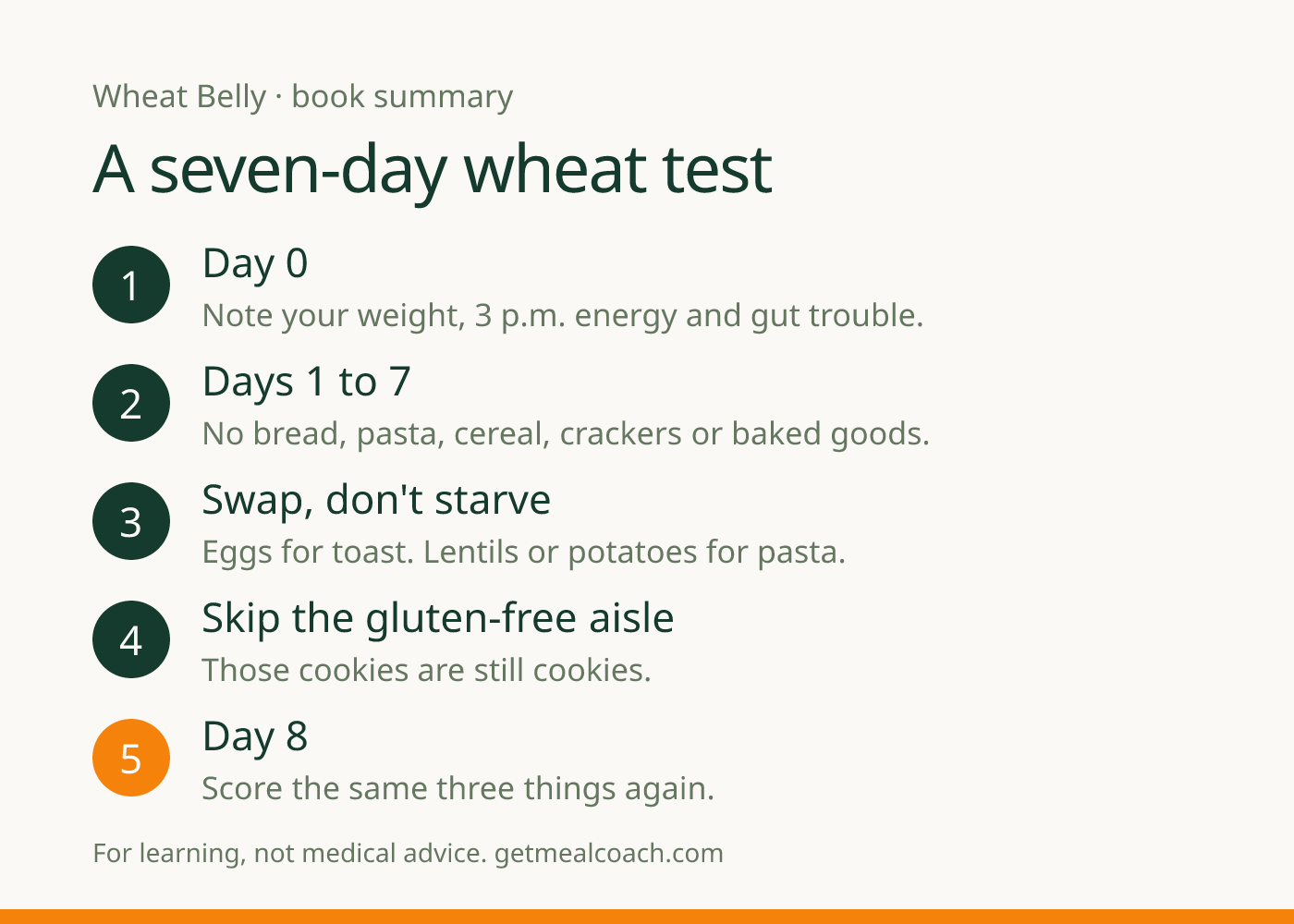
Day 0: write down your weight, your 3 p.m. energy from 1 to 10, and any gut trouble.
Days 1 to 7: no bread, pasta, cereal, crackers or baked goods.
Swap, don't starve. Eggs for toast. Rice bowl or lettuce wrap for a sandwich. Lentils or potatoes for pasta.
Skip the gluten-free aisle. Those cookies are still cookies.
Day 8: score the same three things again.
Then eat two slices of bread and see how you feel.
If nothing changed, you've lost nothing. If something did, you've learned it in a week, not from a book.
Action item: Pick your start day now. Put "Day 0 notes" in your calendar.
Now for the part Davis leaves out.
Where Wheat Belly goes too far
I think this book is half right and oversold.
The weight loss has a plainer cause. A McGill chemist put it this way: "Davis' scheme basically translates to a low carb, low calorie diet. No miracle here" (McGill).
Wheat isn't proven guilty. WebMD says there's "no scientific evidence that foods with gluten cause more weight gain than other foods."
Whole grains look good in studies. The same three scientists link whole-grain wheat to lower risk of type 2 diabetes and heart disease (FoodNavigator).
Stories aren't trials. Wendy's story is moving. It's still one person, with no comparison group.
They also made a joke I love. Wheat sales rose as obesity rose. So did sales of sports shoes.
So is the book dead? New research says the truth is stranger.
Why Wheat Belly matters now
In October 2025, The Lancet published a big review on people who feel sick after eating gluten. About 10 percent of people worldwide say they do (ScienceDaily).
The lead author, Jessica Biesiekierski, summed it up:
"Contrary to popular belief, most people with NCGS aren't reacting to gluten."
Jessica Biesiekierski, University of Melbourne (ScienceDaily)
NCGS means feeling sick from gluten without having celiac disease. The review points to other culprits: certain carbs in wheat that ferment in the gut, and what people expect to feel.
So Davis was right that many people feel better without wheat. He was likely wrong about why.
What you get from this
✅ You know why "whole wheat" isn't a free pass for blood sugar
✅ You can tell the tested claim from the two shaky ones
✅ You have a one-week test in place of a lifelong ban
Short on time? Here's the whole post in six lines.
The 5-Minute Version
Wheat Belly says wheat spikes blood sugar, builds belly fat, and hooks your brain.
The first claim checks out: whole wheat bread scores higher than table sugar.
The plan bans rice, potatoes, sugar and beans too. It's low-carb with a wheat label.
Scientists say the "poison" and "addiction" claims aren't backed by studies.
A 2025 review found most people who react to wheat aren't reacting to gluten.
Try seven days without wheat, score how you feel, then decide.
One story sums it up.
Conclusion
A teacher was headed for surgery to remove her colon. She quit wheat and, by her doctor's telling, got her life back.
That's the pull of Wheat Belly. The honest version is smaller: wheat isn't poison, but your daily toast may be doing less for you than you think.
You don't have to pick a side. Run the seven-day test and trust your own notes.
What's the one wheat food you'd find hardest to give up for a week?
This post is for learning, not medical advice. Don't stop any medicine because of a book. If you think you may have celiac disease or a gut condition, see your doctor before you cut wheat.
 MealCoach