
“The best bridge between despair and hope is a good night’s sleep.”
E. Joseph Cossman, quoted by Matthew Walker in Why We Sleep
It's 4 p.m. You slept five and a half hours. The snack drawer is calling, and the salad you packed looks like homework.
You tell yourself you'll be stronger tomorrow.
But what if this fight didn't start at 4 p.m.? What if it started at midnight, when you picked "one more episode"?
Why We Sleep is one of the most popular sleep books ever written, and one of the most criticized. I think it's worth your time, if you know which parts to trust.
You'll learn what holds up, what goes too far, and one thing to try tonight. You'll also meet a reader who lost sleep because of this book, and how he got it back.
The Scientist Who Measured at the Wrong Time
Matthew Walker didn't set out to study sleep.
As a young researcher, he recorded the brainwaves of people with dementia, hoping to tell different types apart. The results kept coming back muddy.
The missing piece was sleep. He taught himself to record sleep at night, and the data got clear.
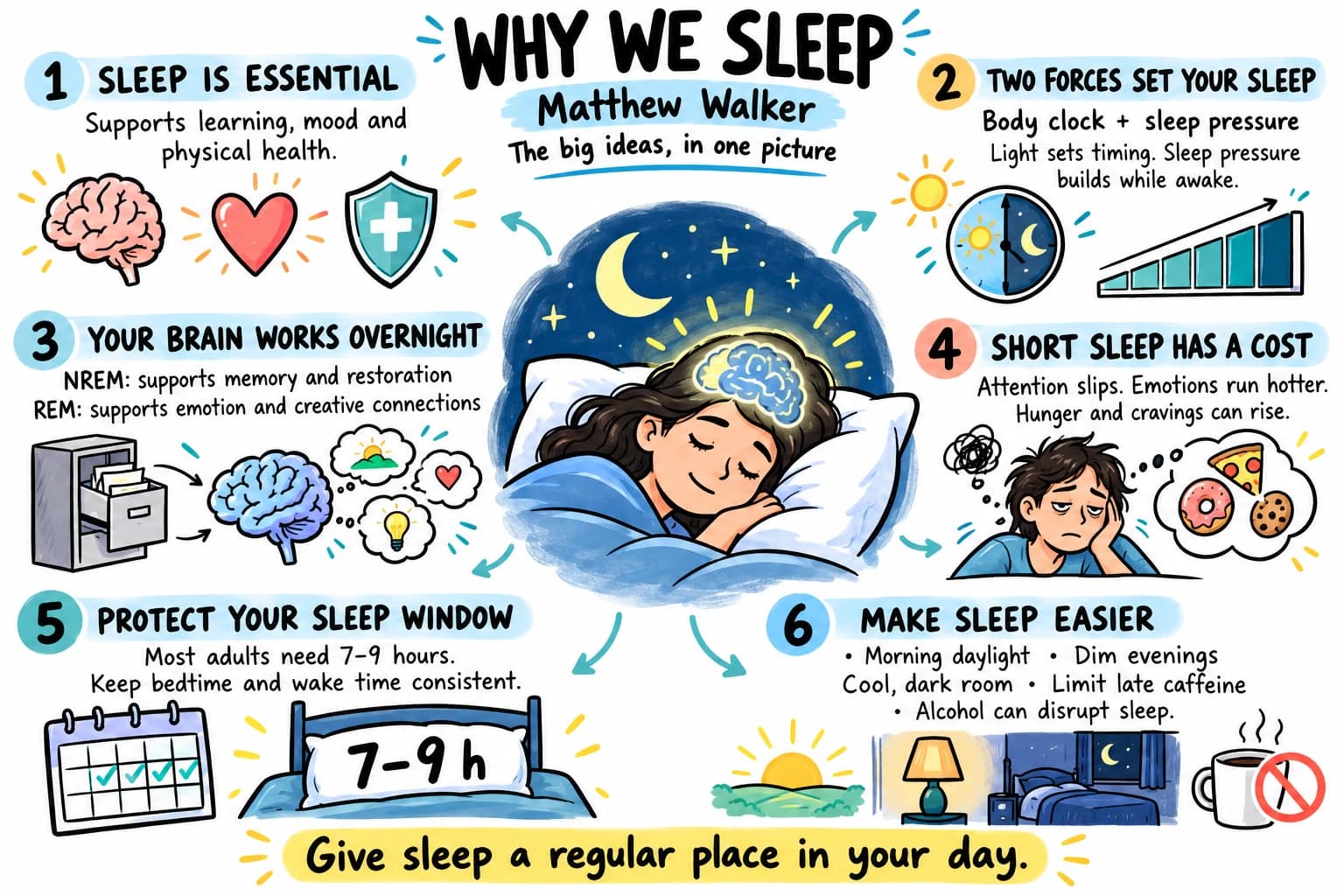
He later ran a sleep lab at UC Berkeley and published Why We Sleep in 2017. The big idea: sleep isn't wasted time. It's when your body and brain do their upkeep.
Walker puts the role of sleep in learning this way:
“Practice does not make perfect. It is practice, followed by a night of sleep, that leads to perfection.”
Matthew Walker, Why We Sleep
Some of its claims are rock solid. Some aren't. Let's start with a solid one.
Try this: Tomorrow morning, roughly note when you fell asleep and woke up. No clock-watching required.
Two Dials Decide When You Feel Sleepy
Think of sleepiness as two dials. This is the book at its most useful.
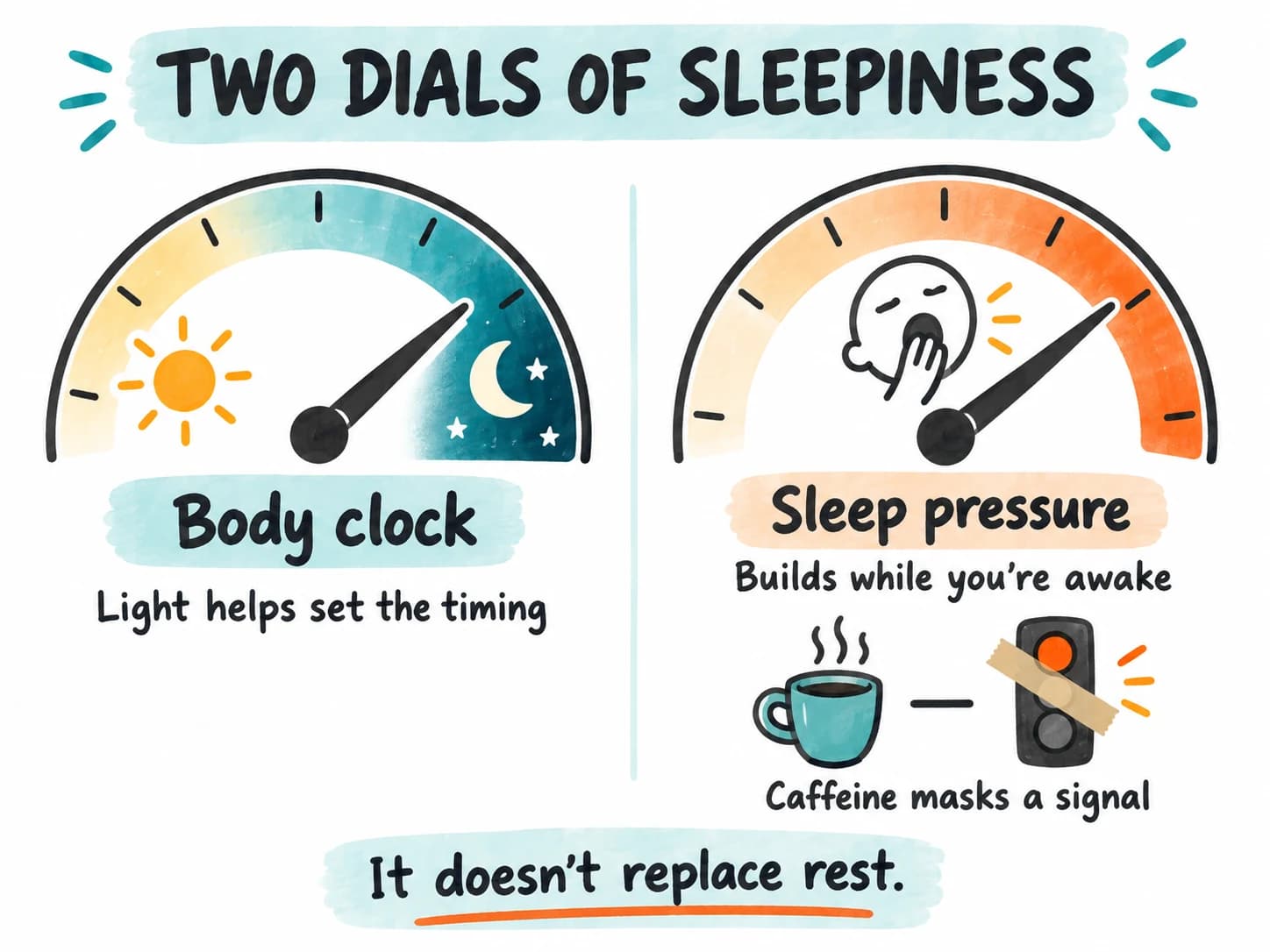
Dial one is your body clock. It runs on a loop of about 24 hours. Light helps set its timing.
Dial two is sleep pressure. A chemical called adenosine helps this pressure build while you're awake. It decreases during sleep. These two systems work together, so sleepiness doesn't simply rise in a straight line all day.
Caffeine doesn't remove that pressure. It masks the signal, a bit like covering a warning light. When the caffeine wears off, the pressure is still there.
And caffeine can linger. In one small study, 12 healthy adults took 400 mg of caffeine six hours before bed. An in-home sleep monitor showed they lost more than an hour of sleep.
Try this: Set a last-coffee time at least six hours before your usual bedtime. Keep it for one week. Sensitivity varies, so some people need an earlier cutoff.
A Tired Brain Goes Shopping for Calories
This is the part I care about most. It's where sleep meets your plate.
In 2013, Walker's own lab studied 23 young adults after a normal night and after a night without sleep. After no sleep, they wanted higher-calorie foods more. Brain scans showed changes in areas involved in food evaluation and desire.
But a night with zero sleep isn't normal life. Here's a study closer to home.
A 2022 trial randomly split 80 adults with overweight, all sleeping under 6.5 hours a night, into two groups. Only one group got a personal sleep-coaching session. That group slept about 1.2 hours more per night. Over two weeks, its daily energy intake fell by about 270 calories more than the control group's. Nobody was told to diet.
My take: a short night doesn't make you weak. It can make the snack aisle louder.
Two weeks isn't two years, so this doesn't establish long-term weight loss. But it changes how I read a bad afternoon.
Try this: After a short night, pick your afternoon snack in the morning. Then eat it sitting down, slowly, with no screen. When you're tired, it's easy to eat on autopilot.
The Nightcap That Can Cost You Dreams
Walker is blunt about alcohol and its effects on REM sleep, the dream-heavy stage the book ties to memory and mood.
Newer evidence points the same way. A 2025 review of 27 studies found that low doses, roughly two standard drinks in the authors' description, can reduce REM sleep. Larger amounts may help people fall asleep faster, but REM tends to drop further.
A nightcap may help you nod off. It may not give you the same night.
Try this: If you occasionally drink in the evening, try skipping the nightcap and notice how rested you feel. If you drink heavily or may be dependent, get medical advice before stopping suddenly.
Where Why We Sleep Oversells
Now the honest part.
In 2019, researcher Alexey Guzey published a long essay challenging claims and figures in the book. Columbia statistician Andrew Gelman discussed the critique on his blog.
Take the book's blood-sugar claim:
“Inadequate sleep—even moderate reductions for just one week—disrupts blood sugar levels so profoundly that you would be classified as pre-diabetic.”
Matthew Walker, Why We Sleep
A small laboratory study found reduced glucose tolerance after six nights with just four hours in bed. That is substantial sleep restriction, not proof that any modest reduction for a week makes someone pre-diabetic.
Another line makes an even bigger leap:
“Routinely sleeping less than six or seven hours a night demolishes your immune system, more than doubling your risk of cancer.”
Matthew Walker, Why We Sleep
That sweeping risk estimate isn't supported by a systematic review of sleep duration and cancer incidence, which found no significant overall dose-response relationship. It doesn't settle every cancer question, but it doesn't justify telling every short sleeper their cancer risk has doubled.
One line in the publisher's excerpt is worth slowing down for:
“The shorter your sleep, the shorter your life span.”
Matthew Walker, Why We Sleep
A systematic review found associations between both short and long sleep and mortality. Those observational results don't establish that sleep duration itself caused the outcomes. Illness and other factors can affect both sleep and health.
Here's my view. The book is right that sleep matters. It's wrong to make you scared of every short night. Fear is a terrible sleeping pill.
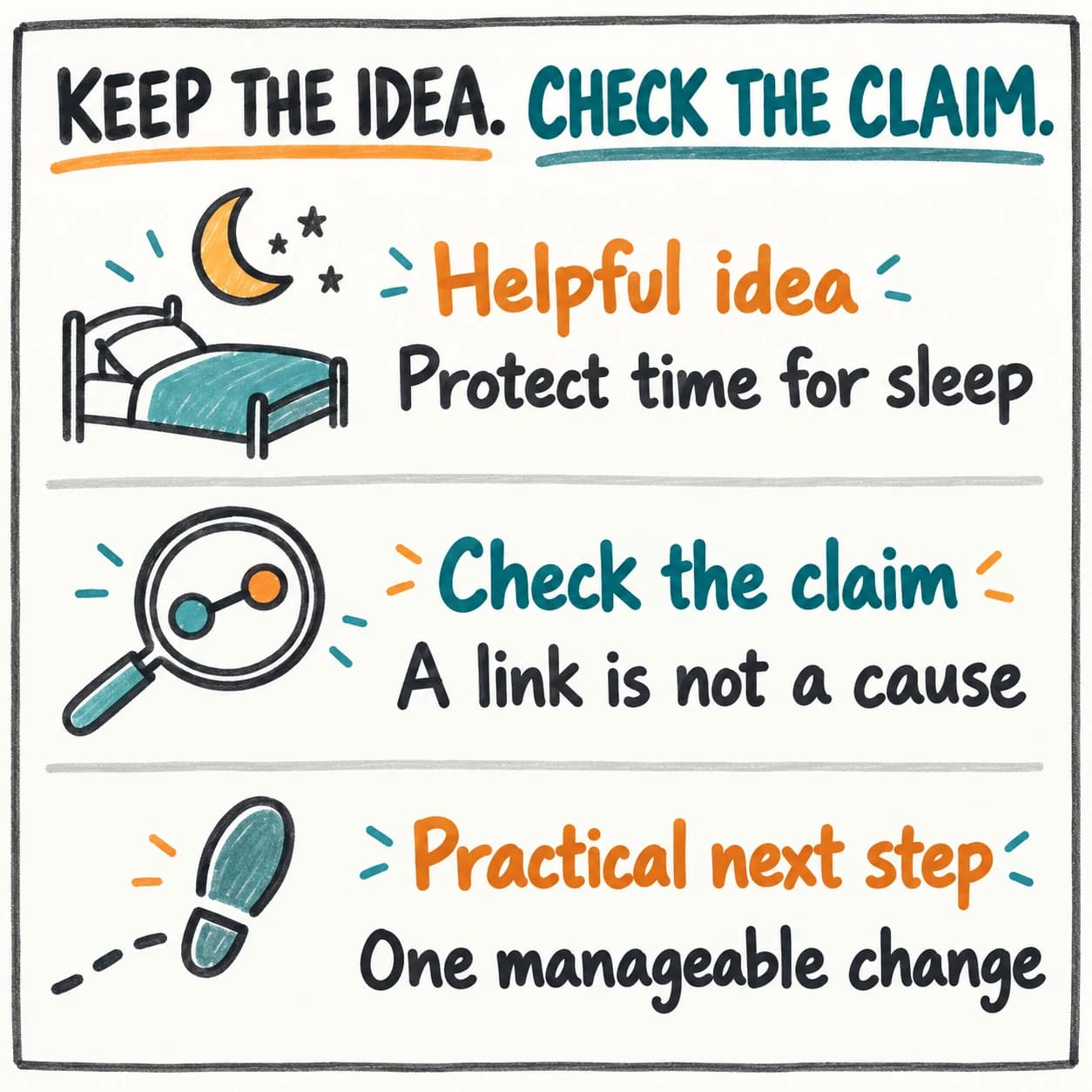
The expert guideline is calmer. The American Academy of Sleep Medicine and the Sleep Research Society recommend that adults get 7 or more hours regularly. Sleep needs vary with age and individual circumstances.
Try this: Swap "I need eight perfect hours" for "I'm making enough room for sleep, most nights."
When Sleep Advice Backfires
Remember the reader who lost sleep because of this book? Here he is.
Writer David Kadavy described reading Why We Sleep and waking at 3 a.m. with a pounding heart and racing thoughts. In his account, worry about sleep was keeping him up.
He describes finding help in a program based on CBT-I, cognitive behavioral therapy for insomnia. That's a structured treatment that works on thoughts and habits around sleep, not proof that one book or program works for everyone.
There's even a term for an unhealthy pursuit of a perfect sleep score: orthosomnia. It fits right into today's "sleepmaxxing" craze of trackers, gadgets, and nightly scores.
For chronic insomnia, the AASM strongly recommends multicomponent CBT-I and advises against sleep hygiene alone as treatment. So a tips list, including mine, is not a cure.
If you work nights or care for a baby or a sick parent, "same bedtime every night" can sound like a joke. For you, it might mean one anchor you control. Think a dark room for day sleep, or protected rest while someone covers. Good enough counts.
Try this: If poor sleep persists or affects your day, ask a clinician about it and whether CBT-I could help. If a tracker makes you anxious, try taking a break from the scores.
A Good-Enough Day
Walker also highlights research on short naps:
“They discovered that naps as short as twenty-six minutes in length still offered a 34 percent improvement in task performance and more than a 50 percent increase in overall alertness.”
Matthew Walker, Why We Sleep
The NASA study involved long-haul flight crews. Pilots offered a 40-minute rest opportunity slept for about 26 minutes on average and showed benefits on specific performance and alertness measures. The book's percentages aren't a guaranteed boost from setting a 26-minute nap timer, and the naps didn't erase accumulated sleep debt.
This isn't a niche problem. A CDC report from April 2026, based on 2024 survey data, found that 30.5% of U.S. adults reported less than 7 hours of sleep. It also found that 18.1% had trouble staying asleep most days or every day.
Here's an example for someone with an 11 p.m. bedtime, not a schedule everyone has to follow:
7:00 a.m.: Wake at your usual time. Step outside for daylight.
8:00 a.m.: Pick your afternoon snack while your brain is fresh.
2:00 p.m.: Last coffee.
3:30 p.m.: Eat that planned snack, sitting down and slowly.
7:00 p.m.: Dinner. Skip the nightcap.
10:00 p.m.: Dim the lights. Keep the bedroom cool, dark, and quiet.
11:00 p.m.: Wind down for sleep. Don't turn bedtime into a performance test.
Miss half of these? Fine. Pick one and start there.
The 5-Minute Version
Sleep is upkeep, not wasted time.
Two systems shape sleepiness: body clock and sleep pressure. Caffeine masks a signal; it doesn't replace rest.
Sleep can affect appetite. One short trial found lower energy intake after sleep coaching, not a guaranteed weight-loss method.
Alcohol can reduce REM sleep, even at relatively low doses.
Read dramatic claims carefully. Protect time for sleep without chasing perfection.
Ongoing insomnia? Ask about CBT-I rather than relying on sleep tips alone.
Conclusion
Why We Sleep gets the big thing right: sleep is worth protecting. Where it goes wrong is fear, and fear can keep people up.
At MealCoach, we think a lot about how people eat. This book reminded me that part of that story can start the night before.
Your one step: pick a caffeine cutoff tonight and keep it for a week. Then notice your 4 p.m.
Which would be hardest for you to give up: the late coffee, the nightcap, or "one more episode"?
This is a book summary, not medical advice. If you have ongoing sleep problems, loud snoring, or daytime sleepiness that worries you, talk to a doctor.
 MealCoach