
“…makes people feel full faster rather than suppressing appetite like GLP1s.”
In this post you’ll learn what amylin is, how it differs from GLP-1, why drug companies are suddenly racing to copy it, and which amylin drugs are closest to your pharmacy. About 5 minutes.
It’s Not All “Just Another Ozempic”
Every new weight-loss drug gets the same nickname: “the new Ozempic.”
That shortcut hides the most interesting story in obesity medicine right now. A different hormone, one your body has always made, is becoming the next big target.
It isn’t all GLP-1. GLP-1 is one fullness lever. Amylin is another one, and it works differently.
Action item: When a new drug makes headlines, ask one question: which hormone does it copy?
Meet Amylin, Insulin’s Quiet Sidekick
Amylin is a hormone made by the same pancreas cells that make insulin. They’re released together when you eat, per a review of amylin’s role in diabetes and obesity.
Insulin gets all the fame. Amylin does three quieter jobs:
- It slows your stomach, so food arrives in your gut more gradually.
- It holds back glucagon after meals, which helps keep blood sugar from spiking.
- It tells your brain “that’s enough,” through a part of the brainstem that tracks fullness.
This isn’t new science. An amylin copy called pramlintide (Symlin) was approved for diabetes back in 2005. It’s a shot taken before meals, and it was never approved for weight loss.
Action item: Remember it this way: insulin handles the sugar, amylin handles the “stop.”
Amylin vs GLP-1: Two Different Levers
Here’s the simplest way to picture it.
- GLP-1 drugs turn down the volume on hunger and food noise. You want food less.
- Amylin drugs turn up the volume on fullness. You feel “done” sooner.
Both slow the stomach, and both overlap more than the cartoon suggests. But the main reason drug makers care is that the two levers seem to add up.
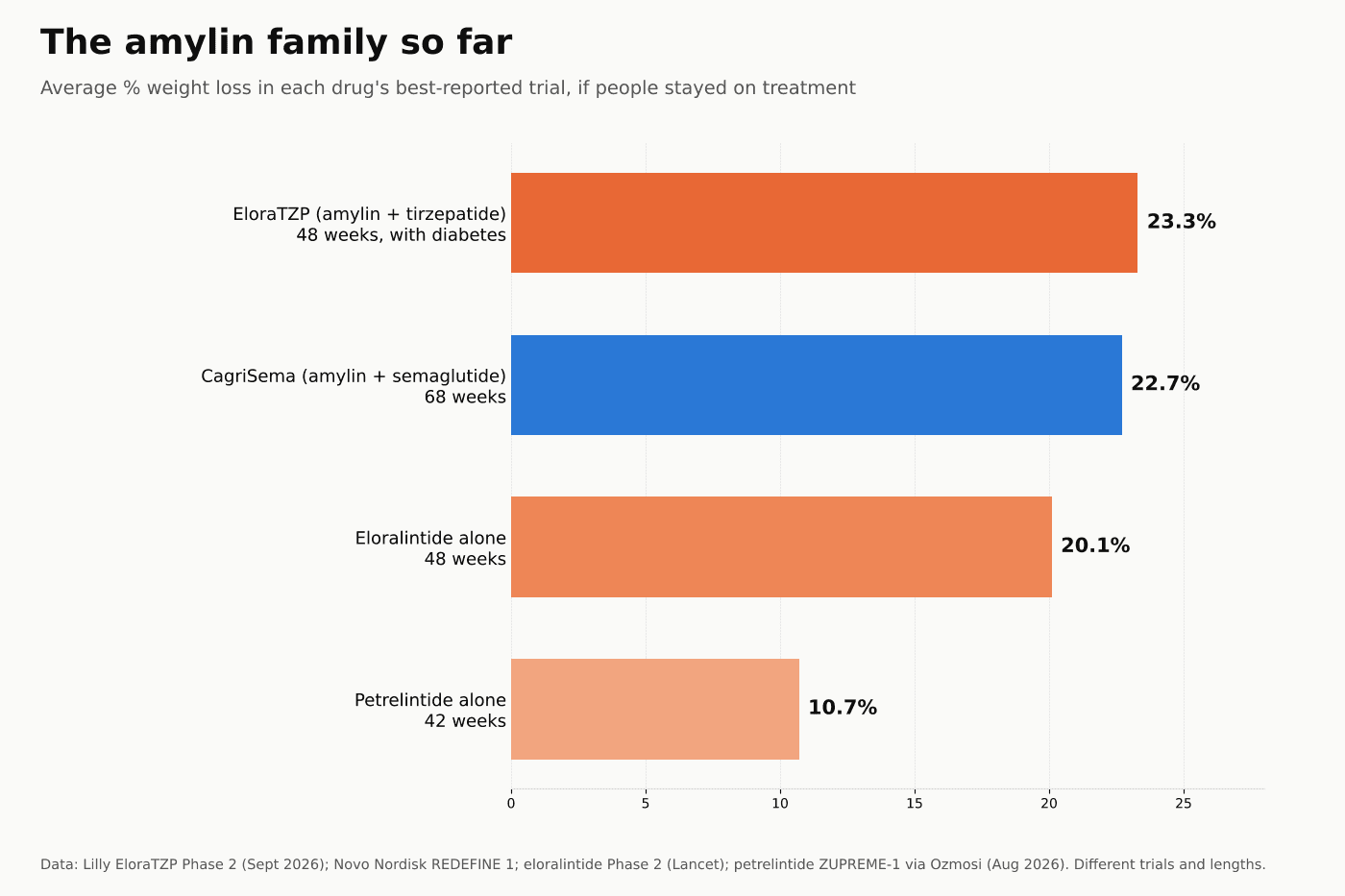
In CagriSema’s big trial, semaglutide alone gave 14.9% weight loss and the amylin drug cagrilintide alone gave 11.5%. Together: 20.4%, counting everyone.
Action item: Think of amylin drugs as “partners,” not replacements. The biggest results so far come from pairing them with a GLP-1-based drug.
Eloralintide: Amylin on Its Own
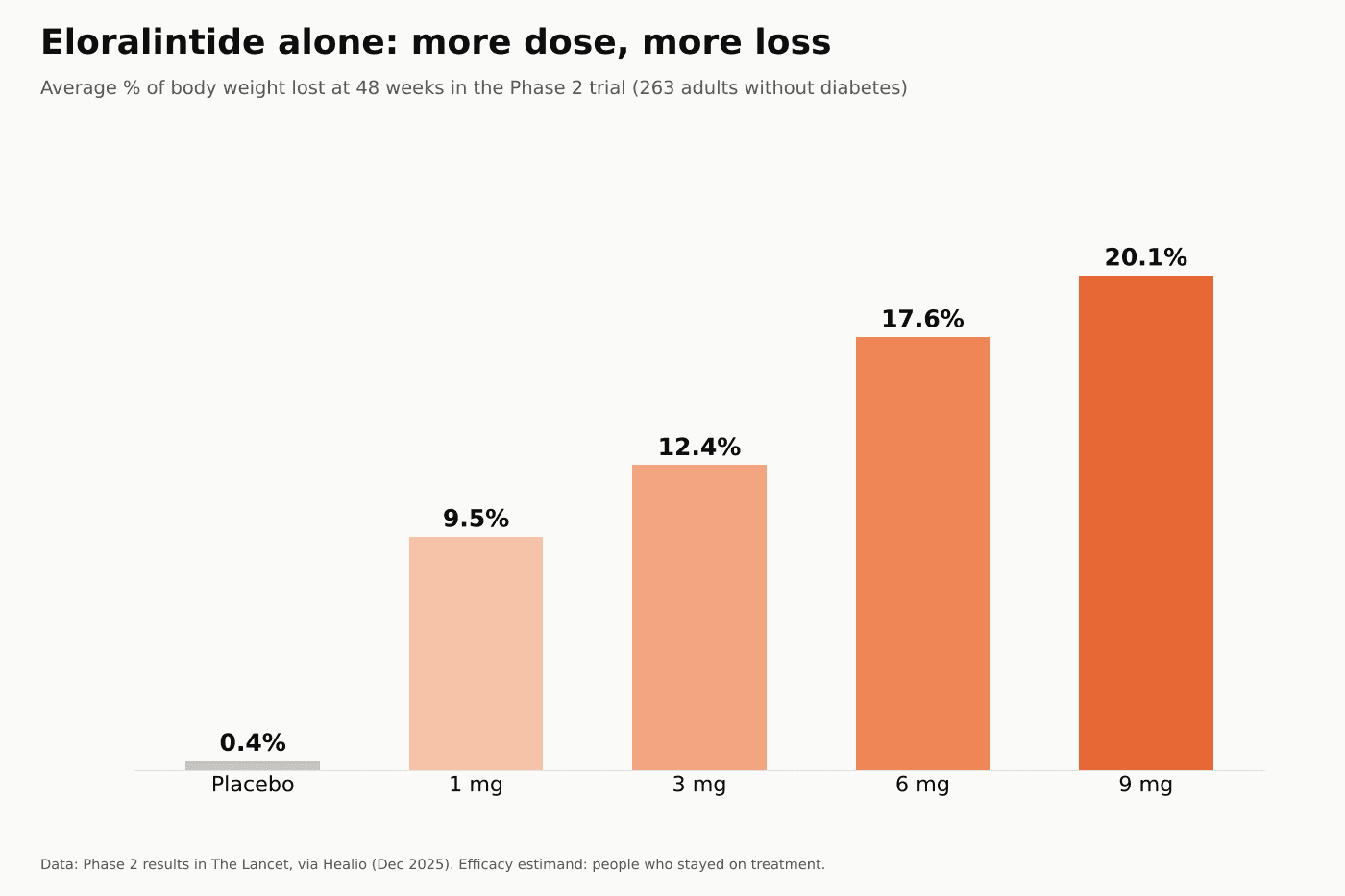
Lilly’s eloralintide is the amylin drug in EloraTZP, but it was also tested alone. In a Phase 2 trial of 263 adults without diabetes, published in The Lancet, the 9 mg dose led to 20.1% weight loss at 48 weeks for people who stayed on it. Placebo: 0.4%.
That’s close to Zepbound territory, from an amylin drug alone. It’s now in Phase 3.
“Eloralintide may expand weight loss treatment options for patients unable to achieve adequate benefit…”
Side effects still happen. Nausea affected 32.7% and tiredness 26.9%. But the slowest dose ramp, 3 to 6 to 9 mg, had stomach side effects close to placebo. That’s a hint amylin-only drugs may be gentler, which is part of the hype.
Action item: If GLP-1 side effects have been your problem, keep an eye on amylin-only drugs as they move through Phase 3.
The Amylin Lineup, From Closest to Furthest
- CagriSema (Novo Nordisk): amylin + semaglutide. Filed with the FDA in December 2025; a decision is expected in Q4 2026.
- Eloralintide (Lilly): amylin alone. In Phase 3.
- Zenagamtide, formerly amycretin (Novo Nordisk): a single molecule that hits both amylin and GLP-1. In Phase 3.
- EloraTZP (Lilly): eloralintide + tirzepatide. Phase 3 planned to start by the end of 2026.
- Petrelintide (Roche and Zealand): amylin alone. Finished Phase 2, with up to 10.7% at 42 weeks.
I compared the two leading combos head to head in CagriSema vs EloraTZP.
Action item: Bookmark the lineup. CagriSema’s FDA decision is the first real test of whether amylin combos reach patients.
A Worked Example: What Amylin Does at One Meal
Here’s the hormone’s day job, step by step, at an ordinary dinner.
- Minute 0: you start eating. Food reaches your gut.
- Within minutes: your pancreas releases insulin, with amylin riding along.
- Next: amylin slows your stomach and keeps glucagon in check, so sugar enters your blood more gently.
- Meanwhile: amylin signals your brainstem. The thought “I’m good” shows up.
Notice that every step takes time. That’s why fullness signals, natural or drug-boosted, work best when the meal isn’t over in five minutes. I dug into that research in Eating Too Fast on Ozempic?
Action item: At dinner tonight, notice when the “I’m good” thought shows up. That’s your fullness system, amylin included, doing its job.
What This Means for You
✅ You know amylin is released with insulin and says “that’s enough”
✅ You can explain amylin vs GLP-1 in one sentence
✅ You know eloralintide alone reached 20.1% in Phase 2
✅ You know which amylin drug arrives first
✅ You know why fullness signals need time
The 5-Minute Version (Screenshot This)
- Amylin is a fullness hormone your pancreas releases with insulin.
- It slows the stomach, holds back glucagon, and signals “enough” to the brain.
- Paired with GLP-1 drugs, it adds weight loss: CagriSema 20.4% vs semaglutide 14.9%.
- Alone, eloralintide hit 20.1% at 48 weeks in Phase 2.
- First to market: CagriSema, with an FDA decision expected in Q4 2026.
Conclusion
Amylin drugs work on fullness, a different lever from GLP-1’s quieter hunger. Paired together, the two add up, and alone, amylin is looking surprisingly strong. None are approved yet, but CagriSema could be soon.
Your one action today: next time you see “the new Ozempic,” ask which hormone the drug actually copies.
So tell me: would you rather a drug that quiets hunger, or one that makes you feel full sooner? Why?
See every drug in one place: the 2026 weight-loss drug pipeline, ranked.
Sources
- Amylin, another important neuroendocrine hormone for the treatment of diabesity (review)
- Healio: eloralintide Phase 2 results in The Lancet
- American Diabetes Association: REDEFINE 1 results
- Eli Lilly: EloraTZP Phase 2 and Phase 3 plans
- Ozmosi: obesity drug pipeline 2026
- Medical Daily: CagriSema FDA status (October 2026)
 MealCoach