
“EloraTZP represents our next frontier, pairing a selective amylin receptor agonist with tirzepatide.”
In this post you’ll learn what CagriSema and EloraTZP actually are, how much weight people lost on each, which one reaches pharmacies first, and the side-effect catch. About 6 minutes.
“Amylin Is the New GLP-1” Is Lazy Hype
Amylin is having a moment. Your feed says it’s the next big thing after Ozempic.
Then it lumps every amylin drug together, as if they’re all the same shot from different companies.
They aren’t. CagriSema and EloraTZP share one idea, but they’re built on different partner drugs, tested in different people, at very different stages. Mixing them up leads to wrong expectations.
Action item: When you see “amylin drug” in a headline, look for two things: which drug it’s paired with, and whether the trial was Phase 2 or Phase 3.
One Idea, Two Tag Teams
Both drugs pair an amylin drug with a GLP-1-based drug. Amylin is a hormone your pancreas releases with insulin after you eat. Its job is to help you feel full sooner.
- CagriSema (Novo Nordisk) = cagrilintide (amylin) + semaglutide, the drug in Wegovy. One weekly shot.
- EloraTZP (Eli Lilly) = eloralintide (amylin) + tirzepatide, the drug in Zepbound. A weekly combo.
So this is really Novo’s best drug plus amylin against Lilly’s best drug plus amylin. A rematch, with a new teammate on each side.
Action item: Remember it this way: CagriSema is “Wegovy plus amylin.” EloraTZP is “Zepbound plus amylin.”
Round 1: CagriSema’s Big Phase 3 Numbers
CagriSema has three large trials behind it. All numbers below assume people stayed on treatment.
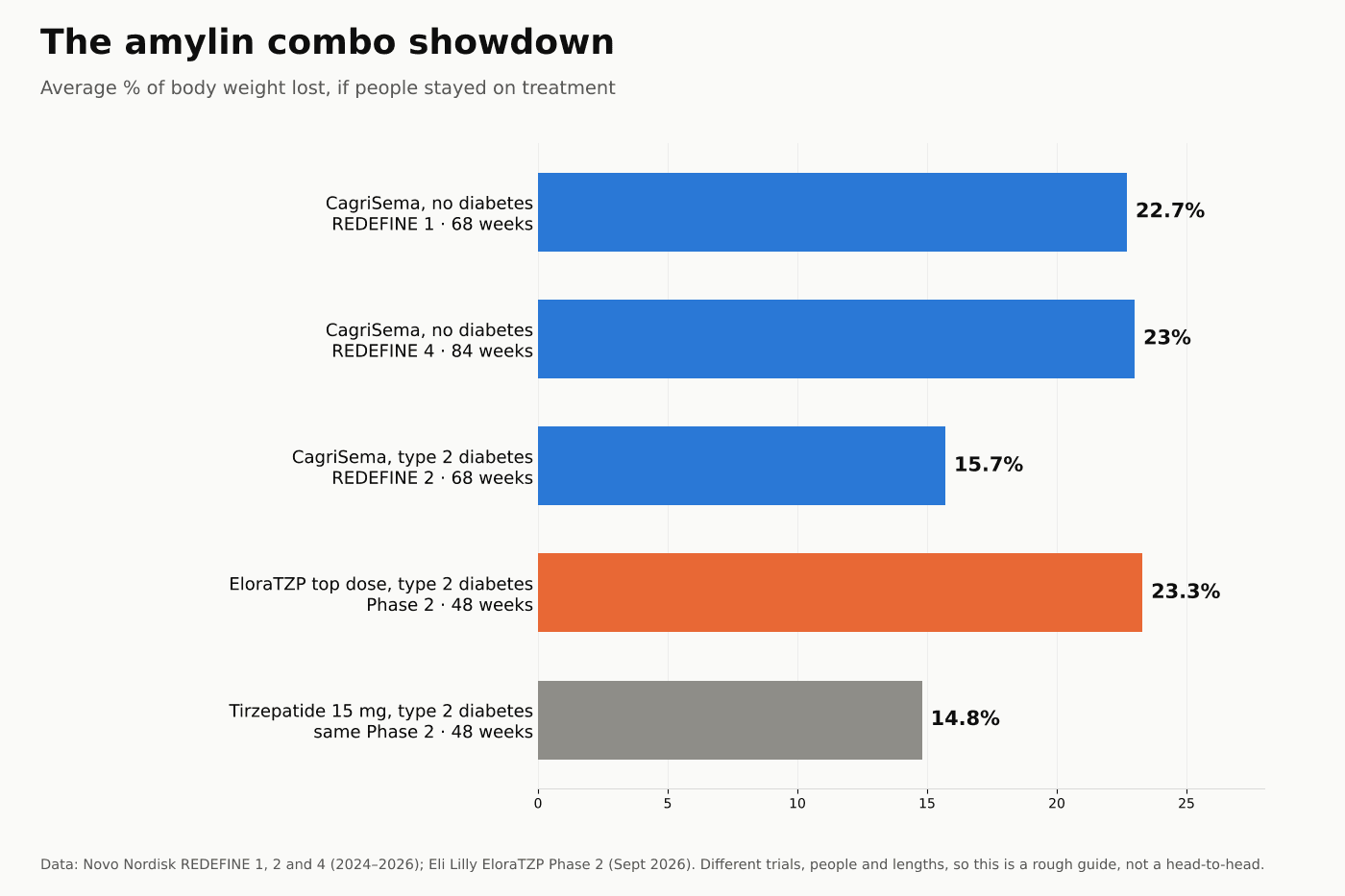
- REDEFINE 1: 3,417 adults without diabetes. 22.7% weight loss at 68 weeks. Semaglutide alone: 14.9%. Placebo: 3%. Counting everyone, it was 20.4%.
- REDEFINE 2: 1,206 adults with type 2 diabetes. 15.7% at 68 weeks. Placebo: 3.1%.
- REDEFINE 4: 809 adults, CagriSema vs Zepbound head to head. 23.0% vs 25.5% at 84 weeks. CagriSema missed its goal of proving it was at least as good.
“We are pleased with the weight loss of 23% for CagriSema.”
Pleased, yes. But losing a head-to-head to Zepbound is the most important CagriSema fact of 2026.
Action item: If you’re already doing well on Zepbound, CagriSema isn’t an obvious upgrade. The one direct comparison favored Zepbound.
Round 2: EloraTZP’s Smaller, Faster Trial
EloraTZP has one Phase 2 trial, presented in September 2026. It had 367 adults with obesity or overweight and type 2 diabetes, followed for 48 weeks.
- Top combo (eloralintide 9 mg + tirzepatide 15 mg): 23.3% weight loss
- Lower combo (6 mg + 5 mg): 19.4%
- Tirzepatide 15 mg alone: 14.8%
- Placebo: 3.0%
A1C, the 3-month blood sugar test, fell by 2.9 points on the top combo vs 2.4 on tirzepatide alone.
I compared EloraTZP with Lilly’s other big bet in Retatrutide vs EloraTZP.
Action item: Treat EloraTZP’s numbers as promising, not proven. Phase 2 trials are small, and results often shrink in Phase 3.
The Fair Fight: Both in Type 2 Diabetes
People with type 2 diabetes usually lose less weight on these drugs. So the fair comparison uses diabetes trials on both sides:
- CagriSema (REDEFINE 2): 15.7% at 68 weeks, in 1,206 people
- EloraTZP (Phase 2): 23.3% at 48 weeks, in 367 people
On paper, EloraTZP lost about 7.6 points more, in 20 fewer weeks. That’s a big gap.
Now the asterisks. EloraTZP’s trial was a third the size, a different design, and only Phase 2. And it was built on tirzepatide, which already beats semaglutide on its own: 20.2% vs 13.7% in the head-to-head SURMOUNT-5 trial, per the American College of Cardiology. Some of the gap is simply Zepbound vs Wegovy.
Action item: If you have type 2 diabetes, compare only diabetes trials. The no-diabetes numbers will set the wrong expectations.
The Catch: Side Effects and Quitting
Both combos mostly cause stomach side effects. In REDEFINE 1, 79.6% of people on CagriSema had some stomach side effect, vs 39.9% on placebo. Nausea alone hit about 55%.
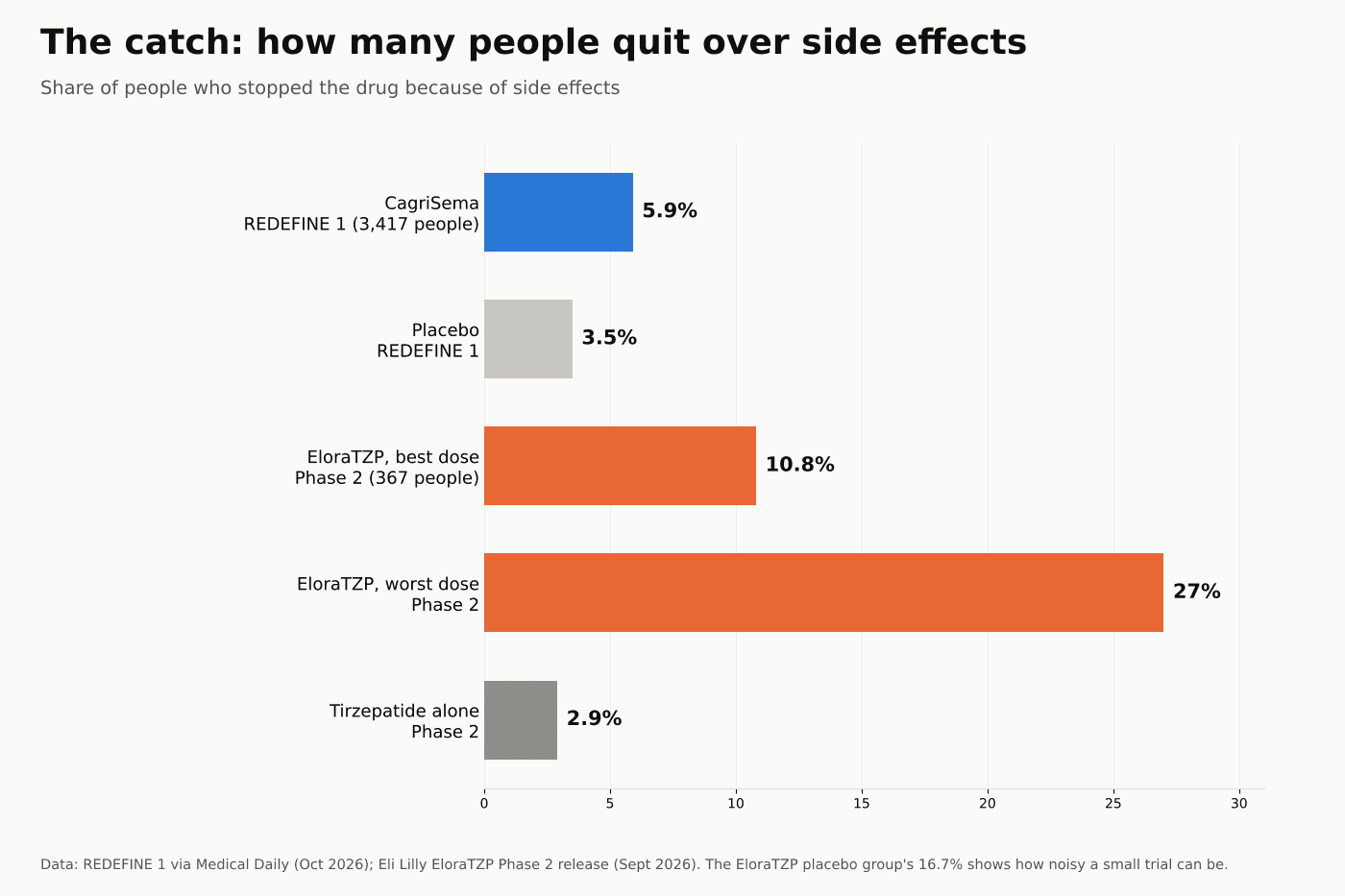
But only 5.9% quit CagriSema because of side effects, vs 3.5% on placebo.
EloraTZP’s quit rates were much higher: 10.8% to 27% depending on the dose. One oddity: 16.7% of the placebo group quit too, which shows how noisy a small trial can be. Lilly says Phase 3 will use a gentler dose ramp.
Action item: When you read “up to 23% weight loss,” always find the quit rate next to it. A drug only works if you can stay on it.
Which One Reaches Pharmacies First?
CagriSema, by a long way. Novo filed it with the FDA in December 2025, and a decision is expected in the fourth quarter of 2026. As of October 21, 2026, it isn’t approved.
EloraTZP hasn’t started Phase 3 yet. Lilly plans to begin by the end of 2026. Phase 3 trials usually take a year or two, then the FDA review. That makes 2029 or later a realistic guess. That’s our estimate, not Lilly’s.
Action item: If you’re interested in CagriSema, watch for Novo’s FDA news before the end of 2026. Then ask your doctor and your insurer.
My Take
CagriSema is the amylin combo you can likely get soon. It’s solid, well tested, and gentler on quit rates. But it lost its head-to-head with Zepbound, so it isn’t the new king.
EloraTZP is the more exciting drug and the less certain one. Its diabetes numbers are the best I’ve seen from an amylin combo. Its quit rates are the worst. Phase 3 will tell us which story wins.
If you’re also weighing timing, I mapped out when retatrutide will be available, and for what’s on shelves today, Foundayo vs Zepbound.
What This Means for You
✅ You can tell CagriSema (“Wegovy plus amylin”) from EloraTZP (“Zepbound plus amylin”)
✅ You know CagriSema lost its head-to-head with Zepbound
✅ You know the fair comparison: 15.7% vs 23.3% in type 2 diabetes
✅ You check the quit rate before getting excited
✅ You know which one arrives first
The 5-Minute Version (Screenshot This)
- CagriSema: 22.7% weight loss at 68 weeks without diabetes; 15.7% with type 2 diabetes. Phase 3.
- EloraTZP: 23.3% at 48 weeks with type 2 diabetes. Phase 2, 367 people.
- Head-to-head: CagriSema 23.0% vs Zepbound 25.5%. CagriSema missed its goal.
- Quit rates: CagriSema 5.9%. EloraTZP 10.8% to 27%.
- Timing: CagriSema FDA decision expected Q4 2026. EloraTZP Phase 3 starts by end of 2026.
Conclusion
CagriSema vs EloraTZP is a fight between a proven drug arriving soon and a stronger-looking drug years away. CagriSema wins on readiness and tolerability. EloraTZP wins on early weight-loss numbers, especially in type 2 diabetes.
Your one action today: next time you see an amylin headline, check the partner drug, the trial phase, and the quit rate.
So tell me: would you take the proven drug available soon, or wait for the stronger one with more side effects? Why?
 MealCoach