
“I have never seen weight loss at this level.”
In this post you’ll learn what retatrutide really did in its big 80-week trial. You’ll see how a new combo shot called EloraTZP stacks up. And you’ll find out which one wins on blood sugar. No jargon. Real numbers. About 8 minutes.
The Headline Wars Are Confusing on Purpose
Every few months, a new weight-loss shot “breaks the record.” Your feed fills with numbers. 28%! 23%! 30%!
Then your cousin texts you: “Is the new one better than Zepbound?” And you have no idea.
Here’s the problem: the headlines compare apples, oranges, and a pineapple. Different people. Different trial lengths. Different ways of counting.
So let’s slow down and read the actual results. I did the boring part so you don’t have to.
Action item: Next time you see a weight-loss headline, ask three things: How long was the trial? Who was in it? Did they have diabetes?
Meet the Two Contestants
Retatrutide is Lilly’s “triple” shot. It presses three hormone buttons at once: GLP-1, GIP, and glucagon. Think of it as a remote with three buttons for hunger and energy use.
EloraTZP is a combo. It pairs tirzepatide (the drug in Zepbound and Mounjaro) with a new drug called eloralintide.
Eloralintide copies amylin, a hormone your body releases after you eat. Its job is to say, “Okay, that’s enough.”
“Amylin affects satiety, meaning it makes people feel full faster rather than suppressing appetite like GLP1s.”
So one drug is a Swiss Army knife. The other is a tag team. Both are made by Eli Lilly, so this is a family feud.
Action item: Remember the one-line version: retatrutide = one shot, three hormones. EloraTZP = two drugs, one tag team.
Round 1: Retatrutide’s 80-Week Marathon
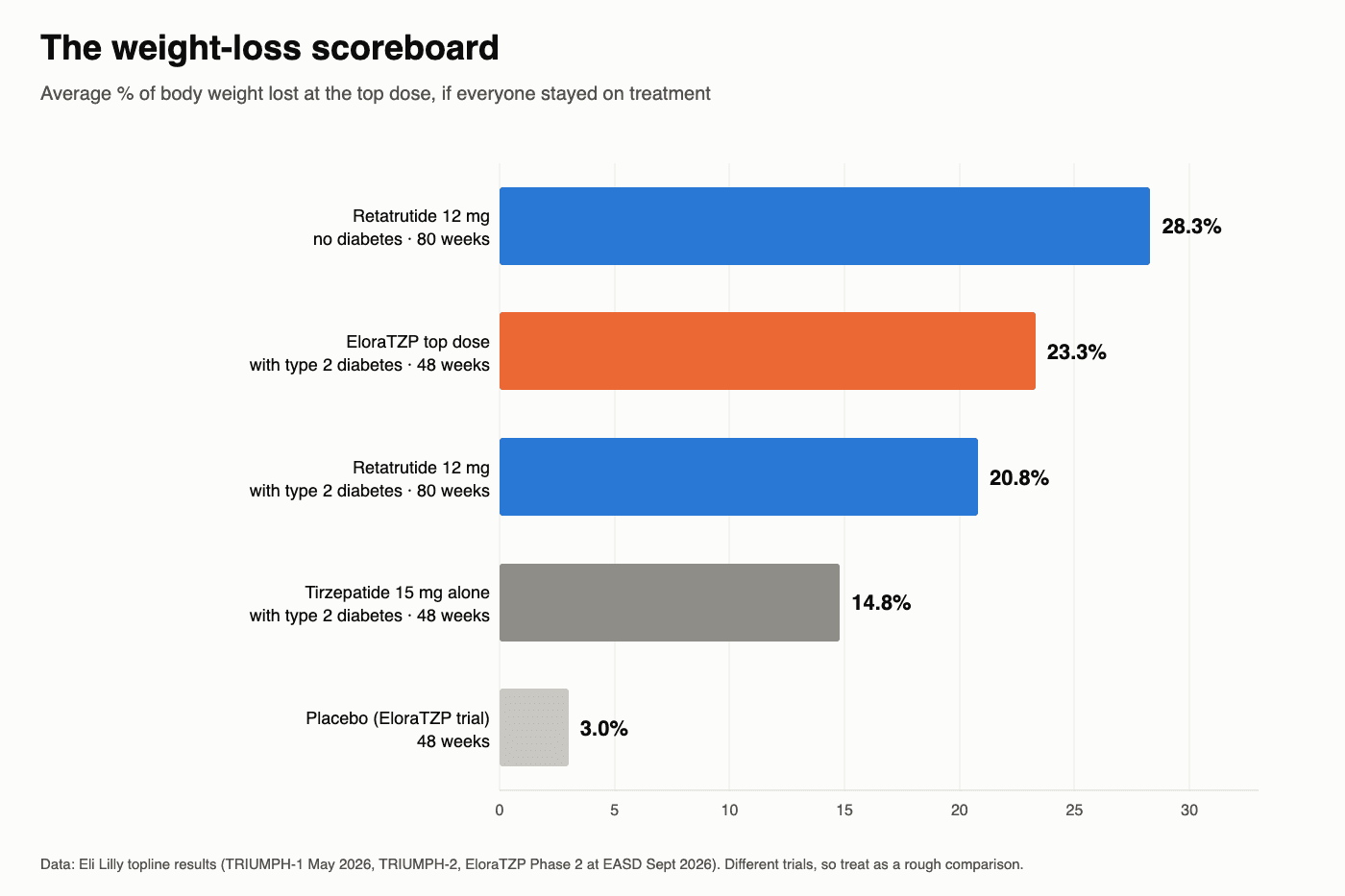
The big trial is called TRIUMPH-1. Lilly shared the results in May 2026. It had 2,339 adults with obesity or overweight, without type 2 diabetes.
After 80 weeks (about 18 months), here’s the average weight lost:
- 12 mg: 28.3%, about 70 pounds
- 9 mg: 25.9%
- 4 mg: 19.0%
- Placebo (fake shot): 2.2%
Nearly half the people on 12 mg (45.3%) lost 30% or more of their body weight. That’s the kind of result people used to need surgery for.
And it kept going. People who stayed on for 104 weeks lost 30.3% on average, about 85 pounds.
“Treatment with retatrutide, the first triple hormone receptor agonist in phase 3 of development for obesity, resulted in substantial weight reduction with nearly two thirds of participants reaching targets below the obesity threshold.”
One honest footnote. The 28.3% assumes everyone stayed on the drug. If you count the people who quit too, it’s 25%. Still huge. Just smaller.
Action item: When you quote a trial number, check which version it is. “If everyone stayed on” is always the bigger number.
Round 2: EloraTZP’s 48-Week Sprint
EloraTZP’s trial was smaller and shorter. It had 367 adults who had obesity or overweight and type 2 diabetes. It lasted 48 weeks (about 11 months). Lilly presented it in September 2026.
The top dose (eloralintide 9 mg plus tirzepatide 15 mg) led to 23.3% weight loss, about 54 pounds.
In the same trial, tirzepatide 15 mg alone gave 14.8%, about 34 pounds. Placebo gave 3.0%.
So adding eloralintide took tirzepatide from about 15% to about 23%. Even a lower combo (eloralintide 6 mg plus tirzepatide 5 mg) hit 19.4%. That beat the full tirzepatide dose with a third of the tirzepatide.
Now, a myth check. You may have seen “the combo hit about 30%.” It didn’t. The best result was 23.3%. And 48 weeks is 60% of 80 weeks, not “less than half.”
“Obesity and type 2 diabetes are interconnected, and we are seeing the potential benefit of targeting multiple hormonal pathways to address both.”
The Fair Fight: Same Kind of Patients
Here’s the twist most headlines miss. People with type 2 diabetes usually lose less weight on these drugs. So comparing a diabetes trial to a non-diabetes trial isn’t fair.
“It is well established that weight reduction with currently available medications is often less for people living with type 2 diabetes compared to those without diabetes.”
Luckily, retatrutide has its own diabetes trial. It’s called TRIUMPH-2. It had 1,152 adults with type 2 diabetes and extra weight. It also lasted 80 weeks.
Now the matchup is fair-ish:
- Retatrutide 12 mg, with diabetes: 20.8% in 80 weeks
- EloraTZP top dose, with diabetes: 23.3% in 48 weeks
In people with diabetes, the combo lost more weight in 32 fewer weeks. Analysts at Citi called the result “notable given the efficacy attenuation typically seen with diabetes,” per Fierce Biotech. In plain English: diabetes usually drags the number down, and this one didn’t sag much.
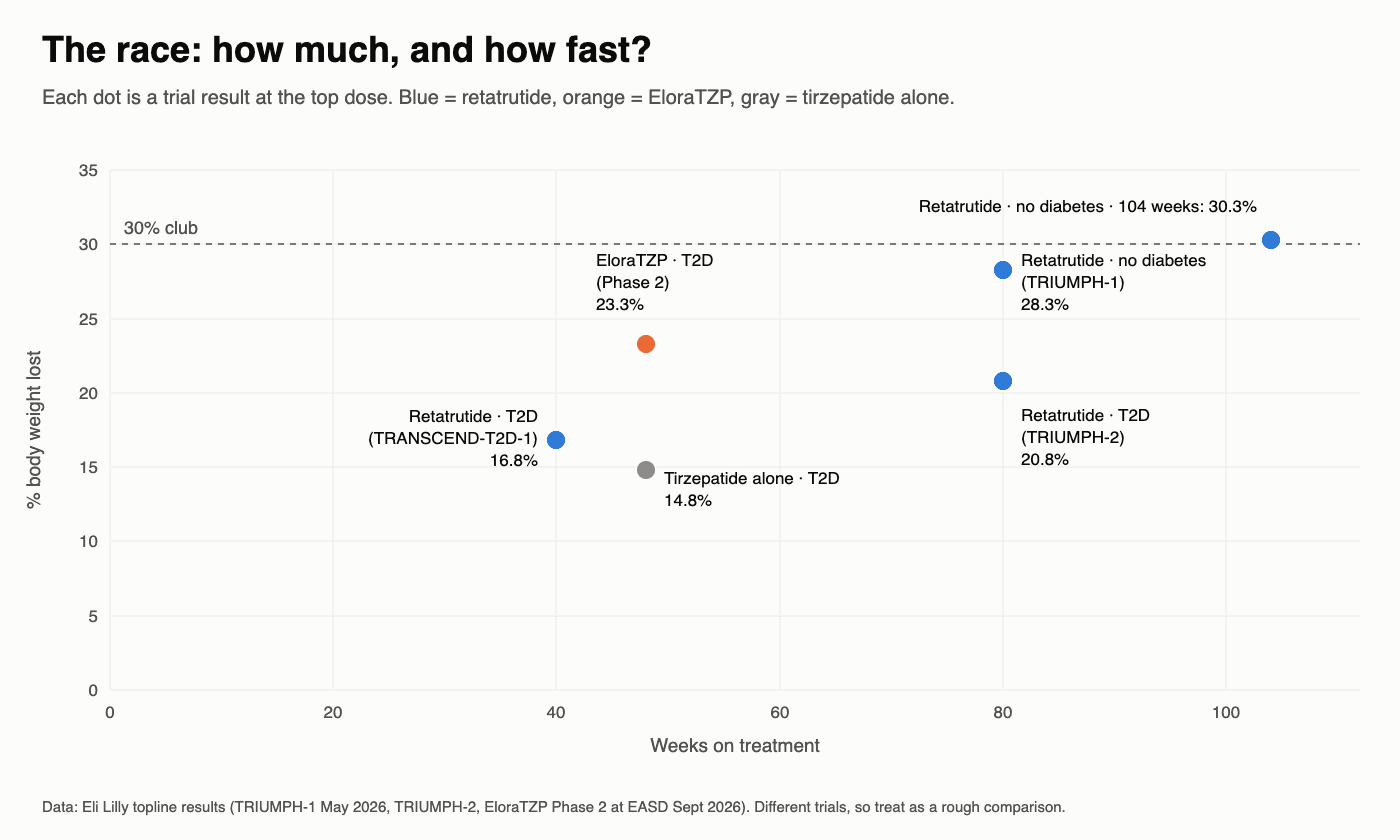
But careful. These are still two separate trials. Different people, different lengths, different doses. Only a head-to-head trial can crown a real winner.
Action item: If you have type 2 diabetes, compare yourself to diabetes trials only. The no-diabetes numbers will set the wrong expectations.
Round 3: The Blood Sugar Battle (A1C)
A1C is a blood test. It shows your average blood sugar over about 3 months. Below 5.7% is normal. 6.5% or higher means diabetes, per the CDC.
Here’s how far A1C fell at the best dose:
- EloraTZP top dose: down 2.9 points in 48 weeks (started at 8.1%)
- Tirzepatide alone: down 2.4 points in 48 weeks (started at 8.1%)
- Retatrutide 9 mg, TRANSCEND-T2D-1: down 2.0 points in 40 weeks (started at 7.9%)
- Retatrutide 9 mg, TRIUMPH-2: down 1.6 points in 80 weeks (started at 7.7%)
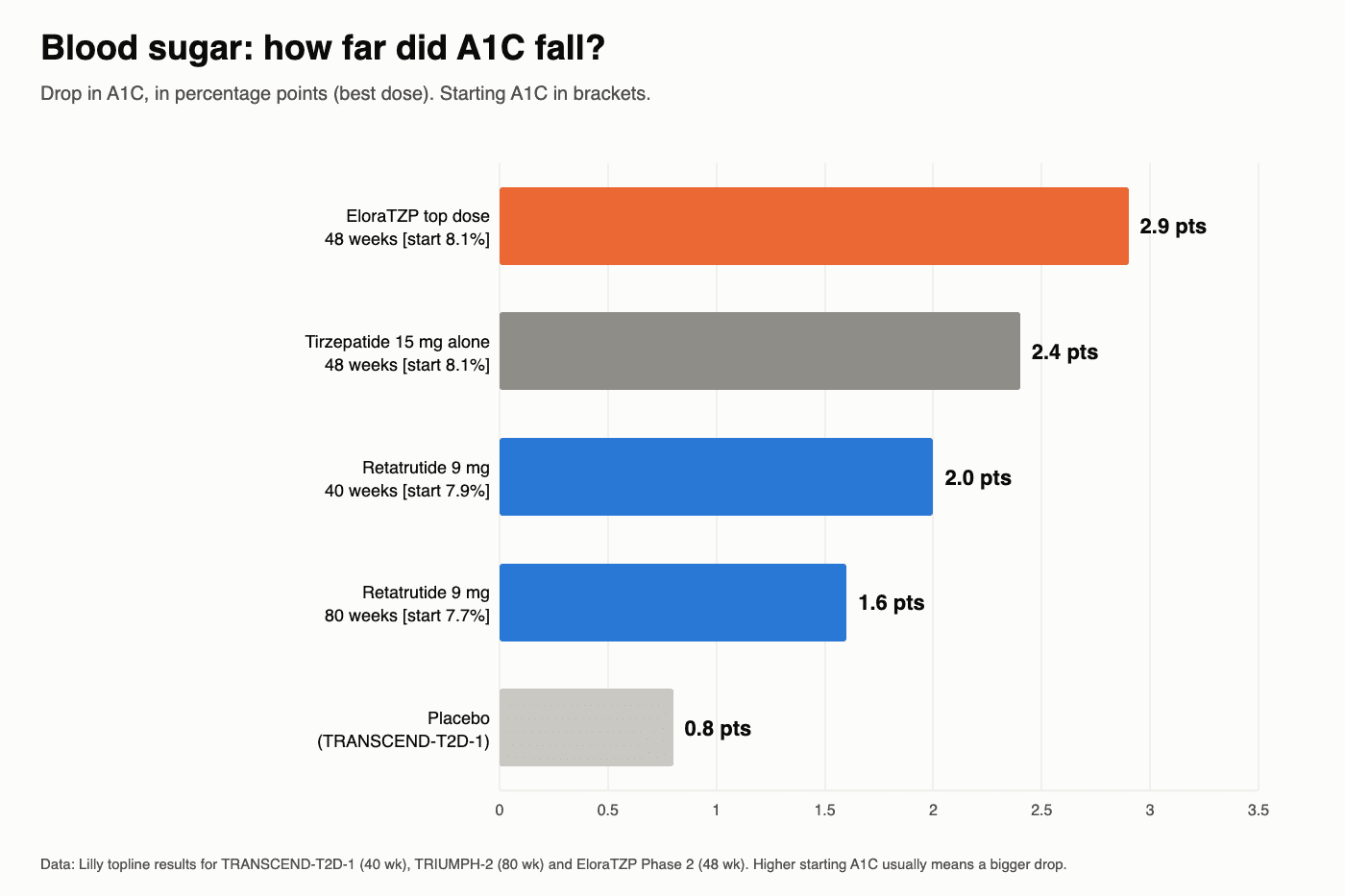
The combo posts the biggest drop. But there’s a catch. People who start higher usually drop further. The combo group started at 8.1%. The retatrutide groups started lower.
Retatrutide still did great. In TRANSCEND-T2D-1, about 90% of people got their A1C below 7%. Up to 85% got to 6.5% or lower. That study was published in The Lancet.
“The magnitude of weight loss observed with retatrutide has the potential to slow disease progression and reshape how we treat and manage type 2 diabetes.”
Action item: Know your own A1C. If you haven’t had it checked this year, ask for it at your next checkup.
The Catch Nobody Puts in the Headline: Side Effects
Most side effects hit the stomach. The common ones are nausea, diarrhea, constipation, and vomiting.
In TRIUMPH-1, 42.4% of people on 12 mg had nausea, versus 14.8% on placebo. Across these trials, most stomach issues showed up while doses were being raised.
The real red flag is how many people quit.
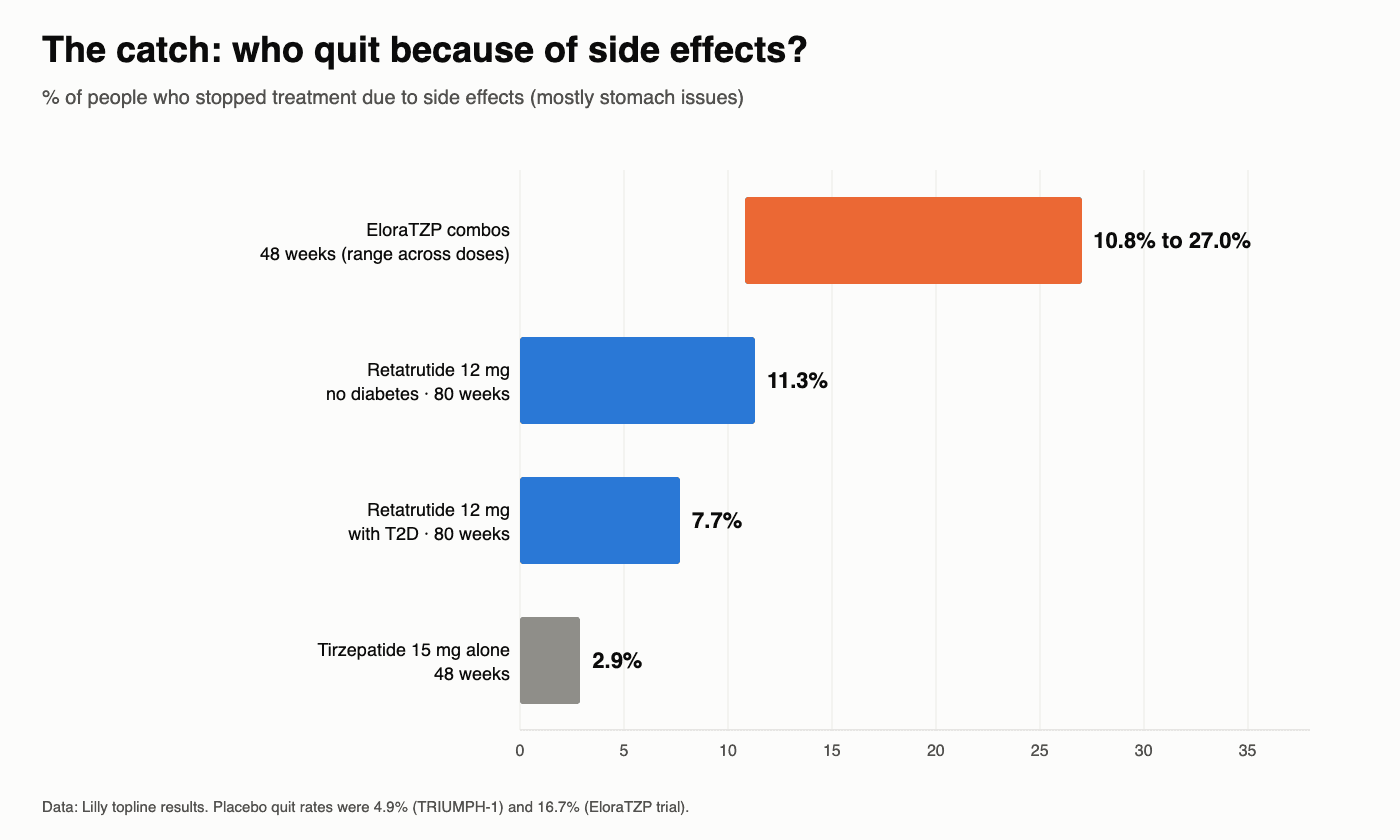
- EloraTZP combos: 10.8% to 27% quit due to side effects
- Retatrutide 12 mg: 11.3% (no diabetes) and 7.7% (with diabetes)
- Tirzepatide alone: 2.9%
One odd detail: 16.7% of the placebo group in the EloraTZP trial also quit for side effects. Small trials get noisy. That’s why Phase 3 matters.
Action item: When you read “up to X% weight loss,” look for the quit rate too. A drug only works if you can stay on it.
So Who Wins? My Take
Retatrutide wins the marathon. 28.3% in 80 weeks, and over 30% by 104 weeks, in a huge Phase 3 trial. That’s the strongest weight-loss data I’ve seen for any shot.
EloraTZP wins the sprint, with an asterisk. In people with diabetes, it lost more weight, faster, than retatrutide did. But it was a small Phase 2 trial, and more people quit.
My honest bet? The future isn’t one magic shot. It’s mixing hormones, like a playlist, tuned to each person. Lilly plans to start Phase 3 trials of EloraTZP by the end of 2026. We’ll know a lot more then.
And here’s the bit I love. Both drugs work by turning up your body’s “I’m full” signals. Even without a shot, you can listen to those signals better. Eating slower gives them time to arrive. That’s exactly why we built MealCam, a gentle pace coach for your meals.
Action item: At your next meal, put your fork down between bites for the first five minutes. Notice when “enough” shows up.
What This Means for You
✅ You can read a weight-loss headline and spot the missing context
✅ You know that diabetes trials and non-diabetes trials aren’t a fair fight
✅ You know what A1C is and what “good” looks like
✅ You check the quit rate, not just the top number
✅ You walk into your next doctor visit with better questions
The 5-Minute Version (Screenshot This)
- Retatrutide (TRIUMPH-1): 28.3% weight loss in 80 weeks. 30.3% by 104 weeks.
- EloraTZP: 23.3% in 48 weeks, in people with type 2 diabetes. Not 30%.
- Fair fight (diabetes only): EloraTZP 23.3% in 48 weeks vs. retatrutide 20.8% in 80 weeks.
- A1C: EloraTZP down 2.9 points. Retatrutide down up to 2.0 points, from a lower start.
- The catch: up to 27% quit EloraTZP for side effects. Neither drug is approved yet.
Conclusion
Retatrutide is the heavyweight champ for total weight loss. EloraTZP is the fast newcomer that shines in type 2 diabetes. Neither is on pharmacy shelves yet.
Your one action today: next time a “record-breaking” headline shows up, check the trial length, the people in it, and the quit rate. That habit will save you from a lot of hype.
So tell me: if you could pick one, would you choose the slow-and-steady marathon drug or the fast combo with more side effects? Why?
Keep Reading
- Foundayo vs Zepbound: pill or shot?
- When will retatrutide be available?
- CagriSema vs EloraTZP: the amylin combo showdown
 MealCoach