
“…position us for several important Phase II readouts in 2027.”
The short answer: in its Biomea Fusion Q3 2026 report on November 10, 2026, the company said it had dosed the first patient in OPAL, an obesity trial pairing its drug icovamenib with semaglutide. It also had $26.8 million in cash, which it expects to last into the second quarter of 2027.
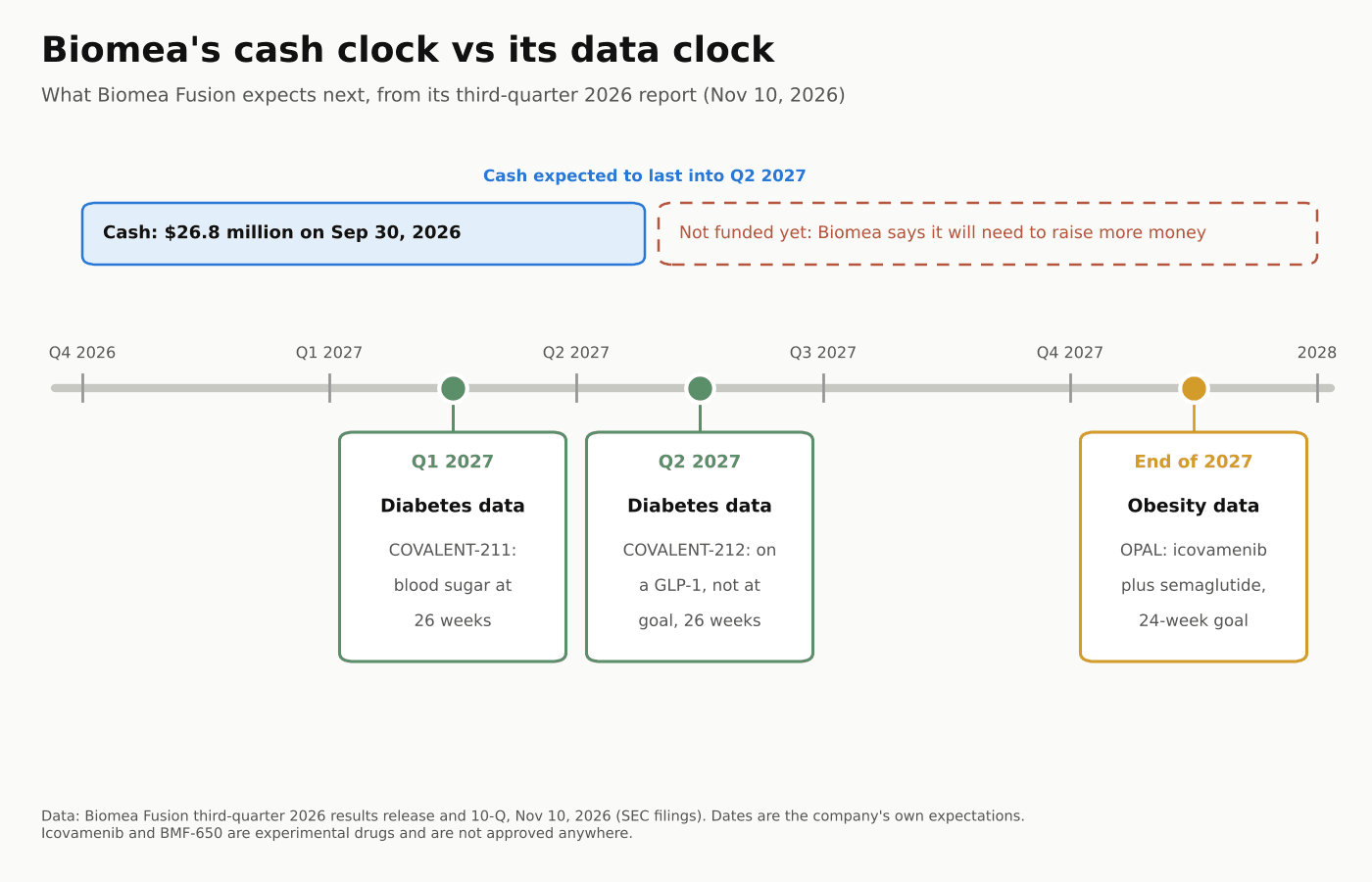
That puts the two clocks out of step. The obesity results are expected at the end of 2027, after the money now in the bank runs out. Biomea’s quarterly filing says there is substantial doubt it can keep going without raising more.
In this post you’ll learn what Biomea reported for Q3 2026, what icovamenib and the OPAL trial are, how its GLP-1 pill BMF-650 did in its first study, and what the cash position means for when you’d hear more. About 6 minutes.
What Was in the Biomea Fusion Q3 2026 Report?
Biomea has no drug on sale, so its report was about spending, cash and trials. It lost $6.2 million in July to September 2026, down from $16.4 million a year earlier. That’s per its November 10, 2026 results release, filed with the SEC. The release mentions no earnings call.
- Research spending: $8.5 million, down from $14.4 million, with cuts spread across lab programs, manufacturing, consultants, trials, staff and facilities.
- Overhead: $4.4 million, up from $4.2 million.
- Cash: $26.8 million in cash and restricted cash on September 30, 2026, down from $56.2 million at the end of 2025.
- How long it lasts: Biomea projects its cash runway into the second quarter of 2027.
One detail matters for reading that smaller loss. Day-to-day costs were $13.0 million. The loss came in at $6.2 million mainly because of a $6.5 million accounting gain on the value of warrants Biomea issued earlier, which brings in no cash.
The 10-Q filed the same day is blunter than the release. It says there is “substantial doubt” about Biomea’s ability to continue as a going concern, and that it will need to raise more money.
Action item: For a small drug developer, the cash line tells you whether its trials can finish on today’s money, and so whether results are likely to arrive on time.
What Is Icovamenib?
Icovamenib is an experimental daily pill that blocks menin, a protein that holds back the growth of insulin-making beta cells. Biomea’s main focus for it is now type 2 diabetes. The idea is to help the pancreas make more of its own insulin, rather than to curb appetite the way GLP-1 drugs do.
In its Phase 2 COVALENT-111 trial of 216 adults with type 2 diabetes, people who took icovamenib for 12 weeks had an average blood sugar (HbA1c) drop of 0.5 points at 26 weeks, versus no change on placebo, Healio reported. That was a per-protocol analysis, which counts only people who followed the plan.
The trial was paused by the FDA in 2024 over liver problems seen while doses were being raised, then allowed to resume. About 2% of people on the drug had raised liver enzymes, which came down without stopping treatment, per Healio.
Action item: Icovamenib isn’t a weight-loss drug on its own. Its obesity test is as a partner to semaglutide, which is the next section.
What Is the OPAL Obesity Trial?
OPAL is a Phase 2 trial run with the University of Leicester that adds icovamenib to semaglutide in adults who are overweight or have obesity, without type 2 diabetes. The first patient was dosed this quarter, and Biomea expects topline results at the end of 2027.
Here’s what the Q3 release, the 10-Q and Biomea’s August 13, 2026 first-patient release say about it:
- Design: randomized and double-blind, run as a new arm of an ongoing adaptive “platform” trial overseen by the Leicester Diabetes Centre.
- Size: 64 adults, split evenly between two groups.
- The pairing: low-dose semaglutide, the drug in Wegovy and Ozempic, for 24 weeks; one group also takes icovamenib 100 mg once a day for 12 weeks.
- What it measures: physical function, body weight, body composition, muscle health and metabolic outcomes.
- Main result: measured at week 24.
Biomea hasn’t said what semaglutide dose counts as low. The interesting part is the focus on muscle and physical function, not just the number on the scale. Whether a second drug can help people keep strength on a lower semaglutide dose is a question many patients care about.
Action item: If you’re on a GLP-1 today, protecting muscle doesn’t have to wait for a trial. Our guide on how to eat on a GLP-1 covers protein and meals.
How Did the BMF-650 GLP-1 Pill Do?
In a four-week first study, people taking Biomea’s experimental GLP-1 pill BMF-650 outside a clinic lost 1.5% to 3.2% of their body weight on average by day 29, versus 0.1% on placebo. That’s per Biomea’s October 13, 2026 release, repeated in the Q3 report.
A fifth group, kept in a clinic so every dose was taken, lost 6.1% on average. Biomea says those numbers should be read separately, because confinement seemed to change how people ate. Its October release adds that the two placebo patients in that group lost a similar amount.
Across the 40 people in the five multiple-dose groups, all side effects were mild or moderate. Nausea came up in 17.5%, constipation in 10%, vomiting in 7.5% and diarrhea in 5%. Nobody stopped because of side effects.
Like Lilly’s Foundayo, BMF-650 is a small molecule, a chemical built to work like the GLP-1 hormone. Biomea says further work needs longer-term toxicology (safety) studies, and it is looking for a partner to license the drug for late-stage trials and sales.
Action item: A four-week study is a safety check, not proof of weight loss. Two GLP-1 pills for weight loss, Foundayo and the Wegovy pill, are already sold in the US; see how one compares with a shot in Foundayo vs Zepbound.
Which Biomea Results Come Next?
Biomea expects two diabetes readouts in the first half of 2027, then the OPAL obesity results at the end of 2027. Per the Q3 report:
- COVALENT-211 (Q1 2027): blood sugar after 26 weeks in adults with type 2 diabetes who make too little insulin. Enrollment is complete.
- COVALENT-212 (Q2 2027): blood sugar after 26 weeks in adults whose type 2 diabetes isn’t at goal on a GLP-1 drug. Still enrolling.
- OPAL (end of 2027): the obesity trial with semaglutide.
The first readout is due while Biomea still expects to have cash. The second is due in Q2 2027, the quarter its cash is expected to last into, assuming no new money. The obesity results come later, so Biomea would need new money, a partner or both to get there on its own plan.
Action item: COVALENT-212 is the one to watch if you’re on a GLP-1 with diabetes. It tests whether icovamenib adds blood sugar control on top of the drug you already take.
When Could Icovamenib or BMF-650 Be Available?
Biomea hasn’t given a filing or launch date for either drug. Both are in Phase 1 or Phase 2, and neither has started a Phase 3 trial.
Phase 3 trials for weight loss usually run more than a year, and an FDA review often takes about a year after that. BMF-650 also still needs longer safety studies and, by Biomea’s own plan, a partner.
So we’d be surprised to see either drug in US pharmacies before 2030. That’s our estimate, not Biomea’s.
Other weight-loss pills are already further along. Viking has started a Phase 3 program for its oral pill, VK2735, as covered in our Viking Q3 2026 recap.
Action item: Don’t put off treatment you need while waiting for a pipeline drug. Ask your doctor about what’s approved today.
What We Don’t Know Yet
Several answers patients care about weren’t in the report. As of November 10, 2026:
- OPAL’s semaglutide dose: what “low-dose” means in milligrams.
- Funding: how Biomea plans to pay for trials past the second quarter of 2027.
- A BMF-650 partner: whether one signs, and on what plan.
- Longer BMF-650 results: nothing beyond four weeks.
Action item: Watch for COVALENT-211 in early 2027. It’s the next real data, and it lands while Biomea still has cash.
Quick Answers
What did Biomea Fusion report in Q3 2026? A net loss of $6.2 million, $26.8 million in cash expected to last into Q2 2027, the first patient dosed in the OPAL obesity trial, and a search for a partner for its GLP-1 pill BMF-650.
Is icovamenib approved? No. It’s in Phase 2 trials and isn’t approved anywhere as of November 2026.
How much weight did people lose on BMF-650? 1.5% to 3.2% on average after four weeks in outpatient groups, versus 0.1% on placebo, in a small first study.
When are the OPAL obesity results due? At the end of 2027, per Biomea.
Does this news change my GLP-1 treatment? No. Nothing here is approved, and no prices or launch dates were announced.
What This Means for You
✅ You know Biomea’s cash is expected to last into Q2 2027
✅ You know the OPAL obesity results are due at the end of 2027
✅ You know icovamenib is a diabetes drug being tested as a partner to semaglutide
✅ You know BMF-650’s numbers come from a four-week safety study
✅ You know neither drug is coming to pharmacies soon
The 5-Minute Version (Screenshot This)
- News: Biomea Fusion reported Q3 2026 results on November 10, 2026; the release mentions no earnings call.
- Money: net loss $6.2 million; $26.8 million in cash, expected to last into Q2 2027.
- Obesity: first patient dosed in OPAL, icovamenib plus semaglutide; results expected at the end of 2027.
- Pill: BMF-650 showed 1.5% to 3.2% weight loss at day 29 in outpatient groups; Biomea is seeking a partner.
- Next: diabetes results in Q1 and Q2 2027.
Conclusion
The Biomea Fusion Q3 2026 report started an obesity trial and ran a cash clock beside it. The diabetes answers arrive in the first half of 2027, near the end of the money. The obesity answers arrive later, and getting there depends on funding the company doesn’t have yet.
Your one action today: if you’re on a GLP-1, focus on what you can control now, like eating enough protein and slowing down at meals.
So tell me: would you add a second daily pill to a GLP-1 if it helped you keep more muscle?
Sources
- Biomea Fusion: third-quarter 2026 financial results and corporate highlights (SEC filing, Nov 10, 2026)
- Biomea Fusion: quarterly report on Form 10-Q for the period ended Sep 30, 2026 (SEC filing, Nov 10, 2026)
- Biomea Fusion: first patient dosed in OPAL study of icovamenib with semaglutide in obesity (Aug 13, 2026)
- Biomea Fusion: Phase I results for BMF-650 (Oct 13, 2026)
- Healio: novel oral agent lowers HbA1c, improves beta-cell function in type 2 diabetes (2026)
 MealCoach