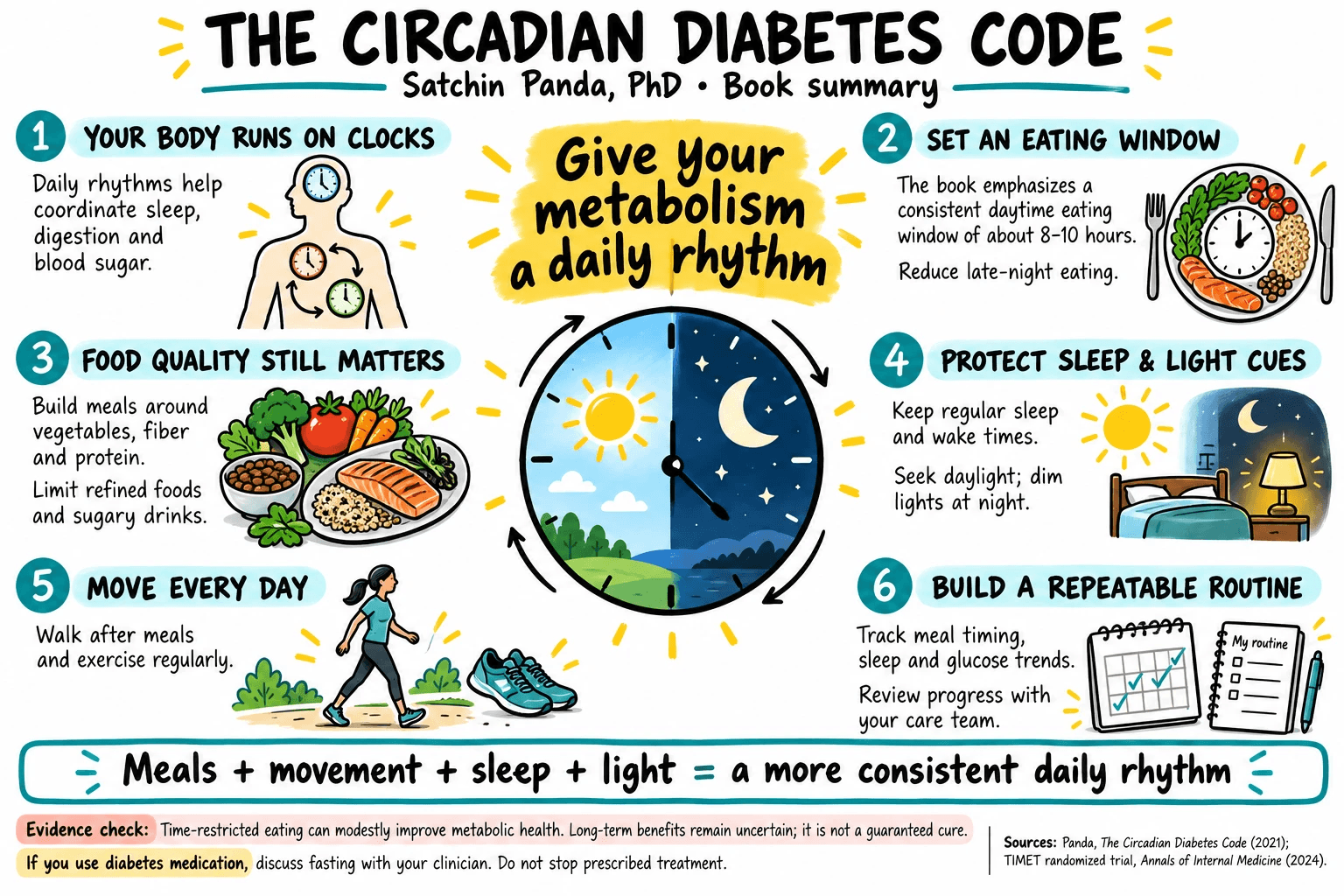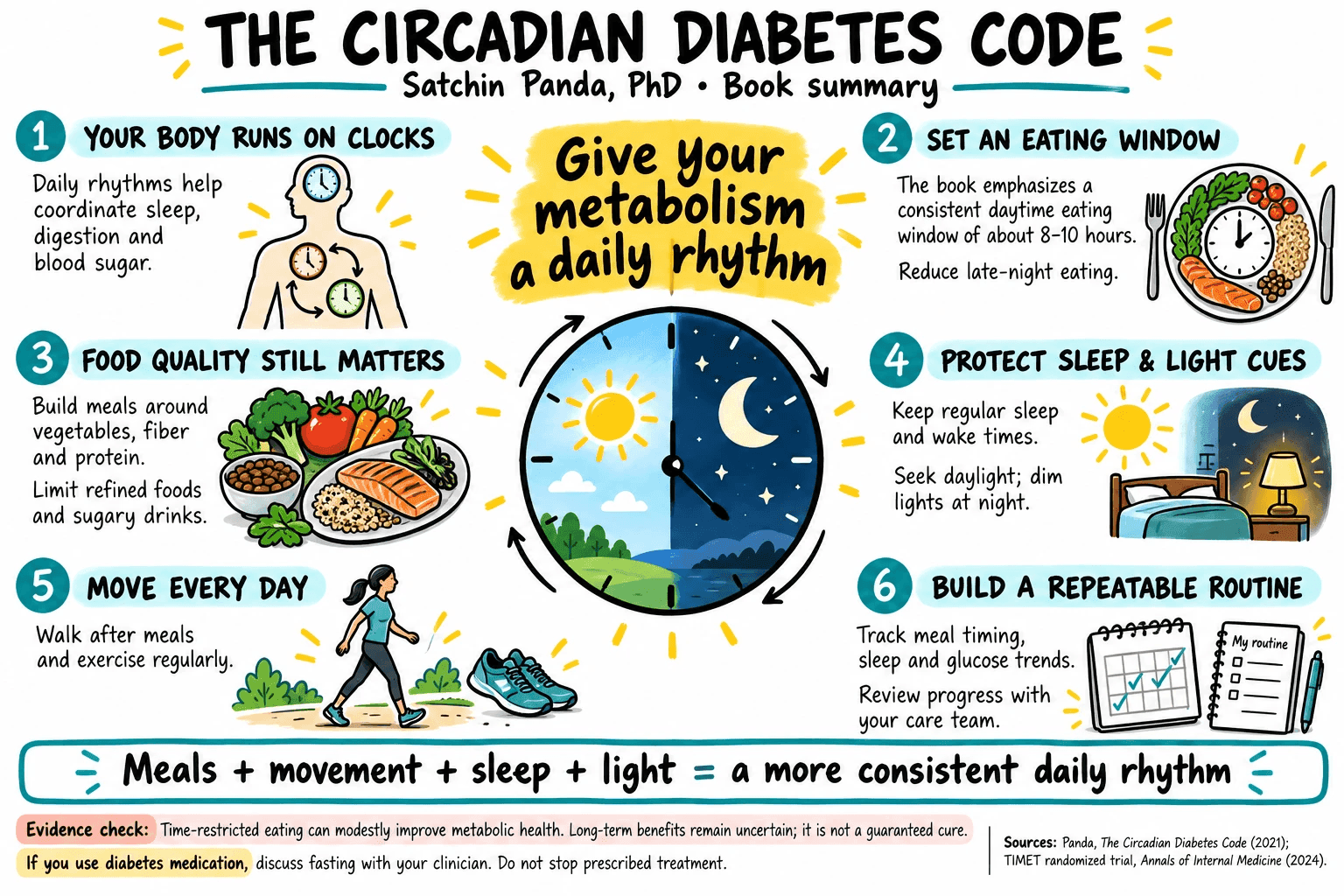
A plain-English summary of The Circadian Diabetes Code by Satchin Panda
"Diabetes is a disease of timing"
Satchin Panda, author of The Circadian Diabetes Code, on The Doctor's Kitchen podcast
What you'll learn: the 10-hour rule from The Circadian Diabetes Code, a sample day to copy, and where the science runs thin.
The list that never ends
The doctor turns the screen toward you. One number is in red.
Then comes the list. Eat less. Move more. Cut sugar. Count every calorie. Log every walk.
You nod. You try. By week six, the food diary is in a drawer.
Satchin Panda studies body clocks for a living. He says the list isn't wrong. It's too hard to live with, and it skips a question nobody asks you.
Not what you ate. When did you eat it?
His book says you may hit your goals "without counting a single calorie" (publisher's sample, introduction).
That's a big promise. He backs it with a story from his own family.
Meet Mrs Panda
Panda's mother lives in India. Year after year, her blood sugar numbers crept up.
Her doctor wasn't worried. She was. She'd watched friends take pills for years and still lose their eyesight and their kidneys.
Here's the maddening part. She was already doing it all. She ate vegetarian food with heaps of fruit and vegetables. She walked every evening. Dinner was over by 8 p.m.
So her son went looking for something small. Two or three nights a week, she'd visit relatives and have tea with milk and sugar around 9 p.m.
He told her the tea was the problem. She laughed at him.
Then she stayed at his home in the United States. His rule: breakfast at 9 a.m., no food after 6 p.m.
Five months later, her morning blood sugar, taken before food, sat near a healthy range. Panda writes that she's stayed off all medication for five years (publisher's sample, introduction).
His line in the book: "How do I know all this? Just ask my mother."
One mother is a story, not proof. So why would a cup of tea matter at all?
Your blood holds one teaspoon of sugar
This fact from the book stopped me.
A healthy adult has about 4 to 6 grams of sugar in the blood at any moment. That's one teaspoon (publisher's sample, chapter 1).
A can of fizzy drink has about 39 grams. So every meal is a flood, and your body has to mop it up fast.
The mop is insulin, a hormone that opens your cells so sugar can get in. Panda compares it to a garage door opener. Sugar is the car.
Now the clock part. Panda says we handle sugars and fats differently depending on the time of day (Salk Institute).
Late at night, the cleaning crew has gone home. The flood stays longer.
Action item: Tonight, write down the time of your last bite or sweet drink. Don't change anything yet.
Could timing alone do that much? Panda tested it on mice.
Same food, same calories, different mice
In 2012, Panda's lab fed two groups of mice the same fatty food. One group could eat any time. The other could eat only during 8 hours a day.
Here's the twist. Both groups ate the same amount.
After 100 days, the round-the-clock mice were obese, with fatty livers. The 8-hour mice weighed 28 percent less and were protected (study summary, Salk Institute).
Same food. Same calories. A different clock.
Mice aren't people. Panda said so himself, and told reporters we'd have to wait for human studies.
Action item: Tomorrow morning, write down the time of your first bite. Now you have both ends of your eating day.
So he looked at people. What he found is a little embarrassing for all of us.
We eat for 15 hours a day
Panda's team gave more than 150 adults a phone app. For three weeks, they snapped a photo of everything they ate or drank (Salk Institute).
The photos were a shock. Most people ate across 15 hours or more each day. More than a third of their calories came after 6 p.m.
Think about your own day. Coffee with milk at 6:30 a.m. A biscuit at 11 p.m. That's a 16-hour shift for your insides, with no night off.
Then eight overweight people cut their eating day to 10 or 11 hours. After 16 weeks, they'd lost weight.
Action item: Do the maths on your two times. If your eating day is over 12 hours, you're normal. You also have room to shrink it.
Eight people is tiny. The bigger tests came next.
The 10-hour rule, tested on real patients
The core rule of The Circadian Diabetes Code is short. Eat all your food and drink inside the same 10 hours each day.
Panda and heart doctor Pam Taub first tried it on 19 patients with early warning signs of diabetes (AJMC). Then came a proper trial in 2024, with 108 adults. Half also ate inside 8 to 10 hours for three months.
The clock group lost 3 to 4 percent more weight and belly fat. Their long-term blood sugar marker dropped a little too (Salk Institute).
Nobody changed what they ate. They changed when.
It even helped firefighters on 24-hour shifts. Panda called it "not a pill, but a healthy habit" (Salk Institute).
The 2024 trial used two guard rails:
Start eating at least one hour after you wake up.
Stop eating at least three hours before bed.
Action item: Pick your 10 hours now. Write the two times on a sticky note and put it on the fridge.
Fine. But what does that look like on a Tuesday?
A 10-hour day you can copy
Here's my version for someone who wakes at 7 a.m. and sleeps at 10:30 p.m.
7:00 a.m. Water, plain tea, or black coffee. The window isn't open yet.
8:30 a.m. First bite. That's over an hour after waking.
1:00 p.m. Lunch, your biggest meal if you can. Earlier is easier on blood sugar.
6:30 p.m. Last bite. That's four hours before bed.
After 6:30. Water or herbal tea, no milk or sugar. Mrs Panda's 9 p.m. tea lives here.
The last chapter of The Circadian Diabetes Code stretches this into a 12-week challenge. Other chapters cover when to exercise, sleep, and light at night.
I think the window is the piece to start with. It's free.
Action item: Run this day once this week. One day, not seven.
Now the part where I stop cheering.
Where The Circadian Diabetes Code worries me
I like this book. I also think it oversells.
Take the calories out, and the magic shrinks. In 2024, Johns Hopkins fed 41 adults the same calories for 12 weeks. Half ate in a 10-hour window. Both groups lost the same weight (Futurity). The lead doctor's guess: a short window helps because people eat less.
"Reverse" is a strong word. The subtitle promises to prevent and reverse diabetes. Much of the proof is mice and small pilot studies. Goodreads readers noticed too (Goodreads).
Diabetes medicine changes the maths. Some pills can push blood sugar too low if you move or skip meals. Panda says to ask your doctor first. So do I.
My take: the window works mostly because it's a simple way to eat less, and less at night. That's useful. It isn't magic.
This book builds on Panda's first one. My summary of The Circadian Code covers the light and sleep side.
Is The Circadian Diabetes Code, a 2021 book, still worth your time? This year's numbers say yes, with an asterisk.
Why The Circadian Diabetes Code fits right now
About 115 million American adults have prediabetes. That's blood sugar that is high, but not yet diabetes (CDC). That's a lot of people being handed the list.
In 2026, researchers pooled 12 studies of timed eating in 344 people with type 2 diabetes. The long-term blood sugar marker fell by about a third of a point (Diabetology & Metabolic Syndrome).
That's small, and real. A year-long trial is running now to see if it lasts.
The fair summary in 2026: a helpful habit, not a cure.
What you get from this
✅ One rule to follow, not a diary of calories
✅ A free experiment you can start tonight
✅ A clear idea of what the science does and doesn't show
Short on time? Here's the whole post in six lines.
The 5-Minute Version
Your blood holds about one teaspoon of sugar. Every meal is a flood your body must clear.
Your body clears sugar worse late at night.
Most people eat across 15 hours a day or more.
The Circadian Diabetes Code says: eat everything inside the same 10 hours daily.
Start an hour after waking. Stop three hours before bed.
In trials, results are modest. Much of the benefit may come from eating less. Ask your doctor first if you take diabetes medicine.
One cup of tea sums it up.
Conclusion
A woman in India ate her vegetables, took her walks, and watched her blood sugar rise anyway. The thing she changed wasn't on her plate. It was on the clock.
That's the heart of The Circadian Diabetes Code. You don't need a perfect diet to start. You need a closing time.
I don't buy every promise in the book. I do buy this one small habit.
Go back to the two times you wrote down. Tonight, move your last bite one hour earlier.
What's your 9 p.m. tea?
This post is for learning, not medical advice. If you have diabetes or take medicine for blood sugar, talk to your doctor before you change when you eat.
 MealCoach