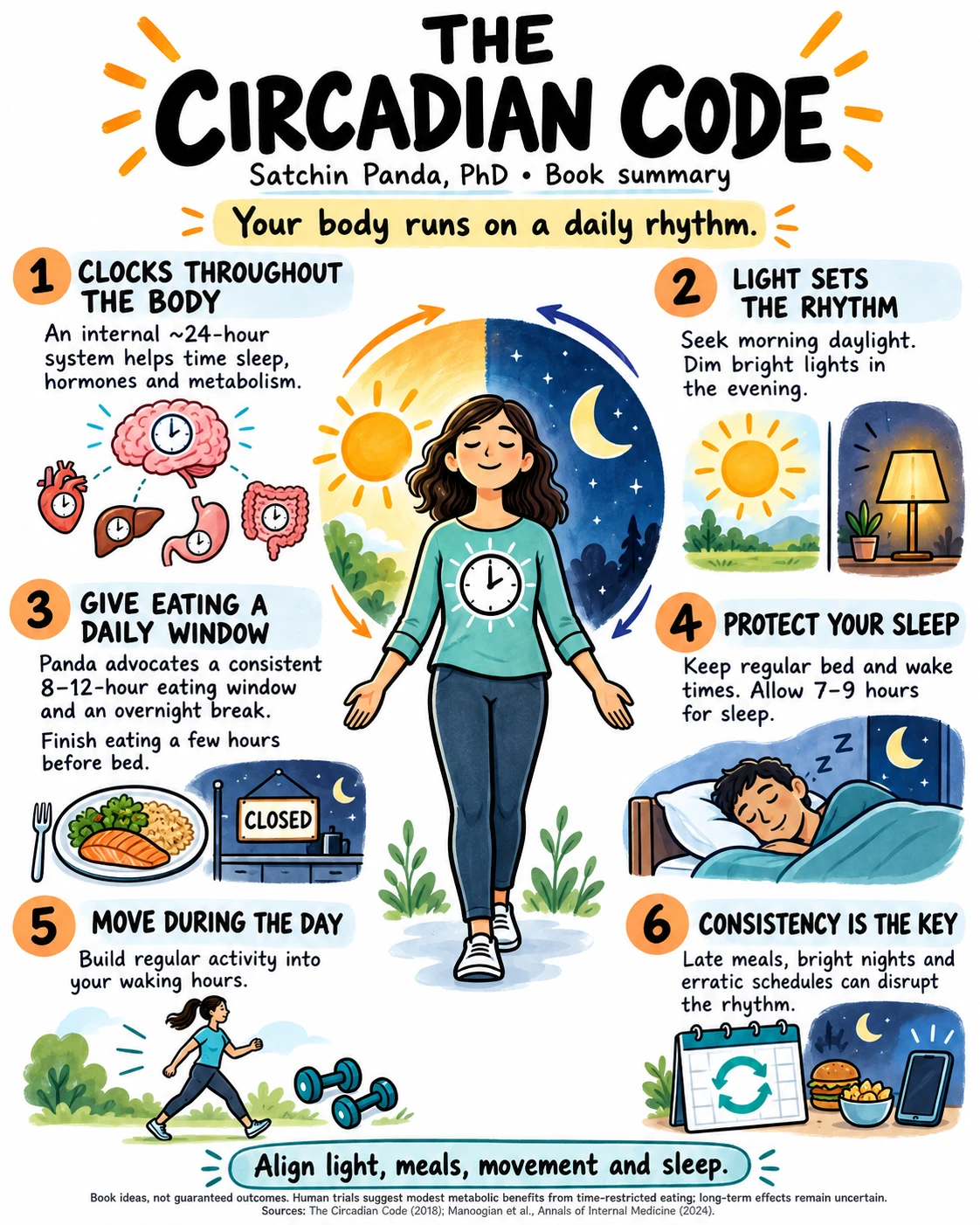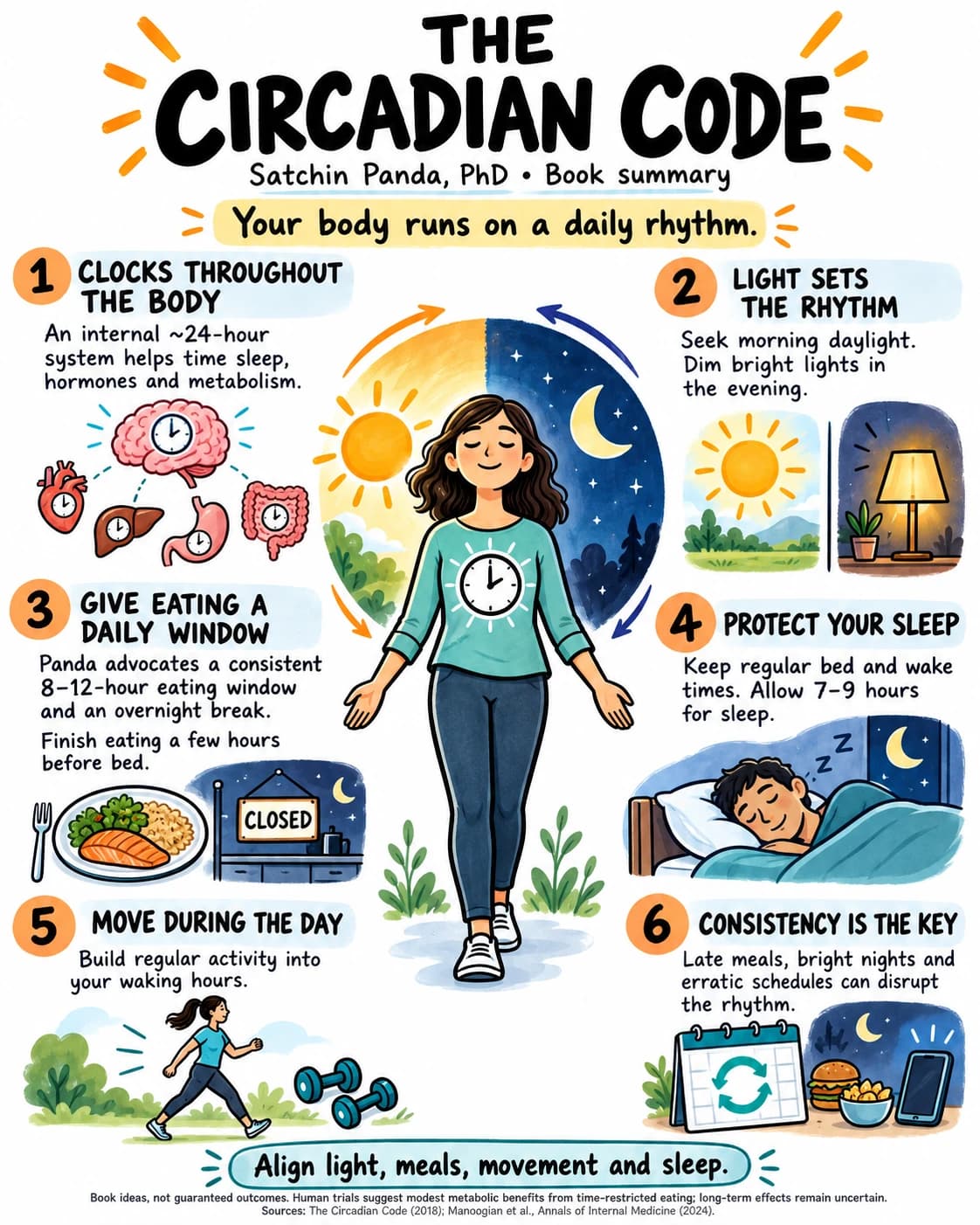
A plain-English summary of The Circadian Code by Satchin Panda, PhD
"When we eat may be as important as what we eat."
From the publisher's description of The Circadian Code (Penguin Random House)
What you'll learn: the one rule at the heart of The Circadian Code and what happened when people tried it. Plus a sample day you can copy tomorrow.
The kitchen light at 11 p.m.
It's 11 p.m. The house is dark. The fridge light isn't.
You ate a good dinner. Now you're holding a spoon and a jar of peanut butter, and you're not even hungry.
You've got company. Satchin Panda's lab had about 150 adults photograph everything they ate for three weeks. Most ate across 15 hours or more each day (Salk Institute).
That's a mouth that opens at 7 a.m. and closes near midnight.
Every diet you've tried argued about what's on the plate.
Panda asks a different question: what time is it?
His answer started with two old men in India.
Two grandfathers, two clocks
Panda grew up in Odisha, India. He spent his childhood between two grandfathers whose lives were nothing alike.
One worked for the Indian Railways, sometimes on night shifts. He lived near good doctors.
The other farmed in a far-off village. No power lines. No clinic. He rose with the sun, ate from his own fields and slept when it got dark.
Which one would you bet on?
The railway grandfather died first, of a disease that wears down the brain. Panda says he only saw the pattern looking back (Heartfulness interview, 2021).
One family story proves nothing. So Panda ran a test that's hard to argue with.
The mouse test that started a diet craze
In 2012 his team fed two groups of mice the same greasy food. Call it mouse pizza.
Group one ate whenever they liked. Group two got the same food, but only during an 8-hour window.
Both groups ate the same calories. The test ran for 100 days.
The mice with a window weighed 28% less. The all-day eaters got fat, with sick livers and high blood sugar (Salk Institute, 2012).
That number stopped me cold. But mice aren't people, and the human results are messier. We'll get there.
Action item: Tonight, write down the time of your first bite and your last bite today. Count the hours between. That's your eating window.
Idea 1: your body keeps a schedule
"Circadian" means "about a day." It's your body's 24-hour rhythm.
Panda's claim in The Circadian Code is that your gut, liver and muscles keep time too. They expect food by day and rest at night.
Eat at midnight and you wake the kitchen staff after closing. They'll cook for you. They won't do it well.
Meals do move the clock. In a 2025 German trial, 31 women ate the same food on an early and a late schedule. On the late one, their body clocks ran about 40 minutes later (ScienceDaily).
Action item: Pick a breakfast time you can keep seven days a week. Weekends count.
Idea 2: shrink the window
Here's the core rule of the Circadian Code. Eat all your food inside one set window each day.
His steps, as Shortform sums them up:
Start with 12 hours. Say 8 a.m. to 8 p.m.
Trim about an hour a week until you reach 8 to 11 hours.
Stop eating 2 to 4 hours before bed.
Anything but water starts the clock. Yes, coffee counts.
No calorie counting. No banned foods. I think that's why it spread so fast. I also think the coffee rule is the one most people quietly skip.
Action item: Set a phone alarm called "Kitchen closed" for three hours before your bedtime.
Idea 3: light is the other half
Panda made his name on eyes, not food.
In the early 2000s his team helped show that a sensor in the eye tells the brain's clock the time. It reacts most to blue light (Wikipedia).
Your phone at midnight sends that sensor a clear message: it's noon.
The book's sleep recipe starts like this:
"lots of light during the day, no light at night, less noise"
Satchin Panda, The Circadian Code (Goodreads)
It goes on to a cooler room and an earlier dinner.
Action item: Get outside within an hour of waking. Dim the lights after dinner.
What happened when people tried it
Eight overweight adults. They cut from 14-plus hours of eating to 10 or 11 and changed nothing else. After 16 weeks they'd lost 3.5% of their excess weight and slept better (Salk Institute).
150 firefighters. They worked 24-hour shifts. Half ate inside a 10-hour window for three months. A blood fat tied to clogged arteries improved, and they drank about three fewer drinks a week (Salk Institute, 2022).
Eight people is tiny. But firefighters on 24-hour shifts kept this up, so my excuse about busy Tuesdays looks thin.
Action item: Try a 12-hour window for two weeks before you judge it. Each morning, score your sleep and energy from 1 to 5.
A sample day on the Circadian Code
Here's a 10-hour Circadian Code day that fits a normal job.
7:00 a.m.: Wake up. Water. Ten minutes of daylight.
8:00 a.m.: Breakfast. The window opens. Coffee goes here, not earlier.
12:30 p.m.: Lunch.
6:00 p.m.: Dinner. The window closes.
8:00 p.m.: Lights low. Screens dimmed or down.
10:00 p.m.: Bed, in a cool, dark room.
Too tight? Start at 12 hours.
Where the Circadian Code oversells
I like this book. I also think it promises too much.
The big claims lean on mice. The publisher says the plan can help prevent or ease diabetes, cancer and dementia (Penguin Random House). The strongest proof still comes from animals.
A fair human test fell flat. In 2020, a UCSF team put 116 adults on noon-to-8 eating or three meals a day. After 12 weeks the window group had lost about 2 pounds and the other about 1.5. No real gap (UCSF).
Same calories, same result. In that 2025 German trial, an 8-hour window didn't improve blood sugar or blood fats when calories stayed equal (ScienceDaily).
My read: a window works mostly when it makes you eat less. It shuts the kitchen during your snack hours. Useful. Not magic.
Why the Circadian Code matters now
The Circadian Code came out in 2018, when the best proof was mice.
Eight years on, each new human trial swings the headlines. "Fasting windows work." "Fasting windows don't work." It's enough to make you eat a sandwich at midnight.
The trials shrank the promise and kept the habit. A window won't melt fat. It does give your day a closing time.
Worried about blood sugar? Panda wrote a second book on that. Here's my summary of The Circadian Diabetes Code.
What you get from this
✅ A kitchen with closing hours, so 11 p.m. stops being a meal
✅ A fair view of the science, so no headline can fool you
The 5-Minute Version
The Circadian Code says when you eat matters, not only what you eat.
Most adults in Panda's study ate across 15 hours or more a day (Salk Institute).
Mice fed the same calories in 8 hours weighed 28% less than all-day eaters (Salk Institute, 2012).
The rule: eat inside a set window. Start at 12 hours. Work toward 10.
Stop 2 to 4 hours before bed. Coffee starts the clock.
Bright days, dark nights.
Human trials are mixed. A window helps most when it makes you eat less.
Conclusion
The Circadian Code makes one bet: your body cares what time it is.
The mouse results are striking. The human ones are smaller and don't all agree. I still think the Circadian Code habit is worth two weeks. It's free.
So do one thing tonight. Write down your first bite and your last bite. Count the hours.
If the number is 15, close the kitchen one hour earlier this week.
What time did your kitchen close last night?
This post is for learning, not medical advice. Talk to your doctor before you change when you eat. That matters most if you're pregnant, have diabetes, take medicine with food, or have a history of disordered eating.
 MealCoach