
“…another strong quarter, exceeding our prior expectations…”
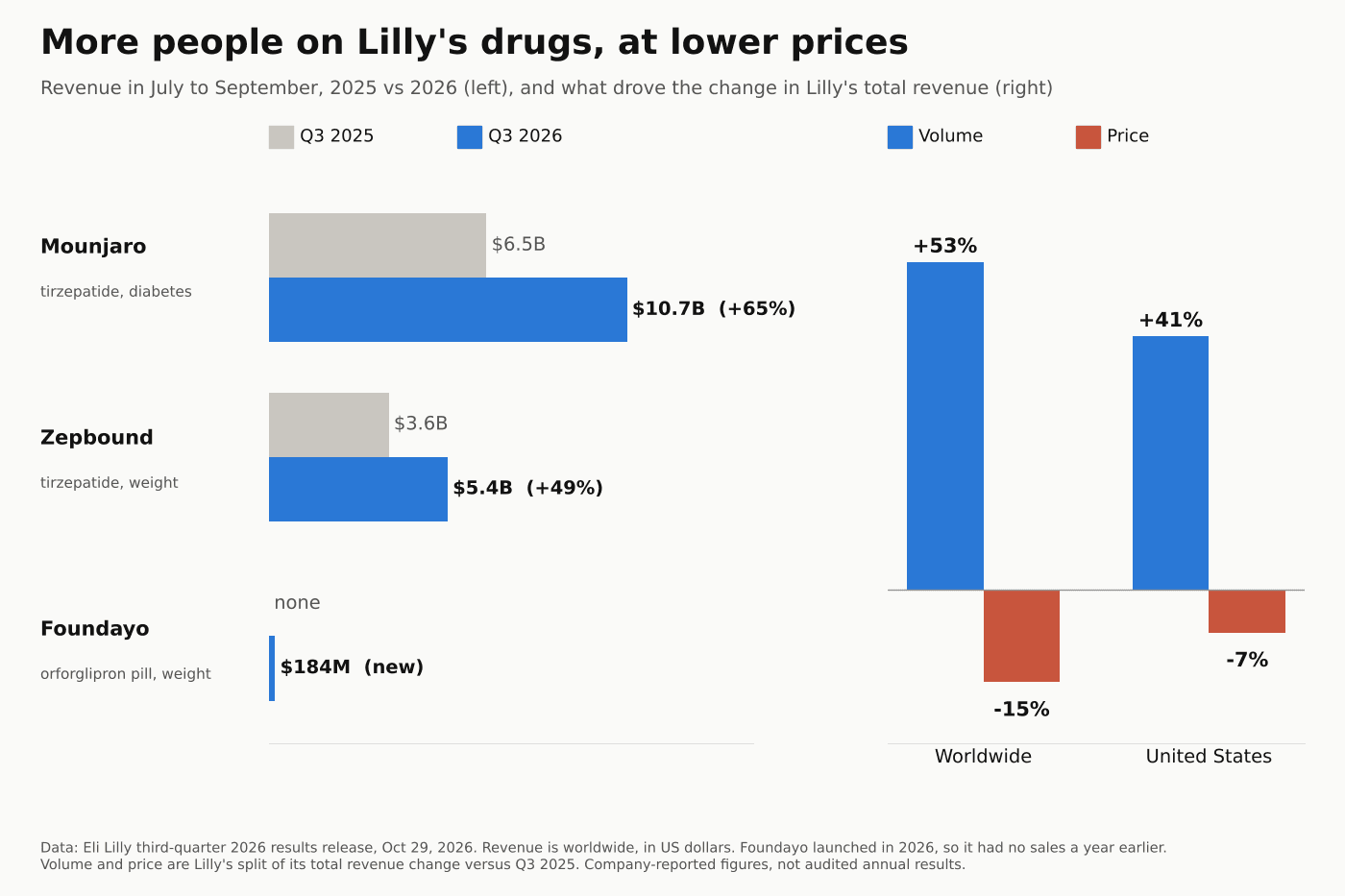
The short answer: on its Lilly Q3 2026 earnings call on October 29, 2026, Eli Lilly said far more people are taking its weight and diabetes drugs, at lower prices. Mounjaro and Zepbound (both tirzepatide) brought in $16.1 billion in July to September, while the new Foundayo pill brought in $184 million.
For people on these drugs, the big news was Medicare: more than half a million people have filled a Lilly prescription through Medicare’s $50 GLP-1 Bridge since July 1. Lilly still plans to file retatrutide with the FDA in early 2027; the call gave no update on that.
In this post you’ll learn what Lilly’s third-quarter 2026 report said about Zepbound, Mounjaro and Foundayo, what changed for Medicare patients, what Lilly said about prices, and where retatrutide and EloraTZP stand. About 7 minutes.
What Was in the Lilly Q3 2026 Earnings Report?
Lilly’s revenue rose 39% to $24.4 billion in the third quarter of 2026. It also raised its full-year sales forecast to $91 to $92 billion, up from $85 to $87 billion. That’s per its October 29, 2026 results release.
- Mounjaro (tirzepatide, for type 2 diabetes): $10.7 billion worldwide, up 65%. US sales were $5.0 billion and sales outside the US $5.7 billion.
- Zepbound (tirzepatide, for weight): $5.4 billion worldwide, up 49%. US sales rose 48% to $5.3 billion.
- Foundayo (orforglipron, a daily weight-loss pill): $184 million in its second quarter on sale, and $281 million so far in 2026.
About $900 million of that revenue was one-time benefits, including $410 million in milestone payments for Jardiance, per the release. The release says US Zepbound sales were driven mainly by strong demand, partly offset by lower prices. Lilly also listed a new FDA approval for Mounjaro to reduce heart risk in adults with type 2 diabetes.
Action item: Read revenue as a demand signal, not a health signal. Rising sales tell you more people are on these drugs, not how well they work for you.
How Are Zepbound and Mounjaro Doing?
Prescriptions are still climbing fast. US prescriptions for obesity drugs in the GLP-1 family grew 82% from a year earlier, Lilly’s finance chief said on the call. About 6 in 10 of those prescriptions, and more than 7 in 10 of the injectable ones, were for a Lilly medicine, per the earnings call transcript.
All US incretin prescriptions, diabetes included, grew 32% from a year earlier. In type 2 diabetes alone, Lilly said it holds more than 60% of the US market.
Ilya Yuffa, president of Lilly USA, said people are staying on Zepbound well. He said people paying cash stay on nearly as long as people with insurance. Lilly gave no exact numbers.
Action item: If you’re on Zepbound or Mounjaro, nothing in this report changes your treatment. Lilly didn’t flag any supply problems on the call.
Is Foundayo Catching On?
It’s picking up. About 4 in 10 US patients starting an obesity pill now choose Foundayo, and new Foundayo patients doubled from the second quarter to the third, Lilly said on the call. Yuffa said the pill passed half a million US prescriptions in the quarter, and about 25% of people on it have reached one of its maintenance doses.
Foundayo’s $184 million was below the roughly $217 million analysts expected, Reuters reported. Lilly’s finance chief, Lucas Montarce, told Reuters in an interview that about $30 million of second-quarter sales were stock sent to pharmacies. Without that, he said, US demand grew from about $37 million to over $120 million.
- Type 2 diabetes: Lilly expects the FDA to act on Foundayo for type 2 diabetes in the fourth quarter of 2026.
- Outside the US: launched in the UAE, the UK, Saudi Arabia and Mexico, with reviews under way in more than 40 other countries. Lilly expects to launch in all major markets in 2027.
- Heart safety: in ACHIEVE-4, a trial in people with type 2 diabetes, obesity and higher heart risk, orforglipron met its main goal of being no worse than insulin glargine on major heart events, said Daniel Skovronsky, Lilly’s chief scientific and medical officer. The results were published in The Lancet on September 30, 2026, per Pharmacy Times.
Skovronsky also cited a 16% lower risk of major heart events (a four-part measure called MACE-4) and a 57% lower risk of death from any cause versus insulin glargine. Neither proves a heart benefit.
The 16% gap wasn’t statistically significant, and the death result wasn’t adjusted for multiple comparisons, per Pharmacy Times. The trial was open-label and compared the pill with insulin, not placebo.
Action item: If you’re weighing Foundayo against a shot, compare weight loss and price side by side in our Foundayo vs Zepbound guide before you talk to your doctor.
What Did Lilly Say About Medicare Coverage for Weight-Loss Drugs?
Medicare now covers these drugs for many seniors through the GLP-1 Bridge. Since it started on July 1, 2026, more than half a million people have filled a Lilly prescription through it, CEO David Ricks said. About 7 in 10 new Bridge patients started on a Lilly obesity drug.
Yuffa said about 75% of Bridge patients chose an injectable, and about 80% had never been on one of these drugs before.
The Bridge is a CMS demonstration that runs from July 1, 2026, to December 31, 2027, outside the normal Part D benefit, per CMS. Here’s how it works:
- Cost: a $50 copay, which NPR and KFF Health News report is per month and doesn’t rise with the dose.
- Drugs covered: Foundayo, every form of Wegovy, and Zepbound in the KwikPen only. Zepbound vials and single-dose pens aren’t included.
- Who qualifies: adults on Part D with a BMI of 35 or more, or a lower BMI (27 or 30) with certain conditions such as prediabetes, a past heart attack or stroke, or stage 3 or worse kidney disease. The drug has to be prescribed for weight loss.
- Who doesn’t: people with type 2 diabetes, moderate to severe sleep apnea, or certain fatty liver disease (MASH). Per NPR, people already taking a GLP-1 for a covered condition stay on their regular Part D plan.
Ricks said he thinks the long-term home for this coverage is the regular Part D benefit, working with insurers from 2028. That’s his view, not a CMS decision.
Action item: If you or a parent is on Medicare and has been paying cash, ask the prescriber whether you meet the Bridge criteria. It needs prior authorization.
Are Zepbound and Foundayo Prices Going Down?
The average price Lilly collects is falling. US prices fell 7% in the quarter, or 10% without an accounting adjustment, Lilly’s finance chief said. Worldwide, price fell 15% while volume rose 53%.
That doesn’t mean your copay or cash price changed. It’s an average across Medicare, discounts and cash sales. Lilly announced no new list or cash prices on the call. Asked about prices outside the US, Ricks said Lilly wants a “much tighter band of pricing on obesity medicines” between countries than is usual for other drugs.
Yuffa said he expects a modest and disciplined approach to commercial pricing, and that Medicare will drive most of the access gains in 2027. Outside the US, prices fell 29%, mostly because Mounjaro joined China’s national reimbursement list at a lower price, per the release.
Action item: Check your actual cost before each refill. Current cash and savings-card prices for both drugs are in our Foundayo vs Zepbound comparison.
What’s Next in Lilly’s Weight-Loss Pipeline?
Retatrutide and EloraTZP are the two to watch, and neither is approved yet. Here’s where each stood as of October 30, 2026:
- Retatrutide: a day before the call, Lilly reported that in TRANSCEND-T2D-2, retatrutide lowered A1C by 2.2 points versus 1.8 on Ozempic 2 mg over 80 weeks, with 19.5% to 20.9% weight loss versus 9.4%, if people stayed on treatment. Lilly plans to file with the FDA in the first quarter of 2027, per its September 29, 2026 release.
- EloraTZP (eloralintide, an amylin drug, plus tirzepatide): in Phase 2 in people with type 2 diabetes and obesity, the top dose cut weight by 23.3% at 48 weeks if people stayed on treatment, versus 14.8% on tirzepatide 15 mg alone. Skovronsky called that 57% more weight loss. Phase 3 trials are set to start in the fourth quarter of 2026.
- Lilly Innovation Day on December 7, 2026, is where Lilly said it will share more pipeline detail.
The trial details are in Retatrutide vs Ozempic and EloraTZP’s Phase 3 trials. Lilly also listed an FDA approval on September 24, 2026, for Onswik (insulin efsitora alfa), a once-weekly basal insulin for adults with type 2 diabetes.
Action item: Don’t buy “retatrutide” online while you wait. The FDA says it isn’t in any approved drug and has warned sellers marketing it “for research purposes.”
What Does This Mean If You Take a Lilly Drug?
For most people, nothing changes this week: no new prices, no supply warnings and no new approvals for weight loss. The practical changes are on the coverage side.
- On Medicare: the Bridge can bring Zepbound KwikPen, Foundayo or Wegovy to $50 a month if you qualify.
- On Foundayo: most people are still on the lower doses. Stepping up takes time, and your prescriber sets the pace. Its side effects are covered in Foundayo Side Effects.
- Waiting for retatrutide: a decision before late 2027 is unlikely, based on a first-quarter 2027 filing and a typical review. That’s our estimate. We track it in When Will Retatrutide Be Available?
Action item: Write down one question for your next appointment, such as “Do I qualify for the Medicare Bridge?” or “Is Foundayo an option for me?”
What We Don’t Know Yet
The call left out several things patients care about. As of October 30, 2026:
- Exact persistence numbers. Lilly said people stay on Zepbound well but gave no figures.
- Foundayo patient counts. Lilly gave prescription volume and share, not how many people take it.
- Whether Foundayo’s heart findings hold up. ACHIEVE-4 showed heart safety, but the lower death rate was an exploratory result, not proof of benefit.
- What happens after December 2027. The Bridge ends then. Moving coverage into Part D is Lilly’s suggestion, not a rule.
- Retatrutide’s full safety data and its “counting everyone” results, which come with the papers.
Action item: Treat call comments as the company’s view. Look for the CMS rule, the FDA decision or the journal paper before planning around them.
Quick Answers
What did Lilly report in its Q3 2026 earnings? Revenue of $24.4 billion, up 39%, on October 29, 2026. Mounjaro brought in $10.7 billion, Zepbound $5.4 billion and Foundayo $184 million, and Lilly raised its 2026 sales forecast to $91 to $92 billion.
How is the Foundayo launch going? About 4 in 10 US patients starting an oral obesity drug choose it, and new patients doubled from the prior quarter. Its $184 million in sales was below analyst expectations, per Reuters.
Does Medicare cover Zepbound now? Through the GLP-1 Bridge (July 2026 to December 2027), Medicare Part D members who qualify can get the Zepbound KwikPen, Foundayo or Wegovy for a $50 copay. Vials aren’t covered, and people with type 2 diabetes aren’t eligible for the Bridge; their GLP-1s stay under regular Part D.
When will retatrutide be approved? Lilly plans to file with the FDA in the first quarter of 2027. The call gave no newer date.
Did Lilly lower Zepbound’s price? Lilly announced no new prices. Its average US price fell 7% in the quarter, which reflects discounts, Medicare and cash sales, not a list price cut.
What This Means for You
✅ You know Lilly’s Q3 2026 sales grew on volume, while prices fell
✅ You know Foundayo is gaining share among new pill patients
✅ You know who qualifies for Medicare’s $50 GLP-1 Bridge
✅ You know retatrutide’s filing is planned for early 2027
✅ You know which claims are company comments, not published data
The 5-Minute Version (Screenshot This)
- News: Lilly reported Q3 2026 results and held its earnings call on October 29, 2026.
- Sales: Mounjaro $10.7 billion, Zepbound $5.4 billion, Foundayo $184 million; total revenue $24.4 billion, up 39%.
- Medicare: more than 500,000 people have filled a Lilly prescription through the $50 GLP-1 Bridge since July 1.
- Prices: Lilly’s average US price fell 7%; no new list or cash prices were announced.
- Pipeline: retatrutide filing planned for Q1 2027; EloraTZP Phase 3 starts Q4 2026; Foundayo diabetes decision expected Q4 2026.
Conclusion
The Lilly Q3 2026 earnings call told one story: many more people are getting tirzepatide and Foundayo, largely through new coverage like Medicare’s Bridge, and each prescription earns Lilly less. For patients, that’s mostly good news, though the Bridge has an end date and the pipeline drugs are still a year or more away.
Your one action today: if cost is what keeps you off treatment, ask your prescriber or plan whether you now qualify for coverage you didn’t have last year.
So tell me: would a $50 Medicare copay change whether you or someone you know starts a GLP-1?
Sources
- Eli Lilly: third-quarter 2026 financial results (PR Newswire, Oct 29, 2026)
- Eli Lilly Q3 2026 earnings call transcript (The Motley Fool, Oct 29, 2026)
- Reuters: Eli Lilly lifts revenue outlook on weight-loss drug sales (Oct 29, 2026)
- CMS: Medicare GLP-1 Bridge, information for Part D plans
- NPR and KFF Health News: some Medicare beneficiaries can now get obesity drugs for $50 a month (2026)
- Eli Lilly: retatrutide TRIUMPH-2 results and FDA filing plans (Sep 29, 2026)
- Eli Lilly: retatrutide vs Ozempic, TRANSCEND-T2D-2 (PR Newswire, Oct 28, 2026)
- Pharmacy Times: orforglipron shows cardiovascular safety vs insulin glargine in ACHIEVE-4 (Oct 5, 2026)
- FDA: concerns with unapproved GLP-1 drugs used for weight loss
 MealCoach