
“Head-to-head trials show patients and physicians how a potential new medicine compares…”
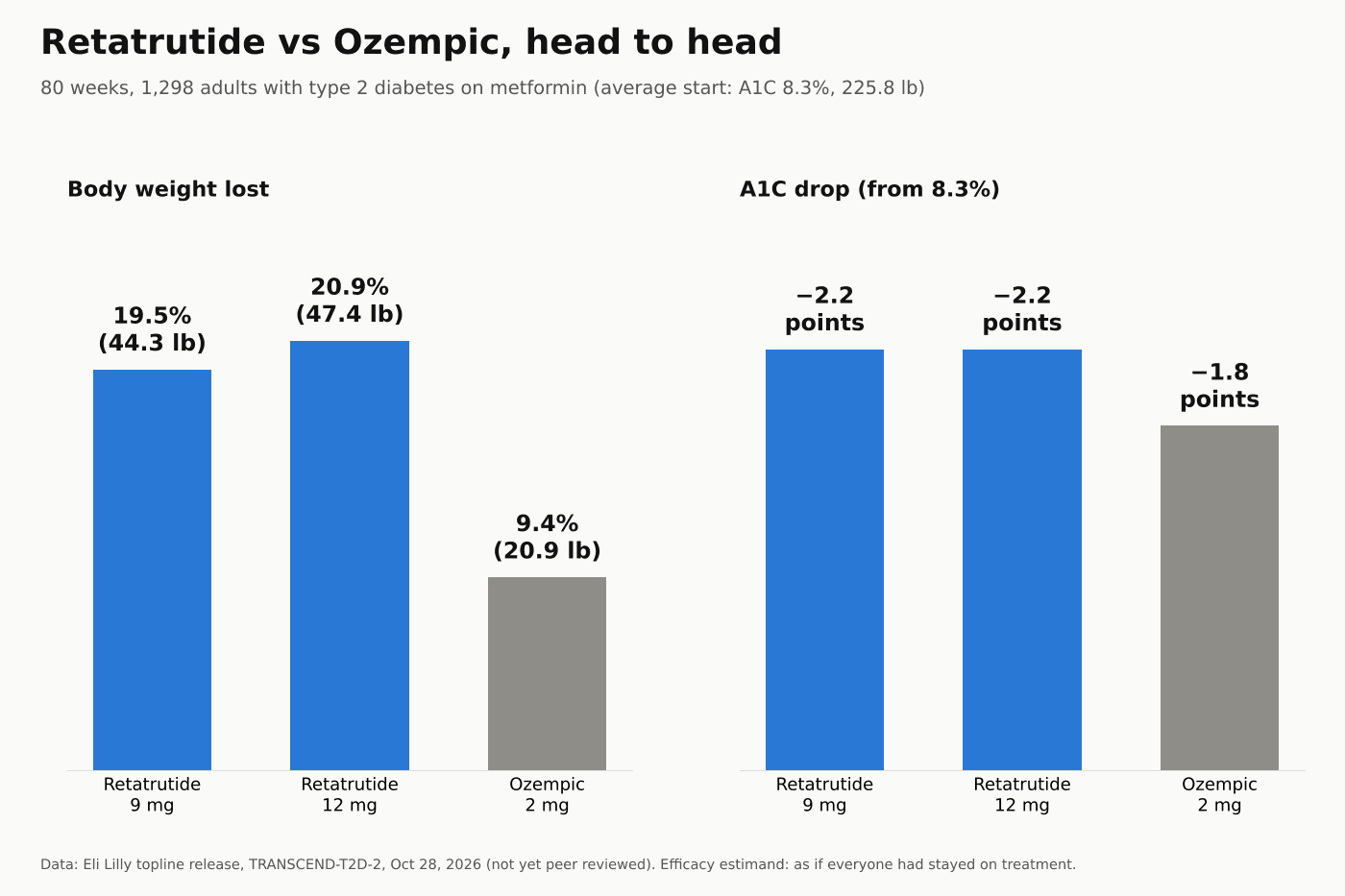
The short answer: on October 28, 2026, Eli Lilly reported the first head-to-head Phase 3 trial of retatrutide vs Ozempic (semaglutide). In 1,298 adults with type 2 diabetes, retatrutide 12 mg cut body weight by 20.9% over 80 weeks, versus 9.4% on Ozempic 2 mg. It also lowered A1C more: 2.2 points versus 1.8.
Those numbers assume everyone stayed on treatment. More people quit retatrutide over side effects, and it isn’t approved yet.
Updated October 29, 2026: added why the A1C drop here (2.2 points) was bigger than in retatrutide’s TRIUMPH-2 trial (about 1.5 to 1.6 points), with a chart across three trials.
In this post you’ll learn what the TRANSCEND-T2D-2 trial tested, what the numbers mean in pounds and A1C, why the A1C drop beat earlier trials, the side effect trade-off, what it means if you take Ozempic today, and what we still don’t know. About 7 minutes.
What Did the Retatrutide vs Ozempic Trial Test?
TRANSCEND-T2D-2 compared retatrutide with Ozempic in 1,298 adults with type 2 diabetes whose blood sugar wasn’t controlled on metformin, with or without an SGLT2 inhibitor. It ran for 80 weeks, about 18 months.
People were randomly assigned 2:2:1 to weekly retatrutide 9 mg, retatrutide 12 mg, or Ozempic 2 mg. Ozempic 2 mg is the highest dose on its label, per the FDA-approved Ozempic label (revised May 2026). Retatrutide started at 2 mg and stepped up every four weeks.
At the start, the average participant had an A1C of 8.3%, weighed 225.8 lb (102.4 kg), and had a BMI of 36.8. The trial is registered as NCT06260722.
Retatrutide is a “triple agonist”: one weekly shot that acts on three hormone receptors (GIP, GLP-1 and glucagon). Ozempic acts on one, GLP-1.
Action item: Check the population before you compare numbers. These were people with type 2 diabetes, who often lose less weight on these drugs. In retatrutide’s TRIUMPH-1 trial, people without diabetes lost 28.3% on 12 mg at 80 weeks, per AJMC.
How Much Weight Did People Lose?
Retatrutide 12 mg cut body weight by 20.9% on average (47.4 lb), versus 9.4% (20.9 lb) on Ozempic 2 mg, after 80 weeks. Retatrutide 9 mg came close behind at 19.5% (44.3 lb).
That’s roughly 26 extra pounds on the 12 mg dose for the average person in this trial. Lilly reported p<0.001 for both doses versus Ozempic on weight.
The estimand matters here. Every number Lilly released uses the “efficacy estimand”: the result if everyone had stayed on their assigned drug for all 80 weeks, without adding other diabetes medicines.
Lilly didn’t release the “counting everyone” (treatment-regimen) numbers. Those tend to be a bit lower: in Ozempic’s SUSTAIN FORTE trial, the 2 mg dose’s weight loss was 6.9 kg on the stayed-on-treatment measure and 6.4 kg counting everyone, per Patient Care. The gap may be bigger for the arm where more people quit.
The result fits retatrutide’s earlier data. In TRIUMPH-2, which enrolled adults with type 2 diabetes and obesity or overweight, the 12 mg dose cut weight by 20.8% at 80 weeks on the same efficacy estimand, versus 4.0% on placebo, per Lilly’s September 29, 2026 release on the paper in The Lancet.
Action item: When you see “more than double the weight loss” in a headline, remember it means trial averages if everyone stayed on the drug. Ask for the “counting everyone” number when the full paper comes out.
Did Retatrutide Lower Blood Sugar More Than Ozempic?
Yes, modestly: both retatrutide doses lowered A1C by 2.2 points from a starting 8.3%, versus 1.8 points on Ozempic 2 mg. That puts the average retatrutide participant near 6.1% and the average Ozempic participant near 6.5%, by simple subtraction.
The trial’s main goal was narrower: to show retatrutide 12 mg was at least as good as Ozempic for A1C (noninferior). It met that goal, and then beat Ozempic. The 9 mg dose also met noninferiority as a key secondary goal.
Lilly says retatrutide also improved non-HDL cholesterol, triglycerides and systolic blood pressure more than Ozempic. It gave no numbers for those, so we can’t say by how much.
Action item: If you have type 2 diabetes, know your own A1C and your target. A 0.4-point difference matters more for some people than others, and your doctor can tell you which you are.
Why Was the A1C Drop Bigger Than in TRIUMPH-2?
A big reason is that people started higher: the average A1C was 8.3% here, versus 7.7% in TRIUMPH-2, and diabetes drugs lower A1C more when there is more to lower. In TRIUMPH-2, retatrutide cut A1C by 1.6 points on 9 mg and 1.5 on 12 mg over 80 weeks. Here, both doses cut it by 2.2.
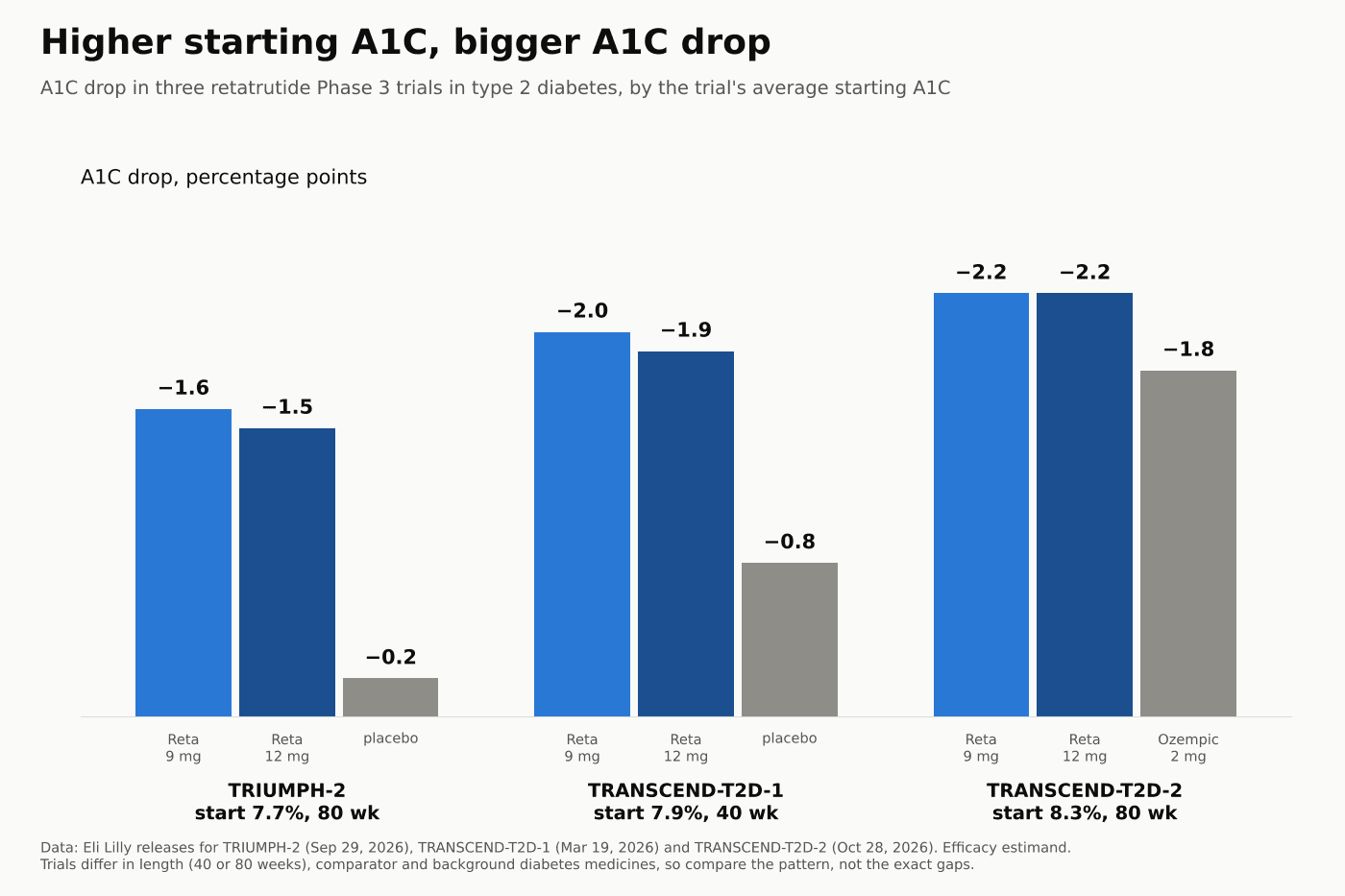
The pattern holds across retatrutide’s three Phase 3 diabetes trials, all on the efficacy estimand:
- TRIUMPH-2 (80 weeks, start 7.7%): down 1.6 and 1.5 points, versus 0.2 on placebo, per Lilly.
- TRANSCEND-T2D-1 (40 weeks, start 7.9%, no other diabetes drugs): down 2.0 and 1.9 points, versus 0.8 on placebo, per Lilly’s March 19, 2026 release.
- TRANSCEND-T2D-2 (80 weeks, start 8.3%): down 2.2 and 2.2 points, versus 1.8 on Ozempic.
This is a well-known effect, not something special to retatrutide. A meta-analysis of 59 trials covering 10 categories of glucose-lowering drugs found that the higher the starting A1C, the bigger the drop, whatever the drug class (DeFronzo and colleagues, Diabetic Medicine, 2010).
A smaller drop from a lower start can still mean a good result. In TRIUMPH-2, about 79% of people on 9 mg or 12 mg reached an A1C of 6.5% or lower, versus 26.3% on placebo, per Lilly. These trials also differ in length, comparator and background medicines, so compare the pattern, not the exact gaps.
Action item: When you compare A1C results between trials, check the starting A1C first. A 1.5-point drop from 7.7% and a 2.2-point drop from 8.3% both land near the same place.
What Were the Side Effects?
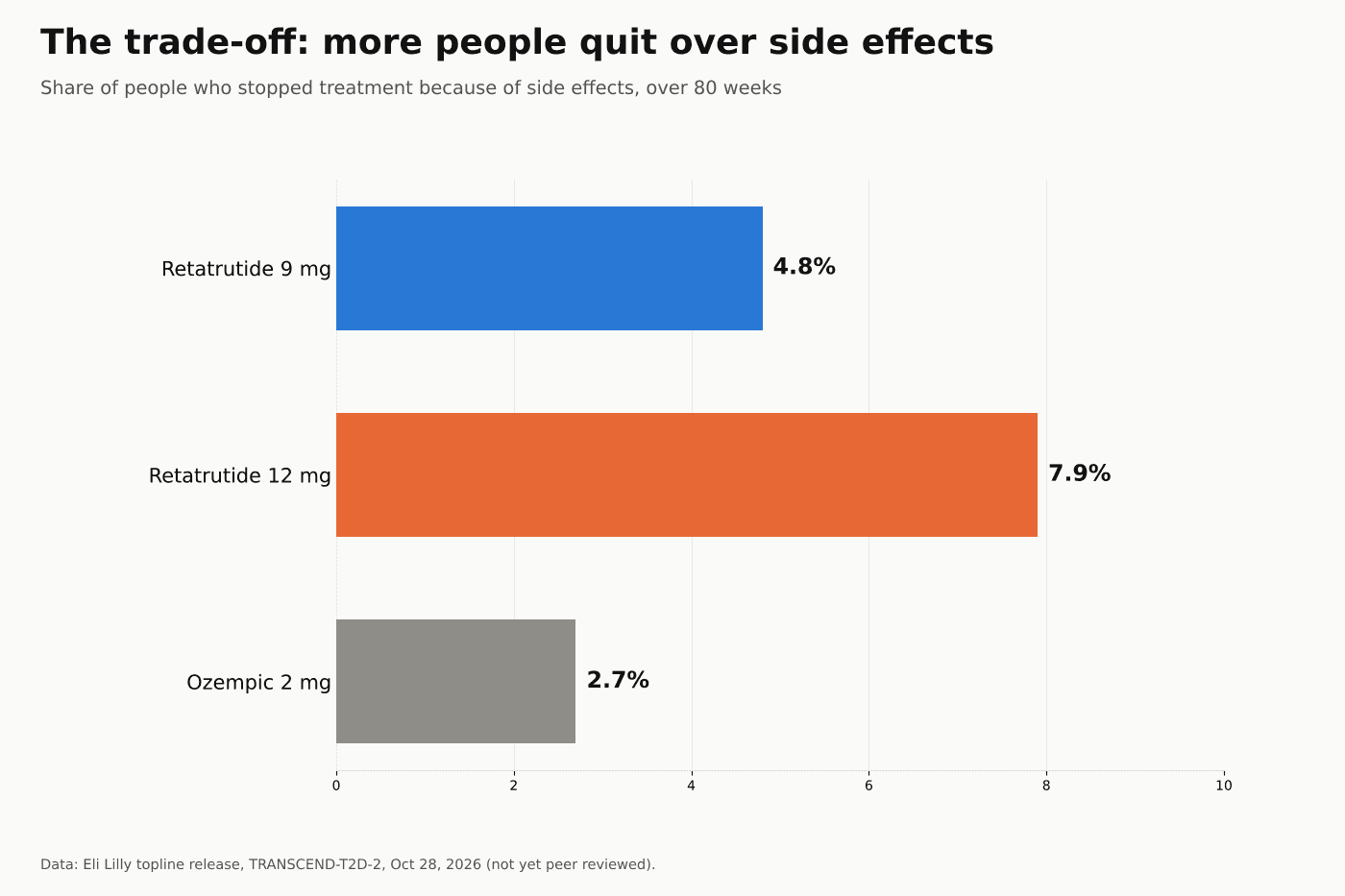
Stomach side effects were common on all three arms: a little higher on retatrutide 12 mg for diarrhea and vomiting, and lower on retatrutide for constipation. More people quit retatrutide because of side effects: 4.8% on 9 mg and 7.9% on 12 mg, versus 2.7% on Ozempic.
Here are the rates Lilly reported for retatrutide 9 mg, 12 mg and Ozempic 2 mg:
- Diarrhea: 28.3%, 32.7%, 26.4%
- Nausea: 21.2%, 23.8%, 21.3%
- Constipation: 14.2%, 13.1%, 19.8%
- Vomiting: 10.2%, 15.0%, 13.2%
- Dysesthesia: 4.8%, 6.5%, 2.7%
Dysesthesia means unusual skin sensations such as tingling, burning or pins-and-needles, per Cleveland Clinic. The release doesn’t say how long it lasted or how severe it was, so it’s one to watch in the full paper. Lilly said most side effects were mild to moderate.
Action item: If you’re weighing future options, ask about the quit rate, not just the weight loss. The best drug on paper is the one you can stay on.
When to Call Your Doctor on a GLP-1 Medicine
These come from the warnings on the FDA-approved Ozempic label, and they apply to anyone on this drug family today. Contact your doctor promptly, or get urgent care, if you have:
- Stomach pain that is severe or won’t go away, sometimes spreading to your back
- Nausea, vomiting or diarrhea that keeps going and stops you keeping fluids down
- Shakiness, sweating, confusion or a racing heart, especially if you also take insulin or a sulfonylurea
- Upper belly pain with yellow skin or eyes, fever or pale stools
- Swelling of the face, lips or throat, or trouble breathing
- A lump or swelling in your neck, hoarseness or trouble swallowing
Action item: Save this list on your phone. If you’re not sure whether a symptom counts, call.
What Does This Mean If You’re on Ozempic Now?
Nothing changes today: retatrutide isn’t approved or available, so this trial doesn’t change what you can be prescribed. Ozempic is approved for type 2 diabetes, not for weight management, and in this trial it still lowered A1C by 1.8 points and weight by 9.4%.
For context, in Novo Nordisk’s SUSTAIN FORTE trial, Ozempic 2 mg lowered weight by 6.9 kg (about 15 lb) over 40 weeks, if people stayed on treatment, per Patient Care. Here, over a longer 80 weeks, it was 9.5 kg (20.9 lb).
Don’t buy “retatrutide” online. The FDA says it isn’t part of any approved drug, can’t be used in compounding, and has warned sellers marketing it “for research purposes” (FDA, Oct 1, 2026).
Weight loss on any of these drugs is also about eating less without feeling deprived. If meals feel hard to judge on a GLP-1, our guide on how to eat on GLP-1s covers slowing down and stopping at full.
Action item: If this news makes you wonder whether your current plan is the right one, bring the question to your next appointment. Don’t stop or change a dose on your own.
When Could Retatrutide Be Available?
Not before 2027 at the earliest, based on Lilly’s filing plan. Lilly plans to submit retatrutide to the FDA in the first quarter of 2027, per its September 29, 2026 release. Lilly’s Oct 28 release gave no new filing date.
A standard FDA review takes about a year, so a decision in late 2027 to 2028 is plausible. That’s our estimate, not Lilly’s. We track the timeline in When will retatrutide be available?
Action item: Watch for two things next: the full TRANSCEND-T2D-2 paper, and TRIUMPH-5, the ongoing head-to-head trial against tirzepatide (Zepbound and Mounjaro).
What We Don’t Know Yet
The biggest gaps are the “counting everyone” results, the full safety data, and how retatrutide compares with tirzepatide. As of October 29, 2026, these are open:
- Treatment-regimen numbers. Lilly released only the efficacy estimand. With more people quitting retatrutide, the gap may narrow somewhat when everyone is counted.
- Open-label design. Participants knew which drug they were taking, which can affect side effect reporting and dropouts.
- Peer review. Lilly says full results will be presented at a medical meeting and published in a journal. No dates yet.
- Heart outcomes. This trial measured A1C and weight, not heart attacks or strokes.
- Tirzepatide. TRIUMPH-5 is still running. For how retatrutide stacks up against Lilly’s other next drug, see Retatrutide vs EloraTZP.
Action item: Treat today’s numbers as a strong early signal, not the final word. We’ll update this post when the paper is out.
Quick Answers
Is retatrutide better than Ozempic? In this 80-week trial in type 2 diabetes, it lowered weight about twice as much (20.9% vs 9.4% on 12 mg) and A1C a bit more (2.2 vs 1.8 points), if people stayed on treatment. More people quit it over side effects.
How much weight did people lose on retatrutide vs Ozempic? On average 47.4 lb on retatrutide 12 mg and 44.3 lb on 9 mg, versus 20.9 lb on Ozempic 2 mg, from a starting weight of 225.8 lb.
What are retatrutide’s side effects compared with Ozempic? Diarrhea, nausea and vomiting were common on both. Constipation was less common on retatrutide, while dysesthesia (skin tingling or burning) was more common: 6.5% on 12 mg vs 2.7%.
Why did retatrutide lower A1C more here than in TRIUMPH-2? A big reason is that people started higher: an average A1C of 8.3% versus 7.7%. Diabetes drugs lower A1C more from a higher start, so the 2.2-point drop here and the 1.5 to 1.6-point drop in TRIUMPH-2 fit the same pattern.
Can I switch from Ozempic to retatrutide? Not now. Retatrutide isn’t approved anywhere, and products sold online as retatrutide aren’t Lilly’s drug.
When will retatrutide be approved? Lilly plans to file with the FDA in the first quarter of 2027. A decision in late 2027 to 2028 is our estimate.
What This Means for You
✅ You know retatrutide beat Ozempic on weight and A1C in the first head-to-head Phase 3 trial
✅ You know the numbers assume everyone stayed on treatment
✅ You know more people quit retatrutide over side effects
✅ You know the red flags that need a call to your doctor
✅ You won’t change your current medicine because of a headline
The 5-Minute Version (Screenshot This)
- The news: Lilly’s TRANSCEND-T2D-2 topline results, Oct 28, 2026. First Phase 3 head-to-head of retatrutide vs Ozempic.
- Who: 1,298 adults with type 2 diabetes on metformin, 80 weeks.
- Weight: 20.9% (12 mg) and 19.5% (9 mg) vs 9.4% on Ozempic 2 mg, if everyone stayed on treatment.
- A1C: down 2.2 points on both retatrutide doses vs 1.8 on Ozempic.
- Trade-off: 7.9% quit retatrutide 12 mg over side effects vs 2.7% on Ozempic. Not peer reviewed yet; FDA filing planned Q1 2027.
Conclusion
Retatrutide vs Ozempic now has its first direct answer: in people with type 2 diabetes, retatrutide roughly doubled the weight loss and lowered A1C a bit more over 80 weeks. That’s a big result, with real caveats: an open-label trial, efficacy-only numbers, more side-effect dropouts, and no approval yet.
Your one action today: if you take Ozempic, know that this news doesn’t change your prescription. Write down one question about your goals to bring to your next visit.
Curious how retatrutide does on sleep apnea? Read what the NEJM sleep apnea trials found.
So tell me: if retatrutide is approved, would you trade a higher chance of side effects for twice the weight loss? Why or why not?
Sources
- Eli Lilly: retatrutide vs Ozempic head-to-head trial, TRANSCEND-T2D-2 (PR Newswire, Oct 28, 2026)
- ClinicalTrials.gov: TRANSCEND-T2D-2 (NCT06260722)
- AJMC: retatrutide tops semaglutide on A1C, weight in head-to-head trial (Oct 28, 2026)
- Eli Lilly: TRIUMPH-2 results in The Lancet, and FDA filing plans (Sep 29, 2026)
- Eli Lilly: TRANSCEND-T2D-1 results (PR Newswire, Mar 19, 2026)
- DeFronzo RA et al. Relationship of baseline HbA1c and efficacy of glucose-lowering therapies: a meta-analysis. Diabetic Medicine, 2010
- FDA: Ozempic prescribing information (revised May 2026)
- Patient Care: SUSTAIN FORTE, semaglutide 2 mg vs 1 mg (Nov 2020)
- FDA: concerns with unapproved GLP-1 drugs used for weight loss (Oct 1, 2026)
- Cleveland Clinic: dysesthesia
 MealCoach