
“Obesity drives more than 200 downstream diseases.”
The short answer: in two Phase 3 trials published in the New England Journal of Medicine on October 21, 2026, retatrutide cut sleep apnea events by about 25 to 34 per hour after 80 weeks, versus about 10 on placebo.
For the average participant without diabetes, that’s roughly the difference between severe and moderate sleep apnea. It doesn’t cure it for most people, and it isn’t approved yet.
In this post you’ll learn what retatrutide did for sleep apnea in the TRIUMPH-OSA trials, what those numbers mean for a real night’s sleep, how it compares with Zepbound, and what to do now. About 6 minutes.
Sleep Apnea Is Not “Just Snoring”
Obstructive sleep apnea means your airway keeps collapsing while you sleep. Breathing stops or gets shallow, oxygen dips, and your brain jolts you half-awake. Over and over, all night.
Doctors measure it with the apnea-hypopnea index (AHI): breathing pauses per hour of sleep. Under 5 is normal. 5 to 15 is mild, 15 to 30 is moderate, and 30 or more is severe, per Cleveland Clinic.
It’s easy to shrug this off as snoring. But the people in these trials started at about 56 to 59 pauses an hour. That’s nearly one a minute, all night.
Action item: If you snore loudly, wake up gasping, or feel exhausted after a full night, ask your doctor about a sleep test. Many people with sleep apnea don’t know they have it.
What the TRIUMPH-OSA Trials Tested
Lilly ran two sleep apnea trials inside its big retatrutide program. Both lasted 80 weeks, about 18 months, and compared three weekly doses (4, 9, and 12 mg) with placebo:
- TRIUMPH-1-OSA: about 240 adults with obesity or overweight and moderate-to-severe sleep apnea, without type 2 diabetes. Average starting AHI: 58.6.
- TRIUMPH-2-OSA: about 445 adults, the version run in people with type 2 diabetes. Average starting AHI: 55.9.
The full results were presented at the European Sleep Research Society’s 2026 congress and published in NEJM the same day.
Action item: If you have type 2 diabetes, look at TRIUMPH-2-OSA’s numbers. People with diabetes usually see smaller changes on these drugs.
The Results: How Much Did Breathing Pauses Drop?
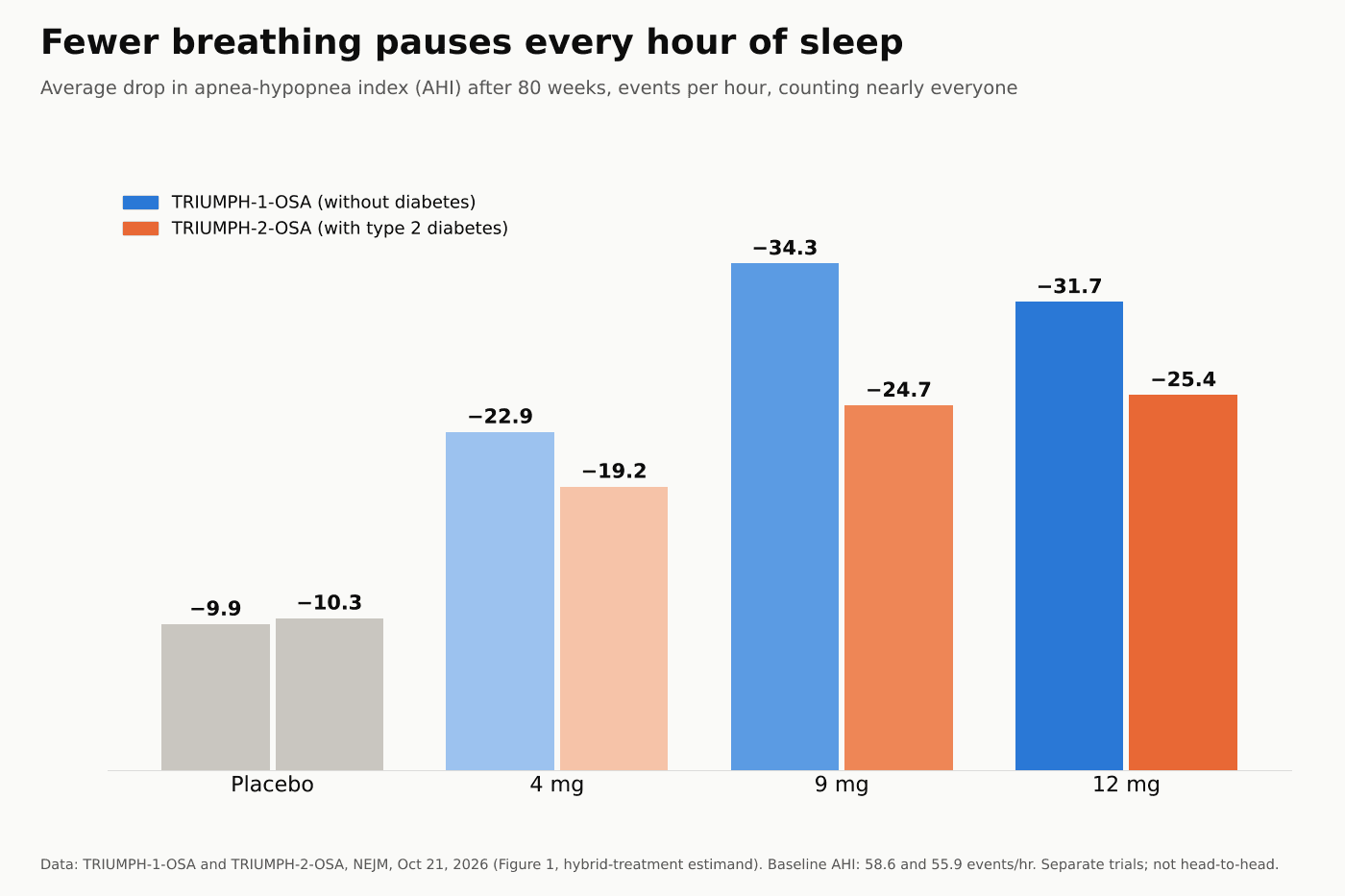
Here’s the average drop in AHI after 80 weeks, using the trials’ main way of counting, which includes almost everyone who started:
- Without diabetes: 22.9 fewer events an hour on 4 mg, 34.3 on 9 mg, 31.7 on 12 mg. Placebo: 9.9.
- With type 2 diabetes: 19.2 on 4 mg, 24.7 on 9 mg, 25.4 on 12 mg. Placebo: 10.3.
Counting only people who stayed on treatment, the numbers were a bit higher: up to 36.1 fewer events an hour without diabetes and 28.4 with diabetes.
So on the two higher doses, retatrutide removed roughly 22 to 24 extra breathing pauses an hour beyond placebo in people without diabetes, and about 15 in people with diabetes.
Weight came down too. For people who stayed on the higher doses, average weight loss was about 23% without diabetes and about 19 to 20% with diabetes.
Action item: When you read “retatrutide cuts sleep apnea by X,” check whether it’s events per hour or a percentage, and which trial. Headlines mix them up.
What That Means for a Night’s Sleep
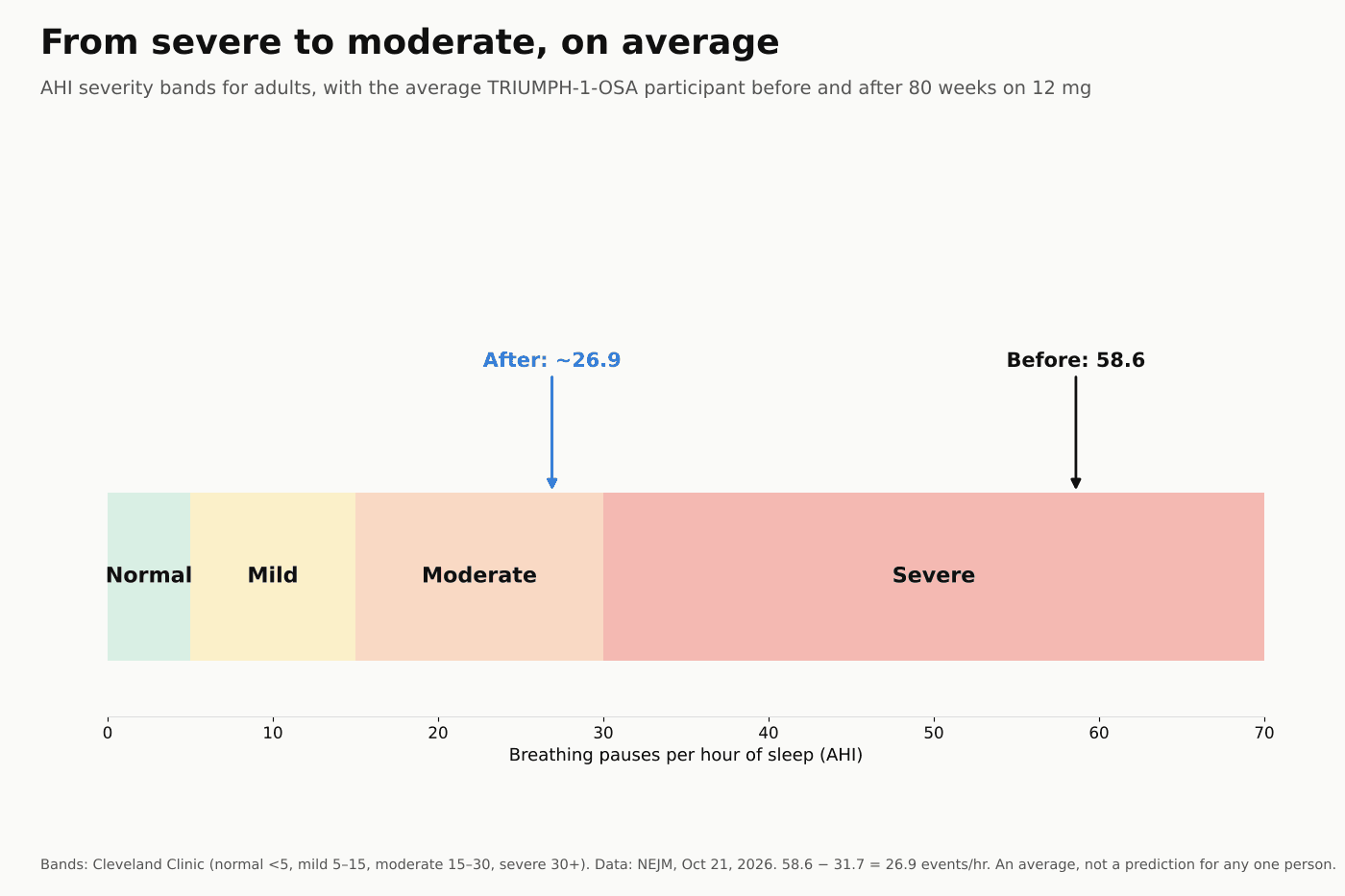
Let’s do the math for the average participant without diabetes on 12 mg. They started at 58.6 pauses an hour. After an average drop of 31.7, they’d be at about 26.9.
That moves the average person from “severe” to “moderate.” Fewer oxygen dips and fewer awakenings every hour. But moderate sleep apnea is still sleep apnea, and many people will still need CPAP or another treatment.
Action item: If you’re on CPAP, think of drugs like this as a possible way to need less help, not a reason to stop. Any change to CPAP should go through your sleep doctor.
How It Compares With Zepbound
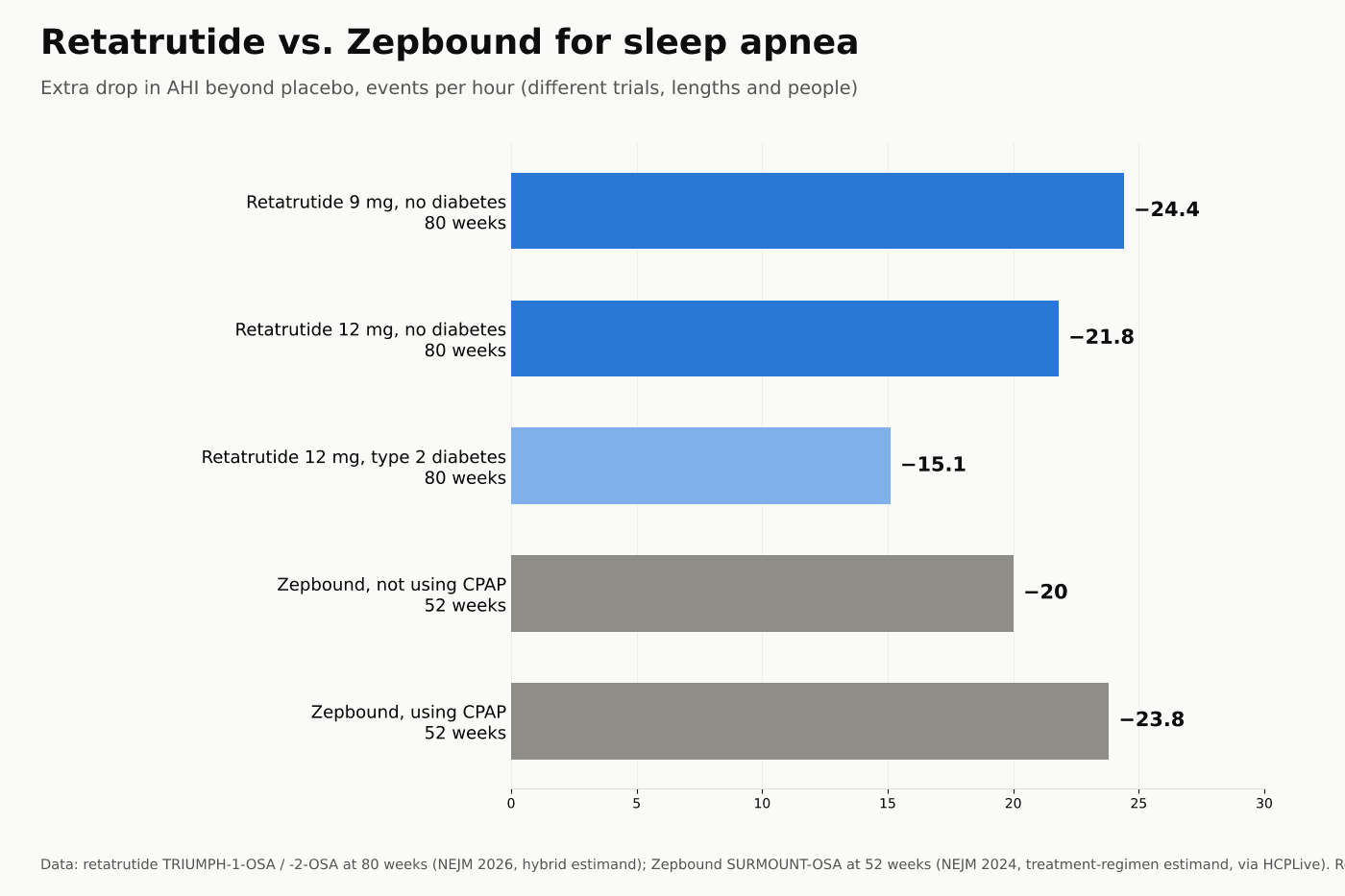
Zepbound (tirzepatide) is already FDA-approved for moderate-to-severe sleep apnea in adults with obesity. In its SURMOUNT-OSA trials, it cut AHI by 25.3 and 29.3 events an hour over 52 weeks, versus about 5 on placebo, per HCPLive. Up to about half of people on the top dose reached disease resolution.
“Support the efficacy of tirzepatide in adults living with moderate-to-severe OSA and obesity.”
My take: on sleep apnea specifically, retatrutide looks roughly comparable to Zepbound, not dramatically better. Its edge is total weight loss. The trials differ in length, starting severity, and how they counted, so only a head-to-head trial could settle it.
I compared retatrutide’s weight-loss numbers with Lilly’s newest combo in Retatrutide vs EloraTZP.
Action item: If you have sleep apnea and obesity and want a medicine option now, ask your doctor about Zepbound. It’s approved for exactly this today.
When Could Retatrutide Be Prescribed for Sleep Apnea?
Not yet. Lilly plans to file retatrutide with the FDA in the first quarter of 2027, and it has said it plans to seek approval for sleep apnea as well as obesity, per Epocrates. A standard review takes about a year, so late 2027 to 2028 is a realistic window. That’s our estimate, not Lilly’s.
Side effects were the familiar ones for this drug family: mostly nausea, diarrhea, constipation, and vomiting, generally mild to moderate.
Action item: Don’t buy “retatrutide” online. It isn’t approved, and anything sold today isn’t Lilly’s product.
Quick Answers
Does retatrutide cure sleep apnea? Not for most people. On average it moved participants without diabetes from severe to moderate sleep apnea after 80 weeks.
How much did retatrutide lower AHI? By about 32 to 34 events per hour on the higher doses in people without diabetes, and about 25 in people with type 2 diabetes, versus about 10 on placebo.
Is retatrutide better than Zepbound for sleep apnea? The results are in a similar range. They come from different trials, so there’s no clear winner yet.
Can I stop using CPAP on a GLP-1 drug? Only your sleep doctor can decide that, usually after a repeat sleep test.
When will retatrutide be approved? Lilly plans to file in Q1 2027. Approval would likely come in late 2027 or 2028.
What This Means for You
✅ You know what AHI measures and what the severity bands mean
✅ You know retatrutide cut sleep apnea events by about 25 to 34 an hour in these trials
✅ You know that’s a big improvement, but usually not a cure
✅ You know Zepbound is the approved option today
✅ You won’t stop CPAP without your doctor
The 5-Minute Version (Screenshot This)
- The trials: TRIUMPH-1-OSA (no diabetes) and TRIUMPH-2-OSA (type 2 diabetes), 80 weeks, NEJM, Oct 21, 2026.
- Results: AHI down about 32 to 34 events/hr (no diabetes) and about 25 (diabetes) on the higher doses, vs about 10 on placebo.
- In real terms: the average participant without diabetes went from severe to moderate.
- Versus Zepbound: a similar range; Zepbound is already approved for sleep apnea.
- Timing: filing planned Q1 2027; approval likely late 2027 to 2028.
Conclusion
Retatrutide for sleep apnea looks real and meaningful: tens of fewer breathing pauses every hour, plus large weight loss. But for most people it’s an improvement, not a cure, and it isn’t available yet.
Your one action today: if you suspect sleep apnea, get tested; if you already have it, ask your doctor whether an approved option like Zepbound fits your plan.
Sleep matters for appetite too. If that connection interests you, start with our summary of Why We Sleep.
So tell me: if a weekly shot could cut your sleep apnea in half, would you still keep your CPAP as backup? Why?
Sources
- NEJM: Retatrutide once weekly for treatment of obstructive sleep apnea (Oct 21, 2026)
- Sleep Review: retatrutide reduces OSA severity in Phase 3 (June 2026)
- HCPLive: TRIUMPH-1 including the sleep apnea basket (Sept 2026)
- HCPLive: SURMOUNT-OSA (Zepbound) results
- Patient Care: FDA approves Zepbound for sleep apnea with obesity (Dec 2024)
- Cleveland Clinic: apnea-hypopnea index
- Epocrates: retatrutide filing plans
 MealCoach