
“OSA is one of the most serious complications of obesity…”
The short answer: Foundayo for sleep apnea works, but modestly. In two 52-week ATTAIN-OSA trials published in JAMA on November 9, 2026, Foundayo (orforglipron), Lilly’s daily GLP-1 pill, cut sleep apnea events by about 17 to 18 an hour, versus about 5 on placebo, counting everyone.
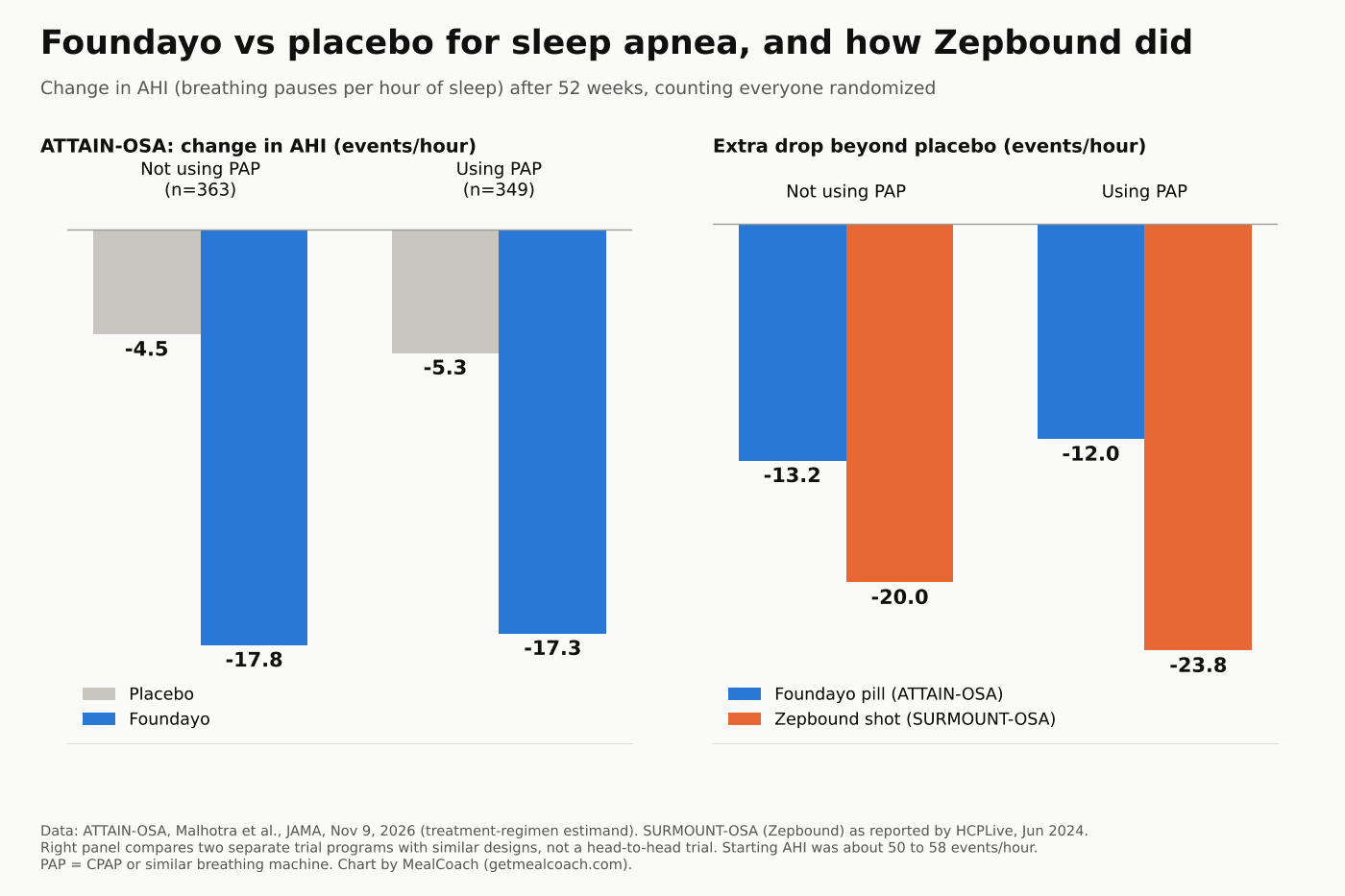
That’s about 12 to 13 more than placebo, less than Zepbound managed in its own trials.
In this post you’ll learn what the Foundayo sleep apnea trials found, what “counting everyone” means for the headline numbers, how Foundayo compares with Zepbound, the side effects, and what’s still unknown. About 7 minutes.
What Did the ATTAIN-OSA Trials Test?
Two year-long trials, 712 adults in all, tested whether a daily Foundayo pill could ease moderate-to-severe obstructive sleep apnea in adults with obesity or overweight. Both compared Foundayo with a dummy pill (placebo), and neither patients nor doctors knew who got which.
- Study 1: 363 adults with a BMI of 27 or higher who couldn’t or wouldn’t use a PAP machine (CPAP or similar). Average starting AHI: 50.7 events an hour.
- Study 2: 349 adults with a BMI of 27 or higher who were already using PAP and planned to keep using it. Average starting AHI: 57.6.
AHI, the apnea-hypopnea index, counts breathing pauses per hour of sleep. Under 5 is normal, 5 to 15 mild, 15 to 30 moderate, and 30 or more severe, per Cleveland Clinic. So both groups started in the severe range on average.
The dose was raised step by step to the highest dose each person tolerated, equivalent to the 9, 14.5 or 17.2 mg tablets. People with type 1 or type 2 diabetes were excluded, per the American Heart Association’s release. Results were presented at AHA Scientific Sessions 2026 and published in JAMA the same day. Lilly funded the trials.
Action item: Find your own most recent AHI on your sleep study report. You’ll need it to make sense of the numbers below.
What Did ATTAIN-OSA Show About Foundayo for Sleep Apnea?
Foundayo cut AHI by 17.8 events an hour without PAP and 17.3 with PAP, versus 4.5 and 5.3 on placebo. These are the JAMA paper’s main numbers, which count everyone who was randomized, whether or not they kept taking the pill.
That leaves a gap of 13.2 events an hour beyond placebo in Study 1 and 12.0 in Study 2. In percent terms, AHI fell 34.6% and 26.4% on Foundayo, versus 5.3% and 2.9% on placebo.
Here’s how many people got a big improvement, counting everyone:
- AHI cut in half or more: 42.2% on Foundayo vs 16.0% on placebo (Study 1); 30.8% vs 13.1% (Study 2).
- Remission or mild, low-symptom sleep apnea: 28.4% vs 13.0% (Study 1); 19.2% vs 9.0% (Study 2). That’s AHI under 5, or 5 to 14 with little daytime sleepiness.
- Weight: down 10.4% and 10.7% on Foundayo, versus 2.2% and 1.1% on placebo.
Why you’ll see bigger numbers elsewhere: Lilly’s release leads with a different count, “if people stayed on treatment.” On that basis AHI fell 21.1 and 18.3 events an hour (43.8% and 27.5%), versus 4.3 and 5.5 on placebo. Both are real. They answer different questions.
Action item: When a headline says “44% fewer breathing pauses,” check two things: which study (with or without PAP) and which way of counting. The 44% is the best case.
What Does That Mean for a Night’s Sleep?
For the average participant, Foundayo made sleep apnea less severe, though still around the severe line. Here’s a worked illustration using averages, not a prediction for anyone.
The average Study 1 participant started at 50.7 pauses an hour. A drop of 17.8 puts them near 33. That’s still in the severe band, just barely. Over a 7-hour night, it’s about 125 fewer breathing pauses or slowdowns (AHI counts both).
Other measures moved too. Oxygen-drop burden fell more on Foundayo, and so did hs-CRP, a marker of inflammation. Systolic blood pressure fell about 7 to 7.5 mmHg on Foundayo versus about 2 on placebo, measured at week 48, per the AHA release.
One thing didn’t clearly improve: how impaired people felt by their sleep during the day, a self-reported score, missed statistical significance when counting everyone.
Action item: If you’re on CPAP, note what the researchers said: Foundayo is not meant to replace CPAP. Study 2 tested it alongside PAP, not instead of it.
How Does Foundayo Compare With Zepbound for Sleep Apnea?
Zepbound did more in its own trials: about 20 to 24 fewer events an hour beyond placebo, versus about 12 to 13 for Foundayo. Both comparisons count everyone, both trials lasted 52 weeks, and both split people by PAP use the same way.
In SURMOUNT-OSA, Zepbound (tirzepatide) cut AHI by 25.3 events an hour without PAP and 29.3 with PAP, versus 5.3 and 5.5 on placebo, per HCPLive. Zepbound has been FDA-approved for moderate-to-severe sleep apnea with obesity since December 2024, per Patient Care.
The trial discussant at AHA, Dr. Ildiko Lingvay, made the same point, per TCTMD: tirzepatide showed bigger AHI and oxygen improvements, and quit rates for side effects were higher with orforglipron.
My take: Foundayo is a real sleep apnea option in the making, not the strongest one. Its pull is a daily pill with no injections and, per our price comparison, a lower cash price, not a bigger effect.
These are separate trials, not a head-to-head, so treat the gap as a rough guide. We compared the two drugs on weight and price in Foundayo vs Zepbound.
Action item: If you have sleep apnea and obesity and are weighing a medicine, bring this comparison to your sleep doctor. Ask which approved options fit you today.
What Were the Side Effects?
Stomach side effects were common: about 7 in 10 people on Foundayo had one, versus about 4 in 10 on placebo. Per JAMA, gastrointestinal events hit 68.0% vs 37.4% in Study 1 and 70.6% vs 36.6% in Study 2. They were mostly nausea, diarrhea and constipation, mostly mild to moderate.
- Stopped because of side effects: 12.2% on Foundayo vs 3.8% on placebo (Study 1); 6.8% vs 0.6% (Study 2).
- Serious adverse events: 8.8% vs 4.9% (Study 1); 6.2% vs 5.2% (Study 2).
- Heart events: very few. Adjudicated major heart events hit 1 person on Foundayo and 2 on placebo in Study 1, and none in Study 2.
That pattern matches what we found in the label data for Foundayo’s weight-loss use; see Foundayo side effects for the timing and what tends to help.
Action item: If you’re already on Foundayo, keep a short note of any stomach symptoms and when they started. It makes the next conversation with your prescriber faster.
When Should You Call Your Doctor?
Call your doctor or care team promptly if any of these happen on a GLP-1 medicine like Foundayo:
- Severe stomach pain that won’t go away, with or without vomiting.
- Vomiting or diarrhea you can’t keep up with, or signs of dehydration like dizziness or very little urine.
- Pain in the upper right belly, fever, or yellow skin or eyes.
- Your sleep apnea symptoms get worse, such as louder snoring, gasping awake, or new daytime sleepiness.
The first three come from the warnings we covered in Foundayo side effects. In an emergency, call 911.
Action item: Save this list in your phone’s notes, next to your medicine list.
When Could Foundayo Be Approved for Sleep Apnea?
Lilly says it plans to submit Foundayo to the FDA for moderate-to-severe sleep apnea in adults with obesity or overweight by the end of 2026, with other countries to follow, per its November 9 release. It hasn’t given an approval date, and neither has the FDA.
As of November 10, 2026, Foundayo is FDA-approved for weight management, since April 2026, per Healio. Sleep apnea is not on its label.
Action item: If sleep apnea coverage matters for your insurance, ask your plan how it treats a drug approved for weight but not yet for sleep apnea.
What We Don’t Know Yet
The big open questions are long-term results, who benefits most, and people with diabetes.
- Beyond one year: no results past 52 weeks were reported.
- Diabetes: people with type 1 or type 2 diabetes were excluded, so we don’t know how well it works for them.
- Who benefits: the JAMA editorial noted smaller effects in people with moderate (not severe) sleep apnea, and fewer than 4% of participants were Black, per TCTMD.
- Heart outcomes: as the AHA discussant pointed out, orforglipron hasn’t shown a heart benefit yet, while tirzepatide has in type 2 diabetes.
Action item: If you have diabetes and sleep apnea, don’t assume these numbers apply to you. Ask your doctor what evidence exists for your situation.
Quick Answers
Does Foundayo help sleep apnea? Yes, in two Phase 3 trials. It cut breathing pauses by about 17 to 18 an hour after a year, versus about 5 on placebo, counting everyone.
Is Foundayo approved for sleep apnea? Not as of November 10, 2026. Lilly plans to apply to the FDA by the end of 2026. Zepbound is the GLP-1 approved for sleep apnea today.
Is Foundayo as good as Zepbound for sleep apnea? Not in the trials so far. Zepbound cut about 20 to 24 more events an hour than placebo; Foundayo cut about 12 to 13. These are separate trials, not a head-to-head.
Can Foundayo replace CPAP? The researchers say it isn’t meant to. Any change to CPAP should go through your sleep doctor.
Where does the “44%” number come from? It’s Lilly’s “stayed on treatment” result in people not using PAP. Counting everyone, the drop was 34.6%.
What This Means for You
✅ You know Foundayo cut sleep apnea events by about 17 to 18 an hour in a year of treatment
✅ You know the 44% headline is the best-case way of counting
✅ You know Zepbound did more in its own trials and is approved for sleep apnea now
✅ You know stomach side effects were common, and which symptoms mean calling your doctor
✅ You won’t change CPAP or any medicine without your doctor
The 5-Minute Version (Screenshot This)
- The news: ATTAIN-OSA, two 52-week Phase 3 trials of Foundayo (orforglipron) for sleep apnea, JAMA and AHA, November 9, 2026.
- Result, counting everyone: AHI down 17.8 and 17.3 events an hour, vs 4.5 and 5.3 on placebo. About 12 to 13 more than placebo.
- Stayed on treatment: down 21.1 and 18.3 (43.8% and 27.5%).
- Versus Zepbound: smaller effect than in SURMOUNT-OSA; separate trials.
- Next step: Lilly plans an FDA filing by the end of 2026.
Conclusion
Foundayo for sleep apnea works better than placebo, with real drops in breathing pauses, oxygen dips, weight and blood pressure. But it’s a moderate effect, not a cure, and it trails Zepbound in the trials so far.
Your one action today: if you have sleep apnea and are curious about these drugs, bring your latest AHI and this comparison to your sleep doctor.
We covered the next drug in line for sleep apnea in Retatrutide for Sleep Apnea.
So tell me: would a daily pill that does less than a weekly shot still be worth it to you, if it meant no needles?
Sources
- JAMA: Orforglipron for obstructive sleep apnea, results from 2 randomized clinical trials (ATTAIN-OSA), Nov 9, 2026
- Lilly release via StockTitan: Foundayo reduced sleep apnea severity (Nov 9, 2026)
- American Heart Association release: daily oral GLP-1 reduced sleep apnea episodes (Nov 9, 2026)
- TCTMD: ATTAIN-OSA coverage, discussant and editorial comments (Nov 2026)
- HCPLive: SURMOUNT-OSA (Zepbound) results (Jun 2024)
- Patient Care: FDA approves Zepbound for sleep apnea with obesity (Dec 2024)
- Healio: FDA approves orforglipron (Apr 2026)
- Cleveland Clinic: apnea-hypopnea index
 MealCoach