
“Adequate fluids and fiber from foods should be encouraged.”
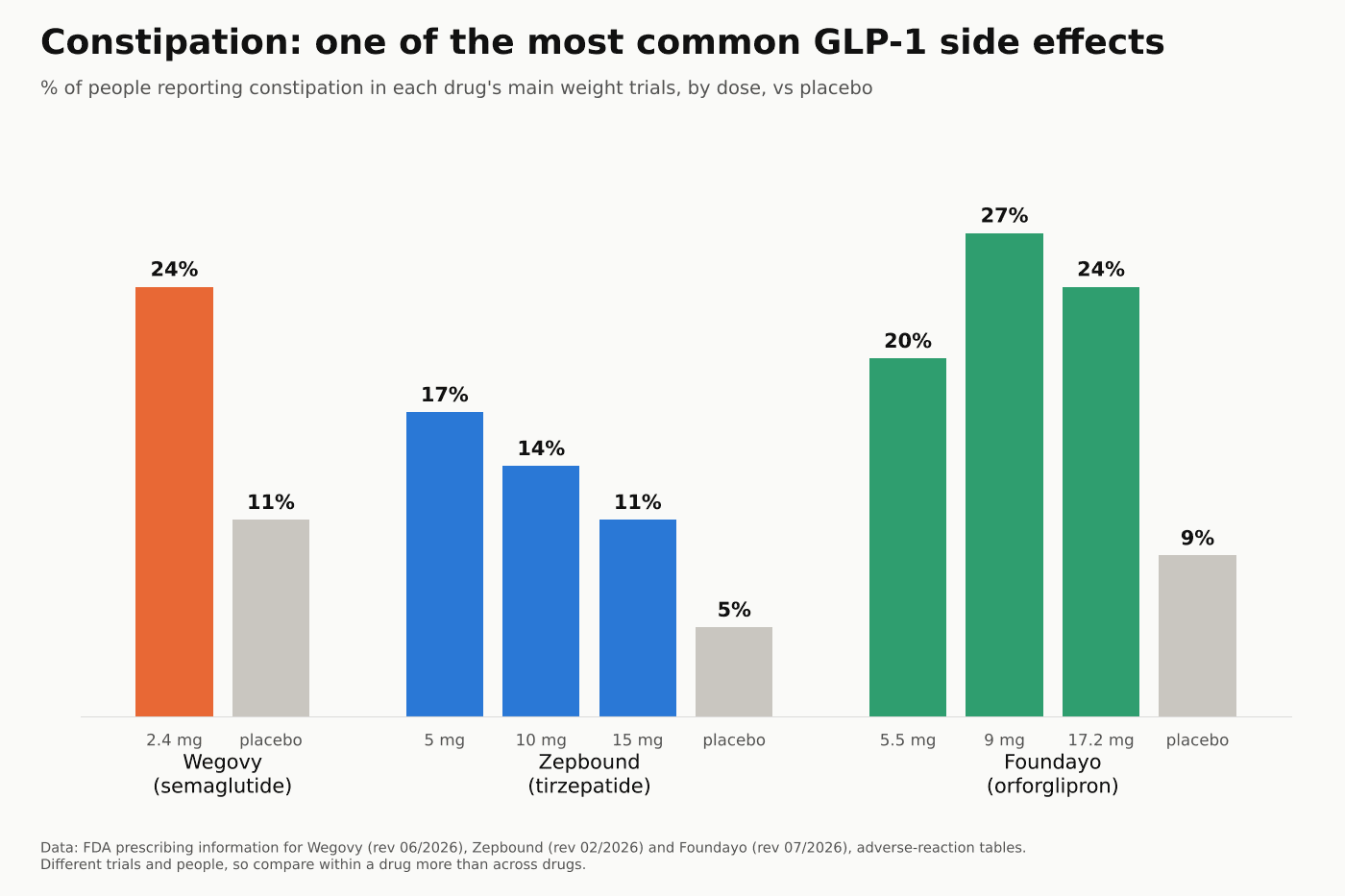
The short answer: GLP-1 constipation is common. In the drugs’ own trials, 11% to 27% of people on Zepbound, Wegovy, or Foundayo reported it, versus 5% to 11% on placebo. Expert advice starts with fluids and fiber from food added slowly, then options to ask your pharmacist about.
Below: why GLP-1s cause constipation, what experts recommend, and the symptoms that mean you should call your doctor today.
In this post you’ll learn how common constipation is on each GLP-1, why it happens, a step-by-step plan, and when it’s an emergency. About 6 minutes.
“Why Haven’t I Gone in Five Days?” You’re Not Alone
On GLP-1 forums, constipation questions are everywhere: “Is it normal not to go for days?” “The stool softener isn’t working.” “Fiber made the bloating worse.”
Most pages answering those questions are selling something: a supplement, a powder, a telehealth plan. The rest offer a one-liner: just eat more fiber. Forum posters often say piling on fiber made their bloating worse. The expert advice is more careful than that.
Action item: For three days, jot down bowel movements, roughly how much you drink, and how much you eat. You’ll have real information for your pharmacist or prescriber instead of a guess.
How Common Is Constipation on GLP-1 Drugs?
Constipation is one of the most common GLP-1 side effects, reported by 11% to 27% of people depending on the drug and dose. Here’s what the FDA labels report from each drug’s main weight-loss trials:
| Drug | Constipation on the drug | On placebo |
|---|---|---|
| Wegovy (semaglutide) 2.4 mg shot | 24% | 11% |
| Zepbound (tirzepatide) 5 / 10 / 15 mg | 17% / 14% / 11% | 5% |
| Foundayo (orforglipron) 5.5 / 9 / 17.2 mg pill | 20% / 27% / 24% | 9% |
Sources: Wegovy label (June 2026), Zepbound label (Feb 2026), Foundayo label (July 2026). The Wegovy label says the pill version had similar types and rates of common side effects to the shot.
Note the placebo column: 5% to 11% of people got constipated without the drug. Some of it is everyday life.
If you’re choosing between a pill and a shot, our Foundayo vs Zepbound comparison covers the bigger picture.
Action item: Find your drug and dose in the table. If your constipation is much worse than “annoying,” that’s worth a call, not a shrug.
Why Do GLP-1s Cause Constipation?
GLP-1 drugs slow digestion and cut how much you eat, so less food and often less fluid moves through more slowly. That’s the likely mix, though the exact mechanism isn’t fully pinned down.
- Slower stomach emptying: Zepbound’s label says tirzepatide delays gastric emptying, most after the first dose, with the effect lessening over time.
- Much less food: GLP-1s reduce how much people eat by about 16% to 39% versus placebo, per the joint advisory. Less food usually means less fiber and less bulk.
- Often less fluid: many people say they drink less when they’re rarely hungry, so drinking enough takes a conscious plan.
Action item: Look at a normal day now versus before your GLP-1. If both food and drinks dropped a lot, start with fluids before anything else.
When Does It Start, and Does It Go Away?
All three labels say stomach and gut side effects were most common while the dose was being increased. The Zepbound and Foundayo labels add that they decreased over time. Both of those labels describe this mostly for nausea, vomiting, and diarrhea, so constipation may not follow the pattern neatly.
So a rough patch after a dose step-up is common. Constipation that keeps getting worse, or that comes with the red flags below, isn’t something to wait out.
Action item: Mark your dose-increase dates on a calendar. If symptoms flare after each step, tell your prescriber; they decide whether the pace of increases should change.
What Helps GLP-1 Constipation? A Step-by-Step Plan
The 2025 joint advisory from the American College of Lifestyle Medicine, American Society for Nutrition, Obesity Medicine Association, and The Obesity Society suggests these steps. They’re expert recommendations, not tested head-to-head in trials, and the order is ours:
- Drink enough fluid. The advisory stresses adequate fluids. When you’re rarely thirsty, it’s easier to spread drinks across the day than to catch up at night.
- Add fiber from food, gradually. Increase both soluble and insoluble fiber gradually; the advisory gives prunes as an example. In practice: add one fiber-rich food a day, with extra fluid, rather than a big jump.
- Check very heavy meals. The advisory notes high-protein or high-fat foods may need to be limited temporarily. Don’t cut protein drastically, though: you still need it to protect muscle. If you tend to eat big meals fast, our post on how to stop eating too fast explains why pace is so easy to miss.
- Ask about over-the-counter options. The advisory lists magnesium (magnesium citrate is described as effective), fiber supplements, polyethylene glycol 3350, and stool softeners. A pharmacist can check which fits your other medicines and health conditions.
- Review your anti-nausea medicine. The advisory notes ondansetron, a common anti-nausea drug, can worsen constipation. If you take it, ask whether an alternative makes sense.
The biggest mistake I see in forum threads: piling on fiber supplements without more water. The advisory pairs fluids and fiber for a reason.
Action item: Pick one change this week: either more fluid spread through the day, or one fiber-rich food added daily. Change one thing at a time so you know what worked.
When Is GLP-1 Constipation an Emergency?
Call your doctor promptly, or get urgent care, if constipation comes with any of these:
- Severe or persistent belly pain, especially pain that spreads to your back. Zepbound’s label lists this as a sign of possible pancreatitis.
- Vomiting, or you can’t keep fluids down. Zepbound’s label warns that dehydration from GI side effects has led to kidney injury.
- Severe constipation that isn’t improving. The Wegovy and Zepbound labels list post-approval reports of severe constipation with fecal impaction, and of ileus or intestinal obstruction (the bowel stopping or getting blocked).
Trust your gut, literally: if something feels very wrong, don’t wait for day seven.
Action item: Save your prescriber’s after-hours number in your phone today, so you’re not searching for it at 2 a.m.
Quick Answers
Is constipation normal on Wegovy, Zepbound, or Foundayo? It’s common. FDA label data show 11% to 27% of people on GLP-1 weight-loss drugs reported constipation, versus 5% to 11% on placebo.
How long does GLP-1 constipation last? The labels say stomach side effects are most common during dose increases, and the Zepbound and Foundayo labels say they decreased over time. If constipation lasts or worsens, talk to your prescriber.
What laxative is best on a GLP-1? The 2025 joint advisory lists magnesium, fiber supplements, polyethylene glycol 3350, and stool softeners as options. A pharmacist can help you choose one that fits your health and other medicines.
Can a GLP-1 cause a bowel obstruction? Ileus and intestinal obstruction have been reported after approval and are listed on the Wegovy and Zepbound labels. Severe belly pain, vomiting, or not being able to keep fluids down needs urgent care.
Should I skip my shot if I’m constipated? Don’t change your dose on your own. Call your prescriber; they can decide whether to adjust anything.
What This Means for You
✅ You know GLP-1 constipation is common, and how common for your drug
✅ You know why it happens: slower digestion, less food, less fluid
✅ You have a step-by-step plan, starting with fluids
✅ You know which OTC options to ask your pharmacist about
✅ You know the red flags that mean call now
The 5-Minute Version (Screenshot This)
- How common: 11% to 27% on GLP-1 drugs vs 5% to 11% on placebo (FDA labels).
- When: stomach side effects peak around dose increases; on Zepbound and Foundayo they decreased over time.
- Why: slower stomach emptying, much less food, often less fluid.
- What helps: fluids, fiber from food added slowly, then OTC options chosen with a pharmacist.
- Red flags: severe or back-radiating belly pain, vomiting, can’t keep fluids down, or worsening constipation.
Conclusion
GLP-1 constipation is one of the most common side effects of these drugs, and usually one of the most fixable. Start with fluids, add fiber slowly, and bring a pharmacist in before reaching for supplements. Know the red flags and act on them fast.
Your one action today: unless you’ve been told to limit fluids, drink a glass of water now and set one fluid reminder for later today.
So tell me: what helped your constipation on a GLP-1, and what made it worse?
Sources
- FDA: Zepbound (tirzepatide) prescribing information, revised Feb 2026
- FDA: Wegovy (semaglutide) injection and tablets prescribing information, revised June 2026
- FDA: Foundayo (orforglipron) prescribing information, revised July 2026
- Mozaffarian D et al. Nutritional priorities to support GLP-1 therapy for obesity: a joint advisory. Obesity, 2025
 MealCoach