
“Help you feel full sooner and for longer.”
In this post you’ll learn why you feel full so fast on Zepbound, why that fullness can sneak up late, how to tell fullness from nausea, and a simple way to listen to it. About 5 minutes.
“Three Bites and I’m Done”
People starting Zepbound often describe the same strange moment. You’re hungry. You sit down. Three bites in, the hunger just… leaves.
Sometimes the opposite happens. You feel fine, keep going, and twenty minutes later you’re uncomfortably stuffed.
Most of us stop eating when the plate is empty, not when our body says so. On Zepbound, that old habit stops working.
Action item: At your next meal, notice the moment your hunger fades. Don’t act on it yet. Just notice it.
Why You Feel Full Faster on Zepbound
Zepbound (tirzepatide) copies two gut hormones, GLP-1 and GIP. Your body normally releases them after you eat to say, “Food is here, you can ease off.”
The drug does two big things you can feel:
- It slows your stomach. Food leaves more slowly, so you feel full sooner and stay full longer, per Cleveland Clinic.
- It turns down appetite signals in the brain. Many people describe this as quieter “food noise”: fewer intrusive thoughts about food.
That second part has early data behind it. In a 2026 Pennington Biomedical study, people who started a GLP-1 saw their food-noise scores fall from 13.1 to 8.7 in one month. A behavioral program alone moved scores from 10.7 to 9.7. It was a small, short, industry-funded study, so treat it as a first look.
“May serve as an early indicator of treatment response.”
Action item: Once a week, rate your food noise from 0 to 10. Bring the trend to your doctor; it’s useful information.
Why Fullness Can Arrive Late
Here’s the twist. Your fullness signal has always lagged behind your fork. Your brain can take up to 30 minutes to register that you’re full, per Cleveland Clinic.
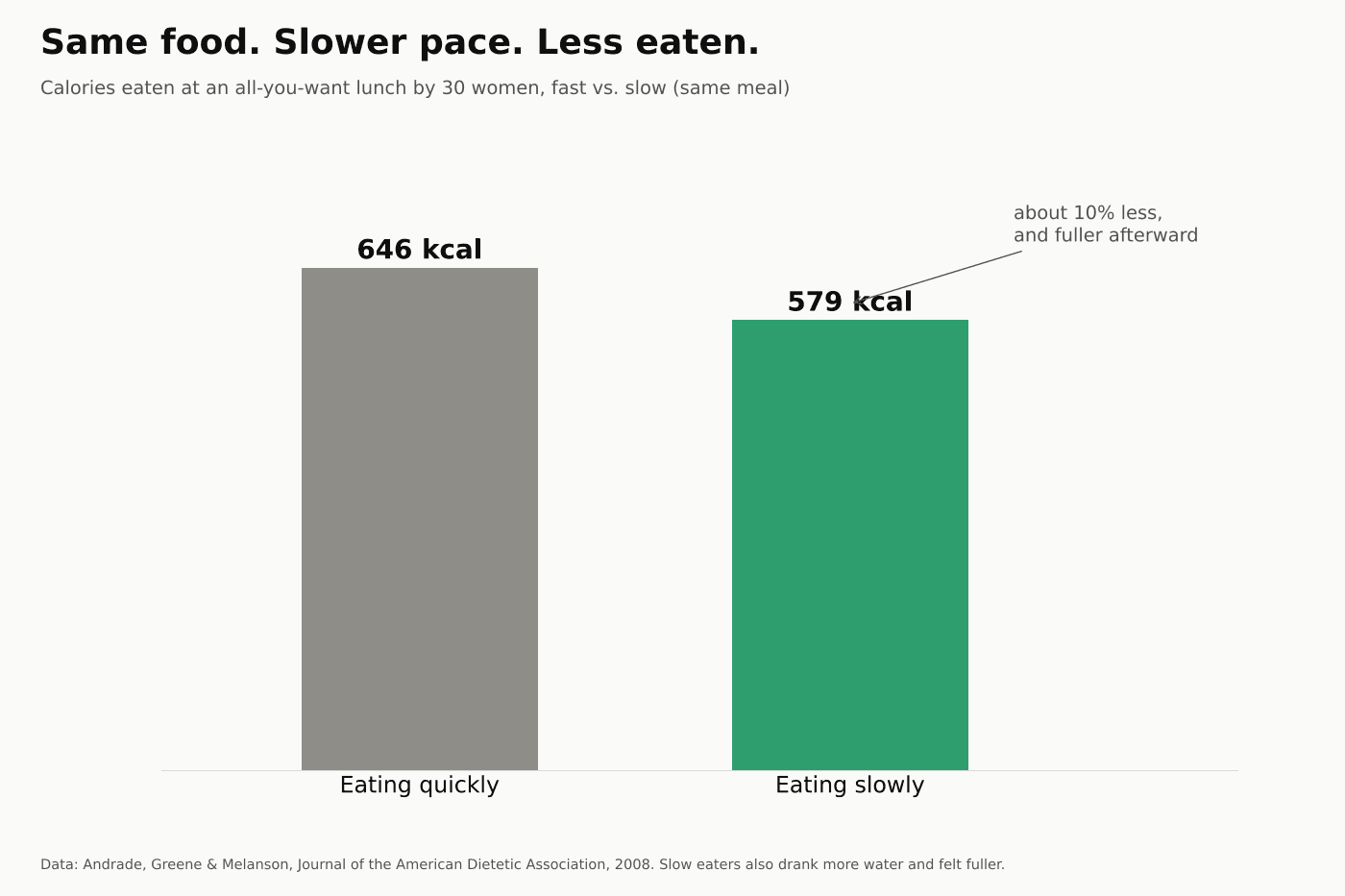
Fast eating beats the signal. In a 2008 study, 30 women ate the same lunch twice, once quickly and once slowly. Eating slowly, they ate 579 calories instead of 646, and felt fuller afterward.
A 2014 review of 22 studies found the same pattern: slower eating led to eating less. Interestingly, people weren’t hungrier later.
On Zepbound, you’re full sooner, but the signal still takes time to reach you. Eat at your old speed and you can blow past “enough” before you know it.
Action item: Set a soft goal: make your next meal last at least 15 minutes. Use a clock, not a feeling.
Fullness or Nausea? How to Tell
These two get confused all the time, and the difference matters.
- Fullness feels like “I’m done.” Food stops being interesting. It’s calm.
- Nausea feels queasy and unpleasant. It may come with sweating, burping, or reflux.
The ACLM handout says nausea needs attention, while fullness is the drug doing its job. Fullness is a signal to stop. Nausea is often a sign you didn’t stop soon enough.
If nausea keeps showing up, the six rules in How to Eat on GLP-1s are a good place to start.
Action item: If you feel queasy after a meal, write down how fast you ate and how big the portion was. Look for the pattern.
How to Listen: The 1-to-10 Fullness Check
Here’s a simple scale many dietitians use. 1 is starving. 5 is neutral. 10 is painfully stuffed.
- Start eating around 3 or 4: hungry, not frantic.
- Check in at the five-minute mark and halfway through.
- Stop around 6 or 7: comfortably satisfied. On Zepbound, that may come after half your old portion.
The trick is the check-in, not the number. Pausing is what lets the signal catch up.
If you’d like a nudge to pause mid-meal, that’s the job we built MealCam for. It’s the pace coach inside our MealCoach iPhone app, and it watches your eating pace, not your calories.
Action item: At your next three meals, check your fullness at minute five and halfway. Stop at 6 or 7.
A Worked Example: One Dinner, Four Check-Ins
Here’s what the scale looks like across one dinner. It’s an illustration, not a rule.
- Minute 0: hunger at 3. Plate is a smaller version of the usual.
- Minute 5: fork down. Fullness at 5. Hunger is already fading.
- Minute 12: about half eaten. Fullness at 6. Food looks less interesting.
- Minute 15: stop at 6 to 7. Leftovers go in a container for tomorrow.
Without the check-ins, this is the meal where you finish the plate in eight minutes and feel sick at minute 25.
Action item: Try this exact routine once this week, with leftovers ready to save.
What This Means for You
✅ You know feeling full fast is the drug working
✅ You know the fullness signal still lags behind your fork
✅ You can tell calm fullness from queasy nausea
✅ You have a 1-to-10 check-in you can use tonight
✅ You’ve stopped letting the plate decide when you’re done
The 5-Minute Version (Screenshot This)
- Why: Zepbound slows your stomach and quiets appetite signals.
- The lag: your brain can take up to 30 minutes to register fullness.
- The evidence: slower eaters ate less in 22 studies, without more hunger later.
- Fullness vs nausea: calm “done” vs queasy “too much.”
- The habit: check fullness at minute five and halfway; stop at 6 or 7 out of 10.
Conclusion
You feel full faster on Zepbound because the drug slows your stomach and turns down appetite signals. But the message still takes time to arrive, so speed can carry you past it.
Your one action today: check your fullness at minute five of your next meal, and stop at comfortably satisfied.
So tell me: what does “full” feel like for you on a GLP-1, and has it changed since you started?
Sources
- Cleveland Clinic: how to manage GLP-1 side effects
- American College of Lifestyle Medicine: GLP-1 side effects handout
- Pennington Biomedical: GLP-1s and food noise (May 2026)
- Andrade et al. 2008: eating slowly led to decreases in energy intake
- Robinson et al. 2014: eating rate and energy intake, a meta-analysis
 MealCoach