
You’ve done the work. Maybe the scale moved, maybe a GLP-1 did most of the heavy lifting, and that soft pouch below your belly button is still there, like it never got the memo. So when a post says a new shot makes belly fat cells self-destruct, of course you want it to be true.
“This is a highly innovative approach to obesity pharmacotherapy”
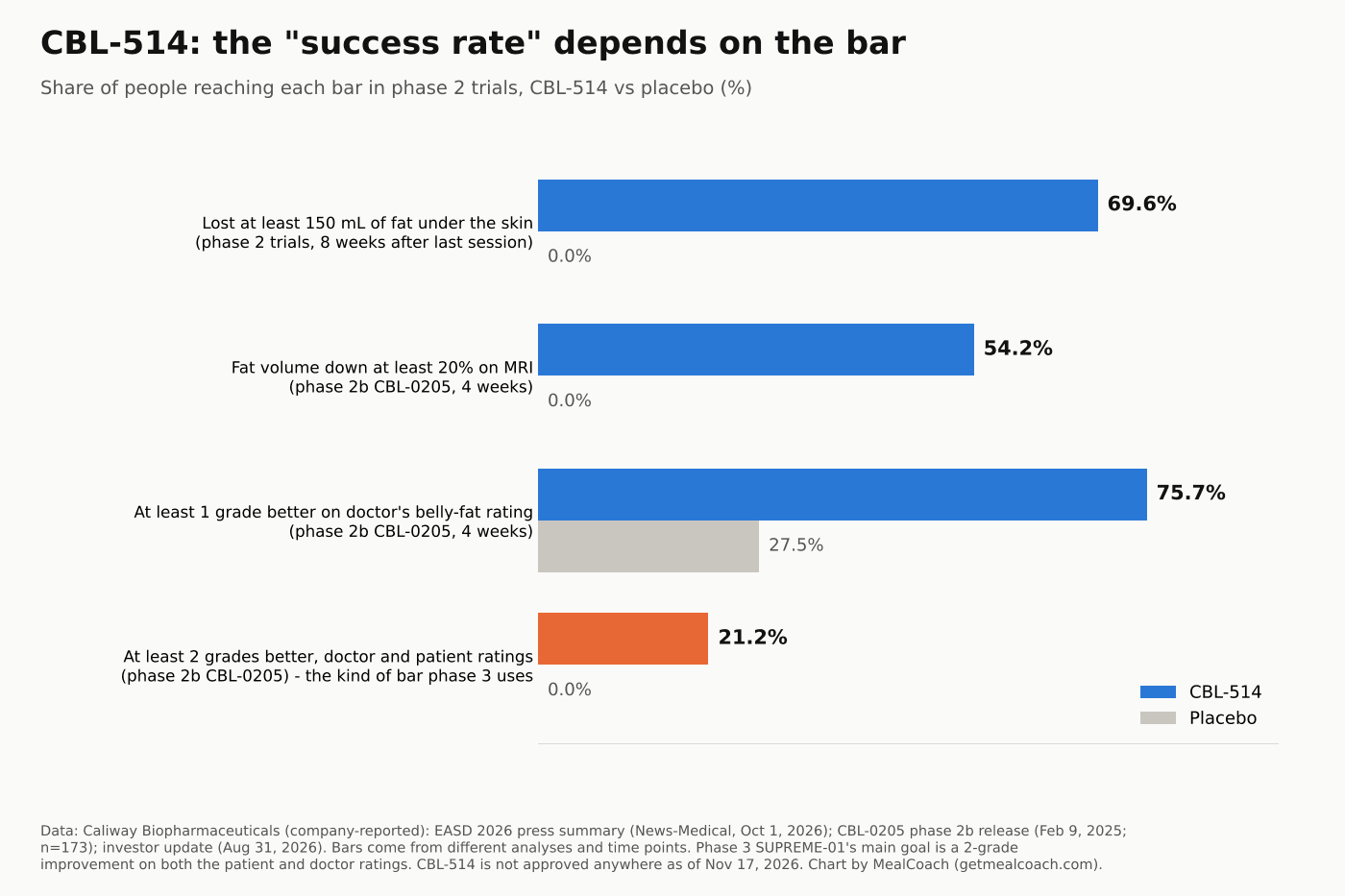
The short answer: CBL-514 is an experimental injection that is meant to make fat cells die off where it’s injected, and it is now in phase 3 trials for belly fat. In phase 2, 69.6% of treated people lost at least 150 mL of fat under the skin, versus 0% on placebo.
That viral number is real. But the first phase 3 trial has to clear a harder bar, a visible two-grade change in how the belly looks, and only about 1 in 5 hit that bar in phase 2b. It isn’t a weight-loss drug, and you can’t buy it.
Below, I walk through what the shot is, whether it really kills fat cells, what the trials found, what phase 3 has to prove, how it stacks up against Kybella, CoolSculpting and liposuction, and why you shouldn’t buy anything sold under its name. About 8 minutes.
What Is CBL-514?
CBL-514 is an injectable small-molecule drug from Caliway Biopharmaceuticals, a Taiwanese company, designed to reduce fat under the skin in one area without surgery. It’s given as many small shots into the treated area, such as the lower belly, every 3 weeks for up to 4 sessions in the phase 2b trial.
- What it targets: subcutaneous fat, the pinchable layer under the skin. The main program is for “large-area” belly fat.
- Who makes it: Caliway Biopharmaceuticals (Taiwan Stock Exchange: 6919), which says more than 550 people have taken part in its CBL-514 trials.
- Other uses being tested: cellulite, and Dercum’s disease (phase 2 trials), a rare condition with painful fatty lumps.
Action item: When you see CBL-514 in your feed, file it under “spot fat treatment in trials”, next to CoolSculpting, not next to Wegovy or Zepbound.
Does CBL-514 Really Make Fat Cells Self-Destruct?
That’s the company’s description: CBL-514 is designed to trigger apoptosis, a tidy, programmed cell death, in fat cells while leaving nearby tissue alone. Caliway says it does this without necrosis, the messy, inflammatory kind of cell death.
The evidence for the mechanism comes mainly from lab and animal work. The 2022 phase 2a paper in Aesthetic Surgery Journal names targeted fat-cell apoptosis in its title, but that human trial measured fat by ultrasound, not by counting dead cells.
A few more things worth knowing:
- It isn’t the first treatment to kill fat cells. Kybella, approved for the chin, is a drug that destroys fat cells on contact.
- Cooling can do it too. CoolSculpting (cryolipolysis) cools fat until cells are believed to undergo apoptosis and get cleared by the immune system, per a 2009 review by Nelson and colleagues. The new part is a drug that aims to do it over a large area.
- The X post’s fat-cell point is broadly right. A 2008 Nature study found adults’ fat-cell number stays stable in both lean and obese people, even after big weight loss, with about 10% of fat cells replaced each year (Spalding et al.). Weight loss mostly shrinks fat cells rather than removing them, and the body pushes back after weight loss; see our summary of The Secret Life of Fat.
My take: “fewer fat cells in that spot” is a real idea with real precedent. Whether it stays that way for years after CBL-514 hasn’t been shown.
Action item: When a post says a drug “kills fat cells,” ask one question: in people, or in a dish? Here it’s mostly the dish and animals, plus fat-volume scans in people.
How Much Belly Fat Did People Actually Lose?
In the phase 2b trial CBL-0205, 173 adults with moderate or severe belly fat got up to 4 sessions, and CBL-514 cut abdominal fat volume by an average of 166.6 mL (22.4%) at 4 weeks after the last session. On placebo, fat volume rose 15.7 mL (1.8%), per Caliway’s February 2025 release.
- At least a 20% drop in fat volume (MRI): 54.2% on CBL-514 vs 0% on placebo, the trial’s main goal.
- At least one grade better on the doctor’s belly-fat rating: 75.7% vs 27.5%. On the patient’s own rating: 73.0% vs 20.0%.
- Design: randomized and placebo-controlled at 15 sites in the US and Canada, with two other comparison injections in the mix.
At EASD 2026, the European diabetes meeting in Milan, a pooled look at 40 people with MRI scans from two phase 2 trials (23 on CBL-514, 17 on placebo, BMI 22 to 30) found deep belly fat around the organs also fell.
It was 10.45% below baseline at the last follow-up on CBL-514, versus 11.76% above on placebo, per Caliway. That’s a small group, and Caliway’s release gave no p-values.
Action item: Remember the scale: about 167 mL is a bit over two-thirds of a cup of fat from one area. Meaningful to how a belly looks, small next to total body fat.
Is That 69.6% Number Too Good to Be True?
Yes, as reported: 69.6% of people treated in the phase 2 trials lost at least 150 mL of fat under the skin at the 8-week follow-up, versus 0% on placebo. That’s the figure from the EASD 2026 press summary on News-Medical.
Here’s the fine print the viral post skips:
- It’s fat under the skin in the treated area, not “belly fat” in general and not body weight.
- The summary doesn’t say which people it counts. It cites “phase 2 clinical trials” without giving the number of people or the analysis set.
- It’s company-presented data. We found no full peer-reviewed paper of the phase 2b trials yet.
- 8 weeks is short. Nobody has shown what the belly looks like a year or five later.
Action item: Before you share a striking trial stat, check three things: what was measured, how many people, and when.
Why Is Phase 3 a Much Harder Test?
Phase 3 asks whether people look noticeably different, not just whether a scan moves: the first trial’s main goal is at least a two-grade improvement on both the patient’s and the doctor’s belly-fat rating scales. That’s per Caliway’s September 23, 2026 release, with MRI fat volume as a key secondary goal.
That’s a much harder bar. In phase 2b, 21.2% of people on CBL-514 reached a two-grade improvement on the combined doctor-and-patient rating, versus 0% on placebo, per Caliway’s August 2026 investor update. Caliway notes that Kybella’s two-grade rates were 13.4% to 18.6%, in a different body area and trial design.
- SUPREME-01 (CBL-0301): first person dosed September 2026; about 320 people in the US and Canada; still enrolling then.
- SUPREME-02 (CBL-0302): enrollment start announced October 29, 2026; about 320 people at 30 to 35 sites in the US and Canada; BMI 18.5 to 30. Its main goals were reported as MRI fat volume plus the patient’s rating.
- Results: Caliway has said it expects results in 2027 (ReachMD, May 2026). No approval date has been announced.
So the X post’s “320 people are currently going through a Phase 3 trial” is close but not quite right. Each of two trials aims to enroll about 320, and both were still recruiting when last reported.
Action item: Watch for the SUPREME-01 two-grade result in 2027. That one number will tell you more than any phase 2 headline.
Can CBL-514 Finish What Ozempic Started?
Not in the way you might hope. CBL-514 isn’t a weight-loss drug: it reduces fat only in the spot where it’s injected, while GLP-1 drugs like semaglutide (Ozempic, Wegovy) and tirzepatide (Mounjaro, Zepbound) lower appetite and reduce weight across the whole body. SUPREME-02 enrolls people with a BMI of 18.5 to 30, and phase 3 measures belly appearance, not pounds.
Caliway is also testing combinations. A phase 2 trial of CBL-514 with tirzepatide in about 120 adults was cleared by the FDA in August 2026, per the company. The claim that CBL-514 reduces weight regain after a GLP-1 stops comes from rats, not people, so far.
If regain is the worry on your mind, see what happens when you stop a GLP-1, which covers what the human trials actually show. For the drugs that do target body weight, see the 2026 weight-loss drug pipeline.
Action item: If someone pitches CBL-514 as a way to lose weight, correct them kindly: it’s a contouring drug in trials, for one area at a time.
How Does It Stack Up Against Kybella, CoolSculpting and Liposuction?
All four aim to remove fat from one area; CBL-514 is the only one not yet approved or cleared, and unlike Kybella it’s being tested on the large area of the belly.
- Kybella (deoxycholic acid): FDA-approved on April 29, 2015 for fat under the chin only; it destroys fat cells and can damage other cells it touches, per Drugs.com. Use elsewhere isn’t approved.
- CoolSculpting (cryolipolysis): a cooling device, not a drug. A rare side effect, paradoxical adipose hyperplasia, makes the treated fat grow instead; a 2017 review found it may be more common than first reported.
- Liposuction: surgery that removes fat directly. In a randomized trial in women, fat came back within a year, mostly in the upper belly, per the University of Colorado researchers.
- CBL-514: injections, no surgery, phase 3. No long-term data yet.
My take: the liposuction result is the one to keep in mind. Removing fat cells from one spot doesn’t stop the rest of your body from storing fat.
Action item: If you’re weighing any spot-fat treatment now, ask the provider what happens if your weight goes up afterward.
Does It Hurt, and What Are the Side Effects?
In the trials reported so far, the main side effects were mild to moderate reactions where the shots went in, such as pain, swelling and redness, and no drug-related serious side effects were reported. That’s per Caliway’s phase 2b release and the EASD summary.
What’s missing is just as important. We found no published rates for each side effect, no data on how many people stopped, and no follow-up longer than a few months. Caliway has a long-term follow-up study (CBL-0303) cleared in the US, which should help.
If you’re in a trial, or have had any fat-reducing injection, call your doctor promptly for spreading redness, fever, pus, or a hot, painful lump at the injection site. In an emergency, call 911.
Action item: When the phase 3 results land, look for the side-effect table, not just the headline. Rates per 100 people tell you far more than “well tolerated.”
Can You Get CBL-514 Yet?
No. As of November 17, 2026, CBL-514 has no marketing approval in any country, and Caliway says “It is not commercially available in any market.” The company issued that warning on October 30, 2026 after finding unauthorized online sellers claiming to offer it.
Anything sold online as CBL-514 today isn’t the trial drug, and you can’t know what’s in the vial. The only legitimate way in is a clinical trial.
Action item: If you see CBL-514 for sale, don’t buy it. If you’re curious, ask a doctor whether a trial site near you is recruiting.
What Nobody Knows Yet
The big gaps are whether phase 3 hits its looks-based goal, how long results last, and what happens with weight gain later.
- The phase 3 result: only about 1 in 5 cleared the two-grade bar in phase 2b.
- Durability: phase 2 follow-up ran 4 to 12 weeks after treatment.
- Fat redistribution: whether fat shifts elsewhere later, as it did after liposuction.
- Full data: side-effect rates and a peer-reviewed phase 2b paper.
- Cost and access: no price, filing date or approval date has been announced.
Action item: Treat any CBL-514 launch date you see online as a guess until Caliway or a regulator announces one.
Quick Answers
What is CBL-514? An experimental injection from Caliway Biopharmaceuticals, designed to make fat cells die off where it’s injected. It’s in phase 3 trials for belly fat.
Is CBL-514 approved? No, not anywhere as of November 17, 2026. Caliway expects phase 3 results in 2027.
Does CBL-514 cause weight loss? It isn’t being tested as a stand-alone weight-loss drug. It reduces fat in the treated area, and phase 3 measures belly fat and how it looks.
Where does the 69.6% come from? Phase 2 data presented at EASD 2026: 69.6% of treated people lost at least 150 mL of fat under the skin at 8 weeks, versus 0% on placebo.
Can I buy CBL-514 online? No. Caliway says it isn’t sold anywhere, and it has warned about unauthorized sellers.
What This Means for You
✅ You know CBL-514 is a spot-fat injection in phase 3, not a weight-loss drug
✅ You know the 69.6% figure is real, and what it does and doesn’t measure
✅ You know the first phase 3 trial must clear a two-grade looks bar that about 1 in 5 hit in phase 2b
✅ You know how it differs from Kybella, CoolSculpting and liposuction
✅ You know anything sold online under its name isn’t the real thing
The 5-Minute Version (Screenshot This)
- What it is: CBL-514, an experimental injection meant to make fat cells die off where it’s injected, from Caliway Biopharmaceuticals.
- Phase 2b: belly fat volume −166.6 mL (−22.4%) vs +15.7 mL on placebo, 4 weeks after the last session.
- The viral stat: 69.6% lost at least 150 mL of fat under the skin at 8 weeks, vs 0% on placebo.
- The real test: the first phase 3 trial needs a two-grade looks improvement; 21.2% vs 0% reached that in phase 2b. Results expected in 2027.
- Status: not approved or sold anywhere. Spot fat, not weight loss.
Conclusion
CBL-514 is a genuinely new idea: a drug that aims to remove fat cells from a large area like the belly without surgery. The phase 2 numbers are real, but they’re short-term, company-reported, and measured on an easier bar than the one the first phase 3 trial has to clear.
Your one action today: if CBL-514 shows up in your feed, share the 5-minute version instead of the hype, and don’t buy anything sold under its name.
So tell me: if an injection could flatten one stubborn spot, would you choose it over liposuction, or wait for the long-term data?
Sources
- News-Medical (EASD press summary): CBL-514 injection reduces visceral and subcutaneous fat in trials (Oct 1, 2026)
- Caliway: EASD press room features new data on CBL-514 (Oct 2, 2026)
- Caliway release (via BioSpace): CBL-514 phase 2b study CBL-0205 results (Feb 9, 2025)
- Caliway: Investor conference key takeaways, phase 3 progress and GLP-1 combination strategy (Aug 31, 2026)
- Caliway: First patient dosed in phase 3 SUPREME-01 (Sep 23, 2026)
- Caliway: SUPREME-02 enrollment begins (Oct 29, 2026)
- Caliway: Clarification of unauthorized online claims regarding CBL-514 (Oct 30, 2026)
- ReachMD: FDA clears Caliway’s phase 3 CBL-514 trial (May 22, 2026)
- Efficacy of a Novel Injection Lipolysis to Induce Targeted Adipocyte Apoptosis: A Randomized, Phase IIa Study of CBL-514 Injection on Abdominal Subcutaneous Fat Reduction. Aesthet Surg J 2022;42(11):NP662–NP674
- Spalding KL et al. Dynamics of fat cell turnover in humans. Nature 2008;453:783–787
- Nelson AA, Wasserman D, Avram MM. Cryolipolysis for reduction of excess adipose tissue. Semin Cutan Med Surg 2009;28:244–249
- Ho D, Jagdeo J. A systematic review of paradoxical adipose hyperplasia post-cryolipolysis. J Drugs Dermatol 2017;16(1):62–67
- Drugs.com: FDA approves Kybella (Apr 29, 2015)
- University of Colorado (via EurekAlert): Fat returns after liposuction, Hernandez TL, Eckel RH et al., Obesity (2011)
 MealCoach