
“This isn’t a failing of the medicines.”
The short answer: what happens when you stop a GLP-1 like Zepbound (tirzepatide) or Wegovy (semaglutide)? Much of the lost weight tends to come back. In the STEP 1 trial, people regained about two-thirds of it within a year of stopping semaglutide. A 2026 review projected a return to starting weight in about 1.5 years.
That isn’t a personal failure, and it isn’t the whole story. Below are the real numbers, why it happens, what is and isn’t proven to help, and a plan to make with your prescriber before you stop.
In this post you’ll learn how much weight comes back after stopping a GLP-1, how fast, whether the health benefits fade too, and what you can set up now. About 7 minutes.
Stopping Is Common, and Nobody Warns You
If you’re thinking about stopping, you’re far from alone. A 2025 joint advisory from four obesity and nutrition societies says 50% to 67% of people stop GLP-1 therapy within a year, and about 85% within two years, per the advisory in Obesity.
People stop for cost, insurance changes, side effects, supply problems, or because they reached a goal. On forums, the same fear comes up again and again: “What happens when I come off?”
Regain doesn’t mean you “failed.” The trials show regain is the usual biology of obesity, not a lack of willpower. Knowing that early lets you plan instead of panic.
Action item: Write down why you might stop (cost, side effects, a goal, coverage). The reason changes which options are worth asking your prescriber about.
How Much Weight Comes Back After Stopping Semaglutide?
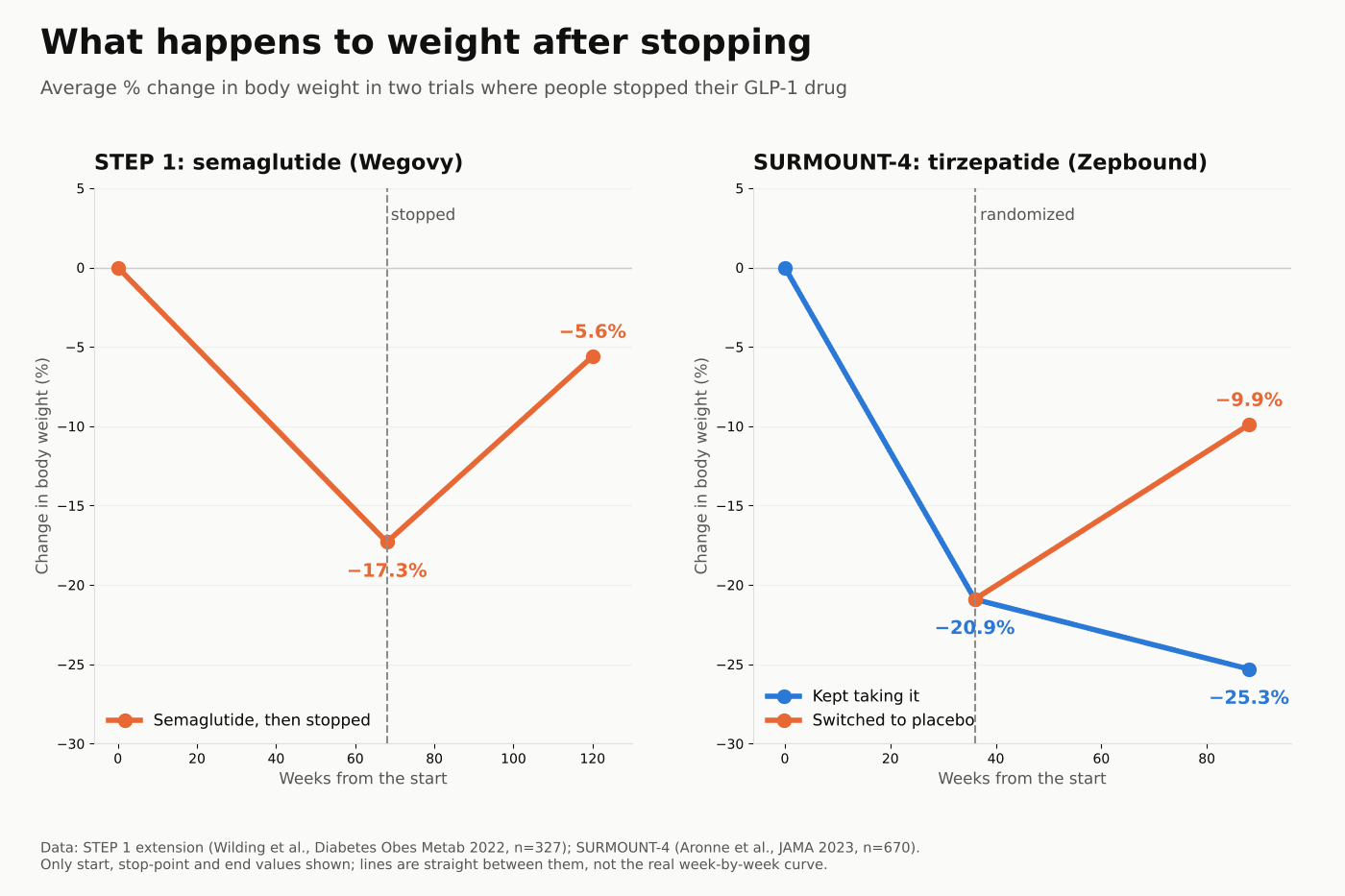
About two-thirds of the weight lost on semaglutide came back within a year of stopping, in the STEP 1 trial extension (Wilding et al., 2022).
- 327 adults took weekly semaglutide 2.4 mg (the dose in Wegovy) or placebo for 68 weeks, then stopped and were followed to week 120.
- The semaglutide group lost 17.3% of their weight by week 68.
- One year after stopping, they had regained 11.6 percentage points, leaving them 5.6% below where they started.
Illustration, not a real person: someone who started at 100 kg (220 lb) and matched these averages would weigh about 82.7 kg at week 68 and about 94.4 kg a year after stopping.
Action item: Note your starting weight and your current weight. Those two numbers make it much easier to spot early changes after stopping.
What Happens When You Stop Zepbound (Tirzepatide)?
People who stopped tirzepatide gained back 14% from their weight at the point they stopped, over the next year, in SURMOUNT-4. Those who kept taking it lost a further 5.5% (Aronne et al., JAMA 2023; summary by HCPLive).
- Everyone first took tirzepatide, the drug in Zepbound, for 36 weeks and lost an average of 20.9%.
- Then 670 people were randomly split: keep taking it, or switch to placebo without knowing which.
- By week 88, the group that kept going was 25.3% below their starting weight. The placebo group was 9.9% below (TCTMD).
- 89.5% of people who stayed on tirzepatide kept at least 80% of their earlier loss, versus 16.6% on placebo.
The takeaway: stopping cost people a lot of their progress, but at the end of the trial they were still about 10% lighter than at the start, on average.
Action item: If you’re weighing whether to stop, ask your prescriber to walk you through SURMOUNT-4. It’s the clearest trial on staying on versus stopping.
How Fast Does Weight Come Back After a GLP-1?
After stopping semaglutide or tirzepatide, weight came back at about 0.8 kg (1.8 lb) a month on average, in a 2026 BMJ review of 37 studies with 9,341 adults (West et al., BMJ 2026; summary by the University of Oxford). Across all weight-loss medicines in the review, the average was 0.4 kg a month.
- For semaglutide and tirzepatide, the researchers projected a return to starting weight in about 1.5 years.
- Across all the medicines studied, regain was faster than after ending diet and behavior programs, by about 0.3 kg a month.
- The authors flag the limits: few studies covered semaglutide and tirzepatide, and follow-up after stopping was short, so some estimates are projections.
Action item: After stopping, weigh yourself on the same scale, at the same time of day, once a week. A trend over a month tells you more than any single day.
Do the Health Benefits Fade Too?
Most heart and metabolic gains fade after stopping, too. In the STEP 1 extension, most of the heart and metabolic improvements seen on semaglutide moved back toward baseline a year after stopping.
The BMJ review estimated that blood sugar, blood pressure, cholesterol, and triglycerides return to baseline about 1.4 years after stopping.
So if you started a GLP-1 partly for blood sugar or blood pressure, stopping affects more than the scale. That’s a key question for your doctor.
Action item: Ask which numbers your prescriber wants to recheck after you stop, such as A1c, blood pressure, or lipids, and when.
Why Does the Weight Come Back?
Weight returns because obesity is a chronic condition and the drug’s effects on appetite wear off once it’s gone. The Oxford team calls obesity a chronic, relapsing condition rather than a short-term problem.
GLP-1 drugs reduce how much people eat by roughly 16% to 39% compared with placebo, through changes in hunger, cravings, and fullness, per the joint advisory. Zepbound’s FDA label also notes the drug slows how fast the stomach empties.
When the drug leaves your system, those brakes come off. Many people describe the “food noise” coming back. The Oxford researchers also suggest that people on drugs may not get as much practice with the eating habits they’ll need afterward.
I wrote about why the body defends its weight in our summary of The Secret Life of Fat.
Action item: While you’re still on the drug, notice what “comfortably full” feels like. That signal is the one you’ll have to listen for later without help.
Does Anything Help Keep Weight Off After Stopping?
Staying on treatment has the strongest evidence. For keeping weight off after stopping, the honest answer is that nothing is proven yet.
- Continuing treatment: SURMOUNT-4 is the clearest evidence that staying on tirzepatide maintains weight loss.
- Diet and behavior support: the joint advisory says structured nutrition and lifestyle therapy to limit regain after stopping “has not been studied in controlled trials.” The BMJ review found behavioral support during treatment boosted weight loss but didn’t slow regain afterward.
- A procedure in testing: Fractyl Health reported that its investigational Revita procedure cut regain after stopping tirzepatide to 5.1% versus 8.2% with a sham procedure at six months (company data, not yet peer-reviewed, not FDA-approved), per HCPLive.
My take: be skeptical of anyone selling a “post-GLP-1 protocol” that promises to stop regain. Nobody has shown that yet.
Action item: If you’re offered a program to “lock in” your results, ask one question: “Which controlled trial showed it prevents regain after stopping?”
A Plan to Make Before You Stop
A good plan won’t guarantee you keep the weight off, but it helps you catch changes early and avoid surprises. Here’s what to set up with your prescriber:
- How to stop. Ask how they want you to come off and whether a step-down makes sense for you. Don’t improvise it.
- A check-in trigger. Agree on a number, for example a certain weight gain over a month, that means you’ll book a follow-up.
- Your health markers. Know which tests get rechecked and when.
- Your meal routine. Regular meals with protein, eaten slowly enough to notice fullness. These are habits to practice, not proven regain blockers.
- A restart conversation. Ask what would happen if you wanted to restart later, and what that would involve.
Eating pace is one habit you can practice now. If you rush meals, our post on how to stop eating too fast explains why it’s so hard to notice. The free browser tool MealCam gives you a gentle pace cue during a meal. It’s an awareness tool, not a weight-loss treatment.
Action item: Bring this five-point list to your next appointment and fill it in together before your last dose.
Quick Answers
Will I gain all the weight back if I stop Zepbound? Not necessarily all of it, but many people regain a lot. In SURMOUNT-4, people who stopped tirzepatide gained back 14% from their weight at stopping over a year, ending about 10% below their starting weight.
How long does it take to regain weight after stopping Wegovy or Ozempic? In STEP 1, about two-thirds came back within a year. A 2026 BMJ review projected a return to starting weight in about 1.5 years after semaglutide or tirzepatide.
Does tapering off a GLP-1 prevent regain? None of the trials in this post tested tapering, so they can’t answer that. How to stop is a decision to make with your prescriber.
Does the food noise come back after stopping? Many people report it does. That fits with the drug’s effects on hunger and cravings wearing off once it’s stopped.
Can I keep weight off with diet and exercise after stopping? Some people do, but it hasn’t been tested in controlled trials after GLP-1s, per the 2025 joint advisory. Plan to monitor and check in early.
What This Means for You
✅ You know regain after stopping is common and expected, not a personal failure
✅ You know the real numbers: about two-thirds back within a year for semaglutide
✅ You know health markers tend to drift back too
✅ You know no “post-GLP-1 plan” is proven to stop regain yet
✅ You have a five-point plan to make with your prescriber
The 5-Minute Version (Screenshot This)
- Semaglutide (STEP 1): −17.3% at week 68; a year after stopping, only −5.6%.
- Tirzepatide (SURMOUNT-4): stopping meant gaining back 14% over a year; staying on meant losing a further 5.5%.
- Speed: about 0.8 kg (1.8 lb) a month; projected return to start in about 1.5 years (BMJ 2026).
- Health markers: back to baseline in about 1.4 years.
- What to do: plan the stop with your prescriber, weigh weekly, set a check-in trigger, and practice regular, slower meals.
Conclusion
What happens when you stop a GLP-1? In the trials, much of the weight and many of the health gains drifted back within one to two years. That’s the biology of a chronic condition, not a verdict on you.
Your one action today: before your last dose, sit down with your prescriber and agree on how you’ll stop, what you’ll track, and when you’ll check back in.
So tell me: if you’ve stopped a GLP-1, what surprised you most in the first three months?
Sources
- Wilding JPH et al. Weight regain after withdrawal of semaglutide: the STEP 1 trial extension. Diabetes Obes Metab, 2022
- Aronne LJ et al. Continued treatment with tirzepatide for maintenance of weight reduction (SURMOUNT-4). JAMA, 2023
- HCPLive: SURMOUNT-4 results summary
- TCTMD: stopping tirzepatide leads to rebound in weight and cardiometabolic risk
- West S et al. Weight regain after cessation of medication for weight management: systematic review and meta-analysis. BMJ, 2026
- University of Oxford: news release on the BMJ review (Jan 8, 2026)
- Mozaffarian D et al. Nutritional priorities to support GLP-1 therapy for obesity: a joint advisory. Obesity, 2025
- FDA: Zepbound (tirzepatide) prescribing information, revised Feb 2026
- HCPLive: Revita and weight regain after GLP-1 discontinuation, REMAIN-1 (Oct 2026)
 MealCoach