
“…offers the potential for strong efficacy with improved tolerability”
The short answer: Eli Lilly has added ENLIGHTEN-10 to its eloralintide Phase 3 program. It’s a placebo-controlled trial in about 3,000 adults with type 2 diabetes, overweight or obesity, and a higher risk of heart problems. Its main goals are weight loss and A1C.
It is listed on ClinicalTrials.gov as NCT07900633, not yet recruiting, with the listing showing a last update of October 28, 2026. Results are years away.
In this post you’ll learn what ENLIGHTEN-10 will test, why it isn’t a heart outcomes trial, how it fits the rest of eloralintide’s Phase 3 program, and when eloralintide could realistically reach patients. About 5 minutes.
What Is the ENLIGHTEN-10 Trial?
ENLIGHTEN-10 is a Phase 3, randomized, double-blind trial comparing once-weekly eloralintide with placebo in adults who have type 2 diabetes, a BMI of 25 or more, and an increased risk of cardiovascular events. That’s per its record in the EU clinical trials register (EU CT 2026-525919-14-00, protocol J3R-MC-YDAS).
The record plans 3,000 people worldwide, including 650 at 85 sites in eight EU countries. Other listed countries include the United States, Canada, Mexico, Brazil, China, India, Japan and Australia.
To join, people need an A1C between 6.5% and 9.5% and must already take one to four diabetes medicines at a steady dose for at least 90 days. People who had a heart attack, stroke or heart failure hospitalization in the 60 days before screening are excluded.
Action item: If you have type 2 diabetes and heart risk factors, bookmark the ClinicalTrials.gov listing. Study sites usually appear there once recruiting starts.
Is ENLIGHTEN-10 a Heart Outcomes Trial?
No. Its two main goals are percent change in body weight and change in A1C versus placebo, not heart attacks or strokes. The EU record lists no other outcomes yet, and no time point for measuring them.
That matters because “increased cardiovascular risk” in the title invites the wrong headline. A true cardiovascular outcomes trial counts events like heart attacks and strokes. Novo Nordisk’s CagriSema has one: REDEFINE 3 plans about 7,100 people with cardiovascular disease, per its registry summary.
Our read: enrolling higher-risk people gives Lilly weight, A1C and safety data in the group most likely to use the drug, many of whom have diabetes and heart risk together. Lilly hasn’t said why it designed the trial this way, and the record doesn’t define “increased risk.”
Action item: When you see “heart risk” in a trial name, check the primary outcome. That tells you what the trial can actually prove.
What Is Eloralintide, and What Did It Do in Phase 2?
Eloralintide is Lilly’s once-weekly amylin drug. Amylin is a natural hormone that Lilly describes as helping regulate fullness (satiety). Eloralintide copies it, alone, without a GLP-1 drug in the same shot.
In its Phase 2 trial of 263 adults with obesity or overweight and no type 2 diabetes, eloralintide cut body weight by 9.5% to 20.1% at 48 weeks across doses, versus 0.4% on placebo. Those numbers assume everyone stayed on treatment (the efficacy estimand), per Lilly’s release. The results were published in The Lancet.
The most common side effects were mild to moderate stomach symptoms and fatigue, more often at higher doses.
In earlier trials, people with type 2 diabetes lost less weight. Semaglutide 2.4 mg cut weight by 14.9% in people without diabetes (STEP 1) and 9.6% in people with type 2 diabetes (STEP 2), both at 68 weeks. So our expectation is smaller numbers in ENLIGHTEN-10 too.
Action item: Don’t confuse eloralintide with EloraTZP. EloraTZP adds tirzepatide (the drug in Zepbound) to the same shot, and it has its own trials. See what the AMPLIFY trials will test.
How Does ENLIGHTEN-10 Fit the Eloralintide Phase 3 Program?
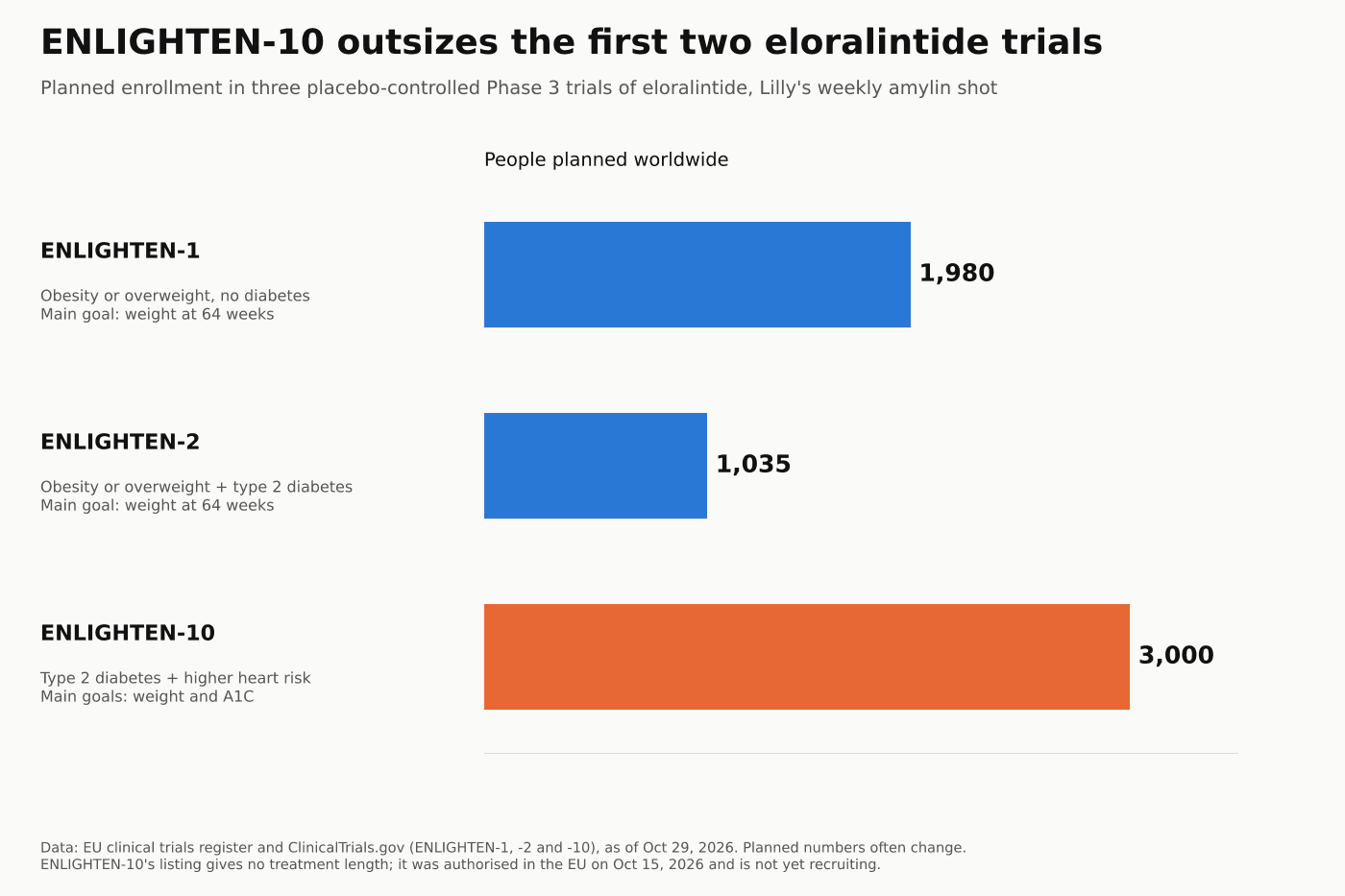
It’s the second eloralintide Phase 3 trial in type 2 diabetes, and the bigger of the two. Here’s the program as the registries show it on October 29, 2026:
- ENLIGHTEN-1 (NCT07321886): about 1,980 adults with obesity or overweight and no diabetes; main goal is weight change at 64 weeks. Recruiting.
- ENLIGHTEN-2 (NCT07282600): about 1,035 adults with obesity or overweight and type 2 diabetes; weight change at 64 weeks. Recruiting.
- ENLIGHTEN-3 (NCT07369011): obstructive sleep apnea in adults with obesity.
- ENLIGHTEN-4 and -6: knee osteoarthritis pain, and people who still have obesity while on a weekly incretin drug, per the EU register’s list of related trials.
- ENLIGHTEN-10: about 3,000 adults with type 2 diabetes and higher heart risk; weight and A1C. Authorised in the EU on October 15, 2026, recruitment pending.
ENLIGHTEN-10 is the first in the program with A1C as a main goal. That points at a possible diabetes use, not just weight management. That’s our inference; Lilly hasn’t announced the trial or its plans for it.
Action item: If you’re tracking eloralintide, watch ENLIGHTEN-1 and -2 first. They started earliest, so they’re expected to report first.
When Could Eloralintide Be Available?
Not soon. The earliest eloralintide trials aren’t expected to finish their main measurements until early 2028, and ENLIGHTEN-10 hasn’t started. ClinicalTrials.gov lists ENLIGHTEN-1’s primary completion as March 2028 and ENLIGHTEN-2’s as January 2028 (read via ctis.eu, which mirrors ClinicalTrials.gov data).
After that come analysis, an FDA filing and a review that usually takes about a year. So 2029 or later is a realistic earliest window for approval. That’s our estimate, not Lilly’s, and registry dates move.
Closer options exist in the same family. Retatrutide, Lilly’s triple-hormone shot, has an FDA submission planned for the first quarter of 2027, per Lilly’s September 29, 2026 release; see how it did against Ozempic in type 2 diabetes.
Action item: If you’re deciding about treatment now, decide based on what’s approved today. Eloralintide is years away.
What Does This Mean If You Have Type 2 Diabetes Now?
Nothing changes today: eloralintide isn’t approved, and this trial isn’t recruiting yet. Approved GLP-1 and GIP/GLP-1 drugs remain among the options your doctor can prescribe.
Don’t buy “eloralintide” online. Products sold as research chemicals aren’t Lilly’s drug, and the FDA has warned about unapproved GLP-1-type drugs sold for weight loss (FDA, Oct 1, 2026).
If you’re on any diabetes or weight medicine and get severe belly pain, repeated vomiting or signs of very low blood sugar, call your doctor or seek urgent care.
If you’re interested in joining a trial, ask your doctor whether you might qualify once sites open. Trials have strict criteria, and being in one means you may get placebo.
Action item: Write down your latest A1C and your diabetes medicines. If a trial site opens nearby, those are the first things they’ll ask about.
What We Don’t Know Yet
The biggest gaps are the doses, the trial length and how “increased cardiovascular risk” is defined. As of October 29, 2026:
- Doses. The EU record doesn’t list eloralintide doses.
- Length. No time point is given for the main goals.
- Heart risk. The record says “increased risk of cardiovascular events” without defining it.
- Dates. No start or completion dates are listed in the EU record.
- Lilly’s plans. We found no Lilly announcement of ENLIGHTEN-10 outside the registries.
Action item: Treat this as a starting line, not a result. Check the ClinicalTrials.gov listing for added details before you read much into it.
Quick Answers
What is ENLIGHTEN-10? A Phase 3 trial of eloralintide versus placebo in about 3,000 adults with type 2 diabetes, overweight or obesity, and higher cardiovascular risk. Its main goals are weight loss and A1C.
Is eloralintide approved? No. It’s in Phase 3 trials and isn’t approved anywhere as of October 2026.
How much weight did eloralintide cause in trials? In Phase 2, 9.5% to 20.1% at 48 weeks across doses, versus 0.4% on placebo, in people without type 2 diabetes, if everyone stayed on treatment.
Will ENLIGHTEN-10 show whether eloralintide protects the heart? Not as designed. It measures weight and A1C, not heart attacks or strokes.
When will eloralintide be available? Its first Phase 3 trials are expected to finish main measurements in early 2028. Approval in 2029 or later is our estimate.
What This Means for You
✅ You know ENLIGHTEN-10 tests eloralintide in type 2 diabetes with higher heart risk
✅ You know its main goals are weight and A1C, not heart events
✅ You know eloralintide is an amylin drug, not EloraTZP
✅ You know approval is likely 2029 or later (our estimate)
✅ You won’t buy “eloralintide” online
The 5-Minute Version (Screenshot This)
- News: Lilly’s ENLIGHTEN-10 (NCT07900633) appeared on ClinicalTrials.gov, last updated October 28, 2026; not yet recruiting.
- Who: about 3,000 adults with type 2 diabetes, BMI 25 or more, A1C 6.5% to 9.5%, and higher heart risk.
- Design: eloralintide vs placebo, double-blind; main goals are weight and A1C.
- Not a heart outcomes trial: it doesn’t count heart attacks or strokes as its main goal.
- Timing: first eloralintide Phase 3 results expected around 2028; approval 2029 or later (our estimate).
Conclusion
The eloralintide Phase 3 program keeps growing. ENLIGHTEN-10 takes the amylin shot into the people with the most at stake: type 2 diabetes plus higher heart risk. It will tell us about weight, A1C and safety in that group, not whether it prevents heart attacks.
Your one action today: if you’re weighing treatment, focus on what’s approved now, and check back on eloralintide when ENLIGHTEN-1 and -2 report.
Curious how Lilly’s amylin combo stacks up against Novo’s? Read CagriSema vs EloraTZP.
So tell me: would a fullness-hormone shot without a GLP-1 appeal to you more or less than the drugs available today?
Sources
- ClinicalTrials.gov: ENLIGHTEN-10 (NCT07900633)
- EU clinical trials register: ENLIGHTEN-10 (EU CT 2026-525919-14-00), via ctis.eu
- EU clinical trials register: ENLIGHTEN-1 (EU CT 2025-523657-34-00), via ctis.eu
- EU clinical trials register: ENLIGHTEN-2 (EU CT 2025-523658-15-00), via ctis.eu
- EU clinical trials register: ENLIGHTEN-3 (EU CT 2025-523769-11-00), via ctis.eu
- Wilding et al., STEP 1, NEJM (2021)
- Davies et al., STEP 2, The Lancet (2021)
- Eli Lilly: retatrutide TRIUMPH-2 results and filing plans (Sep 29, 2026)
- Eli Lilly: eloralintide Phase 2 results (PR Newswire, Nov 6, 2025)
- REDEFINE 3, CagriSema cardiovascular trial (NCT05669755), registry summary
- FDA: concerns with unapproved GLP-1 drugs used for weight loss (Oct 1, 2026)
 MealCoach