
“…a defining moment for Fractyl.”
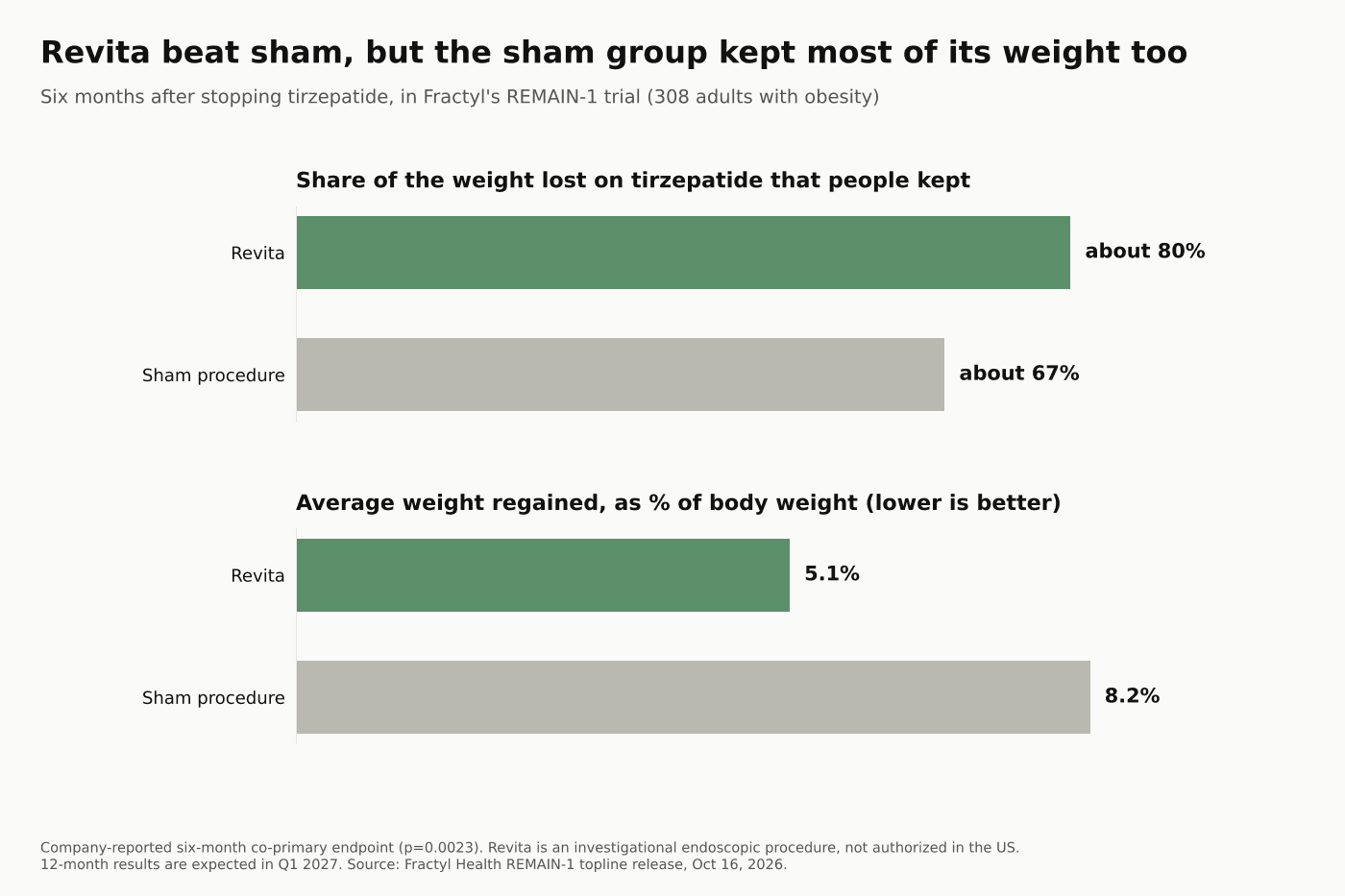
The short answer: in its Fractyl Health Q3 2026 report on November 12, 2026, the company said its one-time procedure, Revita, helped people keep about 80% of the weight they lost on a GLP-1 drug six months after stopping it. People who got a fake (sham) procedure kept about 67%.
That gap was statistically significant, and Fractyl plans to start its FDA filing by the end of 2026. But the company also cut about 45% of its staff, dropped its gene therapy program, and says its cash only lasts into the second quarter of 2027.
In this post you’ll learn what Revita is, what the REMAIN-1 trial showed, why the stock fell on a trial that hit its goal, what Fractyl’s finances look like, and when Revita could reach US clinics. About 7 minutes.
What Is Revita?
Revita is a one-time endoscopic procedure, not a drug. A doctor passes a tube through the mouth into the duodenum, the first part of the small intestine, and uses a heated balloon to destroy the thin top layer of its lining, about half a millimeter deep. The lining grows back over two to four weeks.
The procedure takes about an hour and is done as an outpatient, per Medical Design & Outsourcing. Fractyl’s theory is that years of high-fat, high-sugar eating damage that lining and disturb how the gut senses food. Resetting it is meant to help the body hold a lower weight.
Fractyl’s CEO told MedCity News that Revita is “not a competitor to GLP-1s.” It’s pitched as an off-ramp: a way to stop the drug without the weight coming back. It has FDA Breakthrough Device status, which speeds up talks with the agency but isn’t an approval.
Action item: If you’re thinking about stopping a GLP-1, see what usually happens first. Our post on what happens when you stop Zepbound or Wegovy has the regain data.
What Did the REMAIN-1 Trial Show?
Six months after stopping tirzepatide, people who had Revita regained 5.1% of their body weight on average, versus 8.2% after a sham procedure. Fractyl says that works out to keeping about 80% of the lost weight, versus 67%. The difference was statistically significant (p=0.0023).
The trial enrolled 308 adults with obesity (a BMI of 30 to 45) at more than 30 US sites. None had type 2 diabetes or had used a GLP-1 before. Everyone took tirzepatide, the drug in Zepbound, until they lost at least 15% of their weight.
On average they lost 18.3% over about 25 weeks, the company said on the call.
Then they stopped the drug and were randomly assigned, two to one, to Revita or a sham procedure, without knowing which they got. Details are in Fractyl’s October 16, 2026 topline release and HCPLive’s report.
- Stable or still losing: 32% on Revita vs 18% on sham regained less than 2% of body weight. This was an after-the-fact analysis.
- Longer treatment: people whose duodenum was treated over 20 cm or more regained 3.8% on average. That group had only 47 people and was also an after-the-fact analysis.
- The trend: the gap between the groups widened at each check-in, and nearly doubled between months 3 and 6, the company said.
Action item: When a company reports a subgroup that did better, check whether it was planned in advance. After-the-fact results are clues, not proof.
Is Revita Safe?
Fractyl reported no deaths and no serious side effects related to the device or procedure as of a September 24, 2026 data cutoff. Most related side effects were mild, and 94% happened within seven days of the procedure.
On the November 12 call, an Evercore analyst asked about two events in one Revita patient that had been deemed possibly related to the device or procedure: bleeding in the gut and blood-loss anemia. The company didn’t say how these fit with its September 24 safety summary.
CEO Harith Rajagopalan said the patient was taking two anti-inflammatory painkillers at once, and that no bleeding source was found in the duodenum.
“We do not think this is going to change anyone’s perception of Revita’s safety profile,” he said. The FDA will see the full safety data in Fractyl’s filing and decide for itself.
If you’ve had any procedure on your gut and notice black or bloody stools, vomit that looks like blood or coffee grounds, or severe belly pain, seek medical care right away.
Action item: Any endoscopic procedure carries risks, including bleeding. If Revita is ever offered to you, ask what your other medicines, like pain relievers, mean for those risks.
Why Did Fractyl’s Stock Fall After a Positive Trial?
The trial met its goal, but the gap over sham came in below analyst expectations. Fractyl’s shares fell about 63% right after the October 16 readout, MedCity News reported.
The detail that matters most is the sham group. People who got no real treatment still kept about two-thirds of their weight loss at six months. Revita’s added benefit was about 3 percentage points of body weight. MedCity News also reported that a Craig-Hallum analyst cut the price target from $48 to $5.
The company’s case runs the other way. On the call, Fractyl said people in the sham group were about three times as likely to restart a weight-loss medicine, which would hold their weight down. “If anything, we believe the comparison with sham is conservative,” Rajagopalan said.
Both readings can be true. A real but modest effect at six months could look stronger or weaker by month 12.
Action item: The 12-month results due in early 2027 are the number to wait for. Six months is too early to call a procedure durable.
What Was in the Fractyl Health Q3 2026 Report?
Fractyl has no product on sale and reported no revenue. It had $31.5 million in cash on September 30, 2026, down from $81.5 million at the end of 2025, per its November 12 results release.
- Loss: $14.2 million for the quarter, down from $45.6 million a year earlier, helped by a non-cash gain on warrants.
- Research spending: $12.5 million, down from $17.5 million.
- Cuts: about 45% of staff, with about $2 million in severance, mostly in Q4 2026. Quarterly cash spending is meant to fall by about half, to about $8 million, by mid-2027.
- Gene therapy: internal work on Rejuva, its gene therapy program, has stopped while Fractyl looks for other options for it.
Fractyl expects its cash to last into the second quarter of 2027, if it keeps at least $10 million in cash as its loan agreement requires.
Its quarterly filing warns that without more money it may not be able to meet that minimum by the end of the first quarter of 2027. It also says “substantial doubt exists” about its ability to continue as a going concern. The finance chief said on the call that it will “need additional capital to bring Revita to market.”
Action item: A company’s cash runway is part of a treatment’s timeline. A promising device still needs a funded company to reach clinics.
When Could Revita Be Available in the US?
Fractyl’s target is a possible FDA authorization in late 2027 and a US launch in early 2028. Those are company goals, not FDA commitments.
- Late Q4 2026: start of its De Novo filing, the FDA route for a new kind of device. Fractyl aims to finish the full clinical package in Q1 2027, it said on the earnings call.
- Q1 2027: 12-month results. The second main goal is that more than half of Revita patients stay at least 5% below their weight before tirzepatide.
- January 1, 2027: a temporary (Category III) billing code for the procedure takes effect. It helps track the procedure but doesn’t guarantee insurance payment.
- Launch: Fractyl plans to start with 30 to 50 obesity surgery centers in its first year, per its results release.
Revita is already CE marked in the EU and UK. In the US it remains investigational, and Fractyl hasn’t said what it would cost.
Action item: Don’t plan to stop a GLP-1 around a procedure that isn’t authorized yet. Talk to your doctor about a plan that works with what’s available now.
What We Don’t Know Yet
Several answers patients care about weren’t in the report. As of November 12, 2026:
- Durability: whether the gap holds, grows or shrinks at 12 months.
- Who it’s for: the final label isn’t set. The trial only included people who lost at least 15% on tirzepatide and didn’t have type 2 diabetes.
- Other GLP-1 drugs: the trial didn’t test people stopping semaglutide (Wegovy) or other drugs.
- Price and coverage: no price yet. Fractyl said on the call it expects to learn by early 2027 whether Medicare adopts a proposed faster coverage path for new devices.
- Funding: how Fractyl will pay for a launch.
Action item: Habits travel with you whatever you take. Our guide on how to eat on a GLP-1 covers eating patterns worth building before you ever stop.
Quick Answers
What did Fractyl Health report in Q3 2026? A $14.2 million quarterly loss, $31.5 million in cash, a 45% staff cut, and plans to start its FDA filing for Revita in late 2026.
Is Revita FDA approved? No. It’s investigational in the US. Fractyl hopes for authorization in late 2027.
How well did Revita work in REMAIN-1? At six months, people kept about 80% of their GLP-1 weight loss, versus about 67% after a sham procedure.
Is Revita a drug? No. It’s a one-time endoscopic procedure on the lining of the small intestine.
Does this news change my GLP-1 treatment? No. Revita isn’t available in the US, and no price has been announced.
What This Means for You
✅ You know Revita is a one-time procedure, not a pill or shot
✅ You know it beat sham at six months, but the sham group also kept most of its weight loss
✅ You know the 12-month results come in early 2027
✅ You know Fractyl needs more money to launch
✅ You know the earliest US launch target is 2028
The 5-Minute Version (Screenshot This)
- News: Fractyl Health reported Q3 2026 results on November 12, 2026.
- Trial: Revita kept about 80% of tirzepatide weight loss at six months, vs about 67% for sham.
- Safety: no deaths; mostly mild side effects; an analyst asked about one patient’s bleeding, which the CEO linked to two painkillers.
- Money: $31.5 million in cash, 45% of staff cut, going-concern doubt, cash into Q2 2027.
- Next: FDA filing starts late 2026; 12-month data in Q1 2027.
Conclusion
The Fractyl Health Q3 2026 report put a real result next to a fragile company. Revita beat a sham procedure, but by less than investors hoped, and the company has a few months of cash to prove the effect lasts.
Your one action today: if you’re thinking about stopping your GLP-1, make a plan with your doctor before you do.
So tell me: would you have a one-time procedure if it meant you could stop your weekly shot?
Sources
- Fractyl Health: third quarter 2026 financial results (SEC Form 8-K exhibit, Nov 12, 2026)
- Fractyl Health: Form 10-Q for the quarter ended Sep 30, 2026 (SEC)
- The Motley Fool: Fractyl Health Q3 2026 earnings call transcript (Nov 12, 2026)
- Fractyl Health: REMAIN-1 pivotal topline results (SEC Form 8-K exhibit, Oct 16, 2026)
- HCPLive: Revita reduces weight regain after GLP-1 discontinuation in REMAIN-1 (Oct 16, 2026)
- MedCity News: Revita meets six-month trial goal, but shares fall (Oct 25, 2026)
- Medical Design & Outsourcing: how Fractyl’s Revita works (Aug 28, 2026)
 MealCoach