
“The absolute risk remains low.”
The short answer: the Ozempic vision loss warning covers every GLP-1. On November 9, 2026, the FDA said all of them, Zepbound, Mounjaro and Foundayo included, must warn about NAION, a rare cause of sudden vision loss in one eye. In 126 trials, it was 6.4 cases per 100,000 patient-years on GLP-1s versus 3.8 on comparators.
So the risk is real enough for a label, but rare.
In this post you’ll learn what the FDA changed, what NAION is, how big the risk is in plain numbers, which symptoms mean getting help fast, and what this means if you take a GLP-1 today. About 7 minutes.
What Did the FDA Announce About GLP-1s and Vision Loss?
The FDA is requiring every GLP-1 receptor agonist to add a warning about NAION to the “Warnings and Precautions” section of its label. It announced this in a Drug Safety Communication on November 9, 2026.
The warning covers the whole class, per the FDA:
- Semaglutide: Ozempic, Wegovy and Rybelsus.
- Tirzepatide: Mounjaro and Zepbound (which also act on a second hormone receptor, GIP).
- Orforglipron: Foundayo, a GLP-1 pill (see our Foundayo vs Zepbound comparison).
- Older drugs: liraglutide (Victoza, Saxenda), dulaglutide (Trulicity), exenatide, and the insulin combinations Xultophy and Soliqua.
The FDA is requiring a label change, not a recall. The drugs stay on the market.
Action item: Check which drug and brand you take. If it’s on the list above, the new warning applies to it.
What Is NAION?
NAION (non-arteritic anterior ischemic optic neuropathy) is damage to the optic nerve from reduced blood flow, and it usually causes sudden, painless vision loss in one eye. Some of that loss can be permanent, the FDA says.
Think of the optic nerve as the cable between your eye and your brain. In NAION, the front of that cable doesn’t get enough blood, and part of the signal is lost.
It’s rare in general. The FDA puts it at 2.3 to 10.2 cases per 100,000 people a year in adults over 50.
Its cause isn’t fully understood, but known risk factors include smoking, diabetes, high blood pressure, sleep apnea, anemia and kidney disease. Many of those are common in people prescribed GLP-1s, which is one reason the link is hard to untangle.
Action item: Count how many of those six risk factors apply to you. That list is worth bringing to your next appointment.
How Big Is the Ozempic Vision Loss Risk?
Small in absolute terms: in the FDA’s trial review, GLP-1 users had about 2.6 more NAION cases per 100,000 patient-years than people on comparators. A patient-year is one person treated for one year. That difference is our arithmetic from the FDA’s numbers.
The FDA looked at two main sources:
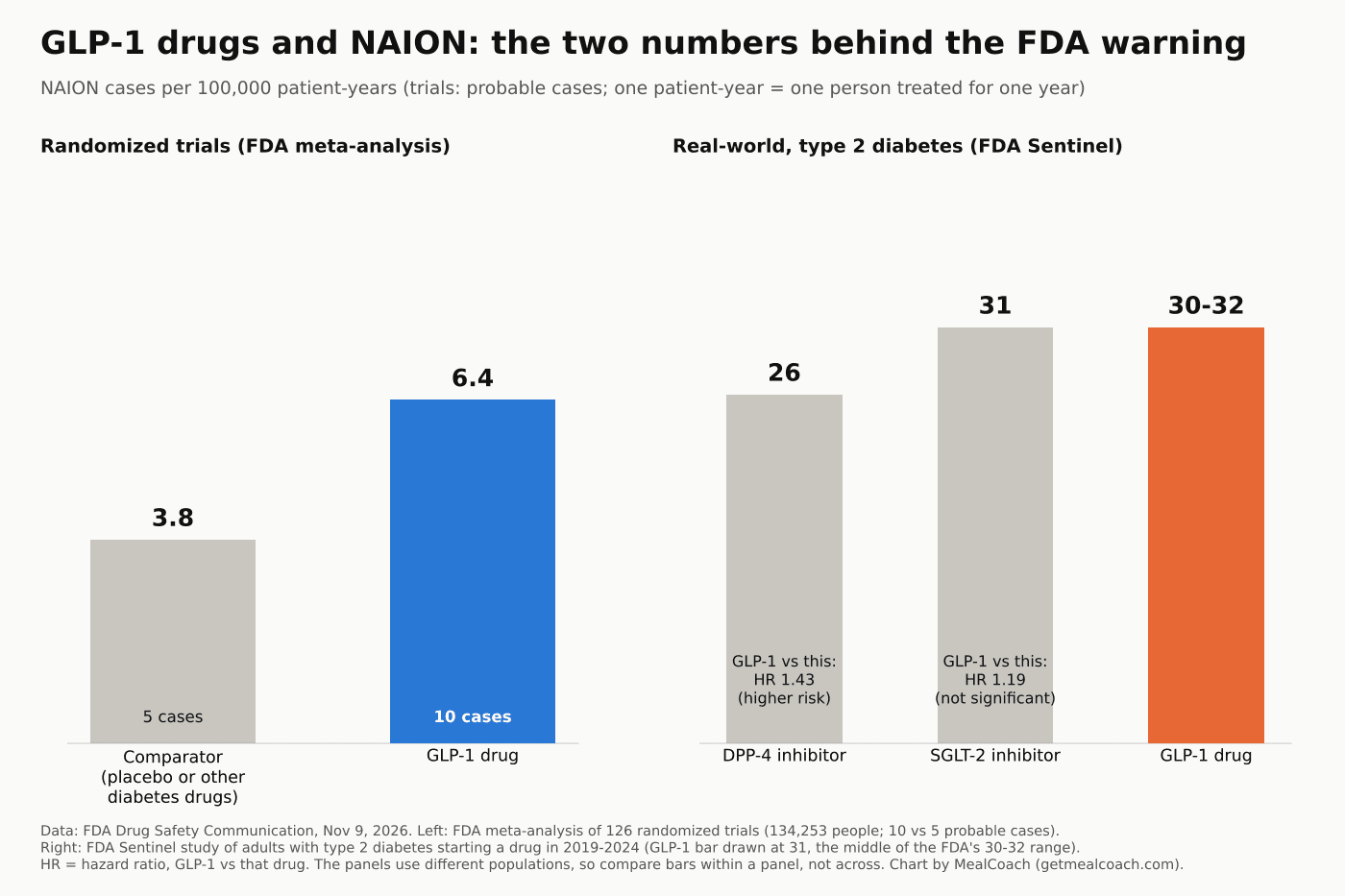
- Randomized trials: a meta-analysis of 126 trials with 134,253 people and 288,879 patient-years. There were 15 probable NAION events: 10 on GLP-1 drugs and 5 on placebo (none on other diabetes drugs). That’s 6.4 versus 3.8 per 100,000 patient-years.
- Real-world data: the FDA’s Sentinel study of adults with type 2 diabetes who started a drug in 2019 to 2024. NAION rates were 30 to 32 per 100,000 patient-years on GLP-1s, 31 on SGLT-2 inhibitors and 26 on DPP-4 inhibitors.
In Sentinel, the risk was higher than with DPP-4 inhibitors (hazard ratio 1.43, 95% CI 1.02 to 2.01). Compared with SGLT-2 inhibitors, it was not clearly different (1.19, 95% CI 0.91 to 1.54). The FDA found no mechanism in animal studies.
Why are the real-world rates so much higher than the trial rates? Our read: partly different people. Sentinel included only adults with type 2 diabetes, who tend to have more NAION risk factors, and the two analyses counted cases differently. So compare bars within each data set, not across them.
Our take: 10 versus 5 cases is a small number to build on, and the real-world comparison depends on which drug you compare against. That’s why “potential risk” is the honest phrase. It’s also why a label warning makes sense: rare, but serious when it happens.
Action item: When you see a headline about GLP-1s and blindness, look for the absolute number. “Twice the risk” of something very rare is still rare.
Why Is the FDA Acting Now?
Concern has built since 2024, and Europe’s regulator reached a similar conclusion for semaglutide in June 2025. The FDA’s move extends a warning to the whole class in the US.
- July 2024: a study in JAMA Ophthalmology (Hathaway and colleagues) of patients at one academic neuro-ophthalmology service linked semaglutide to higher NAION risk, per Pharmacy Times. It reported hazard ratios of 4.28 in type 2 diabetes and 7.64 in overweight or obesity, with wide confidence intervals.
- June 2025: the European Medicines Agency’s safety committee concluded that NAION is a very rare side effect of semaglutide, affecting up to 1 in 10,000 people. In type 2 diabetes it estimated roughly double the risk, about one extra case per 10,000 patient-years.
- November 2026: the FDA’s own trial and Sentinel analyses, summarized above, led to the class-wide label change.
The 2024 study came from a single specialist eye clinic, and its hazard ratios are much larger than the trial and Sentinel estimates. In our view, the newer, larger analyses are the better guide to size.
Action item: If you read a scary number, check the date and the study type. A 2024 single-clinic study and a 2026 review of 126 trials answer different questions.
Which Symptoms Mean You Should Get Help Right Away?
Sudden vision changes in one eye mean contacting a health professional right away. The FDA and the reports summarizing its notice list these warning signs:
- Sudden, painless loss of vision in one eye, which may be noticed on waking.
- A new blind spot, or loss of part of your field of view (such as tunnel vision).
- Colors that look distorted.
- Blurry or hazy central vision that comes on suddenly.
The FDA tells clinicians to refer suspected NAION promptly to an ophthalmologist. Our advice: if you can’t reach your prescriber quickly, sudden vision loss is a reason for urgent care or the emergency room. In an emergency, call 911.
Action item: Save this list in your phone’s notes next to your medicine list, so you don’t have to search for it on a bad morning.
What Does This Mean If You’re on Ozempic, Zepbound or Another GLP-1 Now?
The FDA’s notice doesn’t advise people without symptoms to stop their GLP-1. It asks patients to know the warning signs and contact a health professional right away if they appear.
For people who do develop NAION, the FDA tells clinicians to consider stopping the GLP-1 unless the benefits clearly outweigh the risk, and says patients who’ve had NAION should talk with their clinician about whether to continue. The FDA notes that a past NAION raises the chance of another, including in the other eye.
Dr. Kashyap told Healio the risk shouldn’t overshadow the heart, kidney and metabolic benefits of these drugs, that causality is uncertain, and that the drugs shouldn’t be stopped routinely. She suggested weighing it in shared decisions, especially for people with a past NAION or high vascular risk.
Some GLP-1 side effects, like nausea, show up early and fade. If you’re sorting those out, our guides on Foundayo side effects (which now covers this warning for the pill) and how to eat on a GLP-1 may help. If you’re thinking about stopping for any reason, read what happens when you stop first and talk with your prescriber.
Action item: At your next visit, ask: “Do I have any NAION risk factors, and should I have an eye exam?” If you’ve ever had NAION, say so.
What We Don’t Know Yet
The open questions are whether GLP-1s cause NAION, who is at highest risk, and whether some drugs differ.
- Cause: the FDA found no mechanism in animal studies, and the shared risk factors make it hard to separate drug from disease.
- Individual drugs: the FDA’s summary gives class-wide numbers, not a rate for each drug or dose.
- People without diabetes: the Sentinel study only included type 2 diabetes, so real-world data for weight-loss use is thinner.
- Exact label wording: as of November 11, 2026, the FDA has required the drugs’ makers to add the warning; we haven’t seen the final wording for each label yet.
Action item: When the updated label comes out, check your drug’s patient leaflet for the new eye warning. Your pharmacist can point it out.
Quick Answers
Does Ozempic cause blindness? There’s no proof it does. The FDA says GLP-1s may raise the risk of NAION, a rare cause of sudden vision loss in one eye, but the link isn’t proven. In trials it was 6.4 versus 3.8 cases per 100,000 patient-years.
Does the warning apply to Zepbound and Mounjaro? Yes. It applies to every GLP-1 drug, including tirzepatide (Zepbound, Mounjaro), semaglutide and Foundayo.
Should I stop my GLP-1 because of this? The FDA’s notice doesn’t tell people without symptoms to stop. Talk with your prescriber before any change, and get help fast for sudden vision loss.
Is NAION the same as diabetic retinopathy? No. NAION affects the optic nerve, the cable from eye to brain. Diabetic retinopathy is damage to the retina, the light-sensing layer at the back of the eye.
Does Europe warn about this too? Yes, for semaglutide since June 2025. The EMA calls NAION a very rare side effect, up to 1 in 10,000 people.
What This Means for You
✅ You know the FDA required, on November 9, 2026, a NAION warning on every GLP-1 label
✅ You know the risk is rare: about 2.6 more cases per 100,000 patient-years in trials (our math)
✅ You know the warning signs: sudden, painless vision loss or a blind spot in one eye
✅ You know the FDA’s notice doesn’t tell people without symptoms to stop
✅ You’ll bring your risk factors and questions to your prescriber, not make changes alone
The 5-Minute Version (Screenshot This)
- The news: FDA Drug Safety Communication, November 9, 2026: NAION warning added to all GLP-1 labels.
- Trials: 126 trials, 134,253 people; 6.4 vs 3.8 cases per 100,000 patient-years (10 vs 5 cases).
- Real world (type 2 diabetes): higher than DPP-4 inhibitors (HR 1.43), not clearly different from SGLT-2 inhibitors (HR 1.19).
- Symptoms: sudden vision loss, blind spot or blurry central vision in one eye. Get help right away.
- Not proven: the FDA calls it a potential risk; causation is unproven, and the FDA’s summary gives no per-drug rates.
Conclusion
The Ozempic vision loss warning is real news, but not a reason to panic. NAION is rare, the gap in trials is a few cases per 100,000 patient-years, and the FDA calls it a potential risk. What changes is awareness: everyone on a GLP-1 should know the warning signs.
Your one action today: learn the symptoms, and bring your NAION risk factors to your next appointment.
So tell me: did your prescriber ever mention eye risks when you started your GLP-1?
Sources
- FDA Drug Safety Communication: safety labeling changes for GLP-1 receptor agonists due to potential risk of NAION (Nov 9, 2026)
- Drugs.com: republished FDA safety communication (Nov 2026)
- EMA: PRAC concludes NAION is a very rare side effect of semaglutide (Jun 2025)
- Pharmacy Times: FDA requires class-wide GLP-1 RA labeling changes for potential NAION risk (Nov 9, 2026)
- Healio: FDA to require NAION risk warning for GLP-1 therapies (Nov 9, 2026)
 MealCoach