
“there is a good chance that you’re going to get a meaningful reduction”
The short answer: in TRIUMPH-4, a Phase 3 retatrutide knee osteoarthritis trial published in NEJM on November 8, 2026, Lilly’s experimental weekly shot eased knee pain more than placebo. Counting everyone, pain scores fell 3.96 points on 9 mg vs 2.12 on placebo (0–10 scale). Weight fell 20.0% vs 4.6% over 68 weeks.
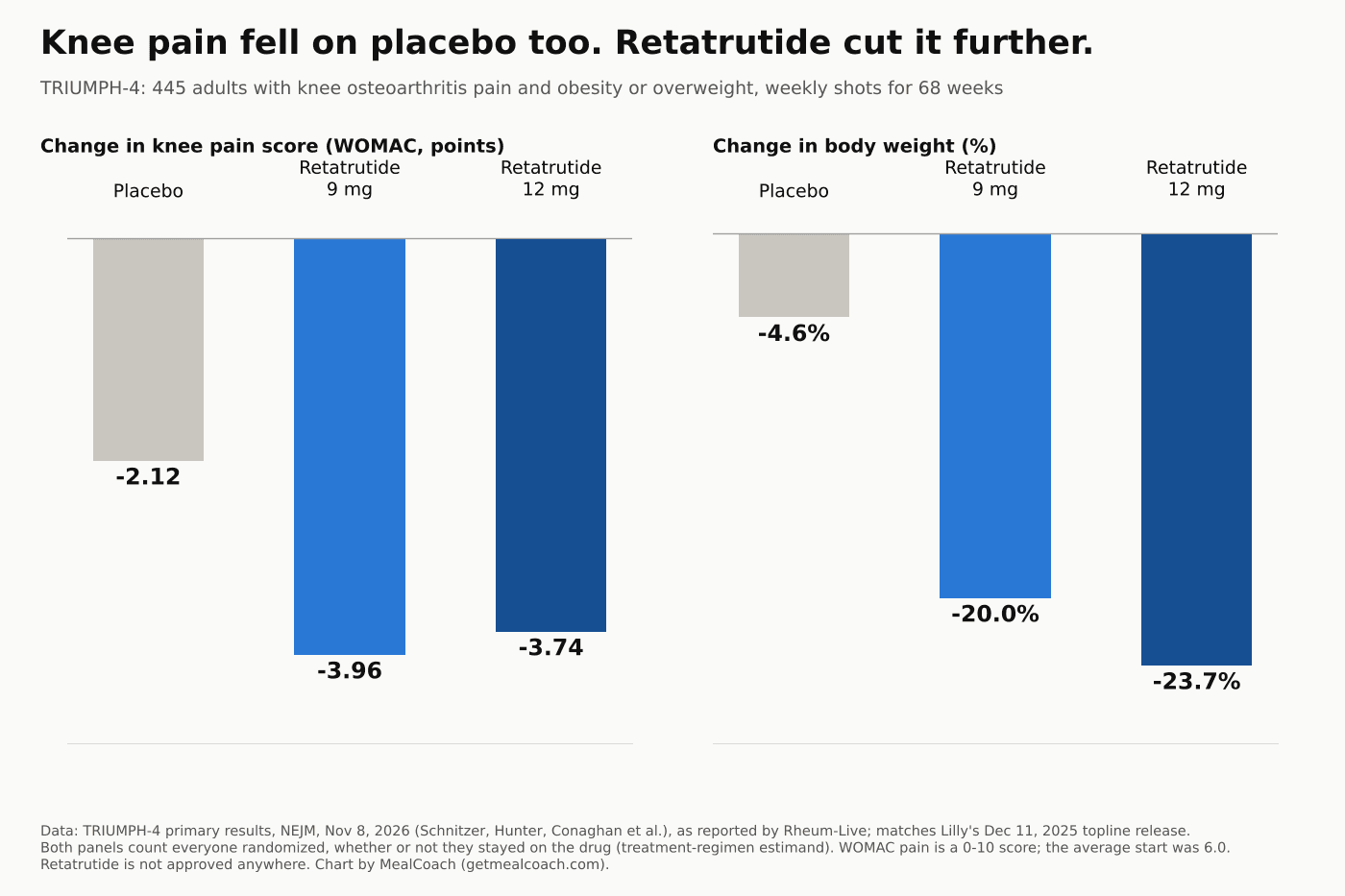
That’s a real result in a serious paper. It’s also smaller than the 75.8% drop in pain Lilly reported last year, and the reason is worth two minutes of your time.
In this post you’ll learn what TRIUMPH-4 tested, why the knee numbers vary by headline, what the side effects were, how it compares with the semaglutide knee trial, and when retatrutide might be available. About 7 minutes.
What did the retatrutide knee osteoarthritis trial test?
TRIUMPH-4 tested whether retatrutide eases knee osteoarthritis pain and lowers weight in adults with both conditions. It randomly assigned 445 adults without diabetes, with a body mass index (BMI) of 27 or more and moderate to severe knee pain (4 to 9 out of 10), to weekly retatrutide 9 mg, 12 mg or placebo for 68 weeks.
Those details are from Rheum-Live’s summary of the NEJM paper.
- Who: people started with an average weight of 112.7 kg (248.5 lb), an average BMI of 40.4 and a knee pain score of 6.0 out of 10, per Lilly’s December 2025 release.
- Pain measure: the WOMAC pain score, a standard questionnaire about knee pain while walking, on stairs, in bed, sitting and standing, scored 0 (none) to 10 (worst).
- Two main goals: change in knee pain and change in body weight.
Retatrutide is a “triple agonist”: one molecule that acts on three hormone receptors (GIP, GLP-1 and glucagon). Dr. Philip Conaghan of the University of Leeds presented the results at the American College of Rheumatology meeting in Orlando on November 8, the same day the paper appeared, per News-Medical.
Action item: If you have knee osteoarthritis, ask your doctor for your own pain or function score at your next visit. Trial results only mean something next to a number you know.
What did the trial show?
Retatrutide lowered knee pain scores by about 1.6 to 1.8 points more than placebo on a 0–10 scale, counting everyone randomized. Here are the results from the NEJM paper, per Rheum-Live:
- Knee pain (WOMAC): down 3.96 points on 9 mg, 3.74 on 12 mg and 2.12 on placebo. The gaps versus placebo were 1.83 points (95% CI 1.30 to 2.37) and 1.61 points (1.07 to 2.16).
- Half the pain or less: pooled across both knee trials, 69.6% on 9 mg and 63.2% on 12 mg cut their pain score at least in half, vs 37.8% on placebo (about two-thirds vs 38%).
- Physical function: improved significantly more than placebo, and results held in people with a BMI of 35 or more.
- Weight: down 20.0% on 9 mg and 23.7% on 12 mg, vs 4.6% on placebo.
Lilly also reported that 14.1% on 9 mg and 12.0% on 12 mg had no knee pain at the end, vs 4.2% on placebo. That was a post hoc look at people still on treatment, so treat it as a hint, not a finding.
Action item: When you read “pain fell X%”, look for the placebo number next to it. Here placebo alone cut pain by about a third.
Why did Lilly report 75.8% and the paper less?
Different headlines use different ways of counting, called “estimands.” Lilly’s December 2025 release led with the efficacy estimand, which estimates results as if everyone stayed on the drug. The NEJM figures above count everyone, including people who stopped.
| 68 weeks, 9 mg | If people stayed on treatment | Counting everyone |
|---|---|---|
| Knee pain (points) | −4.5 (placebo −2.4) | −3.96 (placebo −2.12) |
| Body weight | −26.4% (placebo −2.1%) | −20.0% (placebo −4.6%) |
Sources: Lilly’s December 11, 2025 release for the first column; Rheum-Live’s summary of the NEJM paper for the second. At 12 mg, weight fell 28.7% if people stayed on treatment and 23.7% counting everyone.
The 75.8% is 4.5 points out of a starting score of 6.0. Lilly’s own release notes that percent changes in pain weren’t pre-specified and came from a post hoc analysis.
My take: the counting-everyone number is the one to plan around. Real life includes people who stop, and in this trial quite a few did.
Action item: If someone quotes you a retatrutide number, ask one question: “Is that if people stayed on it, or counting everyone?”
What were the side effects?
Side effects were mostly stomach-related and led more people to stop than on placebo. In TRIUMPH-4, 12.8% on 9 mg and 18.2% on 12 mg stopped because of side effects, vs 4.0% on placebo, per Rheum-Live’s summary of the paper. Lilly’s 2025 topline gave 12.2% for 9 mg.
- Stomach effects (9 mg / 12 mg / placebo): nausea 38.1% / 43.2% / 10.7%, and vomiting 20.4% / 20.9% / 0%, per Lilly’s release; most happened while the dose was being raised, per Rheum-Live.
- Dysesthesia (odd skin sensations such as tingling or sensitivity): 8.8% / 20.9% / 0.7% in TRIUMPH-4, described by Lilly as generally mild.
- Serious side effects: 9.5% on 9 mg and 10.8% on 12 mg, vs 2.0% on placebo, per Rheum-Live.
- Deaths: one in each retatrutide group, judged unrelated to the drug.
Lilly said stopping was closely linked to starting BMI and included people who felt they had lost too much weight. Among people with a BMI of 35 or more, 8.8% (9 mg) and 12.1% (12 mg) stopped for side effects, vs 4.8% on placebo.
Action item: If you join a retatrutide trial, ask the team how they handle nausea and skin tingling, and who to call when it starts.
What about TRIUMPH-1, the second knee study?
A second group pointed the same way. TRIUMPH-1 included 574 people with knee osteoarthritis, treated for 80 weeks with 4, 9 or 12 mg, per Rheum-Live.
Pain scores fell 1.35 to 1.77 points more than placebo, using the trial’s pre-specified “hybrid” estimand; counting everyone, the gaps were smaller but still significant. Weight fell 17.5% (4 mg) to 24.8% (12 mg), vs 4.3% on placebo.
Action item: Two trials agreeing is better than one. Still, both were funded by Lilly, so watch for independent studies later.
How does it compare with semaglutide (Wegovy)?
Semaglutide, the ingredient in Wegovy, has its own knee trial, STEP 9, and it also eased pain more than placebo. In STEP 9 (NEJM, October 2024), 407 people took semaglutide 2.4 mg or placebo for 68 weeks, per the published abstract.
- Weight: −13.7% vs −3.2%.
- Knee pain (WOMAC, 0–100 scale): −41.7 vs −27.5 points.
- Stopped for side effects: 6.7% vs 3.0%.
Don’t line these up as a head-to-head. The trials used different pain scales, different people and possibly different ways of counting, and no study has tested the two drugs against each other for knees.
What both show is the same pattern: bigger weight loss came with less knee pain, and placebo groups improved too.
Action item: If you already take a GLP-1 medicine and have knee pain, ask your doctor whether your knee scores are worth tracking alongside your weight.
When could retatrutide be available for knee pain?
Not soon. As of November 9, 2026, retatrutide isn’t approved anywhere. Lilly’s July 2026 release says it plans to submit retatrutide to the FDA in the first quarter of 2027, and Lilly lists knee osteoarthritis pain among the uses its data support, alongside obesity and sleep apnea.
No approval date exists for any use, knee pain included. The full timeline, with our estimate of when a decision could land, is in When will retatrutide be available?
Products sold online as “retatrutide” are not an approved drug, because there isn’t one. Lab tests reported by CBS News found problems with some of them.
Action item: If you want retatrutide before approval, the legitimate route is a clinical trial. Search “retatrutide” on ClinicalTrials.gov with your doctor.
What we don’t know yet
Several big questions are still open, and the trial wasn’t built to answer them.
- Does it slow joint damage? TRIUMPH-4 wasn’t designed to test osteoarthritis progression or whether people avoid knee replacement, per Rheum-Live. People who needed a replacement were excluded.
- Is it the weight or the drug? Dr. Schnitzer pointed to less load on the knees, per Rheum-Live. Whether retatrutide does anything to the joint beyond weight loss isn’t known.
- What happens after stopping? The trial ran 68 weeks. Long-term pain results after treatment ends haven’t been reported.
- Who it suits: most had obesity; about 80% had a BMI over 35. It says nothing about knee pain in people at a lower weight.
Action item: Keep doing what already has evidence for knee osteoarthritis, such as the exercise or physical therapy plan your clinician gave you. A future drug doesn’t replace it.
When to call your doctor
If you’re in a retatrutide trial or taking any GLP-1 medicine, contact your doctor or study team promptly for:
- Severe stomach pain that doesn’t go away, with or without vomiting (possible pancreatitis or gallbladder trouble)
- Vomiting or diarrhea that stops you keeping fluids down, or signs of dehydration such as dizziness or very little urine
- Skin tingling, burning or numbness that is spreading or getting worse
- A knee that is suddenly hot, red and swollen, or that you can’t put weight on
For trouble breathing, chest pain or fainting, call 911 or your local emergency number.
Quick Answers
Does retatrutide help knee osteoarthritis pain? In TRIUMPH-4, it cut knee pain scores by about 1.6 to 1.8 points more than placebo on a 0–10 scale over 68 weeks, counting everyone (NEJM, November 8, 2026).
Is retatrutide approved for knee pain? No. Retatrutide isn’t approved for any use as of November 9, 2026. Lilly plans its first FDA submission in the first quarter of 2027.
How much weight did people lose in TRIUMPH-4? Counting everyone, 20.0% on 9 mg and 23.7% on 12 mg, vs 4.6% on placebo. If everyone had stayed on treatment, Lilly estimated 26.4% and 28.7%.
Where does the 75.8% drop in knee pain come from? Lilly’s 2025 release: 4.5 points out of 6.0 on 9 mg, assuming people stayed on treatment, from a post hoc analysis. Placebo fell 40.3% on the same basis.
What are the main side effects? Nausea, diarrhea, vomiting and constipation, plus skin tingling (dysesthesia) in up to about 1 in 5 on 12 mg. About 13–18% stopped for side effects, vs 4% on placebo.
What This Means for You
✅ You know retatrutide eased knee pain more than placebo in a 445-person NEJM trial
✅ You know placebo also helped, so the 1.6–1.8 point gap is the real effect
✅ You know the 75.8% figure assumes people stayed on treatment
✅ You know side effects led more people to stop, especially at 12 mg
✅ You won’t change any medicine without talking to your doctor
The 5-Minute Version (Screenshot This)
- The trial: TRIUMPH-4, 445 adults with knee osteoarthritis pain and obesity or overweight, retatrutide 9 or 12 mg weekly vs placebo for 68 weeks, NEJM, Nov 8, 2026.
- Pain: WOMAC pain down 3.96 (9 mg) and 3.74 (12 mg) vs 2.12 on placebo, counting everyone.
- Weight: down 20.0% and 23.7% vs 4.6%, counting everyone.
- Side effects: mostly stomach-related; 12.8% and 18.2% stopped for side effects vs 4.0%.
- Next: not approved; Lilly plans its FDA submission in Q1 2027 and lists knee osteoarthritis pain among the uses its data support.
Conclusion
TRIUMPH-4 is good news with a fair-sized asterisk. As a treatment for retatrutide knee osteoarthritis pain, it beat placebo and the weight loss was large.
But placebo helped a lot too, and Lilly’s 75.8% figure assumes everyone stayed on a drug that about 1 in 8 people on that dose (and nearly 1 in 5 on 12 mg) stopped for side effects.
For anyone with knee osteoarthritis and obesity, the paper adds to a pattern that’s getting hard to ignore: when weight comes down a lot, knee pain tends to ease on average.
For the rest of the retatrutide picture, see retatrutide for sleep apnea and the first head-to-head result in retatrutide vs Ozempic.
So tell me: if your knees hurt, would a drug that eases pain mostly through weight loss change how you think about treatment?
Sources
- NEJM: Schnitzer TJ, Hunter DJ, Conaghan PG, et al. Retatrutide once weekly in adults with knee osteoarthritis pain and obesity (Nov 8, 2026)
- Rheum-Live: Retatrutide reduces knee osteoarthritis pain in TRIUMPH-4 and TRIUMPH-1-OA (Nov 8, 2026)
- News-Medical: Retatrutide reduces knee pain and body weight in osteoarthritis patients (Nov 8, 2026)
- Eli Lilly: TRIUMPH-4 topline results (Dec 11, 2025)
- Eli Lilly: ACR Convergence 2026 presentations (Nov 5, 2026)
- Eli Lilly: TRIUMPH-2 and TRIUMPH-3 results and Q1 2027 filing plan (Jul 2026)
- Bliddal H, et al. Once-weekly semaglutide in persons with obesity and knee osteoarthritis (STEP 9), NEJM 2024
- CBS News: lab tests of products sold as retatrutide (Oct 21, 2026)
 MealCoach