
“…the genuine concerns of people who do experience muscle symptoms are not dismissed”
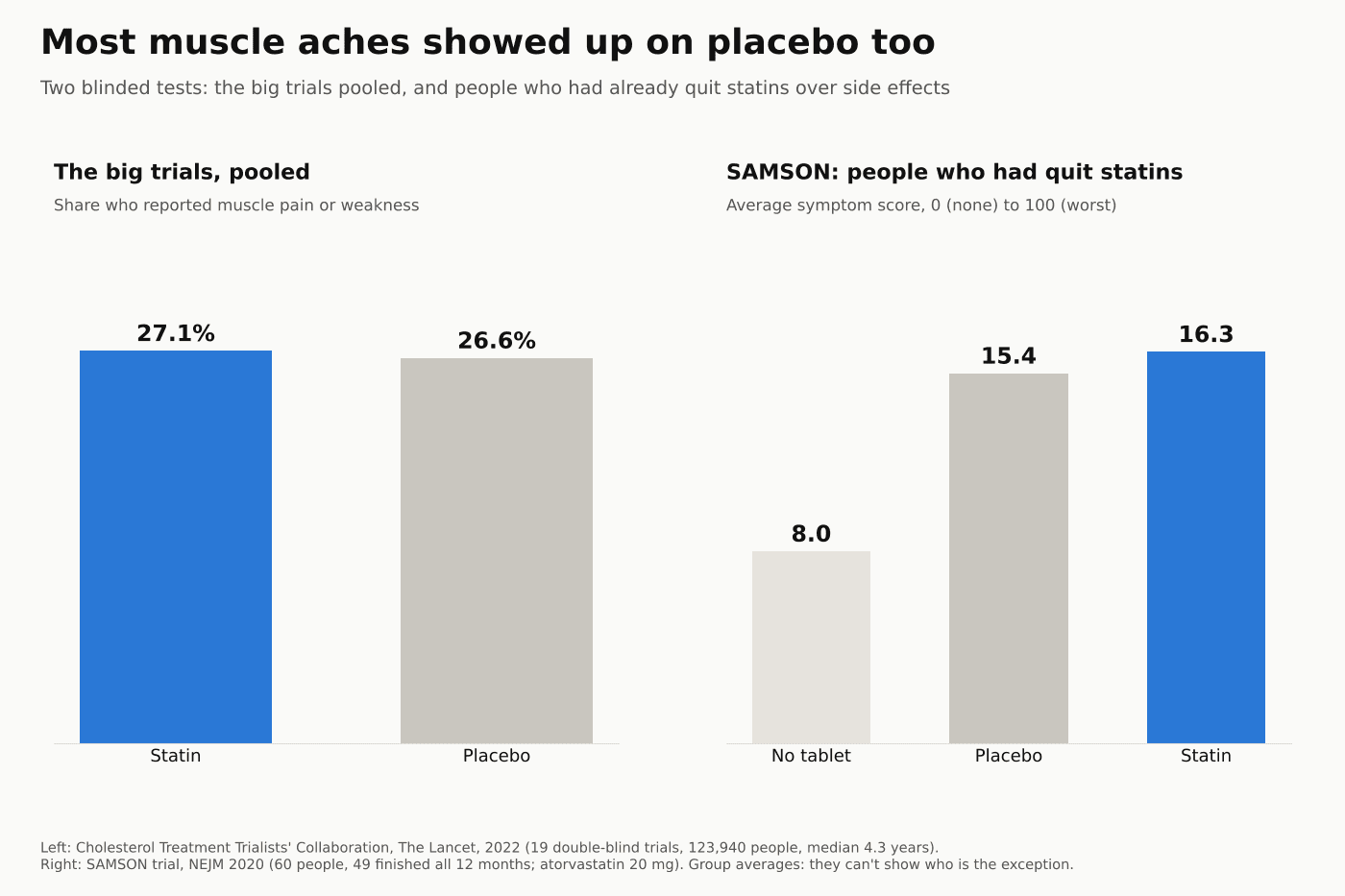
The short answer: We found no sign that the studies behind “statin muscle pain is mostly nocebo” were rigged, and their core finding holds up. In 19 blinded trials, 27.1% of people on a statin and 26.6% on placebo reported muscle pain or weakness.
But the critics have real points. Funding, run-in periods, closed data and moderate doses all limit what those trials can say about any one person. A small, real statin effect exists, mostly in the first year and at higher doses.
In this post you’ll learn what the big statin muscle pain studies found, who paid for them, whether they only counted pain with a blood test, how run-in periods could skew them, and what to bring to your prescriber. About 11 minutes.
What Did the Big Placebo Trials Find About Statin Muscle Pain?
Almost the same rate of muscle complaints on statins and on dummy pills. The Cholesterol Treatment Trialists’ (CTT) Collaboration pooled data on every participant from 19 double-blind statin-versus-placebo trials: 123,940 people, followed for a median of 4.3 years (CTT Collaboration, The Lancet, 2022).
- Overall: 16,835 people (27.1%) on a statin reported muscle pain or weakness, versus 16,446 (26.6%) on placebo. That’s a 3% relative increase.
- Year one: a 7% relative increase, roughly 11 extra reports per 1,000 people per year of treatment.
- After year one: no significant excess overall (rate ratio 0.99), though higher-intensity regimens still showed a small one.
- Higher doses: intensive regimens raised reports by 8%, versus 3% for lower or moderate ones.
The authors concluded that over 90% of statin muscle pain complaints in these trials weren’t caused by the statin. Put differently: about 1 in 15 complaints on a statin was the drug. That isn’t zero.
Action item: Note when your muscle pain started relative to when you started the statin or raised the dose. In the pooled trials, the extra complaints clustered in year one.
Were the Statin Studies Funded by Drug Companies?
Many of the underlying trials were, but the pooling wasn’t, and the key rechallenge trials weren’t either. The 2022 CTT analysis was funded by the British Heart Foundation, the UK Medical Research Council and Australia’s National Health and Medical Research Council. The authors state the collaboration took no industry grants, while some of the pooled trials were partly industry funded.
Some examples from the trials it pooled:
- JUPITER (rosuvastatin) was funded by AstraZeneca, which sells rosuvastatin as Crestor (Ridker et al., NEJM, 2008).
- ASCOT (atorvastatin) was funded by Pfizer, Servier and Leo Laboratories.
- The Heart Protection Study (simvastatin) was funded by the UK Medical Research Council, the British Heart Foundation and Merck, which supplied the simvastatin (Roche supplied the vitamins the trial also tested) (Oxford Population Health).
Several CTT authors also disclose industry ties, such as institutional grants from drug makers. One holds a patent on a genetic test for statin-related muscle damage, licensed through Oxford, with personal reward waived.
My read: that’s a reason to check the work, not proof it’s wrong. Two facts cut against a pure “industry spin” story. SAMSON and StatinWISE, the trials that retested people who’d quit statins, were paid for by a heart charity and the UK government. They found the same thing.
And money pushes both ways. Amgen funded GAUSS-3, and Esperion funded CLEAR Outcomes. Both companies sell non-statin cholesterol drugs, so both arguably had a commercial interest in showing statin intolerance is real.
Action item: When you read a statin study, check two lines: who funded it, and whether its result matches trials paid for by someone else.
Did Statin Trials Only Count Muscle Pain With a High CK Test?
For the rare “myopathy” label, often yes. For the headline muscle pain numbers, no. Creatine kinase (CK) is an enzyme that leaks into the blood when muscle breaks down. A common critique says trials only counted pain if CK was high.
That fits how trials define myopathy, the serious version. The CTT protocol originally defined it as symptoms plus CK above 10 times the upper limit of normal, then dropped the CK requirement before unblinding because CK was so often missing.
But the 27.1% versus 26.6% figures counted any reported muscle pain, cramps or weakness, whatever the blood test showed. CK was available for fewer than 6.2% of those reports.
The bigger weakness is how symptoms were collected. The CTT authors say methods and definitions varied considerably between trials. Uneven collection could miss some aches. But because the trials were blinded, it should miss them in both groups alike, though that can shrink the gap between them.
Action item: If someone says “the trials ignored muscle pain without high CK,” ask which outcome they mean. Myopathy, yes. Everyday aches, no.
Did Run-In Periods Screen Out People Who Couldn’t Tolerate Statins?
In some trials, yes, and it’s the critics’ strongest point. An “active run-in” gives everyone the real drug for a few weeks before randomizing, then drops people who struggle.
The Heart Protection Study did this: 4 weeks of placebo, then 4 to 6 weeks of simvastatin 40 mg. Of 32,145 people who entered, 20,536 were randomized (HPS Collaborative Group, BMC Clinical Pharmacology, 2009).
- 531 people were left out for new, unexplained muscle symptoms.
- 2,992 more were left out for their own wishes or doubtful adherence. Some of them may have felt unwell; the paper can’t say.
The HPS authors wrote that the run-in “raises questions about the generalisability of the safety analyses,” while arguing the exclusions were unlikely to have materially lowered the myopathy rate.
Three things limit the damage. First, the CTT team checked: the year-one excess didn’t differ between trials with an active run-in, a placebo run-in or none. Second, ASCOT had no run-in and still found equal muscle complaint rates while blinded. Third, JUPITER’s 4-week run-in used placebo, which screens for pill-taking, not for statin tolerance.
The flip side matters too. Many of these trials enrolled people before statins were widely used, so few had ever had trouble on one. That’s why the trials of people who had already quit statins matter so much.
Action item: If you’ve already had muscle trouble on a statin, weigh SAMSON and StatinWISE (below) more than the big pooled trials. They studied people like you.
Can Anyone Outside Check the Statin Data?
Not the pooled participant data, as of October 31, 2026. The CTT paper says each trial’s individual records were provided only for its analyses and would not be released to others. Requests go to each trial’s own data custodians.
That’s been a sore point for a decade. The BMJ has run a statins open data campaign for years, asking for independent access to participant-level data. In 2017, cardiologist Rita Redberg urged the CTT to release the data, per The Limbic.
My take: closed data doesn’t make a result wrong. But for a drug taken by millions, letting independent teams rerun the numbers is how you settle a fight like this. Its absence is a fair complaint.
Action item: Give more weight to findings that show up across independently run trials than to any single analysis whose data you can’t see.
What Do the Nocebo Trials Show, and What Can’t They?
They show that expecting side effects can produce them. They can’t prove the statin never hurts anyone. “Nocebo” is the placebo effect’s evil twin: symptoms caused by expecting harm.
SAMSON enrolled 60 people who had quit statins over intolerable side effects that began within 2 weeks of starting. Each got 12 monthly bottles in random order: 4 of atorvastatin 20 mg, 4 of placebo and 4 empty. Forty-nine finished all 12 months (Wood et al., research letter, NEJM, 2020).
Average symptom scores (out of 100) were 8.0 with no tablet, 15.4 on placebo and 16.3 on the statin. About 90% of the statin’s symptom burden appeared on placebo too. Six months later, 30 of the 60 had restarted statins.
StatinWISE ran the same idea in 200 UK patients who had stopped, or were thinking of stopping, statins over muscle symptoms, with six two-month blocks of atorvastatin 20 mg or placebo in random order. Among 151 analyzed, there was no difference in muscle symptom scores (Herrett et al., BMJ, 2021).
ASCOT added a natural experiment. While 10,180 people were blinded, muscle complaints ran 2.03% a year on atorvastatin and 2.00% on placebo. Once people knew whether they took a statin, users reported 41% more (Gupta et al., The Lancet, 2017). That later phase wasn’t randomized.
What these trials can’t tell you:
- Dose: both rechallenge trials used only atorvastatin 20 mg, a moderate dose.
- Who joined: volunteers willing to try again. SAMSON excluded people with dangerous reactions such as rhabdomyolysis.
- Size: 60 and 200 people. Small gaps can hide in small trials.
- Hints in the margins: in SAMSON, people stopped tablets early in 21.6% of statin months versus 17.2% of placebo months. In StatinWISE, 9% withdrew over muscle symptoms during statin periods versus 7% on placebo. Neither gap was statistically significant.
Action item: Don’t read “nocebo” as “it’s in your head.” It means real symptoms, often not caused by the pill. Both can be true for different people.
Why Do Real-World Surveys Find More Statin Muscle Pain?
Because they can’t separate the drug from everything else. France’s PRIMO survey asked 7,924 outpatients on high-dose statins about muscle symptoms. 832 (10.5%) reported them, with a median onset of about a month, and 38% of those said the pain stopped even moderate exertion (Bruckert et al., Cardiovascular Drugs and Therapy, 2005).
PRIMO had no placebo group, so it can’t say how many of those aches came from the statin. Two of its authors worked for Novartis, which made fluvastatin XL, the statin with the lowest rate in the survey (5.1%).
A 2022 meta-analysis of 176 studies and over 4.1 million patients put statin intolerance at 9.1% overall: 4.9% in randomized trials versus 17% in cohort studies (Bytyçi et al., European Heart Journal, 2022). Some of that gap is likely nocebo. Some may be trials enrolling healthier, more tolerant people.
Action item: Treat survey numbers as “how many people blame the statin,” not “how many the statin harms.” Both numbers are useful, for different questions.
So Can a Statin Cause Your Muscle Pain?
Yes, in a minority of people, and the trials agree on that. The CTT excess is small but real, concentrated in the first year and bigger at higher doses.
The rarer, serious kind of statin muscle pain exists too. In the Heart Protection Study, myopathy hit 10 people on simvastatin (0.10%) versus 4 on placebo (0.04%).
GAUSS-3 rechallenged 491 people who had muscle symptoms on at least two statins, in a short test before its main drug comparison. 42.6% had muscle symptoms on atorvastatin but not placebo, while 26.5% had them on placebo but not atorvastatin (Nissen et al., JAMA, 2016). Amgen funded it, which is worth remembering in both directions.
The 2022 meta-analysis linked statin intolerance with being female, older age, hypothyroidism, obesity, diabetes, kidney or liver disease and higher doses. Those are associations, not proof of cause.
Action item: Ask your prescriber whether any of those risk factors apply to you, like an untreated underactive thyroid. Some are checkable with a routine blood test.
The Scorecard: Which Criticisms Hold Up?
Here’s how the main critiques of statin muscle pain studies fare against the papers themselves.
| Critique | What the papers show | Verdict |
|---|---|---|
| Drug companies paid for the trials | Many pooled trials were industry funded; the CTT pooling and both rechallenge trials weren’t | True, not decisive |
| Pain only counted with high CK | True for myopathy; the 27.1% vs 26.6% figures counted any reported pain or weakness | Mostly wrong |
| Run-ins screened out intolerant people | Some did (HPS dropped 531 for muscle symptoms); the year-one excess didn’t change by run-in type | Partly true |
| Nobody can check the data | Pooled participant data isn’t released to outside teams | True |
| Statins never cause muscle pain | Small real excess in year one, more at higher doses; rare myopathy | Wrong |
Action item: Screenshot this table. Next time you see a confident claim either way, check which row it lives in.
What to Bring to Your Prescriber About Statin Muscle Pain
A clear record and good questions beat quitting quietly. Your prescriber knows your heart risk, which is what decides how much a statin is worth to you. I covered how doctors think about that risk in our Outlive summary (the apoB section), and a prevention-first take in our Beat the Heart Attack Gene summary.
- A symptom log: where it hurts, how bad (0 to 10), and when it started versus your statin start or dose change.
- Other causes: ask whether thyroid, vitamin D, other medicines or new exercise could explain it.
- Options doctors use: a different statin, a lower dose, or a structured, blinded rechallenge like StatinWISE’s.
- Non-statin drugs: in CLEAR Outcomes, which randomized 13,970 statin-intolerant patients, those on bempedoic acid had fewer major cardiovascular events than those on placebo, 11.7% versus 13.3% (Nissen et al., NEJM, 2023).
Don’t wait on these. MedlinePlus lists muscle pain, tenderness or weakness, extreme tiredness, fever, flu-like symptoms, dark-colored urine and yellow skin or eyes as reasons to call your doctor or get emergency help right away (MedlinePlus: atorvastatin).
Action item: Start a one-line daily symptom note this week. Bring it to your next appointment instead of a memory.
Quick Answers
Do statins cause muscle pain? Sometimes. In 19 blinded trials, 27.1% on statins and 26.6% on placebo reported muscle pain or weakness. The CTT authors estimate over 90% of complaints on a statin weren’t caused by it.
Were statin side effect trials funded by drug makers? Many of the pooled trials were. The 2022 CTT analysis and the SAMSON and StatinWISE rechallenge trials were funded by charities and governments, and they reached the same conclusion.
Did statin trials require a high CK to count muscle pain? Only for myopathy, the serious form. The main muscle pain numbers counted any reported pain or weakness.
What is the statin nocebo effect? Real symptoms caused by expecting side effects. In SAMSON, about 90% of the extra symptoms people had on a statin, compared with no tablet, also appeared on placebo.
Is statin muscle pain worse at higher doses? In the CTT data, yes: intensive regimens raised muscle complaints by 8%, versus 3% for lower or moderate ones.
What This Means for You
✅ You know there’s no sign the placebo trials were rigged, and where they’re weak
✅ You know the CK critique fits myopathy, not everyday aches
✅ You know run-ins and closed data are fair complaints with limited impact
✅ You know a statin can still be the cause for some people
✅ You know what to bring to your prescriber, and which symptoms can’t wait
The 5-Minute Version (Screenshot This)
- Finding: in 19 blinded trials, muscle pain or weakness was reported by 27.1% on statins vs 26.6% on placebo (CTT, 2022).
- Real effect: small, mostly in year one, bigger at high doses; serious myopathy is rare.
- Funding: many pooled trials were industry funded; the charity- and government-funded rechallenge trials agreed.
- Fair complaints: some active run-ins, uneven symptom collection, pooled data not shared.
- Today: log your symptoms and talk to your prescriber; don’t stop on your own.
Conclusion
The statin muscle pain studies hold up better than their critics say, and worse than their loudest defenders say. Most aches on a statin aren’t the drug. Some are, and the evidence can’t tell you in advance whether yours is.
Your one action today: if muscle pain is making you doubt your statin, write down when it started and bring that to your prescriber before changing anything.
So tell me: would you try a blinded statin-or-placebo test, like SAMSON’s, to find out if your pain is the pill?
Sources
- Cholesterol Treatment Trialists’ Collaboration: Effect of statin therapy on muscle symptoms, The Lancet (2022)
- University of Oxford: muscle pain not due to statins in over 90% of those taking treatment (Aug 30, 2022)
- Wood et al., SAMSON: N-of-1 trial of a statin, placebo, or no treatment, NEJM (2020)
- Howard et al., Side effect patterns in a crossover trial of statin, placebo, and no treatment (SAMSON), JACC (2021)
- Herrett et al., StatinWISE, BMJ (2021)
- HPS Collaborative Group: muscle and liver adverse effects of simvastatin in the Heart Protection Study, BMC Clinical Pharmacology (2009)
- Oxford Population Health: Heart Protection Study
- Gupta et al., ASCOT-LLA blinded and non-blinded adverse events, The Lancet (2017)
- Nissen et al., GAUSS-3, JAMA (2016)
- Ridker et al., JUPITER, NEJM (2008)
- Bruckert et al., the PRIMO study, Cardiovascular Drugs and Therapy (2005)
- Bytyçi et al., Prevalence of statin intolerance: a meta-analysis, European Heart Journal (2022)
- Nissen et al., CLEAR Outcomes (bempedoic acid), NEJM (2023)
- The BMJ: statins open data campaign
- The Limbic: coverage of the ASCOT nocebo analysis and calls for CTT data (2017)
- MedlinePlus: atorvastatin
 MealCoach