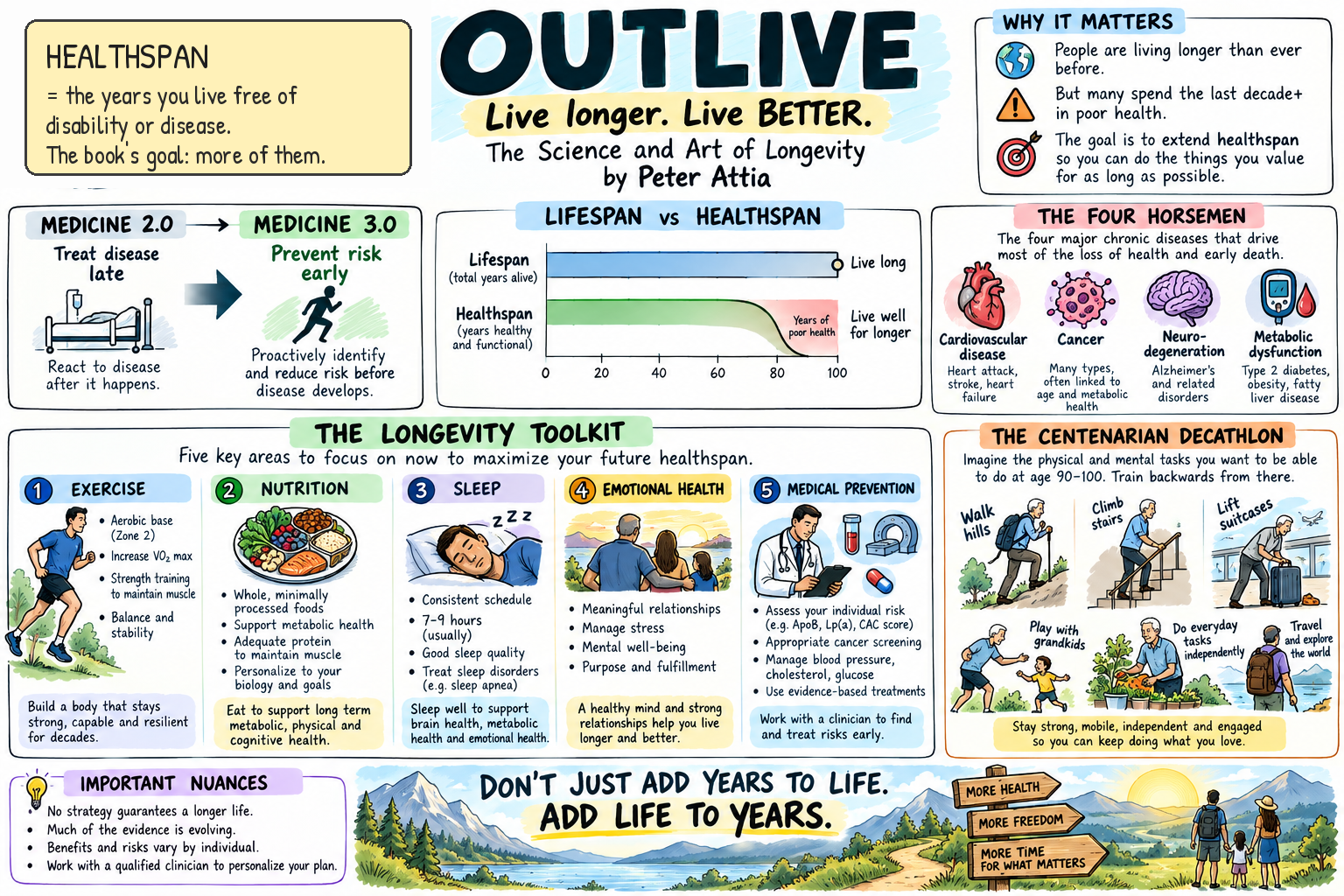
“I believe that we already know more than enough to bend the curve.”
The short answer: Here’s the Outlive summary in brief. Physician Peter Attia argues that heart disease, cancer, dementia and type 2 diabetes start decades before diagnosis, so prevention must start early. His biggest lever isn’t a pill or a diet. It’s exercise: endurance, top-end fitness, strength and balance.
You’ll learn what the “Four Horsemen” are, how fitness compared with smoking in one big study, how to build your own “centenarian decathlon,” and where the book overreaches.
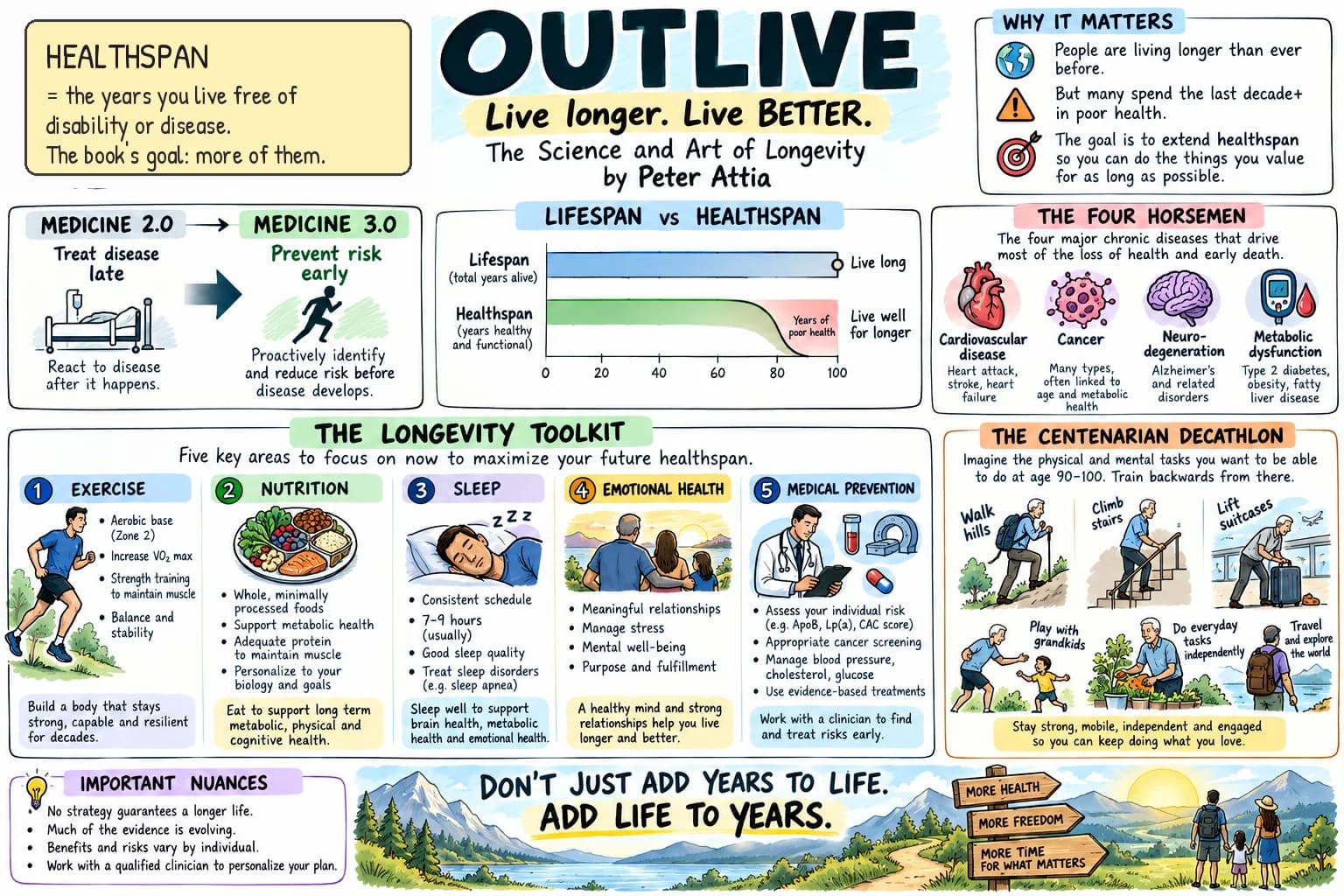
What Is Outlive About?
Outlive: The Science and Art of Longevity is a guide to living better in your last decades, not just longer. Peter Attia wrote it with journalist Bill Gifford. It came out on March 28, 2023, and became a bestseller, per Wikipedia. The Australian hardback runs 496 pages, per Penguin.
The core idea is “healthspan,” the years you live free of disability or disease. Attia contrasts “Medicine 2.0,” which treats disease once it shows up, with “Medicine 3.0,” which goes after risk years earlier, per the book’s Wikipedia entry.
Think of it as fixing the roof while the sun is out, not during the storm.
Action item: Write down your age and the age you’d like to stay active until. The gap between them is your project.
Why Did a Surgeon Change His Mind About Diabetes?
Because he became the kind of patient he used to judge. Attia told this story in a TEDMED talk, and it explains the whole book.
In 2006 he was a surgical resident at Johns Hopkins. At about 2 a.m. he was paged to see a woman with a diabetic foot ulcer who might need an amputation. He privately blamed her: she ate too much, he thought.
Three years later, he had gained weight and developed metabolic syndrome, a cluster of risks that includes high blood sugar and a growing waist. He was exercising three or four hours a day and following the food pyramid to the letter. He was insulin resistant anyway.
He lost 40 pounds by changing his diet, while exercising less. He never saw the woman from the ER again. But on stage, he apologized to her: “…as a human being, I let you down.”
That’s the turning point. Chronic disease isn’t a moral failure. It builds quietly, even in people doing “everything right.”
Action item: At your next checkup, ask what your fasting glucose and HbA1c (a 3-month blood sugar average) say about your trend, not just whether they’re “normal.”
What Are the Four Horsemen in Outlive?
The Four Horsemen are heart disease, cancer, neurodegenerative disease such as Alzheimer’s, and type 2 diabetes. Attia sees them as the main threats to a long, healthy life, per the book’s Wikipedia entry and in Audible’s summary.
His argument: each one starts decades before a diagnosis. Waiting for symptoms is like waiting for smoke before you check the wiring.
Action item: List which of the four ran in your family, and at what age. Bring that list to your next appointment.
Why Does Attia Put Exercise First?
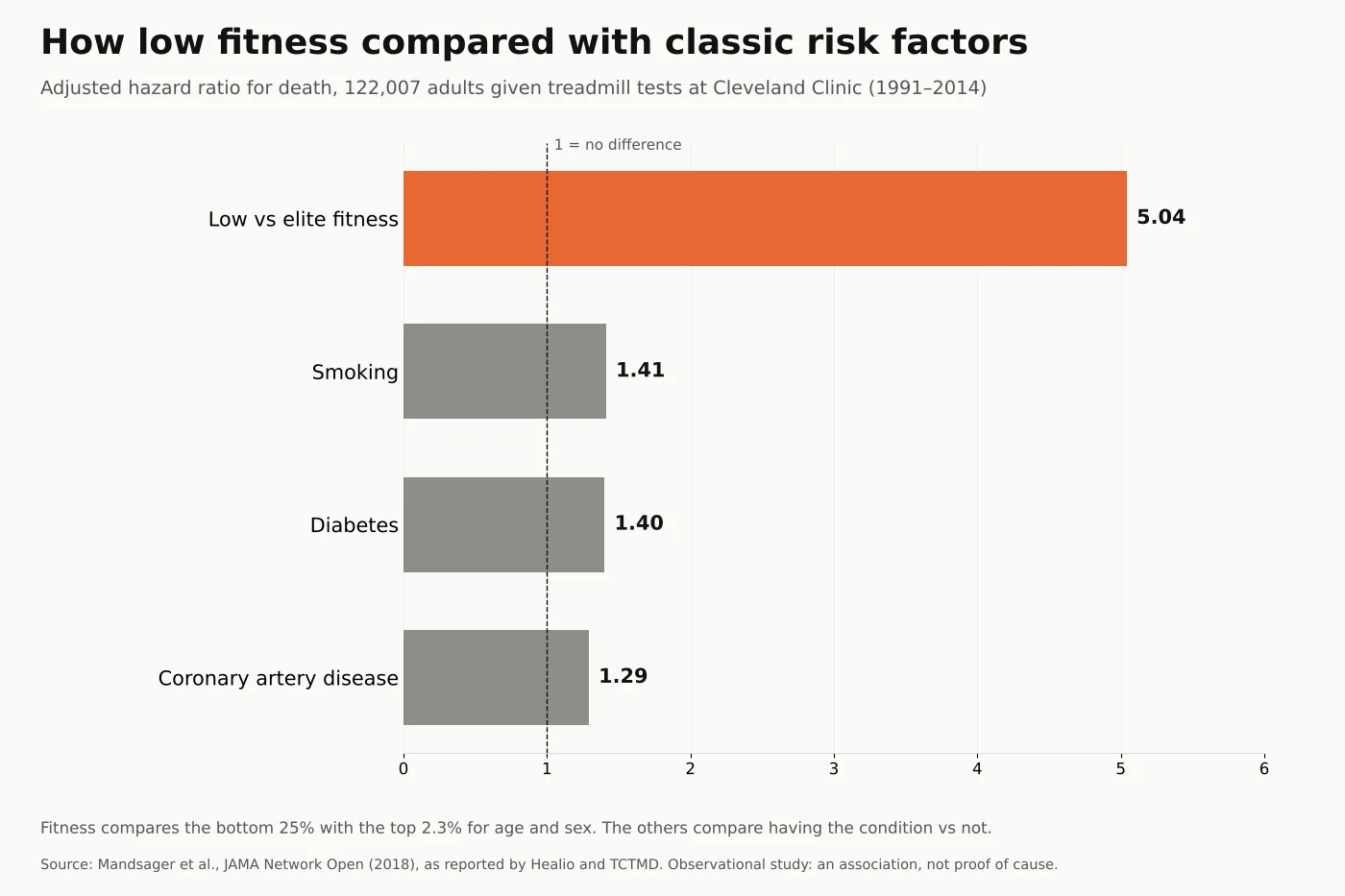
Because in the data he leans on, fitness tracks with survival more strongly than almost anything else. On his site, he cites a 2018 Cleveland Clinic study that followed 122,007 adults who took treadmill tests between 1991 and 2014.
The bottom 25% for fitness had about five times the risk of death of the top 2.3% (hazard ratio 5.04). Median follow-up was 8.4 years, per TCTMD. For comparison, smoking carried a hazard ratio of 1.41 and diabetes 1.40.
Attia’s training plan has four parts, per his own site:
- Zone 2: steady endurance work you can sustain for a long time.
- VO2 max: your top aerobic capacity, raised with short, hard efforts.
- Strength: keeping muscle as you age.
- Stability: balance and control, so you can train without getting hurt.
The official baseline is far smaller. The CDC recommends 150 minutes a week of moderate activity plus muscle strengthening on 2 days.
Action item: This week, hit the CDC baseline: five 30-minute brisk walks and two short strength sessions. Build from there.
What Is the Centenarian Decathlon?
The centenarian decathlon is your list of physical tasks you want to still do in your last decade. You plan today’s training around it. “The marginal decade is the last decade of your life,” Attia writes on his site.
Everyone gets a marginal decade. The only question is whether it’s spent on the floor or on the trail. Attia’s logic: you’ll lose some capacity with age, so you need a bigger reserve now.
A worked example (an illustration, not from the book). A 50-year-old writes her list:
- Get up off the floor without using her hands.
- Carry two bags of groceries up a flight of stairs.
- Lift a 30-pound grandchild into a car seat.
- Hike a hilly mile with a light pack.
Then she works backward. Lifting at 90 means more strength at 70, so she trains legs and grip now.
Action item: Write your own top five tasks for age 90. Pick the one you can’t do easily today and train for it first.
What Does Outlive Say About Food and Protein?
Attia treats nutrition as three levers: eat less overall, cut out certain foods, or eat in a shorter window. He also pushes protein hard. That’s per eNotes’ chapter summary.
He calls cutting calories the most effective lever, but hard to stick with. He is cool on time-restricted eating for most people, partly because they often miss their protein. He also caps alcohol at two drinks a day and fewer than seven a week.
On protein, his practice aims for about 2 grams per kilogram of body weight a day, against an RDA of 0.8, per his site. That’s high. A 2018 meta-analysis of 49 studies found extra protein stopped adding muscle gains from lifting above about 1.62 g/kg a day.
One habit the book doesn’t dwell on: how fast you eat. Slowing down gives fullness signals time to arrive. Our guide on how to stop eating too fast covers it.
Action item: Check tomorrow’s breakfast. If it has little protein, add eggs, Greek yogurt, tofu or beans.
What Does Outlive Say About Cholesterol and ApoB?
Attia argues that apoB matters more than the usual LDL number, and should be lowered early. ApoB counts the particles that carry cholesterol into artery walls. Mainstream lipid experts have moved partway toward him.
A 2024 National Lipid Association consensus said apoB would ideally be part of every lipid panel, though practical limits remain. When apoB and LDL disagree, it called apoB the stronger predictor of heart risk.
Where he goes further is how low and how early. A physician reviewer at Sensible Medicine noted that aggressive targets rest more on reasoning than on direct trial evidence. If inherited cholesterol worries you, our Beat the Heart Attack Gene summary goes deeper.
Action item: Ask your doctor whether apoB should be added to your next lipid panel, and what your result would change.
What About Sleep and Emotional Health?
Outlive treats sleep and emotional health as two of its four pillars, alongside exercise and nutrition. That’s per Audible’s summary. Emotional well-being counts as a core part of healthspan in the book, per Wikipedia. A long life you can’t enjoy isn’t the goal.
For the sleep side in depth, our Why We Sleep summary explains what short nights cost your body.
Action item: Set one fixed wake-up time for the next seven days, weekends included.
When Should You Call a Doctor First?
Stop exercising and get checked if you feel faint, dizzy, or have chest pain during a workout. That’s the standard warning, per Harvard Health. Chest pressure or pain, trouble breathing or a cold sweat can be heart attack signs. The American Heart Association says to call 911 for any of them.
Most people don’t need a doctor’s okay to start low-intensity exercise, Harvard Health says. But if you have heart disease, chest pain on effort, or a past heart attack, call your doctor before adding hard intervals.
Action item: If you have a heart condition, ask your doctor which heart-rate range is safe for you before trying VO2 max work.
Where Outlive Falls Short
The exercise advice holds up. The extras, like an anti-aging drug, extra scans and gadgets, rest on thinner evidence.
- Rapamycin’s longevity evidence is mostly from animals. Writing in Slate, Kristen Martin noted the drug’s longevity evidence is “merely at the stage of animal research.”
- Testing can backfire. Martin also criticized routine DEXA scans, genetic tests and CT angiograms for healthy people, given costs and false positives.
- Conflicts. The book promotes glucose monitors for people without insulin resistance. Martin points out Attia disclosed he was a paid adviser to Dexcom, which makes them, in 2021.
- It’s intense. Sensible Medicine called it “an aggressive recipe for longevity, served up by an intense individual.” Martin notes the program calls for at least 10 hours of training a week.
My take: you don’t need the whole program. The cheap parts, like walking, lifting, sleeping and asking good questions, do the heavy lifting.
Action item: Before paying for any longevity test, ask: “What would I do differently if the result were bad?” No answer means skip it.
Should You Still Read Outlive in 2026?
Yes, if you judge the advice on its evidence rather than on the author. In early 2026, Attia’s name appeared often in Epstein files released by the Justice Department. He then stepped down as a CBS News contributor, per NBC News.
He has not been accused of any crime, NBC reports. In an X post, he called some of his emails “embarrassing, tasteless, and indefensible” and apologized.
That doesn’t change the treadmill data or the lipid science. It’s a reason to read any health guru with your own checklist.
Action item: For any health claim you read this week, ask: who studied it, in how many people, and who paid?
Quick Answers
What is Outlive by Peter Attia about? It’s a 2023 guide to longevity that argues for preventing chronic disease decades early. Its main tools are exercise, nutrition, sleep, emotional health and early testing.
What are the four horsemen in Outlive? Heart disease, cancer, neurodegenerative disease such as Alzheimer’s, and type 2 diabetes.
What is the centenarian decathlon? A personal list of physical tasks you want to still do in your last decade, like playing with your great-grandkids, Attia’s own example. You train now to keep them.
How much protein does Peter Attia recommend? His practice aims for about 2 g per kilogram of body weight a day. That’s above the 0.8 g/kg RDA, and above the roughly 1.6 g/kg where one meta-analysis saw muscle gains level off.
Is Outlive worth reading? For its exercise chapters, yes. Treat its drug, supplement and testing ideas as questions for your doctor, not instructions.
The 5-Minute Version: Outlive Summary (Screenshot This)
- The goal: more healthy years, not just more years.
- The enemies: heart disease, cancer, dementia and type 2 diabetes, which start decades early.
- The big lever: fitness. Low vs elite fitness had a hazard ratio for death of 5.04 in 122,007 adults.
- The plan: zone 2, VO2 max, strength and stability, aimed at your own centenarian decathlon.
- Food: eat less, cut some foods, or narrow your window. Protein is high on his list.
- Heart: ask about apoB.
- The catch: rapamycin is unproven in people, and heavy testing can backfire.
Conclusion
If this Outlive summary leaves you with one idea, make it this. The book sells itself as an operating manual for a longer life. The real gift is smaller and better: a reason to train for the person you’ll be at 85.
My take: skip the gadgets, keep the dumbbells.
Your one step this week: write your centenarian decathlon list, then do two strength sessions.
So tell me: what’s the one thing you want to still be doing at 90?
This is a book summary, not medical advice. Talk to your doctor before you change medicines, start supplements or begin hard training.
Sources
- Penguin Books Australia: Outlive extract and edition details (496 pages)
- Wikipedia: Outlive: The Science and Art of Longevity
- Wikipedia: Peter Attia
- Audible: Summary of Outlive by Peter Attia
- Peter Attia, TEDMED talk transcript: Is the obesity crisis hiding a bigger problem?
- Peter Attia MD: How does VO2 max relate to longevity? (cites Mandsager et al. 2018)
- Peter Attia MD: Training for the centenarian decathlon
- eNotes: Outlive chapter 15 summary (nutrition)
- Healio: Better cardiorespiratory fitness reduces all-cause mortality risk (Mandsager et al., JAMA Network Open, 2018)
- TCTMD: Big fitness equals big survival benefit
- Cardiovascular Business: fitness groups in the Cleveland Clinic study
- CDC: Adult activity guidelines
- Morton et al., British Journal of Sports Medicine (2018): protein supplementation and resistance training meta-analysis
- HCPLive: NLA expert consensus on apoB (Journal of Clinical Lipidology, Sep 2024)
- Harvard Health: Health warnings on exercise equipment
- American Heart Association: Warning signs of a heart attack
- Slate (Feb 26, 2026): So should you trust Peter Attia?
- Sensible Medicine (Oct 10, 2023): Outlive for mortals
- NBC News: Peter Attia leaves CBS News contributor role
 MealCoach