“there is no longer any doubt about the value of lowering blood cholesterol levels.”
The short answer: here’s The Cholesterol Wars summary. Daniel Steinberg, a cholesterol researcher for more than 50 years, tells how scientists proved that high LDL cholesterol helps cause heart disease. He also shows why so many doubted it. The trials since have backed his main point. The open question is who gains enough from a statin to take one.
You’ll learn how a fight that started with rabbits in 1913 ended with statins. You’ll also see what the skeptics still get right, and what a new 2026 trial says about older adults who stop.
What Is The Cholesterol Wars About?
The Cholesterol Wars is the inside story of one of medicine’s longest fights: does high blood cholesterol cause heart disease? Its full title is The Cholesterol Wars: The Skeptics vs the Preponderance of Evidence. The first edition came out in September 2007, per Elsevier. The publisher was Academic Press.
The chapters run like a timeline, per a library record of the contents. It opens with how medical fights work. Then come animal studies, early human evidence, lipid biology and the search for safe drugs. It ends with the 1984 trial, the statins and a look ahead.
It grew out of a five-part history Steinberg wrote for the Journal of Lipid Research, writes physician Christopher Labos in The Skeptic. So it reads more like a history than a diet book. There are no meal plans here.
Action item: Find your last cholesterol test. Look for one number: LDL. Keep it handy as you read.
Who Was Daniel Steinberg?
Steinberg was a lipid scientist who lived through almost the whole cholesterol fight, so he wrote it as a witness, not a bystander. He earned his MD in 1944 and a Harvard PhD in 1950. He then spent 17 years at the NIH. He and his colleagues published more than 400 papers, per the National Lipid Association.
He moved to UC San Diego in 1968. His lab helped show that LDL changes once it’s oxidized, a form that cells handle in a different way, per a 2013 profile.
That profile says he was 90 and still went to the office on weekdays. He died in 2015, per the library record. Think about that. He started work when doctors argued about whether cholesterol mattered at all. He finished in the age of statins.
Action item: When you read about cholesterol online, ask who wrote it. A researcher, a doctor, a seller? It changes how you weigh it.
Why Did Doctors Doubt the Cholesterol Idea for So Long?
Because the early evidence was real but easy to dismiss. The story starts in 1913, when Russian scientist Nikolai Anitschkow fed rabbits pure cholesterol and their arteries clogged, Steinberg recalled in a 2013 journal essay.
The trouble? Rats and dogs didn’t react the same way, Labos writes. And critics noted, Steinberg says, that rabbits eat only plants and normally take in no cholesterol at all. So how could it apply to people? Steinberg gives animal models a full chapter anyway, and argues they still count.
Then came the human data. The Framingham Heart Study linked higher cholesterol to more heart disease. But a link isn’t proof. People with high cholesterol might differ in other ways, like smoking or weight.
The only way to settle it was a trial. Lower cholesterol in one group, not in another, and count heart attacks. The early drugs made that hard. They didn’t lower cholesterol much.
Our How to Lie with Statistics summary covers why a link alone can fool you.
Action item: Next time a headline says a food is “linked” to heart disease, ask: was this a trial, or just people who happened to eat it?
What Changed Minds in 1984?
A long trial finally showed that lowering cholesterol with a drug cut heart attacks. The Lipid Research Clinics Coronary Primary Prevention Trial followed 3,806 men aged 35 to 59 with high cholesterol, per the American College of Cardiology.
Half took cholestyramine, a powder that binds bile acids in the gut. Labos notes it was hard to take. Half took a placebo. After 7.4 years on average, LDL was 12.6% lower than in the placebo group. Heart attacks plus heart deaths fell 19%.
The book gives this trial its own chapter. It was the turning point. But it left a gap the skeptics jumped on. Deaths from all causes fell only 7%, and that wasn’t statistically significant.
In other words: fewer heart attacks, yes. Longer lives? Not proven yet. That gap kept the fight alive for another decade.
Action item: When you read a study, check two numbers: the outcome it targeted, and deaths from any cause. They don’t always move together.
How Did Statins Settle the Main Question?
Statins lowered LDL far more than older drugs, and in 1994 one finally showed people lived longer. The 4S trial gave 4,444 people with heart disease simvastatin or a placebo, per the ACC trial summary.
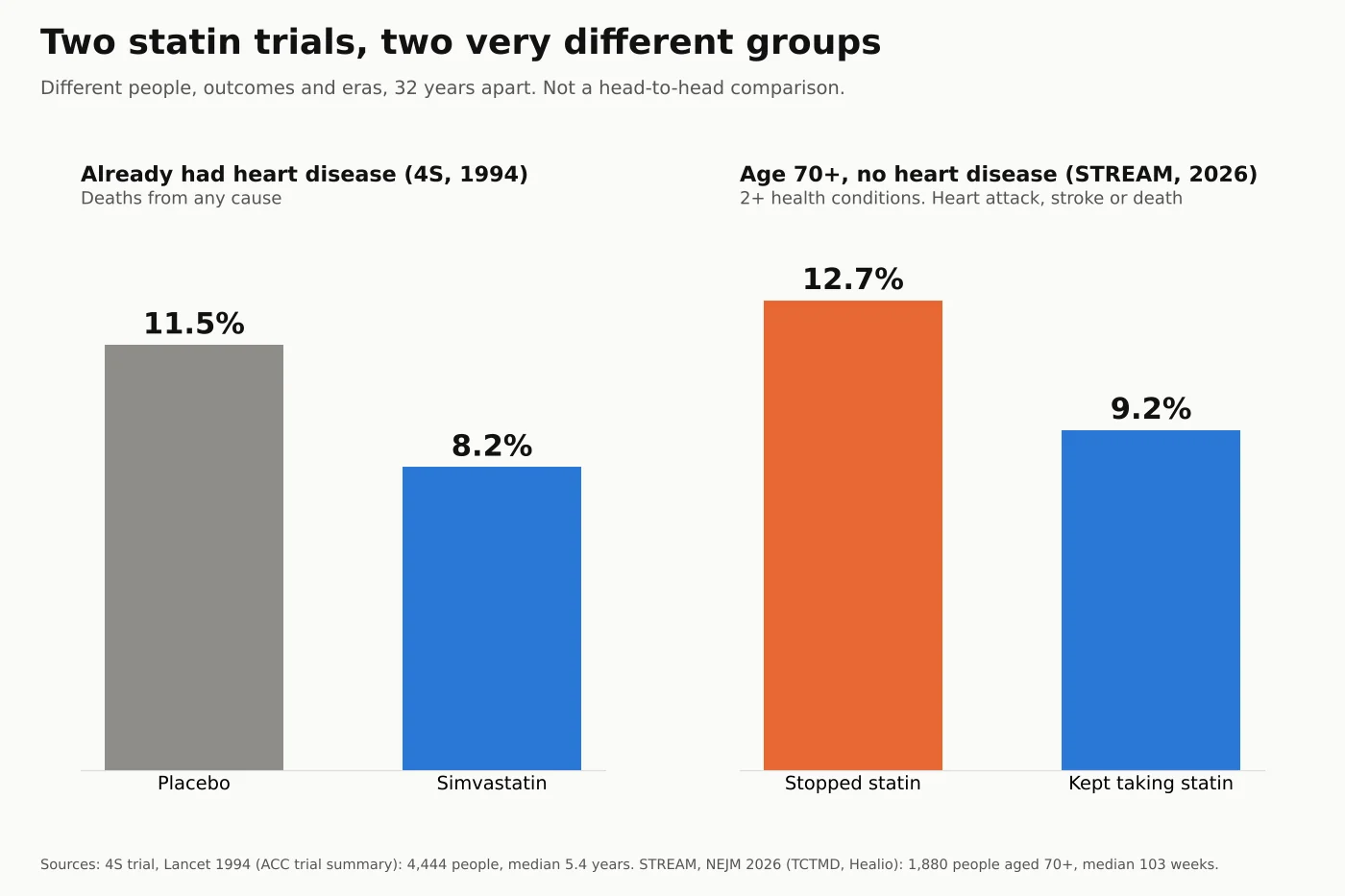
LDL fell 35%. After a median of 5.4 years, 8.2% on the statin had died, versus 11.5% on placebo. That’s 30% fewer deaths. The gap skeptics pointed to in 1984 was closed, at least for people who already had heart disease.
Then came the pooled proof. In 2010, the Cholesterol Treatment Trialists combined 26 trials with about 170,000 people in The Lancet.
For every 1 mmol/L drop in LDL, about 39 mg/dL, major heart and stroke events fell 22%. Deaths from any cause fell 10% per 1 mmol/L. Cancer rates didn’t change.
That’s Steinberg’s core claim, and the evidence keeps backing it. Lower LDL means fewer heart attacks and strokes.
Action item: Ask your doctor what your LDL is now and what it would need to be for your risk. A target is easier to follow than “keep it low.”
What Do the Statin Skeptics Still Get Right?
The benefit depends a lot on your starting risk, and for healthy people it can be small. This is where the war isn’t over.
For people who mostly had no heart disease, a 2013 Cochrane review pooled 18 trials with 56,934 people. Of 1,000 people taking a statin for five years, 18 would avoid a major heart or stroke event. It found no sign of serious harm.
Eighteen in 1,000 is real. But it also means most people taking a statin for five years weren’t going to have that event anyway. That’s why the main US screening panel splits its advice by risk.
The US Preventive Services Task Force backs a statin for adults 40 to 75 with a 10-year heart risk of 10% or more. They also need at least one risk factor, like diabetes or smoking.
Between 7.5% and 10%, it says doctors should offer one selectively, because the benefit is smaller. For people 76 and older starting one, it says the evidence isn’t enough to judge.
Side effects worry people most. Muscle aches are real. But in blinded trials, people on a placebo report them nearly as often, as we found when we dug into statin muscle pain vs placebo.
Call your doctor right away if you take a statin and get muscle pain, tenderness or weakness, extreme tiredness, fever or dark urine. MedlinePlus lists these as reasons to get help fast.
Action item: Ask your doctor for your 10-year heart risk as a number. Then ask: out of 100 people like me, how many would a statin help?
Where The Cholesterol Wars Falls Short
It’s a history written by a winner of the war, and it sometimes reads that way. Steinberg was a central figure, not a neutral judge.
Chris Masterjohn, a nutrition scientist and cholesterol skeptic, reviewed it in 2008. He wrote: “The strangest claim in the book is that statins prove the lipid hypothesis.” His point: statins do other things in the body, so their success may not all come from lower LDL.
He also faulted the book’s pages on diet for leaving out some saturated-fat trials. And he thought the 1984 trial’s extra accidental and violent deaths were brushed aside too fast.
Fair play to Masterjohn, though. He called most of the science in the book solid. He also said it makes a strong case for the animal studies and the 1984 trial.
My take: on LDL itself, the pooled trials since 2007 have only strengthened Steinberg’s side. On diet, and on how far to push statins in healthy people, the debate is real and the book argues one side.
Action item: If you read only one side of the cholesterol debate, read one book from the other side next. Note where they agree on the data.
What Has Changed Since The Cholesterol Wars Came Out?
The newest fight is about stopping statins late in life, not starting them. In November 2026, the STREAM trial asked a question the book never could.
It took 1,880 people aged 70 and older, with no heart disease and at least two long-term conditions. Half stopped their statin. Half kept going, per TCTMD and Healio. The results were published in the New England Journal of Medicine.
By the trial’s main test, stopping was close enough to count as “non-inferior”: about 2 weeks less event-free time over 2 years. But the raw counts point one way.
Over a median of about two years, 12.7% of those who stopped had a heart attack, a stroke or died, versus 9.2% who continued. During the trial, heart attacks were 1.6% versus 0.6%, and strokes 2.2% versus 0.8%.
The lead researcher, Nicolas Rodondi, said there was one extra heart event or death over two years for every 40 people who stopped. He called for “cautious statin discontinuation in primary prevention only after shared decision-making.”
Experts are still split on what that means for each person. Midway, the trial’s safety board advised people who had stopped to talk to their doctor about restarting.
Action item: If an older parent is thinking of stopping a statin, help them bring it up at their next visit. Don’t let them decide alone.
What Should You Ask Your Doctor After Reading It?
The book’s best use is turning a scary topic into a few clear questions. Here’s a worked example. It’s our illustration, built from the book and the trials above, not a script from the book.
- What’s my LDL, and what should it be? Ask for the number, not just “normal.”
- What’s my 10-year heart risk? It decides most of the statin question.
- How much would a statin lower my risk? Ask in people out of 100, not percent.
- What else lowers my risk? Blood pressure, smoking and diabetes count too.
- If I get side effects, what’s the plan? Ask before you need it.
Five questions, one visit. Medicine needed about 80 years to get here. You need about ten minutes.
Action item: Save these five questions in your phone’s notes before your next checkup.
Quick Answers
What is The Cholesterol Wars about? It’s a 2007 history by lipid researcher Daniel Steinberg. It tells how scientists showed that high LDL cholesterol causes heart disease, from rabbit studies in 1913 to the statin trials of the 1990s.
Who wrote The Cholesterol Wars? Daniel Steinberg (1922 to 2015), a cholesterol researcher at the NIH and later UC San Diego. He and his colleagues published more than 400 papers.
Does lowering LDL cholesterol prevent heart attacks? Yes. In 26 trials with about 170,000 people, each 1 mmol/L (about 39 mg/dL) drop in LDL cut major heart and stroke events by 22%.
Are statins worth it for healthy people? It depends on your risk. In a Cochrane review, 18 of 1,000 people avoided a major heart or stroke event over five years. The US Preventive Services Task Force backs statins mainly when 10-year risk is 10% or more.
Is The Cholesterol Wars worth reading? Yes, if you want the history behind today’s advice. It’s technical in places and argues one side, so pair it with a skeptic’s book.
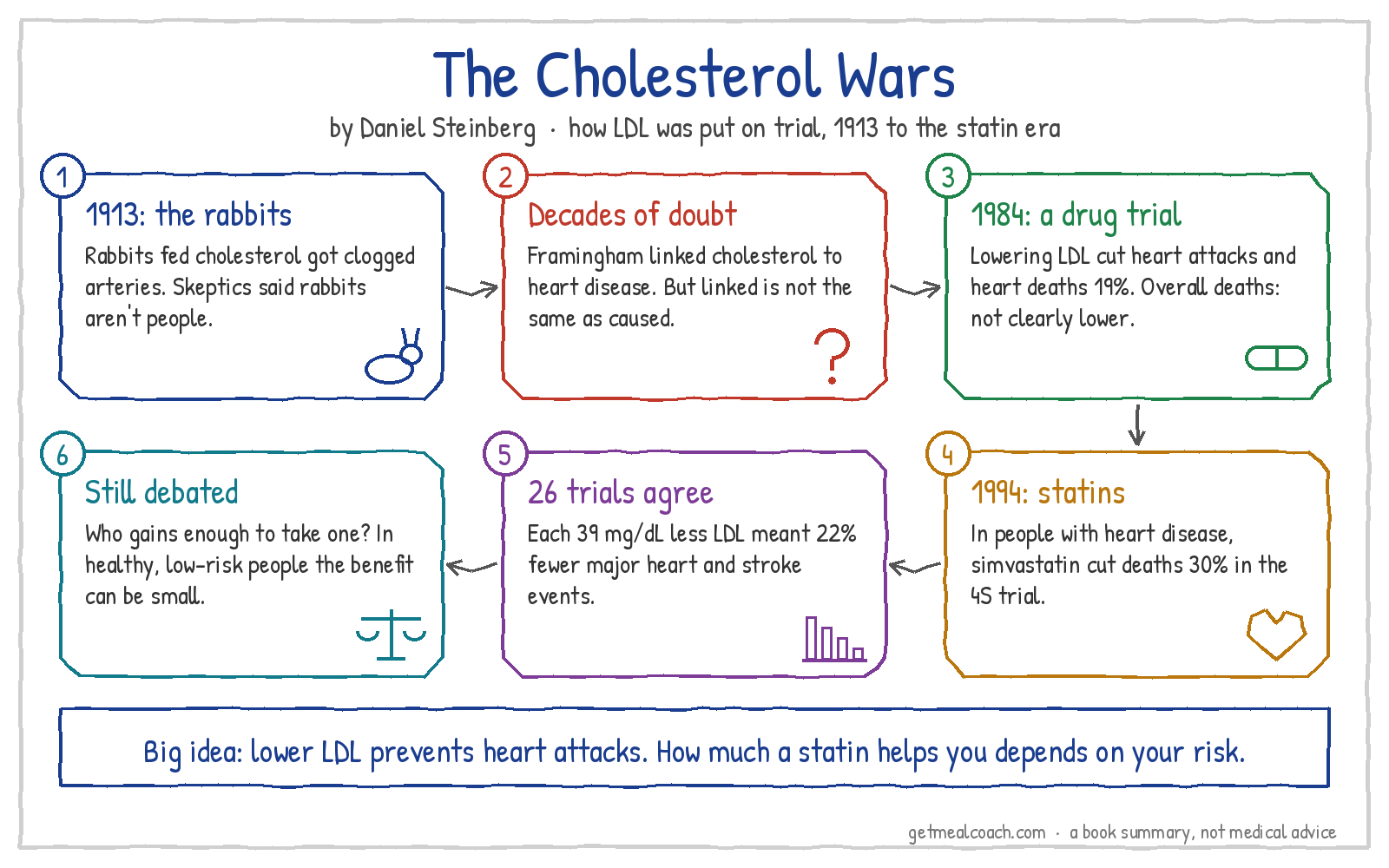
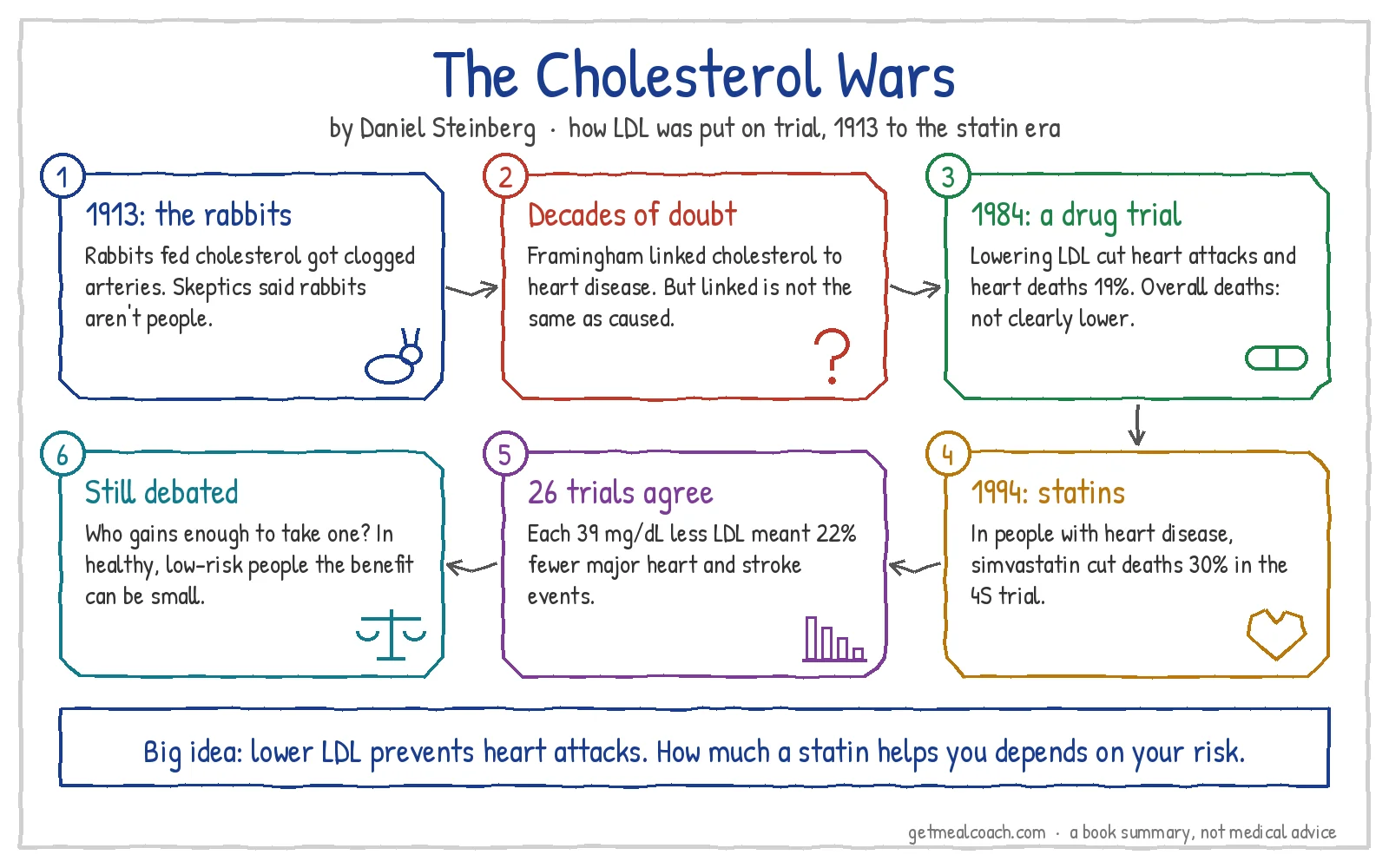
The 5-Minute Version: The Cholesterol Wars Summary (Screenshot This)
- The question: does high cholesterol cause heart disease, or is it just linked to it?
- 1913: rabbits fed cholesterol got clogged arteries. Skeptics said rabbits aren’t people.
- Framingham: higher cholesterol was linked to heart disease, but a link isn’t proof.
- 1984: a drug trial cut heart attacks plus heart deaths 19%. Overall deaths didn’t clearly drop.
- 1994: the 4S statin trial cut deaths 30% in people with heart disease.
- 2010: 26 trials agreed. Each 39 mg/dL less LDL meant 22% fewer major events.
- Still open: how much healthy, lower-risk people gain from a statin.
- 2026: in people 70 and older with several health conditions but no heart disease, stopping statins meant more heart attacks and strokes.
Conclusion
If The Cholesterol Wars summary above leaves you with one idea, make it this. Lowering LDL prevents heart attacks. Whether a pill is worth it for you depends on your own risk.
Steinberg spent a lifetime proving the first half. The second half is a conversation you get to have with your doctor, armed with real numbers. As Steinberg said in a 2013 profile, at 90: “The mystery of HDL is important.” Even he knew the science wasn’t finished.
Your one step this week: get your LDL and your 10-year risk as numbers.
So tell me: what made you start wondering about cholesterol, a test result, a family member, or something you read?
This is a book summary, not medical advice. Talk to your doctor before you start, stop or change any medicine.
Sources
- Elsevier: The Cholesterol Wars (Academic Press, 1st edition, Sep 2007)
- Library catalogue record: The Cholesterol Wars contents
- National Lipid Association: Distinguished Achievement Award to Daniel Steinberg
- Lipid Spin (2013): Member spotlight, Daniel Steinberg
- Daniel Steinberg, Journal of Lipid Research (2013): In celebration of the 100th anniversary of the lipid hypothesis
- Christopher Labos, The Skeptic (Feb 2024): How cholesterol denialism went from reasonable skepticism to pseudoscience
- American College of Cardiology: LRC Coronary Primary Prevention Trial summary
- American College of Cardiology: 4S trial summary
- Cholesterol Treatment Trialists, Lancet (2010): more intensive LDL lowering, 26 trials
- Cochrane review (2013): statins for primary prevention of cardiovascular disease
- US Preventive Services Task Force (Aug 23, 2022): statin use for primary prevention
- Chris Masterjohn (Jan 16, 2008; reposted Feb 28, 2009): The Cholesterol Wars, Steinberg Strikes Back
- MedlinePlus: Atorvastatin (side effects and when to call your doctor)
- TCTMD (Nov 8, 2026): STREAM trial of stopping statins in older adults
- Healio (Nov 8, 2026): STREAM trial results
 MealCoach