“this is not a disease of willpower.”
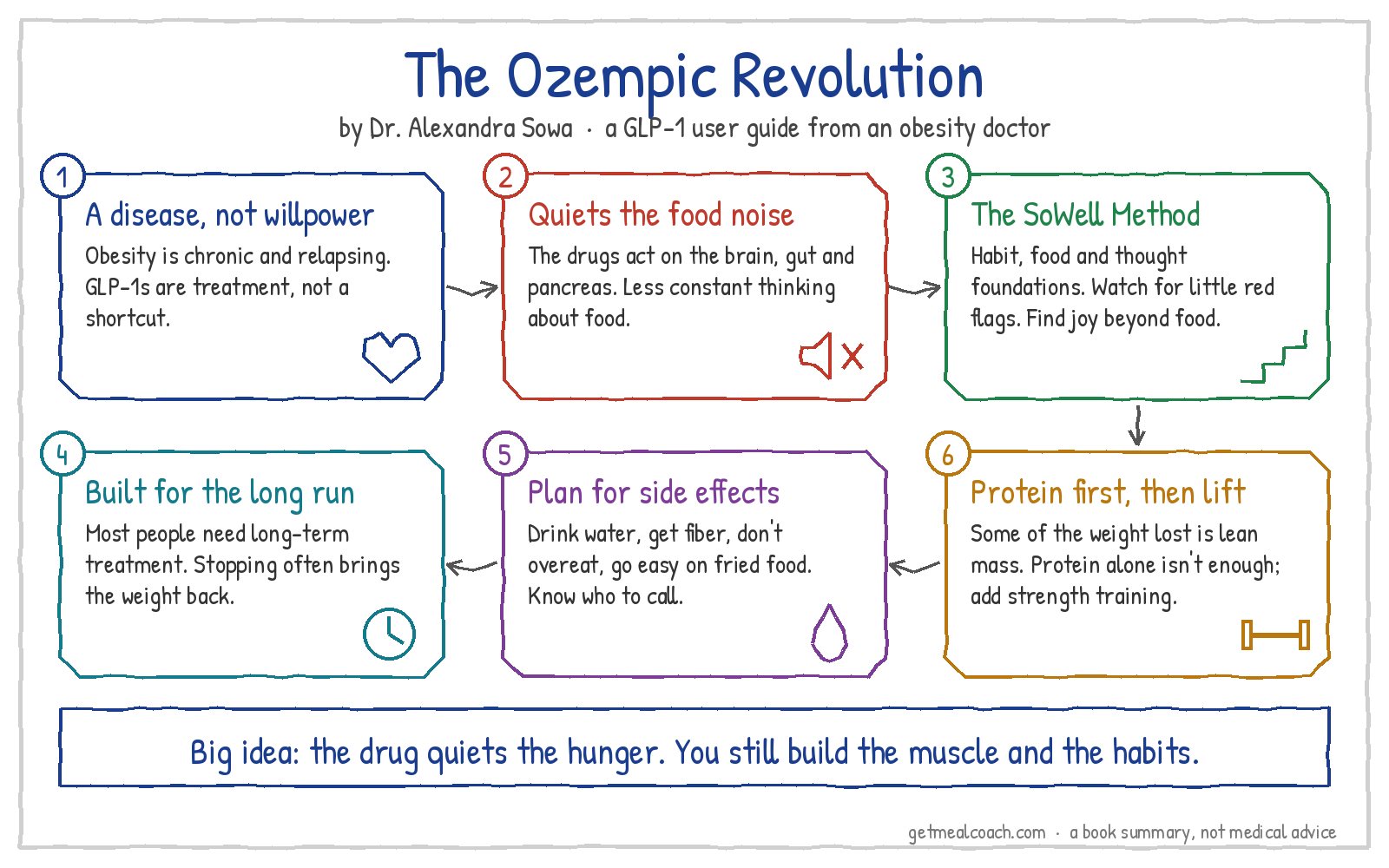
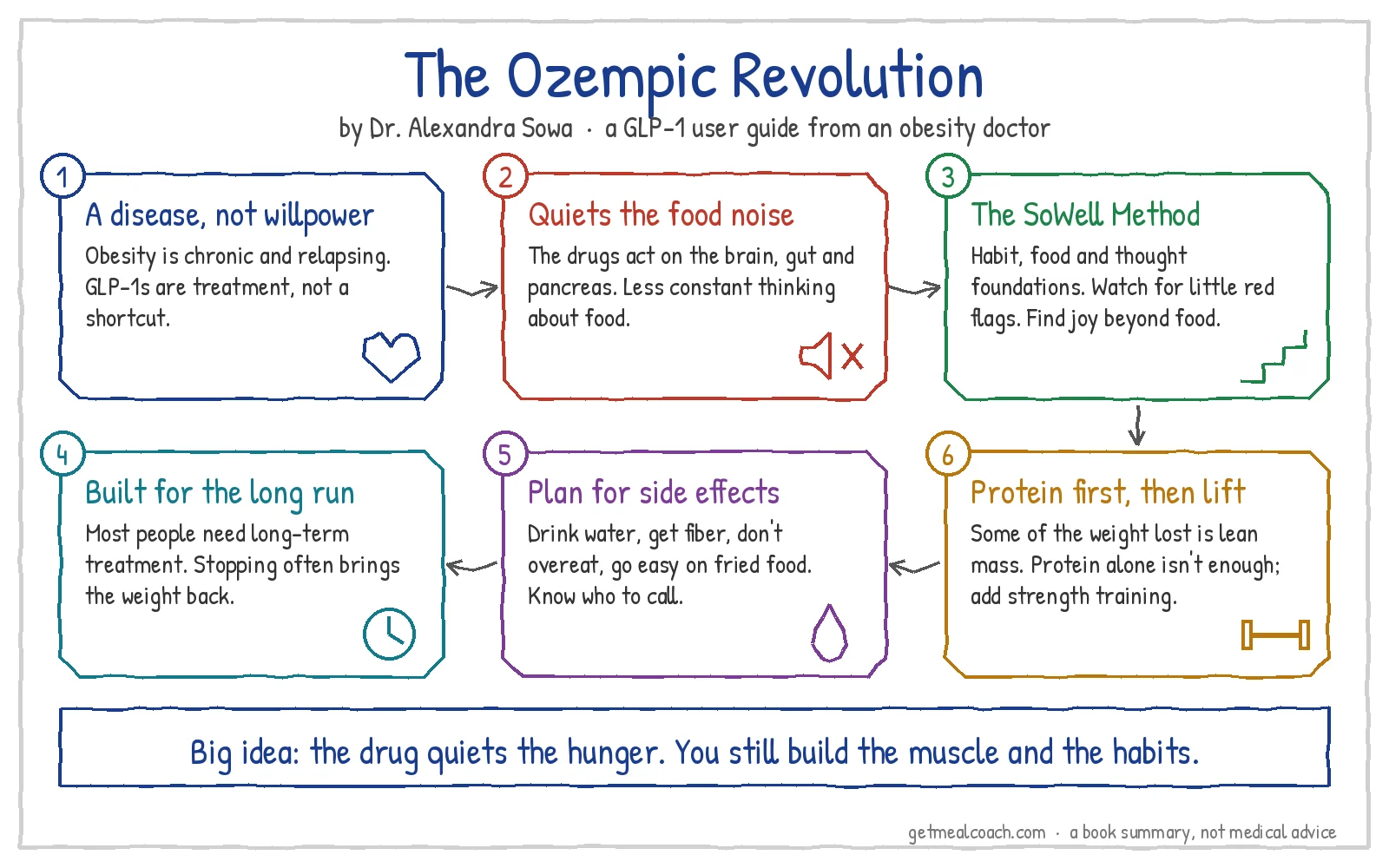
The short answer: here’s The Ozempic Revolution summary. Dr. Alexandra Sowa is an obesity medicine doctor in New York. She argues that GLP-1 drugs like Ozempic, Wegovy and Zepbound work best as long-term treatment for a chronic disease. The shot quiets hunger. Protein, strength training and habit work have to do the rest.
You’ll learn her SoWell Method and her take on side effects and stopping. You’ll also see what the trials show and what has changed since the book came out.
What Is The Ozempic Revolution About?
The Ozempic Revolution is a user guide to GLP-1 weight-loss drugs, written by a doctor who prescribes them every day. Harvest, a HarperCollins imprint, published it on January 7, 2025. It runs 256 pages, per its NetGalley listing.
It has four parts: the science, her SoWell Method, life on the drugs, and recipes for home and eating out. The introduction has a blunt title: “Why Doctors Have Failed You.” The contents are listed on Perlego.
Readers like it. It averages 4.21 stars from 678 ratings on Goodreads, as of November 14, 2026.
Action item: Before you read on, write down why you’re curious about GLP-1s. Health, cost, side effects or a family member? Keep that question in mind.
Who Is Dr. Alexandra Sowa, and Why Did She Write It?
Sowa is a board-certified internist and obesity medicine doctor who watched both her grandmothers fight their weight for life. She trained at Johns Hopkins and NYU. She told Zibby Owens she moved into obesity medicine because she was tired of treating only end-stage disease.
Here’s the story at the heart of the book. Her Eastern European family had a long history of obesity and dieting. Both grandmothers developed diseases linked to their weight. One grandmother’s fatty liver ultimately caused her death, she says in the same interview.
They tried diet after diet. None of it stuck. These drugs, she says, are what she wishes her family had.
She’s also an instructor at NYU Grossman School of Medicine, per Gizmodo’s January 2025 interview.
Action item: Think about who in your family struggled with weight. What did they try? It’s a useful history to share with your doctor.
Why Does Sowa Call Obesity a Disease, Not a Willpower Problem?
Sowa treats obesity as a long-term medical condition, so she sees GLP-1s as treatment, not a shortcut. One line from the book, quoted by a Goodreads reviewer, sums it up: “It is a chronic, relapsing, and progressive disease with a complex set of causes.”
She describes the drugs as acting on the brain, the gut and the pancreas. They can quiet “food noise”, the nonstop thinking about food. She admits it isn’t a clinical term, on Cynthia Thurlow’s podcast in February 2025.
Does the evidence back her? On weight, yes. In the STEP 1 trial, 1,961 adults took semaglutide (Wegovy) or a placebo for 68 weeks. Counting everyone who started, the drug group lost 14.9% of body weight on average, versus 2.4% on placebo, per the published trial.
The SELECT trial went further. It followed more than 17,000 adults aged 45 or older with overweight or obesity, but no diabetes, for about 40 months. All had existing cardiovascular disease, such as a past heart attack, stroke or artery disease.
Heart attacks, strokes and cardiovascular deaths hit 6.5% on semaglutide and 8.0% on placebo, a 20% drop. That’s per Cleveland Clinic’s release on the 2023 New England Journal of Medicine paper. Novo Nordisk, which makes the drug, funded SELECT.
Action item: If you’ve blamed yourself for past diets failing, try reading one trial result like STEP 1. Placebo groups lose a little, too. That’s what diet and exercise counseling alone looks like.
What Is the SoWell Method?
The SoWell Method is the book’s plan for doing well on a GLP-1: build your habits, your food and your thinking before and during treatment. It fills the middle of the book.
In her Zibby Media interview, she describes three foundations:
- Habit foundations: routines that hold up when life gets busy.
- Food foundations: a few simple food rules. She stresses it isn’t a diet book.
- Thought foundations: changing old beliefs about food and your body.
Two ideas stand out. The first is little red flags: small signs of sliding, like skipping a dose or a workout after a trip. The second is what she calls anhedonia, a subtle lack of pleasure. When food stops being the main source of fun, some people feel flat. She tells them to build joy that isn’t food.
One thing to know: SoWell is also the name of her supplement company. It launched a $104.99 “GLP-1 Support System” of protein, fiber and electrolytes in August 2024, per its press release. More on that below.
Action item: Write down your three most likely red flags. Common ones are travel, late work nights and skipped meals. Name yours before they show up.
Why Does Sowa Put Protein and Strength Training First?
Because the scale can’t tell fat from muscle, and GLP-1 weight loss takes some of both. Her advice on Thurlow’s podcast is three words long: “protein, protein, protein.” She tells patients to eat protein first at meals, and to lift weights.
The trials show why. In STEP 1, lean mass made up 38% of the weight people lost on semaglutide. That figure comes from a 2025 joint advisory from four obesity and nutrition groups. In a scan study of 160 people from the tirzepatide (Zepbound) trial SURMOUNT-1, it was about 26%, per Look and colleagues in 2025.
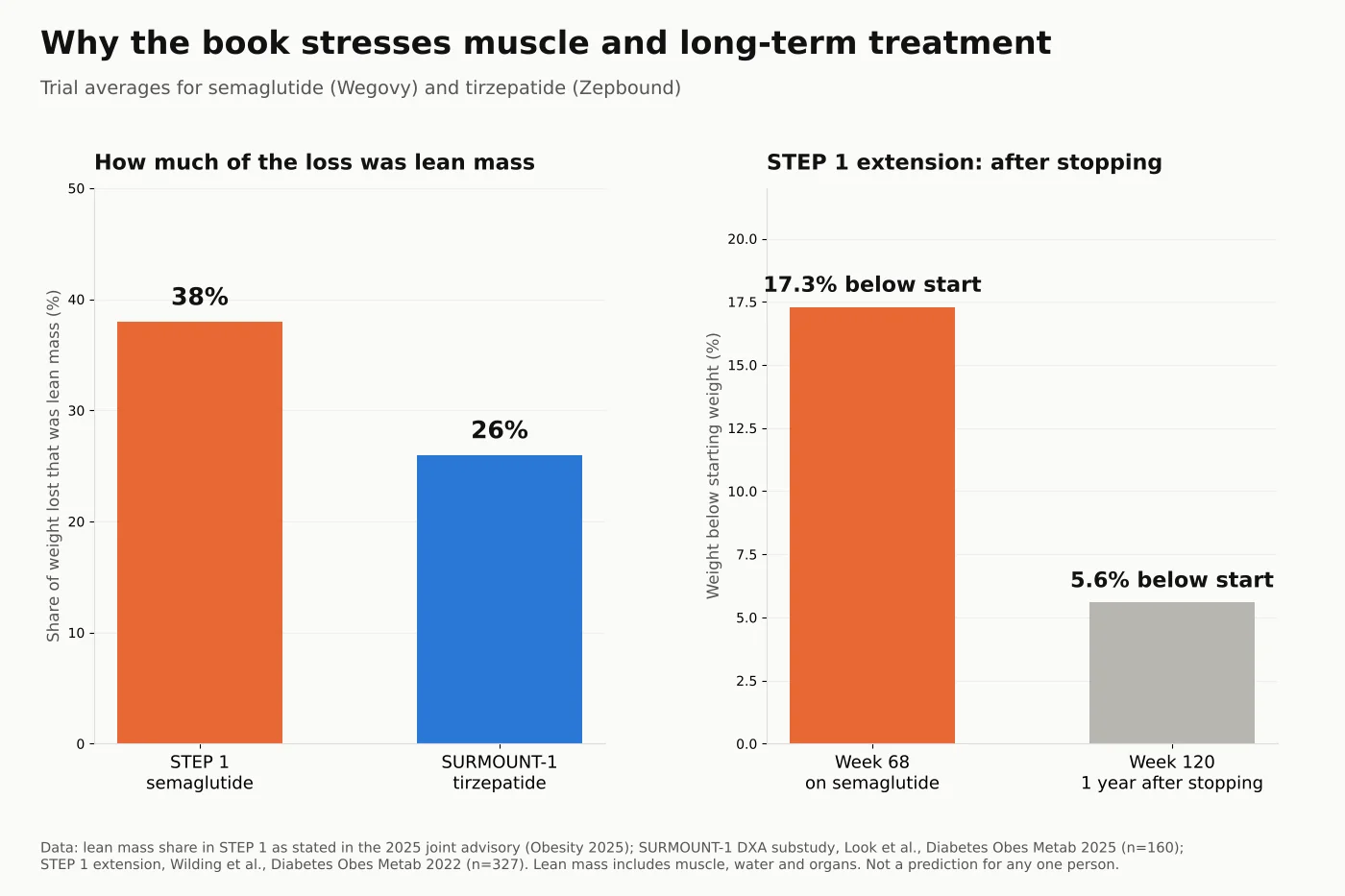
Lean mass isn’t all muscle. But the advisory agrees with Sowa on the fix. It notes higher protein targets of 1.2 to 1.6 grams per kilogram a day have been proposed during weight loss. Then it adds the catch: “[I]ncreased protein intake alone is likely inadequate to support the preservation of muscle mass.” Strength training has to come with it.
For how to eat when your appetite shrinks, see our guide on how to eat on a GLP-1.
Action item: Ask your care team for a protein target that fits your body. Then put the protein on your plate first at your next meal.
How Does The Ozempic Revolution Handle Side Effects?
Sowa treats side effects as expected and mostly manageable, with preparation and a doctor you can reach. Her tips are practical: drink enough, since the drugs can blunt thirst. Get fiber. Don’t overeat, and go easy on fried and carb-heavy foods, she said at a WeightWatchers book club in 2026.
The trial numbers say why this section matters. In STEP 1, 44.2% of people on semaglutide had nausea, versus 17.4% on placebo. Diarrhea hit 31.5% versus 15.9%. About 4.5% stopped the drug because of stomach side effects, versus 0.8%, per an American College of Gastroenterology summary.
Cleveland Clinic gives similar advice in its 2026 guide: smaller meals, slow eating, water through the day. It adds that the worst effects often come in the first three to four weeks.
Call your doctor right away, or get urgent care if it’s severe, for any of these, which the Wegovy label and the FDA flag:
- Stomach pain that is severe or won’t go away, sometimes spreading to the back.
- Vomiting or diarrhea that leaves you unable to keep fluids down.
- Sudden vision loss in one eye.
Action item: Before a first dose or a dose increase, ask your prescriber one question: “Who do I call, and how fast, if side effects get bad?”
Do You Have to Stay on a GLP-1 Forever?
Sowa says most people will need to, and the trial data mostly agree. She told Gizmodo: “These medications are intended and approved for long-term, potentially forever, use.”
On Thurlow’s podcast, she guessed only about 5% to 10% of people can come off. That’s her clinical estimate, not a trial number. She compares the drugs to thyroid hormone: you take it because the condition doesn’t go away.
The trials back the direction. In the STEP 1 extension, people lost 17.3% of their weight by week 68 on semaglutide. A year after stopping, they had regained 11.6 points. They ended 5.6% below where they started, per Wilding and colleagues, 2022. That’s about two-thirds of the loss back.
One gap in the evidence: she has said a small minority can come off by closely tracking their numbers, at the WeightWatchers book club. But the joint advisory says diet and lifestyle plans to limit regain after stopping haven’t been tested in controlled trials. So nobody knows yet whether habits like the SoWell foundations help people who stop.
We dig into this in what happens when you stop a GLP-1.
Action item: If you’re thinking about stopping, don’t decide alone. Ask your prescriber what the plan would be if the weight starts coming back.
What Has Changed Since The Ozempic Revolution Came Out?
Pills arrived, prices fell, compounded copies mostly ended, and the FDA ordered a new eye warning for every GLP-1. In January 2025, Sowa told Gizmodo cost was the biggest barrier, and she expected easier forms like pills. She was right on both counts.
- Compounded copies: the FDA declared the semaglutide shortage over in February 2025. Compounders got until April and May to stop making copies, per STAT.
- Price: in November 2025, Novo cut the self-pay price of Wegovy shots to $349 a month for all doses, per Fierce Pharma.
- The Wegovy pill: approved in December 2025. In its main trial, people on the 25 mg pill lost 13.6% versus 2.4% on placebo, counting everyone, per ConsultantLive.
- Foundayo (orforglipron): Lilly’s daily pill, approved April 1, 2026, with no food or water rules. People on the top dose lost 12.4% at 72 weeks if they stayed on treatment, per Healio. Our Foundayo vs Zepbound comparison covers cost and trade-offs.
- A new warning: on November 9, 2026, the FDA told makers of every GLP-1 to add a NAION warning. NAION is a rare cause of sudden vision loss in one eye. In 126 trials, it was 6.4 cases per 100,000 person-years on GLP-1s versus 3.8 on comparators, per the FDA notice on Drugs.com.
None of that changes her core advice. It does make the book’s drug chapters a snapshot of early 2025.
Action item: If you read the book, check any drug name, price or dose in it against today’s label before you rely on it.
Where The Ozempic Revolution Falls Short
The book is upbeat, light on citations, and written by a doctor who also sells GLP-1 supplements.
- Thin on downsides. One Goodreads reviewer felt it skipped over side effects and dismissed ones the author hadn’t seen in her own patients. Another wanted more study references and more on life after stopping.
- The supplement tie. Dr. Greg Katz, a friend and former co-resident who praised the book, said in his January 2025 review that he doesn’t endorse her supplement recommendations. He wrote that most people don’t need them.
- Tone. Book blogger Jaya Bhattacharji Rose, in her review, found the book’s blurb very upbeat. She wrote that the dangerous side effects can’t be ignored.
My take: the medical core is sound and matches the big trials. Treat the protein and fiber advice as food first. You don’t need a branded powder to follow it.
Action item: If a GLP-1 doctor recommends a product, it’s fair to ask: “Do you have a financial interest in this?”
What Should You Ask Your Doctor After Reading It?
The book’s best use is as a list of questions for your next appointment. Here’s a worked example. It’s our illustration, built from the book’s themes, not a script from the book.
- Am I a good candidate? Bring your weight history and other conditions.
- Which drug, and why? Shot or pill, and what each costs you.
- What’s my protein and strength plan? Ask for a target, not just “eat more protein.”
- What side effects should I expect, and who do I call?
- How long will I take it? And what happens if I stop?
Five questions, ten minutes. That’s the SoWell Method in miniature: a plan before the first dose.
Action item: Copy these five questions into your phone’s notes before your next appointment.
Quick Answers
What is The Ozempic Revolution about? It’s a 2025 guide to GLP-1 drugs like Ozempic, Wegovy and Zepbound by obesity doctor Alexandra Sowa. It covers how they work, side effects, getting coverage, and her SoWell Method of habit, food and thought foundations.
What is the SoWell Method? It’s Sowa’s plan for doing well on a GLP-1. Build habit, food and thought foundations, watch for little red flags of sliding, and find joy beyond food.
Do you have to take Ozempic forever? Sowa says most people will need long-term treatment. In the STEP 1 extension, people regained about two-thirds of their lost weight within a year of stopping semaglutide.
Why does protein matter on a GLP-1? Some of the weight lost is lean mass: 38% in STEP 1 and about 26% in a SURMOUNT-1 scan study. Experts say protein plus strength training helps protect muscle.
Is The Ozempic Revolution worth reading? Yes, as a practical starter guide from a doctor who prescribes these drugs. Its drug facts date from early 2025, and it’s light on study references.
The 5-Minute Version: The Ozempic Revolution Summary (Screenshot This)
- The idea: obesity is a chronic disease, and GLP-1s are long-term treatment, not a shortcut.
- The evidence: in STEP 1, semaglutide meant 14.9% weight loss versus 2.4% on placebo.
- SoWell Method: habit, food and thought foundations, plus watching for little red flags.
- Protein and lifting: lean mass was 38% of weight lost in STEP 1. Protein alone isn’t enough.
- Side effects: nausea hit 44.2% in STEP 1. Hydration, fiber and smaller meals help.
- Stopping: about two-thirds of the weight came back within a year in STEP 1.
- Since 2025: two weight-loss pills, lower cash prices and a new NAION eye warning.
- The catch: the author also sells GLP-1 supplements. Food first.
Conclusion
If The Ozempic Revolution summary above leaves you with one idea, make it this. The drug quiets the noise. It doesn’t build the muscle, the habits or the plan for a bad week.
Sowa wrote the book her grandmothers never had. Its best advice is old-fashioned: eat protein, lift, drink water, and keep a doctor close. Its weakest spots are the ones any 2025 book on a fast-moving drug would have.
Your one step this week: bring the five questions above to your next appointment.
So tell me: what’s the one thing you wish someone had told you before starting a GLP-1?
This is a book summary, not medical advice. Talk to your doctor before you start, stop or change any medicine.
Sources
- NetGalley: The Ozempic Revolution (Harvest, Jan 7, 2025; 256 pages)
- Perlego: The Ozempic Revolution contents
- Goodreads: The Ozempic Revolution ratings and reviews
- Zibby Media: interview transcript with Dr. Alexandra Sowa
- Gizmodo (Jan 29, 2025): An Ozempic expert explains what you need to know
- Everyday Wellness, Ep. 438 (Feb 8, 2025): Dr. Alexandra Sowa
- WeightWatchers Book Club (Feb 26, 2026): Q&A with Dr. Alexandra Sowa
- PR Newswire (Aug 14, 2024): SoWell launches GLP-1 Support System
- Wilding et al., NEJM (2021): STEP 1, semaglutide 2.4 mg
- Cleveland Clinic via EurekAlert (Nov 2023): SELECT trial results
- Joint advisory, Obesity (2025): Nutritional priorities to support GLP-1 therapy
- Look et al., Diabetes Obes Metab (2025): Body composition with tirzepatide in SURMOUNT-1
- American College of Gastroenterology: STEP 1 summary (side effects)
- Cleveland Clinic (Sep 2026): How to manage GLP-1 side effects
- Wegovy Prescribing Information (revised 06/2026)
- Wilding et al., Diabetes Obes Metab (2022): STEP 1 extension, weight after stopping
- STAT (Feb 21, 2025): FDA declares end to semaglutide shortage
- Fierce Pharma (Nov 2025): Novo cuts Wegovy and Ozempic self-pay prices
- ConsultantLive (Dec 23, 2025): FDA approves the Wegovy pill
- Healio (Apr 1, 2026): FDA approves orforglipron (Foundayo)
- FDA safety communication via Drugs.com (Nov 9, 2026): NAION labeling for GLP-1s
- Greg Katz, MD (Jan 24, 2025): How to be successful on Ozempic
- Jaya Bhattacharji Rose: review of The Ozempic Revolution
 MealCoach