
“…NEREUS can meaningfully reduce vomiting…”
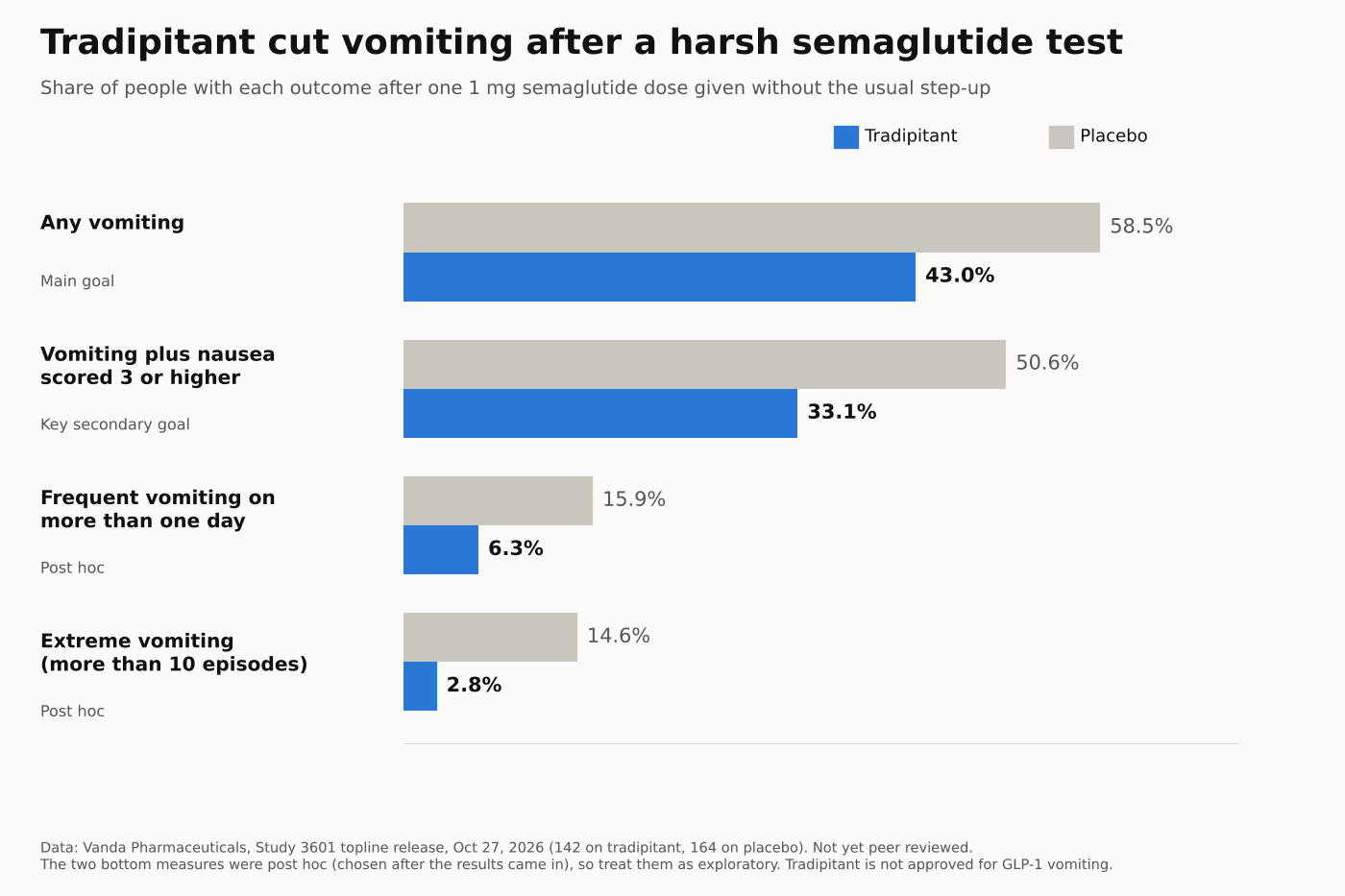
The short answer: Tradipitant for GLP-1 vomiting passed its first Phase 3 test. Vomiting after a semaglutide shot fell from 58.5% on placebo to 43.0% on tradipitant, a 27% relative drop, per Vanda Pharmaceuticals’ October 27, 2026 release on Study 3601.
The test was deliberately harsh: one 1 mg semaglutide dose with no step-up. Tradipitant isn’t approved for GLP-1 vomiting yet, and Vanda says it plans to talk to the FDA before filing.
In this post you’ll learn what tradipitant is, what the Phase 3 trial of tradipitant for GLP-1 vomiting actually tested, why the numbers won’t match your experience, and what you can do about GLP-1 nausea today. About 6 minutes.
What Is Tradipitant?
Tradipitant is an oral NK-1 receptor blocker made by Vanda Pharmaceuticals, sold as Nereus. The FDA approved it on December 30, 2025, “for the prevention of vomiting induced by motion in adults,” per its prescribing information.
NK-1 blockers stop a brain signal called substance P from triggering vomiting. Vanda says tradipitant acts in the brainstem areas that control vomiting, which is why it thinks the drug could work with any GLP-1. The same drug family includes aprepitant (Emend), used to prevent chemotherapy nausea (StatPearls).
Action item: If you read “Nereus” and “tradipitant” in the news, they’re the same drug. Approval for motion sickness doesn’t mean approval for GLP-1 vomiting.
What Did the Phase 3 Trial of Tradipitant for GLP-1 Vomiting Find?
Fewer people vomited on tradipitant than on placebo: 43.0% (61 of 142) versus 58.5% (96 of 164), p=0.006. That was Study 3601’s main goal, per Vanda’s release.
- Vomiting plus nausea scored 3 or higher (the key secondary goal): 33.1% versus 50.6%, p=0.002. That’s a 35% relative drop.
- Frequent vomiting (more than 2 episodes on more than one day): 6.3% versus 15.9%.
- Extreme vomiting (more than 10 episodes in total): 2.8% versus 14.6%, an 81% relative drop.
The last two were post hoc. That means Vanda chose them after seeing the data, so they’re exploratory, not proof. My gripe with headlines leading on “81%”: the main goal, set in advance, was the smaller number. Nearly all vomiting happened by day 2, peaking on day 1.
Vanda called tradipitant generally well tolerated with no new safety signals. The release gives no side effect rates.
Action item: When you see “81% less vomiting” in a headline, check whether it’s the main goal. Here, the main goal was a 27% relative drop.
Why Won’t These Numbers Match Real Life?
Because the trial skipped the slow dose increase that doctors use to keep nausea down. Everyone got a single 1 mg semaglutide dose without titration. Vanda describes the design as a rigorous test with a strong trigger for vomiting.
That’s why 58.5% of the placebo group vomited. Compare Wegovy’s 68-week STEP 1 trial, with its gradual step-up: 24.8% vomited on semaglutide and 6.6% on placebo (Wilding et al., NEJM, 2021).
So Study 3601 shows tradipitant can blunt a big, sudden hit. It doesn’t show how much it helps across months of normal dose increases. It also didn’t test tirzepatide (Zepbound, Mounjaro) or Foundayo, though Vanda expects it to work with all GLP-1s.
Action item: Don’t read “43% still vomited” as your odds. Your doctor’s step-up schedule is designed to make vomiting much less likely than in this test.
Does It Match the Earlier Phase 2 Study?
Yes, in direction, though the Phase 2 effect looked bigger. In Vanda’s Phase 2 study of 116 adults with overweight or obesity, vomiting after a single 1 mg Wegovy dose fell from 58.6% on placebo to 29.3% on tradipitant (p=0.0016), per Vanda’s November 17, 2025 release.
That was a 50% relative drop, versus 27% in Phase 3. Small early studies often show bigger effects than later ones, so the larger trial is the better guide. In Phase 2, people took tradipitant for a week before the shot and a week after.
Action item: Weigh the Phase 3 number more than the Phase 2 one. It came from more people and was the confirmatory test.
Why Does GLP-1 Vomiting Matter So Much?
Because stomach side effects are linked to people stopping these drugs. In a study of 125,474 US adults with overweight or obesity who started a GLP-1, 64.8% of those without type 2 diabetes stopped within a year, and 46.5% of those with it (Rodriguez et al., JAMA Network Open, 2025).
Moderate or severe stomach side effects were tied to a higher chance of stopping. That’s an association, not proof they caused it.
Nausea is the most common one. In STEP 1, 44.2% of people on semaglutide reported nausea, versus 17.4% on placebo. If a drug could make the first weeks easier, more people might stay on treatment. That’s Vanda’s pitch, and it’s still unproven.
Action item: If stomach side effects are making you think about quitting, tell your prescriber before you stop. There may be other options, like a slower step-up.
When Could Tradipitant Be Approved for GLP-1 Vomiting?
No date yet: Vanda hasn’t filed. It plans to discuss Study 3601 with the FDA and then submit a supplemental new drug application (sNDA), an add-on to Nereus’s existing approval. The release’s fine print mentions FDA feedback on a proposed sNDA submission during 2027.
An sNDA review usually takes months after filing. So approval for this use in 2026 isn’t possible, and 2027 isn’t guaranteed. That’s our read, not Vanda’s.
Vanda also registered a Phase 3 trial called Thetis on ClinicalTrials.gov (NCT07446439), in about 280 volunteers with overweight or obesity. Vanda’s Study 3601 release doesn’t say whether that’s the same study.
Action item: To track it, watch for two things: a full paper or congress presentation, and news of an FDA filing.
Can You Get Tradipitant for GLP-1 Nausea Now?
Not as an approved use. Nereus is approved only for motion-induced vomiting in adults. Using it for GLP-1 vomiting would be off-label, which is a prescriber’s decision, and there’s no published data yet on how it works across weeks of real dose increases.
Nereus’s label lists sleepiness, headache and tiredness as its most common side effects. It warns about driving or using machines, and about taking it with strong CYP3A4 inhibitors (such as certain antifungal and HIV drugs). Your pharmacist can check your other medicines.
Action item: Don’t buy tradipitant online or from anyone selling it “for research.” Ask your doctor what nausea help fits your situation.
What Helps With GLP-1 Nausea Today?
Eating habits and your dose schedule are the tools you have now. Cleveland Clinic suggests smaller meals, slowing down (it can take up to 30 minutes to feel full) and limiting high-fat, greasy food, especially when you’re starting out. I covered the details in How to Eat on GLP-1s.
Pace matters because semaglutide slows how fast your stomach empties, per its label, so a fast, big meal can sit heavy. If you want a nudge to slow down, our free browser version of MealCam notices your bites and prompts you to pause. It’s a pace tool, not a medical one.
If you’re on Foundayo, its side effects and timing are in Foundayo Side Effects.
Action item: At your next meal, put your fork down between bites and stop at the first sign of fullness. Note whether the queasy feeling afterward changes.
When Should You Call Your Doctor About Vomiting?
Call your doctor or get urgent care if vomiting won’t stop or comes with severe belly pain. Wegovy’s prescribing information warns about pancreatitis, gallbladder problems and kidney injury from dehydration. Watch for:
- Severe stomach pain that won’t go away, with or without vomiting.
- Vomiting or diarrhea you can’t keep up with, or signs of dehydration like dizziness or very little urine.
- Pain in your upper belly, fever, or yellow skin or eyes, which can point to the gallbladder.
Action item: Save your prescriber’s after-hours number in your phone today, before you need it.
What We Don’t Know Yet
The release leaves out the details that decide how useful tradipitant would be. As of October 29, 2026:
- Who was in it. The release doesn’t describe the participants, the tradipitant dose or how long people took it.
- Nausea alone. No result was reported for nausea without vomiting, which is more common than vomiting on GLP-1s.
- Side effect rates. “No new safety signals,” but no numbers.
- Real-world use. No data on normal dose increases, months of use, tirzepatide or GLP-1 pills.
- A paper. Results are topline only, not peer reviewed.
Action item: Treat this as a promising early signal. Wait for the full paper before reading much into the size of the effect.
Quick Answers
Does tradipitant work for GLP-1 nausea? In Vanda’s Phase 3 Study 3601, it cut vomiting from 58.5% to 43.0% after one untitrated 1 mg semaglutide dose. Vomiting plus nausea scored 3 or higher fell from 50.6% to 33.1%. Nausea alone wasn’t reported.
Is tradipitant FDA approved? Yes, as Nereus, but only to prevent motion-induced vomiting in adults (approved December 30, 2025). It isn’t approved for GLP-1 nausea or vomiting.
When will tradipitant be approved for GLP-1 vomiting? There’s no date. Vanda plans to discuss the results with the FDA and file an sNDA; its fine print points to a proposed submission during 2027.
Does tradipitant work with Zepbound or Mounjaro? It hasn’t been tested with tirzepatide. Vanda expects it to work with all GLP-1s, but the trials used semaglutide.
What are tradipitant’s side effects? On its motion-sickness label, the most common were sleepiness, headache and tiredness, and it carries a driving caution.
What This Means for You
✅ You know tradipitant cut vomiting in a harsh one-dose semaglutide test
✅ You know the main result was a 27% relative drop, not 81%
✅ You know it’s approved only for motion sickness so far
✅ You know pace, portions and a slow step-up are today’s tools
✅ You know which vomiting symptoms mean calling your doctor
The 5-Minute Version (Screenshot This)
- News: Vanda reported Phase 3 Study 3601 on October 27, 2026.
- Result: vomiting 43.0% on tradipitant vs 58.5% on placebo after one untitrated 1 mg semaglutide dose.
- Caveat: a forced, harsh test, not real-world dosing; the biggest gaps were post hoc.
- Status: approved only for motion-induced vomiting; Vanda plans to talk to the FDA and file, with a proposed submission during 2027.
- Today: smaller, slower meals and your doctor’s step-up plan; call if vomiting won’t stop.
Conclusion
Tradipitant for GLP-1 vomiting is the furthest along of any drug we know of with Phase 3 data aimed squarely at this side effect, and the main result held up. But the test was one harsh, untitrated dose, the paper isn’t out, and approval for this use isn’t possible before 2027.
Your one action today: if nausea or vomiting is making your GLP-1 hard to stick with, raise it with your prescriber now rather than waiting for a new drug.
So tell me: if a pill could make your first GLP-1 weeks easier, would you take a second medicine for it?
Sources
- Vanda Pharmaceuticals: Study 3601 results of NEREUS (tradipitant) for GLP-1-induced vomiting (PR Newswire, Oct 27, 2026)
- Vanda Pharmaceuticals: Phase 2 results of tradipitant for GLP-1 nausea and vomiting (BioSpace, Nov 2025)
- FDA: NEREUS (tradipitant) prescribing information (2025)
- HCPLive: FDA approves tradipitant (Nereus) for vomiting induced by motion (Dec 31, 2025)
- ClinicalTrials.gov: the Thetis study of tradipitant after GLP-1 dosing (NCT07446439)
- ClinicalTrials.gov: Phase 2 proof-of-concept study of tradipitant after GLP-1 dosing (NCT06804603)
- Wilding et al., STEP 1, NEJM (2021)
- Rodriguez et al., GLP-1 discontinuation and reinitiation, JAMA Network Open (2025)
- Novo Nordisk: Wegovy prescribing information
- Cleveland Clinic: how to manage GLP-1 side effects
- StatPearls: Aprepitant
 MealCoach