
“…a bonafide monthly drug in development…”
The short answer: the Amgen Q3 2026 earnings report, out November 3, 2026, had no new MariTide results. Amgen said its monthly weight-loss shot has finished enrolling its heart outcomes trial and both sleep apnea trials.
The main weight-loss trials are still running, more are just starting, and Amgen gave no date for any results. If you were hoping to ask your doctor for MariTide soon, the answer is still “not yet.”
In this post you’ll learn what Amgen’s third-quarter 2026 report said, what MariTide is, what its Phase 2 trial showed, where the Phase 3 trials stand, and what it means if you’re on a GLP-1 today. About 6 minutes.
What Was in the Amgen Q3 2026 Earnings Report?
Amgen’s total revenue rose 8% to $10.4 billion in July to September 2026, none of it from obesity drugs, because Amgen doesn’t sell one yet. That’s per its November 3, 2026 results release.
- Product sales: $9.9 billion, up 8%, driven by higher volumes (more medicine sold).
- Adjusted earnings per share: $6.45, up 14%.
- Repatha (evolocumab, a PCSK9 cholesterol drug): $1.085 billion, up 37%.
- 2026 forecast: total revenue of $38.9 billion to $39.7 billion.
On obesity, the news was all about trial progress, with no new data. Its finance chief said part of its manufacturing spending is to prepare for a potential MariTide launch.
Action item: If you came here for a new weight-loss drug you can ask for, there isn’t one from Amgen yet. Everything below is pipeline.
What Is MariTide?
MariTide (maridebart cafraglutide) is an experimental shot that turns on the GLP-1 receptor and blocks the GIP receptor, given once a month instead of once a week. That GIP part is the opposite of tirzepatide (Zepbound, Mounjaro), which turns both receptors on.
It’s built as an antibody joined to GLP-1 peptides, which is why it lasts so long in the body. Amgen’s release says its design supports “starting with monthly dosing,” and that people might stay on it with as few as four or six doses a year.
That last part is Amgen’s goal, not a proven result. It’s what the maintenance trials are testing.
Action item: When you see “monthly” or “four shots a year,” remember that published results so far cover monthly doses and one every-eight-weeks dose for a year, not four shots a year.
Where Do MariTide’s Phase 3 Trials Stand?
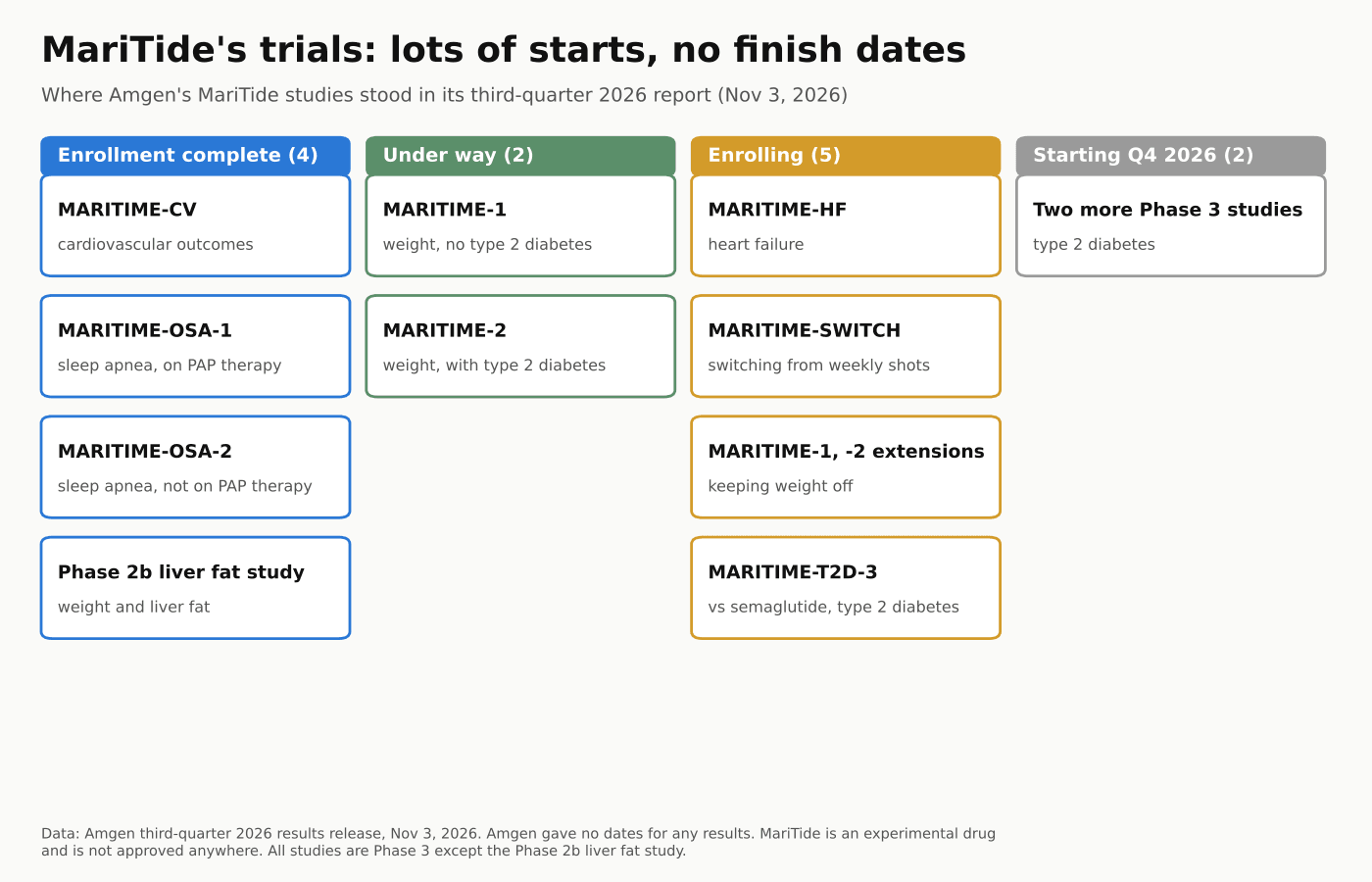
As of November 3, 2026, Amgen said MariTide’s heart outcomes trial, both sleep apnea trials and a Phase 2b liver fat study have finished enrolling. The program is called MARITIME. Here’s the full list from the release:
- Enrollment complete: MARITIME-CV (people with established cardiovascular disease and obesity or overweight), MARITIME-OSA-1 and OSA-2 (sleep apnea, with or without a breathing machine such as CPAP), and the Phase 2b liver fat study.
- Under way: MARITIME-1 and MARITIME-2, the main weight-loss trials in people without and with type 2 diabetes.
- Enrolling: MARITIME-HF (heart failure), MARITIME-SWITCH, extensions of MARITIME-1 and -2 on keeping weight off, and MARITIME-T2D-3, which compares MariTide with semaglutide in type 2 diabetes.
- Starting in Q4 2026: two more Phase 3 studies in type 2 diabetes.
MARITIME-SWITCH is the one to watch if you already take a GLP-1. It moves people from weekly tirzepatide or semaglutide to MariTide every eight weeks or every quarter.
Action item: “Enrollment complete” means everyone is signed up, not that results are in. Sleep apnea trials of other drugs show what to expect; see our breakdown of retatrutide’s sleep apnea trials.
What Did MariTide Show in Phase 2?
In a 52-week Phase 2 trial of 592 adults, people without type 2 diabetes lost 16.3% to 19.9% of their weight on average if they stayed on treatment, versus 2.6% on placebo. That’s per Amgen’s June 23, 2025 release, published the same day in The New England Journal of Medicine.
| Group (52 weeks) | If people stayed on treatment | Counting everyone |
|---|---|---|
| No type 2 diabetes, MariTide | −16.3% to −19.9% | −12.3% to −16.2% |
| No type 2 diabetes, placebo | −2.6% | −2.5% |
| Type 2 diabetes, MariTide | −12.1% to −17.0% | −8.4% to −12.3% |
| Type 2 diabetes, placebo | −1.4% | −1.7% |
The ranges cover several doses and schedules. Amgen said weight loss “had not plateaued by 52 weeks.” In people with diabetes who stayed on treatment, HbA1c fell by up to 2.2 percentage points.
Stomach side effects such as nausea, vomiting and constipation were the most common, mostly mild to moderate and mostly early on. Starting low and stepping the dose up helped, TCTMD reported. In the step-up groups, up to 7.8% stopped because of stomach side effects, per Amgen.
In January 2026, Amgen said the trial’s second part, a maintenance extension after the first year, showed MariTide working on a monthly schedule, with potential for quarterly dosing, Clinical Trials Arena reported. It hasn’t published those numbers yet.
Action item: When comparing drugs, check which column a number comes from. “Up to 20%” is the best dose among people who stayed on it; counting everyone, the top figure was 16.2%.
When Will MariTide Be Available?
Amgen hasn’t said. Its November 3, 2026 release and call gave no date for any Phase 3 results, let alone a launch. On the call, research chief Jay Bradner said Amgen will share more on efficacy and tolerability when the studies read out.
An analyst on the call referred to MARITIME data next year, and Amgen didn’t confirm or correct the timing. The main weight-loss trials last 72 weeks, per Amgen’s 2025 release. An FDA review often takes about another year after a filing.
So we’d be surprised to see MariTide in US pharmacies before 2028. That’s our estimate, not Amgen’s.
Action item: Don’t put off treatment you need while waiting for a pipeline drug. Compare what’s approved today in Foundayo vs Zepbound.
How Does MariTide Fit in the Weight-Loss Drug Race?
Amgen is betting on fewer shots, not the biggest number on the scale. Today’s choices are daily pills and weekly shots. The next wave, like retatrutide, is chasing bigger weight loss, as in our retatrutide vs EloraTZP breakdown.
Gordon said Amgen hasn’t seen another true monthly drug in development that could be dosed as rarely as four or six times a year. Bradner said Amgen expects to deliver it in a single-chamber handheld auto-injector.
The switch trial matters for the same reason. If people can move from a weekly shot to one every two or three months and keep their weight off, that’s a real change in daily life.
Action item: If weekly shots are the hard part for you, tell your doctor. How often you take a drug is a fair thing to weigh, alongside how well it works.
What We Don’t Know Yet
Several answers patients care about weren’t in the report or on the call. As of November 3, 2026:
- Phase 3 results: how much weight people lose over 72 weeks, and how many stop because of side effects.
- Maintenance numbers: how well weight holds on fewer doses, from the trial’s second year.
- Heart and sleep apnea outcomes: the trials are fully enrolled, but results are still to come.
- Dates, price and coverage: none announced. Gordon expects access and coverage outside the US to be tougher.
Action item: Treat call comments as plans. Wait for published results and trial registrations before counting on any date.
Quick Answers
What did Amgen report in its Q3 2026 earnings? Revenue of $10.4 billion, up 8%, on November 3, 2026. There were no new MariTide results, only trial progress.
Is MariTide approved? No. It’s in Phase 3 trials and isn’t approved anywhere as of November 2026.
How much weight did people lose on MariTide? In Phase 2, people without diabetes lost up to about 20% at 52 weeks if they stayed on treatment, and up to 16.2% counting everyone.
How often is MariTide taken? Mostly once a month so far, and Phase 2 also tested every eight weeks. Amgen is now testing whether people can keep weight off with shots every two or three months.
Does Amgen’s news change my GLP-1 treatment? No. Nothing here is approved, and no prices or launch dates were announced.
What This Means for You
✅ You know Amgen’s Q3 2026 report had no new MariTide data
✅ You know which MariTide trials are fully enrolled and which are still starting
✅ You know how to read MariTide’s Phase 2 numbers
✅ You know why Amgen is betting on fewer shots
✅ You know MariTide isn’t coming to pharmacies soon
The 5-Minute Version (Screenshot This)
- News: Amgen reported Q3 2026 results and held its earnings call on November 3, 2026.
- Sales: revenue $10.4 billion, up 8%. No obesity sales; MariTide isn’t approved.
- Trials: MariTide’s heart outcomes and both sleep apnea trials finished enrolling; the main weight trials are under way.
- Phase 2: up to about 20% weight loss at 52 weeks on treatment, 16.2% counting everyone.
- Timing: no results or launch dates given.
Conclusion
The Amgen Q3 2026 earnings call made Amgen’s pitch plain. It isn’t trying to win on pounds alone. It wants a shot you take once a month, and maybe less, that you can switch to from a weekly drug. That’s an appealing idea, but the trials that would prove it haven’t reported yet.
Your one action today: if you’re on a GLP-1, focus on what’s working now, like eating protein and slowing down at meals (our guide on how to eat on a GLP-1 has the basics).
So tell me: would you switch from a weekly shot to one every few months if it worked just as well?
Sources
- Amgen: third-quarter 2026 financial results (PR Newswire, Nov 3, 2026)
- Amgen Q3 2026 earnings call transcript (TradingKey, Nov 3, 2026)
- Amgen: results from Phase 2 obesity study of monthly MariTide presented at ADA (Jun 23, 2025)
- Amgen: robust weight loss with MariTide at 52 weeks in a Phase 2 study (Nov 26, 2024)
- TCTMD: weight-loss drug MariTide gains momentum in Phase II trial (Jun 25, 2025)
- Clinical Trials Arena: Amgen touts MariTide’s weight loss and type 2 diabetes potential at JPM26 (Jan 2026)
 MealCoach