
“…has provided substantial weight loss, in a distinct manner…”
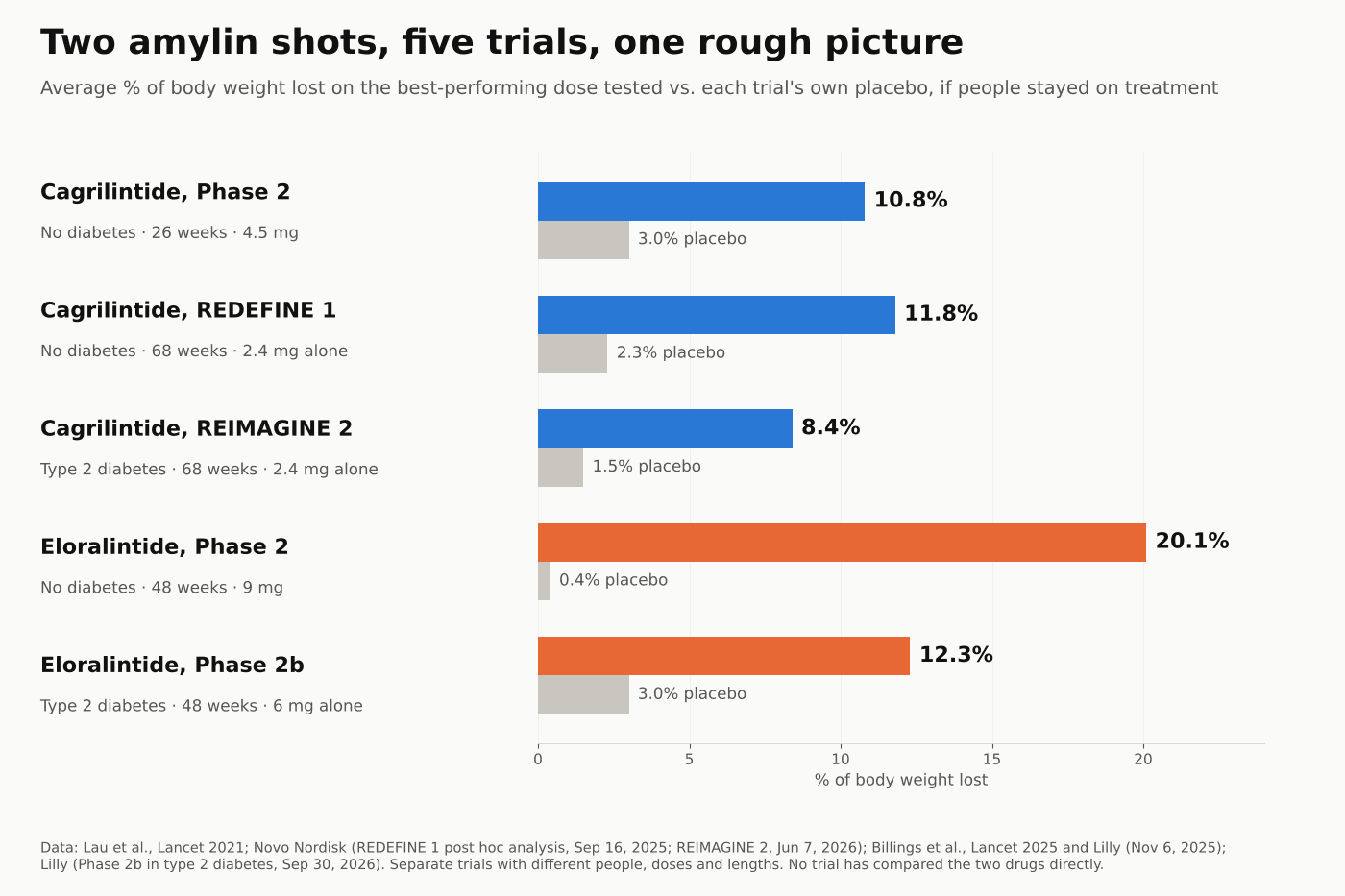
The short answer: In cagrilintide vs eloralintide, the trials so far favor eloralintide (Eli Lilly) over cagrilintide (Novo Nordisk) on weight loss. Eloralintide’s best dose cut weight by 20.1% at 48 weeks in Phase 2, while cagrilintide alone cut it by 11.8% at 68 weeks in Phase 3, both if people stayed on treatment.
But no trial has compared the two drugs directly. The studies differ in size, length, doses and people. In type 2 diabetes, the gap looks smaller. Neither drug is approved. Both are now in their own Phase 3 programs, and cagrilintide’s is further along.
In this post you’ll learn what cagrilintide and eloralintide are, how much weight people lost in every trial we found of each drug used alone, how their side effects compare, and when either could reach pharmacies. About 9 minutes.
What Are Cagrilintide and Eloralintide?
Cagrilintide and eloralintide are once-weekly shots that copy amylin, a hormone your pancreas releases with insulin after meals to help you feel full. Cagrilintide is Novo Nordisk’s. Eloralintide is Eli Lilly’s.
Each company also pairs its amylin drug with its GLP-1-based drug. Cagrilintide plus semaglutide is CagriSema. Eloralintide plus tirzepatide is EloraTZP. This post is about the two amylin drugs on their own.
I compared the combos in CagriSema vs EloraTZP. The solo shots matter too, because both companies are now testing them as stand-alone treatments.
Action item: When you read about an amylin drug, check the name. Cagrilintide and eloralintide are solo drugs; CagriSema and EloraTZP are combos with a GLP-1 drug inside.
Which Amylin Shot Causes More Weight Loss?
On the published numbers, eloralintide’s best results are higher, but the trials aren’t comparable enough to call a winner.
It’s tempting to line up the biggest number from each company’s press release and declare a winner. It feels like analysis. It isn’t. Headline numbers come from different trials, different people, different doses and different lengths.
Here’s what the best like-for-like numbers show, all “if people stayed on treatment” (Novo’s releases call this the trial product or efficacy estimand, Lilly the efficacy estimand):
- Without diabetes: eloralintide 20.1% at 48 weeks (Phase 2, 9 mg) vs cagrilintide 11.8% at 68 weeks (REDEFINE 1, 2.4 mg alone).
- With type 2 diabetes: eloralintide 12.3% vs 3.0% on placebo at 48 weeks (Phase 2b, 6 mg alone) vs cagrilintide 8.4% vs 1.5% on placebo at 68 weeks (REIMAGINE 2, 2.4 mg alone).
The honest reading: eloralintide looks stronger so far, and cagrilintide has more and bigger trials behind it. A fair verdict needs the two Phase 3 programs, or better, a head-to-head trial.
Action item: When someone posts “X beats Y,” ask one question: was it the same trial? If not, it’s a hint, not a result.
Cagrilintide vs Eloralintide: Every Trial, Side by Side
We found seven trials that report results for one of these drugs on its own: four for cagrilintide and three for eloralintide, counting eloralintide’s small Phase 1. Here they are, with each trial’s own placebo where it had one.
| Trial | Who and how long | If people stayed on treatment | Counting everyone |
|---|---|---|---|
| Cagrilintide Phase 2 (Lancet 2021) | 706 adults, no diabetes; 26 weeks; five doses (0.3 to 4.5 mg) | 6.0% to 10.8% vs 3.0% placebo (Saxenda’s drug, liraglutide 3.0 mg: 9.0%) | Not given in the abstract |
| Cagrilintide alone in REDEFINE 1 (Phase 3, post hoc) | 302 adults, no diabetes; 68 weeks; 2.4 mg | 11.8% vs 2.3% placebo | 11.5% vs 3.0% placebo |
| Cagrilintide alone, type 2 diabetes (Lancet 2023) | 30 adults on this arm (92 in the trial); 32 weeks; 2.4 mg; no placebo arm | 8.1% (A1C down 0.9 points); trial product estimand, the “stayed on treatment” analysis | |
| Cagrilintide alone in REIMAGINE 2 (Phase 3, type 2 diabetes) | 152 adults on this arm, on metformin (some also on an SGLT2 inhibitor); 68 weeks; 2.4 mg | 8.4% vs 1.5% placebo (A1C down 0.80 points vs up 0.09) | 7.4% vs 2.0% placebo (A1C down 1.02 vs 0.62) |
| Eloralintide Phase 1 (DOM 2026) | 100 adults with obesity or overweight; 12 weeks; five dose groups | Up to 11.3% (2.6% to 11.3% across doses) | |
| Eloralintide Phase 2 (Lancet 2025) | 263 adults, no diabetes; 48 weeks; 1 to 9 mg | 9.5% to 20.1% vs 0.4% placebo | 7.3% to 17.5% vs 2.3% placebo |
| Eloralintide alone, type 2 diabetes (Phase 2b) | Part of a 367-person trial; 48 weeks; 3, 6 or 9 mg | 8.2% to 12.3% vs 3.0% placebo (A1C down 1.1 to 1.4 points vs 0.3) | Not reported yet |
Sources for each row are listed at the end. Cagrilintide’s REDEFINE 1 numbers come from a post hoc analysis that Novo presented at EASD 2025; the arm size is from the main NEJM paper. REIMAGINE 2 numbers come from Novo’s June 7, 2026 release. The eloralintide “counting everyone” numbers come from Healio’s report of the Lancet paper.
Action item: Screenshot the table, then read across a row, not down a column. Each row only makes sense next to its own placebo.
Why Can’t We Crown a Winner Yet?
Because no trial has put cagrilintide and eloralintide in the same study, and the trials we have differ in four ways that move the numbers.
- Length. The trials ran from 12 to 68 weeks. Weight usually keeps falling for many months, so a 26-week number and a 68-week number aren’t measuring the same thing.
- Dose. Cagrilintide’s Phase 3 data use a single dose, 2.4 mg. Eloralintide’s best number comes from the top dose in a dose-finding trial.
- People. Placebo groups lost anywhere from 0.4% to 3.0%. That spread suggests the trial populations and settings differed.
- Size and phase. Phase 2 groups are small. Results often shrink when a drug moves into bigger Phase 3 trials.
The estimand matters too. Eloralintide’s 9 mg dose drops from 20.1% to 17.5% when you count everyone, including people who stopped. Cagrilintide barely moves (11.8% to 11.5%). Different trials handle dropouts differently, so compare like with like.
Action item: If you compare two numbers, check they use the same estimand. “If people stayed on treatment” is usually the bigger number for the drug group.
How Do the Side Effects Compare?
For both drugs, the most common side effects are stomach-related, mostly mild to moderate. Eloralintide also stands out for fatigue. The trials report side effects differently, so the rates below can’t be compared head to head.
Cagrilintide:
- In Phase 2, the most common side effects were stomach problems and injection-site reactions. Between 2% and 6% of people on cagrilintide stopped because of side effects, vs 3% on placebo and 7% on liraglutide, per a summary of the Lancet paper.
- In REDEFINE 1, nausea led 1.0% of people on cagrilintide alone to stop for good, vs 0.1% on placebo, per Novo.
- In REIMAGINE 2, in type 2 diabetes, 4.6% of people on cagrilintide alone stopped because of side effects, per Novo.
Eloralintide:
- In Phase 2, nausea (32.7%) and fatigue (26.9%) were the most common side effects across all eloralintide doses, per Healio’s report of the Lancet paper. They were more frequent at higher doses and less frequent with slower dose increases, per Lilly.
- In the type 2 diabetes trial, 0% to 10.8% of people on eloralintide alone stopped because of side effects, per Lilly’s September 30, 2026 release.
Our read: fatigue is the side effect to watch for eloralintide, because it showed up in more than a quarter of people in Phase 2.
If you’re on any weight-loss shot and get severe belly pain, repeated vomiting, or can’t keep fluids down, call your doctor or seek urgent care.
Action item: When Phase 3 results land, look for the “stopped because of side effects” number. It’s the most practical tolerability figure in any trial.
What About Type 2 Diabetes?
Both drugs lowered weight and A1C in people with type 2 diabetes, and the weight loss was smaller than in people without diabetes. That’s the usual pattern for weight-loss drugs.
- Cagrilintide alone in REIMAGINE 2 (Phase 3, 68 weeks, 152 people on this arm): weight down 8.4% vs 1.5% on placebo, A1C down 0.80 points vs up 0.09, if people stayed on treatment. Semaglutide 2.4 mg in the same trial: 10.2% and 1.75 points. Average starting A1C was 8.2%.
- Cagrilintide in an earlier Phase 2 (32 weeks, 30 people on this arm): weight down 8.1%, A1C down 0.9 points. Semaglutide alone: 5.1% and 1.8 points. There was no placebo group, per a summary of the Lancet paper.
- Eloralintide alone (48 weeks, three doses): weight down 8.2% to 12.3%, A1C down 1.1 to 1.4 points, vs 3.0% and 0.3 points on placebo, if people stayed on treatment. Average starting A1C was 8.1%.
In both cagrilintide trials, A1C fell about half as much as on semaglutide. Our read: on its own, amylin seems to do less for blood sugar than a GLP-1 drug. A1C is the 3-month blood sugar test.
Compared with placebo, eloralintide’s best dose came out about 9 points ahead and cagrilintide about 7. That gap is much smaller than in people without diabetes, though the trials still differ in length and size.
Action item: If you have type 2 diabetes, expect smaller numbers than the headlines. Ask your doctor which results come from trials of people like you.
When Could Cagrilintide or Eloralintide Be Available?
Cagrilintide alone is about a year ahead: its first dedicated Phase 3 trial of the drug alone is expected to finish its main measurements in May 2027. Eloralintide’s first Phase 3 trials are expected to finish their main measurements in early 2028. Both programs started in late 2025.
- Cagrilintide (RENEW program): RENEW 1 (NCT07220642) tests cagrilintide against placebo for 64 weeks in about 300 adults without diabetes. It started in November 2025, has finished recruiting, and lists May 11, 2027 as its expected primary completion, per the EU register record, which mirrors ClinicalTrials.gov data. RENEW 2 (NCT07220759) does the same in about 330 adults with type 2 diabetes. A separate trial (NCT07745504) compares two versions of cagrilintide for 26 weeks.
- Eloralintide (ENLIGHTEN program): ENLIGHTEN-1 and -2 test it for 64 weeks in people without and with type 2 diabetes, with main measurements expected in early 2028. ENLIGHTEN-10, in about 3,000 people with type 2 diabetes and higher heart risk, was just registered. Details are in our ENLIGHTEN-10 explainer.
After results come analysis, filing and a regulatory review that usually takes about a year. That points to 2028 at the earliest for cagrilintide alone and 2029 or later for eloralintide. Those are our estimates, not either company’s, and registry dates move.
The RENEW trials are small for Phase 3, about 300 people each. Novo hasn’t said how it will use them, alongside REDEFINE 1 and REIMAGINE 2, in a filing.
The combos run on their own tracks. Lilly says EloraTZP Phase 3 trials start in the fourth quarter of 2026; see what the AMPLIFY trials will test.
Action item: If you’re deciding about treatment now, decide based on what’s approved today. Both solo amylin shots are at least a year or two away.
What Does This Mean for You Today?
Nothing changes today: neither drug is approved, and the only way to get either is through a clinical trial.
Don’t buy “cagrilintide” or “eloralintide” online. Products sold as research chemicals aren’t the companies’ drugs. The FDA has warned about unapproved GLP-1-type drugs sold for weight loss and says cagrilintide can’t be used in compounding (FDA, Oct 1, 2026).
What’s interesting for the future is choice. A solo amylin shot could suit people who can’t tolerate GLP-1 drugs, or who want a different way to feel full. That’s our read, not a trial result.
Amylin drugs work on fullness, so people may notice they get full sooner at meals. That’s why I care about this class: it’s about how much you eat before your body says stop.
Action item: If you’re curious about a trial, search the trial numbers above on ClinicalTrials.gov and ask your doctor whether you might qualify. Trials have strict rules, and you may get placebo.
Quick Answers
Is eloralintide better than cagrilintide? Eloralintide posted bigger numbers so far (20.1% at 48 weeks vs 11.8% at 68 weeks, if people stayed on treatment), but in different trials. No head-to-head trial exists.
Are cagrilintide and eloralintide approved? No. As of October 29, 2026, neither is approved anywhere. Both are in Phase 3 trials.
What’s the difference between cagrilintide and CagriSema? Cagrilintide is the amylin drug alone. CagriSema combines it with semaglutide, the drug in Wegovy and Ozempic.
What are the side effects of amylin drugs? Mostly nausea and other stomach symptoms, usually mild to moderate. Eloralintide also caused fatigue in about a quarter of people in Phase 2.
When will eloralintide or cagrilintide be available? Cagrilintide’s first dedicated Phase 3 trial is expected to finish its main measurements in May 2027, eloralintide’s in early 2028. Our estimate: approval no earlier than 2028 for cagrilintide and 2029 for eloralintide.
What This Means for You
✅ You know cagrilintide is Novo’s solo amylin shot and eloralintide is Lilly’s
✅ You know eloralintide’s numbers are higher so far, but from different trials
✅ You can read a trial number with its estimand and its placebo
✅ You know nausea is the main side effect for both, plus fatigue for eloralintide
✅ You won’t buy either drug online
The 5-Minute Version (Screenshot This)
- What they are: once-weekly amylin shots. Cagrilintide is Novo Nordisk’s; eloralintide is Eli Lilly’s.
- Best numbers so far: eloralintide 20.1% at 48 weeks (Phase 2); cagrilintide alone 11.8% at 68 weeks (REDEFINE 1), both if people stayed on treatment.
- Type 2 diabetes: eloralintide 8.2% to 12.3% at 48 weeks (placebo 3.0%); cagrilintide alone 8.4% at 68 weeks in REIMAGINE 2 (placebo 1.5%). A much smaller gap.
- Side effects: mostly nausea and stomach symptoms for both; fatigue in about a quarter of eloralintide Phase 2 patients.
- The catch: no head-to-head trial. Different people, doses and lengths.
- Timing: both in Phase 3. Cagrilintide’s RENEW 1 is expected to finish its main measurements in May 2027, eloralintide’s first trials in early 2028.
Conclusion
Cagrilintide vs eloralintide is the amylin rematch inside the Novo vs Lilly rivalry. On today’s evidence, eloralintide has the bigger numbers and cagrilintide has the longer track record. Neither number settles it, because the trials were never built to be compared.
Your one action today: when you see an amylin “winner” headline, check whether both numbers came from the same trial.
Want the combo version of this fight? Read how CagriSema did in women after menopause.
So tell me: would you try a solo amylin shot, or wait for the combos that pair amylin with a GLP-1?
Sources
- Lau et al., once-weekly cagrilintide, dose-finding Phase 2, The Lancet (2021)
- PACE-CME: summary of the cagrilintide Phase 2 trial (2021)
- Novo Nordisk: cagrilintide REDEFINE 1 data and the RENEW programme (Sep 16, 2025, via BioSpace)
- Garvey et al., REDEFINE 1, NEJM (2025)
- Novo Nordisk: REIMAGINE 2 and the REIMAGINE programme at ADA 2026 (Jun 7, 2026, via BioSpace)
- Frias et al., cagrilintide and semaglutide in type 2 diabetes, Phase 2, The Lancet (2023)
- Medical Dialogues: summary of the Frias et al. trial (2023)
- RENEW 1 (NCT07220642), registry copy via Veeva
- RENEW 2 (NCT07220759), registry copy via Veeva
- RENEW 1, EU clinical trials register (EU CT 2024-519530-24-00), via ctis.eu
- NCT07745504, two versions of cagrilintide vs placebo (EU CT 2025-524249-29-00), via ctis.eu
- Bhattachar et al., eloralintide Phase 1, Diabetes, Obesity and Metabolism (Jan 2026)
- Eli Lilly: eloralintide Phase 2 results (PR Newswire, Nov 6, 2025)
- Healio: Billings et al., eloralintide Phase 2, The Lancet (Dec 2025 report)
- Eli Lilly: EloraTZP and eloralintide in type 2 diabetes, Phase 2b (Sep 30, 2026)
- FDA: concerns with unapproved GLP-1 drugs used for weight loss (Oct 1, 2026)
 MealCoach