
Updated October 26, 2026: Rewrote the hormone therapy section with two newer Mayo Clinic studies, including a cohort of more than 3,800 midlife women presented at The Menopause Society this month. Added a chart and Quick Answers on hormone therapy. The CagriSema trial numbers below haven’t changed.
“The weight loss observed in each group is encouraging.”
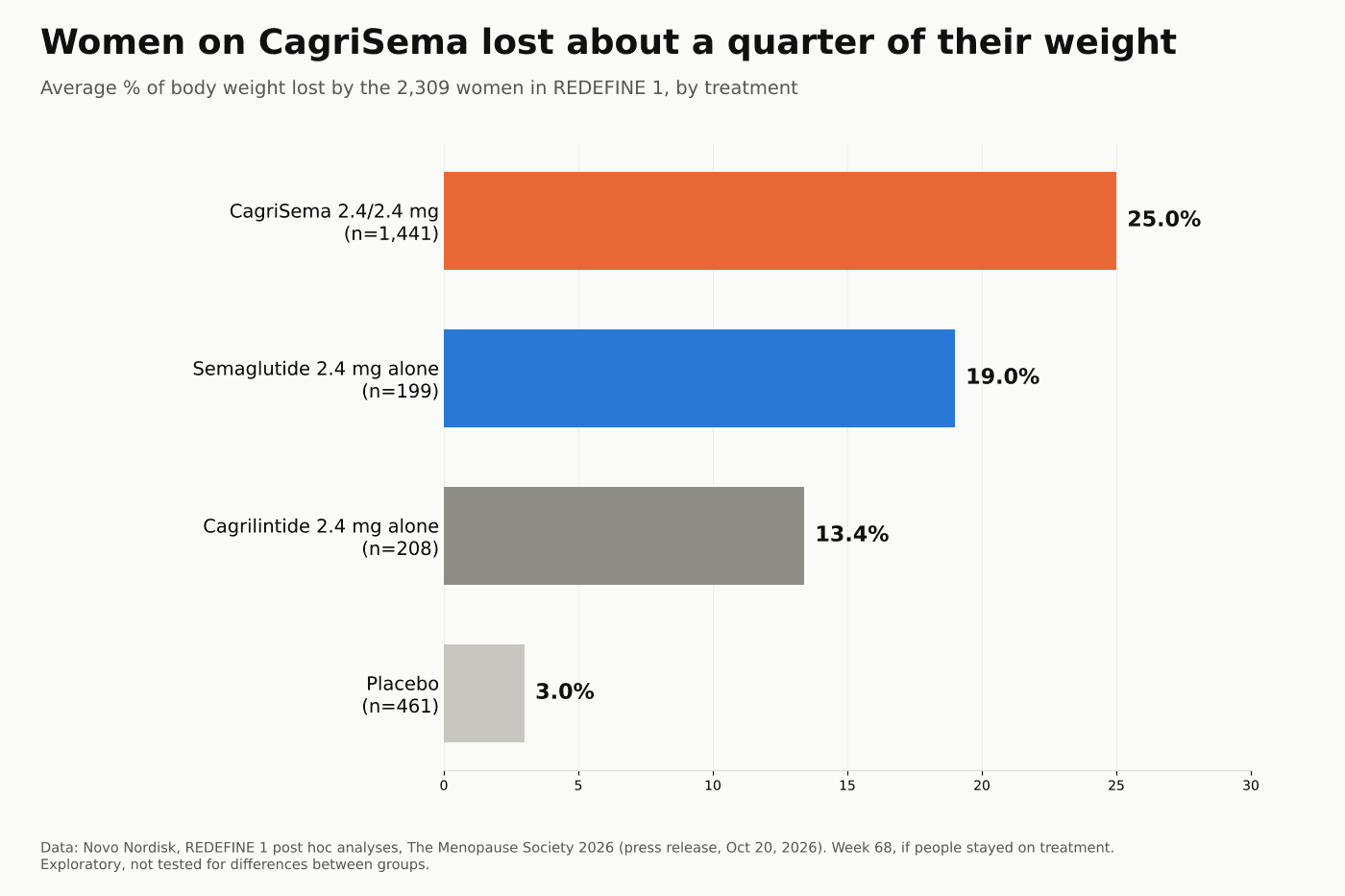
The short answer: in a new look at the REDEFINE 1 trial, women who took CagriSema for 68 weeks and stayed on treatment lost an average of 25.0% of their body weight, versus 3.0% on placebo. Results were similar before, during, and after menopause: about 27%, 25%, and 23%.
That’s a strong signal that CagriSema works for women in midlife. But it’s an after-the-fact analysis, it uses the more flattering way of counting, and the drug still waits on an FDA decision Novo expects in Q4 2026.
In this post you’ll learn what Novo’s CagriSema women data actually showed, how much menopause stage seemed to matter, why women tend to lose more on these drugs, and what to ask your doctor. About 6 minutes.
Midlife Weight Gain Isn’t a Willpower Problem
Plenty of women hit their mid-40s and notice it. Same food, same walks, and the scale creeps up anyway. More of it lands around the middle.
Novo’s release points to hormonal shifts across menopause, which can raise abdominal fat and change body composition. It also notes that more than 86 million US women are 40 or older, yet reproductive stage is rarely studied in obesity research.
So when women in menopause hear “just eat less and move more,” something is missing. Biology changes in midlife. Pretending it doesn’t just makes people blame themselves. (Our summary of The Secret Life of Fat explains why the body defends its fat so hard.)
Action item: If your weight has shifted in perimenopause or after, write down when it started and what else changed (sleep, hot flashes, periods). Bring that timeline to your next appointment.
What Is CagriSema?
CagriSema is a once-weekly shot from Novo Nordisk. It combines two drugs in one injection:
- Semaglutide 2.4 mg, the same GLP-1 drug as Wegovy.
- Cagrilintide 2.4 mg, a long-acting copy of amylin, a hormone that helps signal fullness after you eat.
Novo filed it with the FDA for weight management in December 2025. If approved, Novo says it would be the first amylin plus GLP-1 combination for weight management.
Lilly is racing toward the same idea with its own amylin combo. We put the two side by side in CagriSema vs EloraTZP, and compared Lilly’s next-generation shots in Retatrutide vs EloraTZP.
Action item: Don’t buy anything sold online as “CagriSema” or “cagrilintide.” It isn’t approved in the US, so nothing sold that way is Novo’s product.
What Did the CagriSema Women Data Show?
REDEFINE 1 was a 68-week Phase 3 trial in 3,417 adults with obesity or overweight and at least one related health problem, without type 2 diabetes. About two-thirds were women.
The new analysis, presented as two posters at The Menopause Society’s 2026 meeting in San Diego, looked at the 2,309 women. Here’s what they lost on average by week 68, counting as if everyone stayed on treatment:
- CagriSema: 25.0% (1,441 women)
- Semaglutide alone: 19.0% (199 women)
- Cagrilintide alone: 13.4% (208 women)
- Placebo: 3.0% (461 women)
The women on CagriSema started at an average of 101.5 kg, about 224 pounds. For an average starting weight, 25% works out to roughly 25 kg, or about 56 pounds. That’s simple math on the averages, not anyone’s actual result.
Waists shrank by 20.5 cm on average, about 8 inches, versus 4.7 cm on placebo. And 68.7% of women on CagriSema lost at least 20% of their weight, compared with 38.0% on semaglutide alone and 1.8% on placebo.
Action item: When you see “25% weight loss,” check two things: which group (women only, here) and which way of counting. This one assumes everyone kept taking the drug.
Does Menopause Stage Change the Results?
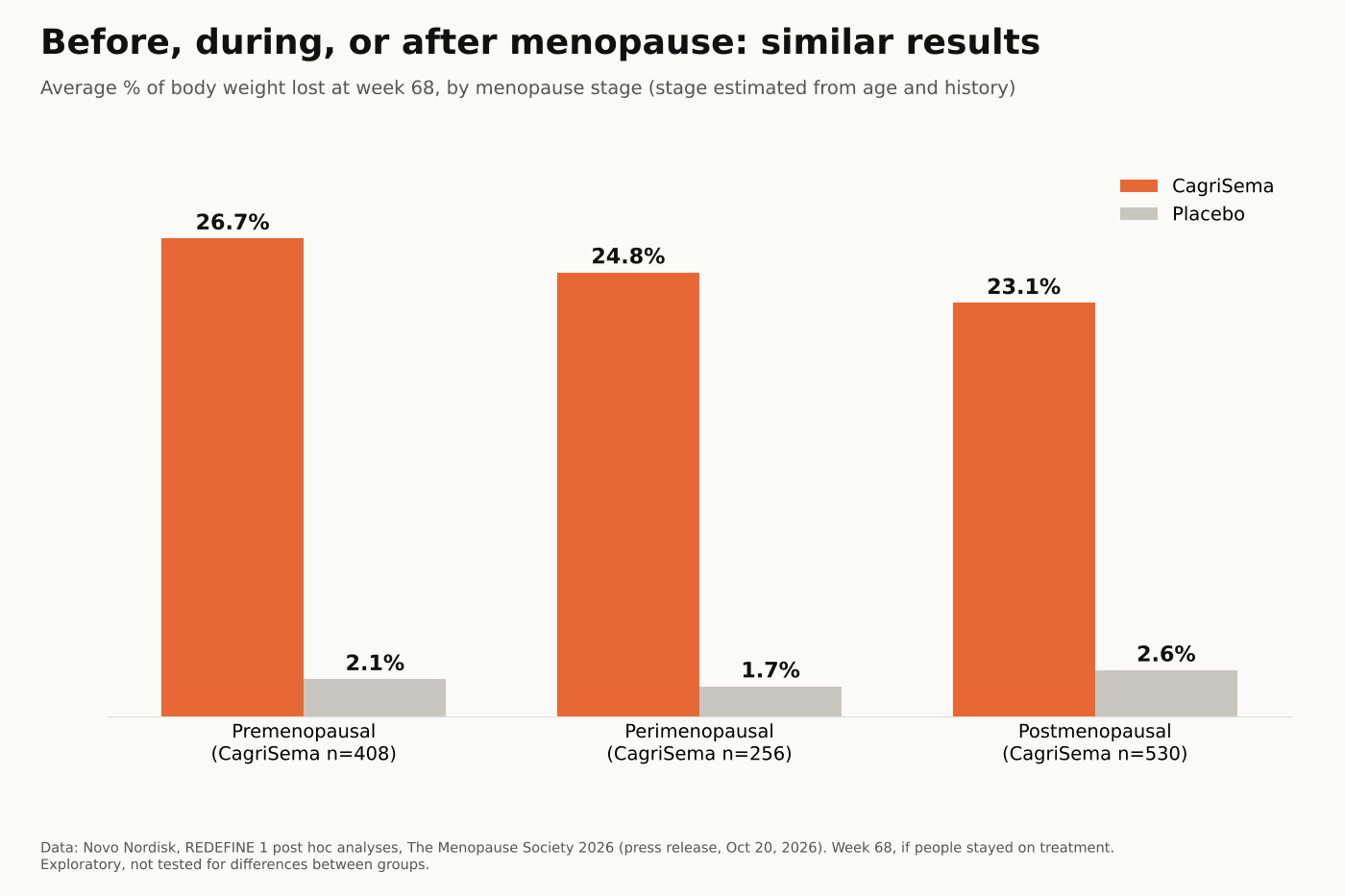
The second poster split women by menopause stage. On CagriSema, they lost:
- Premenopausal (under 45, no signs of menopause): 26.7%, vs 2.1% on placebo
- Perimenopausal (mostly 45 to 54, no clear menopause yet): 24.8%, vs 1.7%
- Postmenopausal (55 or older, or a documented menopause): 23.1%, vs 2.6%
My take: the headline here is “it worked in every group,” not “postmenopausal women do worse.” The 3.6-point gap between the youngest and oldest groups was never formally tested. The lead author called the differences a reason for more research, not a finding.
Action item: If you’re past menopause, don’t let a headline convince you these drugs “stop working” for you. Ask your doctor what results look like for people like you.
Read the Fine Print Before You Share It
This is good news, but it’s not the final word. Four honest caveats:
- It’s post hoc. The trial wasn’t designed to compare menopause stages. Novo itself calls these analyses hypothesis-generating.
- Stage was estimated, not measured. Researchers sorted women by age, medical history, and symptoms, not hormone tests.
- It’s the flattering way of counting. Across the whole trial, CagriSema’s average loss was 22.7% if everyone stayed on treatment and 20.4% counting everyone, per Bariatric News. Novo didn’t share a “counting everyone” number for women.
- Some results are missing. Women on hormone therapy were analyzed as their own group, but the release doesn’t report how they did.
Action item: Before you forward the “25%” headline to a friend, add one line: “after-the-fact analysis, if people stayed on the drug.” That keeps the hope honest.
Why Do Women Lose More on GLP-1 Drugs?
This isn’t just a CagriSema thing. A Johns Hopkins meta-analysis in JAMA Internal Medicine (March 2026) pooled six trials with 19,906 people. Women lost an average of 10.88% of their weight on GLP-1 drugs. Men lost 6.78%.
The researchers floated a few possible reasons: estrogen interacting with the drug, differences in how women’s bodies process it, and women’s lower average body weight. Nobody knows for sure yet.
REDEFINE 1 fits the pattern. Women on CagriSema averaged 25.0%, above the 22.7% for the whole trial on the same counting rule.
Action item: If a partner or friend of a different sex got different results on the same drug, that’s normal in the data. Compare yourself with your own starting point, not with them.
Does Hormone Therapy Make GLP-1 Drugs Work Better?
Women using it lost a little more, but that doesn’t prove hormone therapy caused it. Three Mayo Clinic-led studies found that women using menopause hormone therapy lost more weight on a GLP-1 drug than women who didn’t. All three were observational, and the biggest one found the smallest gap.
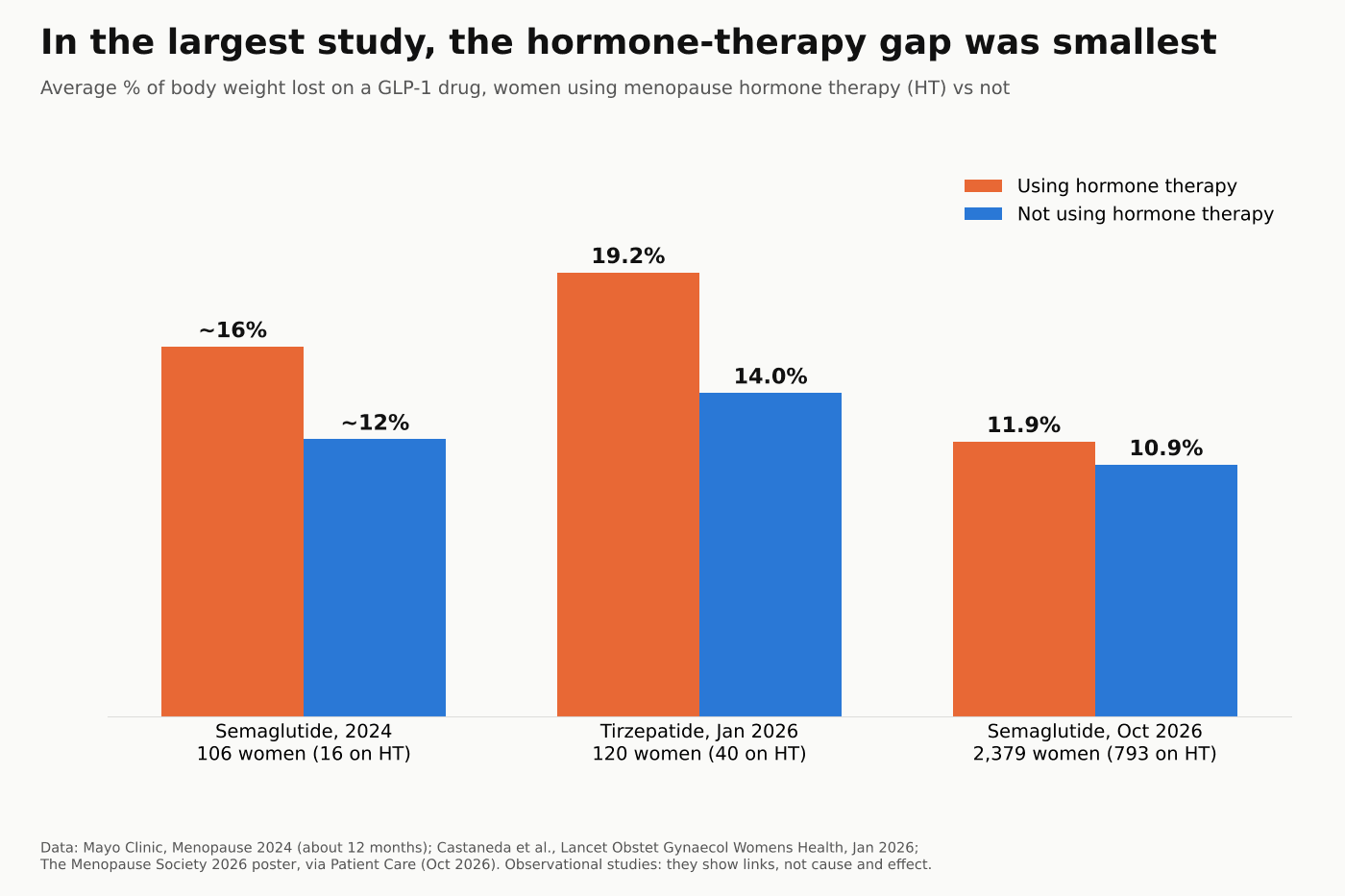
Here’s what each one found, oldest first:
- Semaglutide, 2024: 106 postmenopausal women, only 16 on hormone therapy. After about 12 months, hormone therapy users had lost about 16% versus about 12%, per Managed Healthcare Executive.
- Tirzepatide (Zepbound, Mounjaro), January 2026: 120 postmenopausal women, 40 on hormone therapy, matched 1-to-2 with non-users. At last follow-up, hormone therapy users had lost 19.2% versus 14.0%, per the paper in The Lancet Obstetrics, Gynaecology, & Women’s Health.
- Semaglutide and tirzepatide, October 2026: more than 3,800 women over 45 from health records, presented at The Menopause Society’s 2026 meeting. On semaglutide (2,379 women), hormone therapy users lost 11.9% versus 10.9% at last follow-up, a median of 26 months.
- Tirzepatide arm of the same study: on tirzepatide (1,476 women), hormone therapy users lost a bit more at 3 months, but there was no significant difference in average weight loss after that, per Patient Care.
My take: a one-point gap after two years is real-world-sized, not miracle-sized. The three studies also used different drugs and follow-up lengths, so they aren’t directly comparable.
And because no one was randomly assigned to hormone therapy, the women who used it may simply differ in other ways, such as better sleep, more doctor visits, or better access to care. The new study is a conference poster, not yet a peer-reviewed paper.
The lead author was clear about the limits. In The Menopause Society’s release, Dr. Regina Castaneda said:
“…weight loss is not an indication for menopause hormone therapy.”
The researchers say randomized trials are needed. Novo’s CagriSema release doesn’t report how women on hormone therapy did, so we don’t know yet whether the pattern holds for CagriSema.
Action item: If you’re weighing hormone therapy for hot flashes, sleep, or other menopause symptoms, decide on those merits with your doctor. Don’t start, stop, or change it to chase extra weight loss.
Side Effects and When CagriSema Could Be Available
Side effects in REDEFINE 1 overall were mostly stomach-related, per the trial’s NEJM paper as cited in Novo’s release:
- Any stomach or gut side effect: 79.6% on CagriSema vs 39.9% on placebo
- Nausea: 55.0% vs 12.6%
- Constipation: 30.7% vs 11.6%
- Vomiting: 26.1% vs 4.1%
- Stopped because of side effects: 5.9% vs 3.5%
Most were mild to moderate and faded over time. These figures cover everyone in the trial, not women only.
Call your doctor promptly if you’re on any GLP-1 drug and have severe belly pain that won’t go away, can’t keep fluids down, or notice signs of dehydration such as dizziness or very little urine. The Wegovy label warns about pancreatitis and dehydration-related kidney problems.
Timing: Novo filed in December 2025 and expects an FDA decision in Q4 2026, as of October 26, 2026. Our Foundayo side effects guide has practical tips for the stomach side effects this drug family shares. Approval isn’t guaranteed, and price and insurance coverage are unknown.
Action item: If you’re curious about CagriSema, ask your doctor now what’s available today and whether a newer option would change your plan once it’s approved.
Quick Answers
How much weight did women lose on CagriSema? In REDEFINE 1, women who stayed on CagriSema lost 25.0% of their body weight on average after 68 weeks, versus 3.0% on placebo.
Does CagriSema work after menopause? In this analysis, postmenopausal women lost 23.1% on average, versus 2.6% on placebo. The results were exploratory, but the drug beat placebo by a wide margin in every menopause group.
Do GLP-1 drugs work better for women than men? On average, yes. A 2026 JAMA Internal Medicine meta-analysis found women lost about 10.9% versus 6.8% for men. The reasons aren’t settled.
Is CagriSema FDA approved? Not as of October 26, 2026. Novo filed in December 2025 and expects a decision in Q4 2026.
Does hormone therapy help weight loss on semaglutide? In the largest study so far (2,379 women, presented in October 2026), hormone therapy users lost 11.9% versus 10.9% after a median of about two years. It’s an observational link, not proof of cause and effect.
Does HRT help Zepbound (tirzepatide) work better? It’s mixed. A 120-woman study found 19.2% versus 14.0%, but a larger 1,476-woman cohort found no significant difference in average weight loss after the first 3 months.
Should I start HRT to lose more weight on a GLP-1? The lead researcher put it plainly: weight loss isn’t an indication for menopause hormone therapy. Talk to your doctor about hormone therapy for menopause symptoms.
What This Means for You
✅ You know women lost about 25% on CagriSema in this analysis, if they stayed on it
✅ You know menopause stage made only a small, untested difference
✅ You know women tend to lose more than men on this drug family
✅ You know hormone therapy is linked to slightly more weight loss on semaglutide, but it isn’t proven and isn’t a reason to start it
✅ You know CagriSema isn’t approved yet, so you won’t buy it online
The 5-Minute Version (Screenshot This)
- The news: a REDEFINE 1 post hoc analysis of 2,309 women, announced Oct 20, 2026, at The Menopause Society meeting (Oct 20–24).
- The result: 25.0% average weight loss on CagriSema vs 3.0% on placebo at 68 weeks, if people stayed on treatment.
- By stage: 26.7% premenopausal, 24.8% perimenopausal, 23.1% postmenopausal. All far above placebo.
- The catch: after-the-fact analysis, estimated menopause stage, no “counting everyone” figure, hormone therapy results not shared.
- Hormone therapy: in the biggest study so far, users lost 11.9% vs 10.9% on semaglutide; no significant difference in average loss on tirzepatide after 3 months. Observational, not proof.
- Timing: FDA decision expected Q4 2026; not approved yet.
Conclusion
The CagriSema women data is genuinely encouraging: about a quarter of body weight lost on average, with only a small dip from premenopause to postmenopause. It also adds to the growing evidence that women respond strongly to this drug family.
On hormone therapy, the largest study found the smallest gap: a modest link at best, and not a reason to start it.
But it’s an exploratory analysis of a drug that isn’t approved yet. Your one action today: if midlife weight gain is affecting your health, book a conversation with your doctor about the options available now, and bring your questions about menopause and hormone therapy.
So tell me: should obesity trials report results by menopause stage as standard, the way they report by age and sex?
Sources
- Novo Nordisk: CagriSema 25% weight loss in women, REDEFINE 1 post hoc analyses (Oct 20, 2026)
- BioSpace: the same release, republished
- American College of Cardiology: REDEFINE 1 and REDEFINE 2 journal scan (NEJM 2025)
- Bariatric News: REDEFINE 1 results at ADA 2025
- EurekAlert: Johns Hopkins meta-analysis of GLP-1 weight loss by sex, JAMA Internal Medicine (Mar 2026)
- Managed Healthcare Executive: hormone therapy and semaglutide in postmenopausal women (Menopause, 2024)
- Castaneda et al.: menopause hormone therapy and tirzepatide weight loss, The Lancet Obstetrics, Gynaecology, & Women’s Health (Jan 2026)
- The Menopause Society: hormone therapy may increase weight-loss effectiveness of GLP-1s (Oct 2026)
- Patient Care: hormone therapy and semaglutide/tirzepatide in midlife women, full poster results (Oct 2026)
 MealCoach