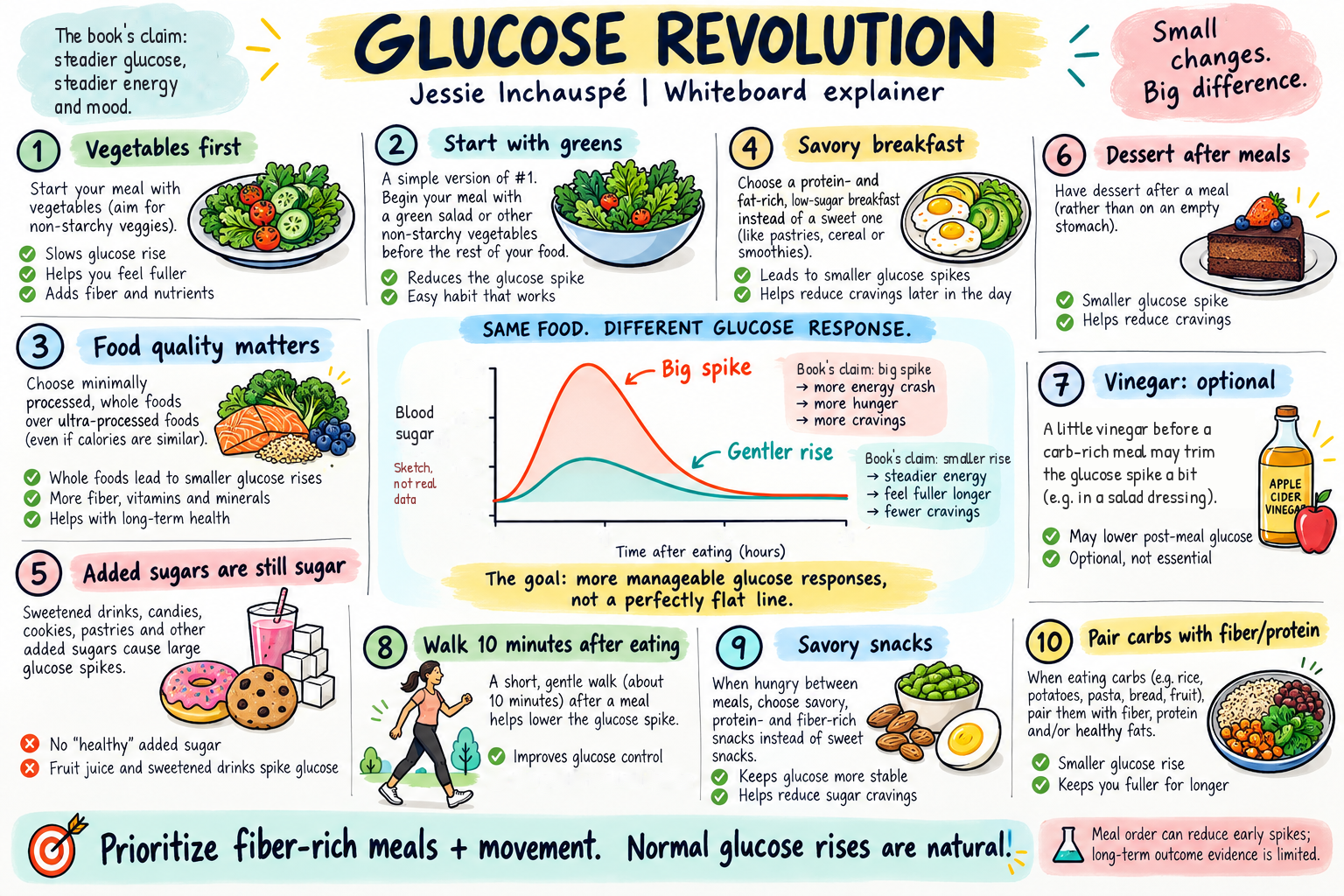
“It’s fibre first, protein and fat second, starches and sugars last.”
The short answer: Here’s the Glucose Revolution summary in brief. Biochemist Jessie Inchauspé says sharp blood sugar spikes drive cravings and tiredness, and she offers 10 food hacks to flatten them. The best-supported ones are simple: eat vegetables and protein before starches, and walk after meals. Her bigger claims, and the vinegar hack, rest on thinner evidence.
You’ll learn all 10 hacks, which ones the research backs, what a “spike” is in healthy people, and a sample day you can copy tomorrow.
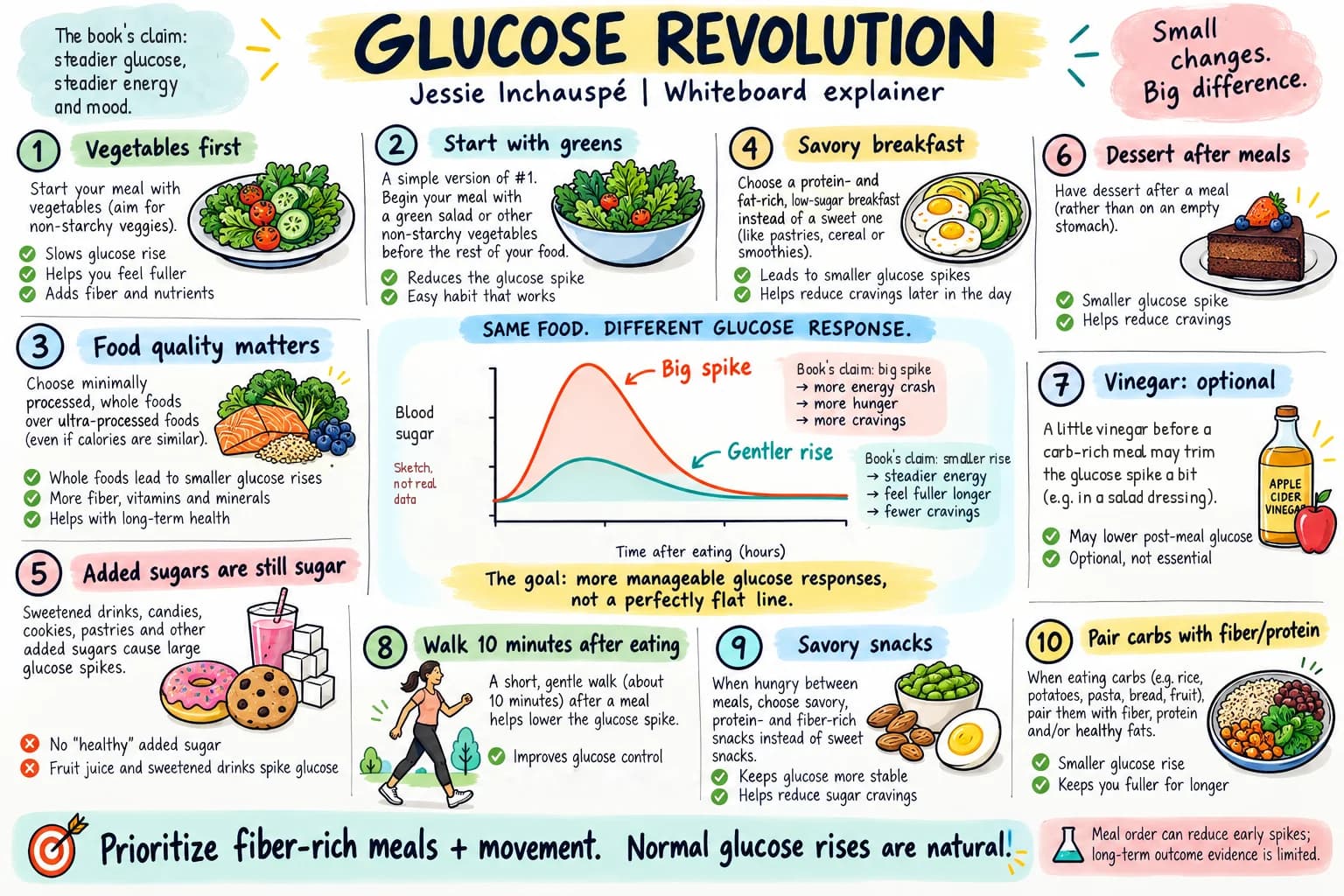
What Is Glucose Revolution About?
Glucose Revolution: The Life-Changing Power of Balancing Your Blood Sugar is a guide to eating the same foods in a smarter order and combination. Simon & Schuster published it in the US on April 5, 2022, at 304 pages, per NetGalley’s listing. It has sold at least 1 million copies in more than 40 languages, per Wikipedia.
The pitch is friendly: keep dessert, change what comes before and after it. Glucose is the sugar your body runs on. A “spike” is a fast rise in blood glucose after eating, followed by a fall. Inchauspé argues that too many big spikes leave you hungry, tired and craving more sugar.
Action item: Think about your last mid-afternoon crash. Write down what you ate in the two hours before it.
Who Is Jessie Inchauspé, the Glucose Goddess?
She is a French writer with a math degree and a biochemistry master’s, not a doctor or dietitian. Per Wikipedia, she studied math at King’s College London and biochemistry at Georgetown University.
Her story starts with a bad fall. At 19 she broke her back in an accident, and that got her interested in health.
Years later she worked at the genetics company 23andMe. In an internal pilot there, she wore a continuous glucose monitor (CGM). It’s a small sensor on the arm that tracks blood sugar all day. She doesn’t have diabetes, but she has called the experience life-changing.
She started posting her own glucose graphs on Instagram as @glucosegoddess. By 2025 the account had over 5 million followers. That’s the turning point: one person’s sensor data became a movement.
Action item: Before you trust any health account, check two things: their training, and whether they sell a product.
Do Glucose Spikes Matter If You Don’t Have Diabetes?
Some spiking after meals is normal, and the long-term harm in healthy people isn’t proven.
The case for concern: a 2018 Stanford study put CGMs on 57 people, mostly healthy or prediabetic. In a breakfast test, 80% spiked after cornflakes and milk, per Stanford Bio-X. Some healthy people hit prediabetic levels.
The other side: a 2019 study tracked 153 healthy people. Their blood sugar stayed between 70 and 140 mg/dL for a median 96% of the day. Time above 140 was about 30 minutes a day.
Healthy blood sugar usually returns to baseline within 2 to 3 hours, notes the American Council on Science and Health. The long-term effect of these spikes is unclear.
My take: a spike is a signal, not a sentence. Your HbA1c (a 3-month blood sugar average) tells you far more than one graph.
Action item: If you haven’t had an HbA1c test in three years, ask about one at your next checkup.
What Are the 10 Glucose Revolution Hacks?
The 10 hacks are food-order, pairing and timing tricks. Here they are, as titled in the book’s table of contents:
- Eat foods in the right order.
- Add a green starter to all your meals.
- Stop counting calories.
- Flatten your breakfast curve.
- Have any type of sugar you like, they’re all the same.
- Pick dessert over a sweet snack.
- Reach for vinegar before you eat.
- After you eat, move.
- If you have to snack, go savoury.
- Put some clothes on your carbs.
Notice what’s missing: banned foods. That’s why people like it.
Hack 5 surprises most readers. Honey and table sugar are chemically alike, Inchauspé writes for Booktopia. Honey’s antioxidants per teaspoon roughly match half a blueberry.
Action item: Pick the two hacks that fit your week best. Ignore the rest for now.
Does Eating Vegetables Before Carbs Lower Blood Sugar?
Yes, in a small study of people with type 2 diabetes, eating vegetables and protein before carbs led to lower blood sugar. It’s the book’s headline hack, and it has the best evidence.
In a 2015 Diabetes Care study, 11 adults with obesity and type 2 diabetes ate the same meal twice. The meals were a week apart, per the Cornell Chronicle.
One time, bread and orange juice came first. The other time, chicken, salad and broccoli came first. With carbs last, blood sugar was about 29% lower at 30 minutes, 37% lower at 60 minutes and 17% lower at 2 hours. Insulin was lower too.
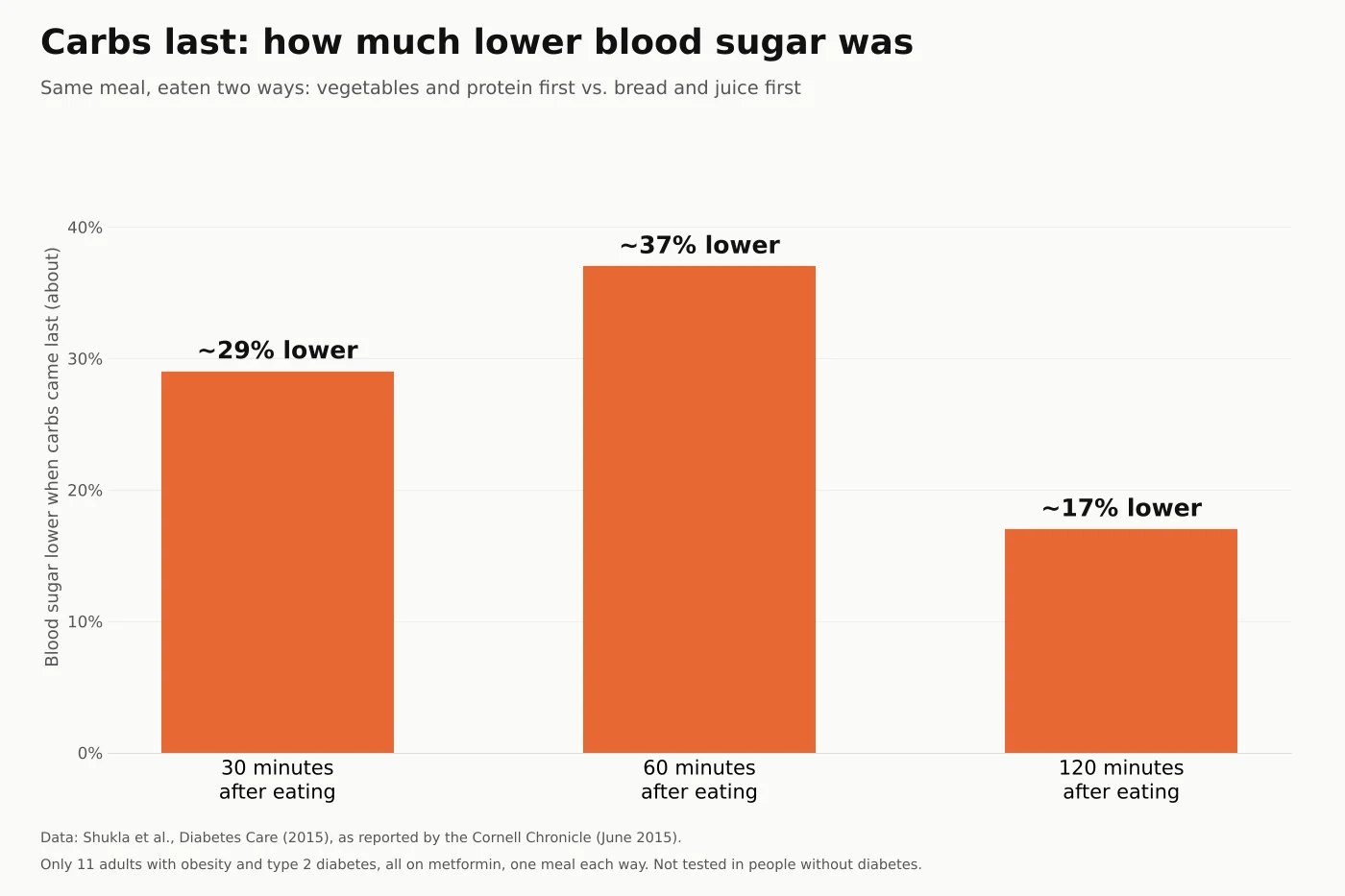
Here’s the catch. A 2024 France Info report quoted specialists who said 11 patients can’t carry a claim that big, per Wikipedia’s summary of it. Still, the hack costs nothing. And starting with vegetables also slows you down, which helps fullness catch up. Our guide on how to stop eating too fast covers that side.
Action item: At dinner tonight, eat your vegetables and protein first. Save the rice, bread or pasta for the last third of the plate.
Does Vinegar Before Meals Really Work?
Vinegar seems to lower the blood sugar and insulin rise after a meal a little, but most of the studies are small. A 2017 meta-analysis of clinical trials found a modest drop in post-meal glucose and a larger drop in insulin.
Registered dietitian Abby Langer calls the evidence for this hack weak. She points to small studies, mostly in people with diabetes, and effects she doesn’t see as clinically meaningful. Her advice for readers: “Beware of lofty claims and fear tactics that aren’t supported by current evidence…”
So vinegar is a garnish, not a plan.
Action item: Skip the shot glass. Dress tonight’s salad starter with an oil-and-vinegar dressing and you’ve tried two hacks at once.
Does a Walk After Eating Lower Blood Sugar?
Probably. Light walking breaks during long sitting lower the post-meal blood sugar and insulin rise, more than standing does. A 2022 meta-analysis in Sports Medicine pooled 7 trials of people breaking up long sitting. Light walking cut post-meal glucose and insulin compared with sitting. Standing helped less.
The trials were short, single-day and small. Still, a walk is free, and it’s the easiest hack in the book.
Action item: After your biggest meal today, take a 10-minute walk, even if it’s laps around the kitchen.
Why Does Breakfast Matter So Much in Glucose Revolution?
Inchauspé argues a sweet breakfast isn’t the best source of energy, so she wants it savory. In her Penguin piece, she says sweet foods give pleasure but aren’t the best way to fuel you. Her stance on cravings is blunt: “Trying to force ourselves to suppress these cravings is not the solution,” she writes for Booktopia.
Langer agrees on savory breakfasts and pairing carbs with protein or fat. That’s long-standing advice for fullness.
A worked example (an illustration, not from the book):
- Breakfast: eggs and spinach on one slice of toast, instead of cereal and juice.
- Lunch: a side salad first, then the sandwich.
- Snack: cheese or nuts, not a cookie.
- Dinner: vegetables and fish first, potatoes last, then dessert right after the meal.
- After dinner: a 10-minute walk.
Same foods. Different order. That’s the whole trick.
Action item: Swap one sweet breakfast this week for a savory one with protein, and note how hungry you are at 11 a.m.
Where Glucose Revolution Falls Short
The habits are mostly sensible. The science around them is often stretched.
- Spikes aren’t a diagnosis. As the ACSH piece notes, CGMs can fuel worry, and even disordered eating, in people without diabetes.
- The supplement. In 2024 she launched an “Anti-Spike” formula marketed to cut spikes by up to 40%. A health watchdog said that figure was extrapolated from single ingredients, per Wikipedia.
- Pushback from experts. In June 2025, over 40 registered dietitians, nutritionists and medical professionals backed a letter to UK broadcaster Channel 4. It raised concerns about her documentary Eat Smart: Secrets of the Glucose Goddess, Wikipedia reports.
My take: keep the hacks, drop the fear. You don’t need a sensor or a pill to eat your salad first.
Action item: Before buying any glucose product, ask: “What would I eat differently if I knew the number?” If the answer is nothing, skip it.
Why Is Glucose Revolution Popular Again in 2026?
Because most adults can now buy a glucose sensor without a prescription. On March 5, 2024, the FDA cleared Dexcom’s Stelo, the first over-the-counter CGM, per BioSpace. It’s for adults who don’t use insulin, including people without diabetes curious about food and exercise.
More sensors mean more spike graphs online, and this book is the manual many reach for. For a doctor’s take on the same territory, our Good Energy summary covers Casey Means’s version of the glucose argument.
Action item: If you’re tempted to buy a CGM, try the free hacks for two weeks first. Then decide if you still need the data.
When Should You See a Doctor?
See a doctor if you have signs of high blood sugar, not just a spiky graph. Mayo Clinic lists intense thirst, frequent urination, unusual tiredness, blurred vision and weight loss you didn’t plan. It also notes the American Diabetes Association advises most adults to start screening at 35, or earlier with risk factors.
If you take insulin or other diabetes medicine, call your doctor or care team before changing meal order or timing.
Action item: If any of those symptoms sound familiar, book an appointment this week rather than buying a sensor.
Quick Answers
What is Glucose Revolution about? It’s a 2022 book by Jessie Inchauspé arguing that flattening blood sugar spikes helps cravings, energy and long-term health. It offers 10 hacks that change food order, pairing and timing, not food bans.
What are the Glucose Goddess hacks? Ten tricks: veggies first, a green starter, no calorie counting, a savory breakfast, and all sugars treated alike. Then dessert over a sweet snack, vinegar, moving after meals, savory snacks, and carbs paired with other foods.
Does eating vegetables first lower blood sugar? In a 2015 study of 11 adults with type 2 diabetes, eating carbs last left blood sugar about 37% lower at one hour. It hasn’t been well tested in people without diabetes.
Is Jessie Inchauspé a doctor? No. She has a bachelor’s in math and a master’s in biochemistry. She is not a medical doctor or registered dietitian.
Do glucose spikes matter if you don’t have diabetes? Some rise after meals is normal, and healthy people spent a median 96% of the day between 70 and 140 mg/dL in one study. Long-term harm from occasional spikes in healthy people isn’t proven.
The 5-Minute Version: Glucose Revolution Summary (Screenshot This)
- The idea: fewer, smaller blood sugar spikes may mean fewer cravings and crashes.
- Best hack: vegetables and protein first, starches last. About 37% lower at one hour in a small diabetes study.
- Easiest hack: walk for 10 minutes after eating.
- Also sensible: savory breakfast, savory snacks, carbs with protein or fat.
- Overstated: vinegar, and the idea that every spike harms healthy people.
- Skip: supplements sold to stop spikes.
- Check instead: your HbA1c at your checkup.
Conclusion
If this Glucose Revolution summary leaves you with one idea, make it this: the order of your plate is a free experiment. Salad first, starch last, a walk after. None of it needs a sensor, a supplement or a ban on cake.
My take: the book’s science is louder than its evidence, but its habits are kind and cheap. For the bigger food-environment picture, our Ultra-Processed People summary is a good next read.
Your one step this week: eat carbs last at three dinners, and walk after each one.
So tell me: which meal of your day would be easiest to flip?
This is a book summary, not medical advice. Talk to your doctor before you change medicines or if you have symptoms of diabetes.
Sources
- NetGalley: Glucose Revolution (Simon & Schuster, April 5, 2022, 304 pages)
- Glucose Revolution table of contents (hack titles)
- Jessie Inchauspé, Penguin Books New Zealand (Apr 5, 2022): 3 tips to help flatten your glucose curves
- Jessie Inchauspé, Booktopia (Apr 1, 2022): 3 major glucose myths
- Wikipedia: Jessie Inchauspé (education, sales, Anti-Spike formula, criticism)
- Stanford Bio-X: Diabetic-level glucose spikes seen in healthy people (Hall et al., PLOS Biology, 2018)
- Shah et al., Journal of Clinical Endocrinology and Metabolism (2019): CGM profiles in healthy nondiabetic participants
- American Council on Science and Health (Sep 1, 2025): The glucose spike myth
- Cornell Chronicle (June 2015): Food order impacts glucose and insulin levels (Shukla et al., Diabetes Care, 2015)
- Shishehbor et al. (2017): Vinegar consumption and postprandial glucose and insulin, a meta-analysis
- Abby Langer, RD (Jan 18, 2024): The Glucose Goddess review
- Buffey et al., Sports Medicine (2022): Interrupting prolonged sitting with standing and light walking, a meta-analysis
- BioSpace (Mar 5, 2024): FDA clears first over-the-counter continuous glucose monitor
- Mayo Clinic: Diabetes symptoms
 MealCoach