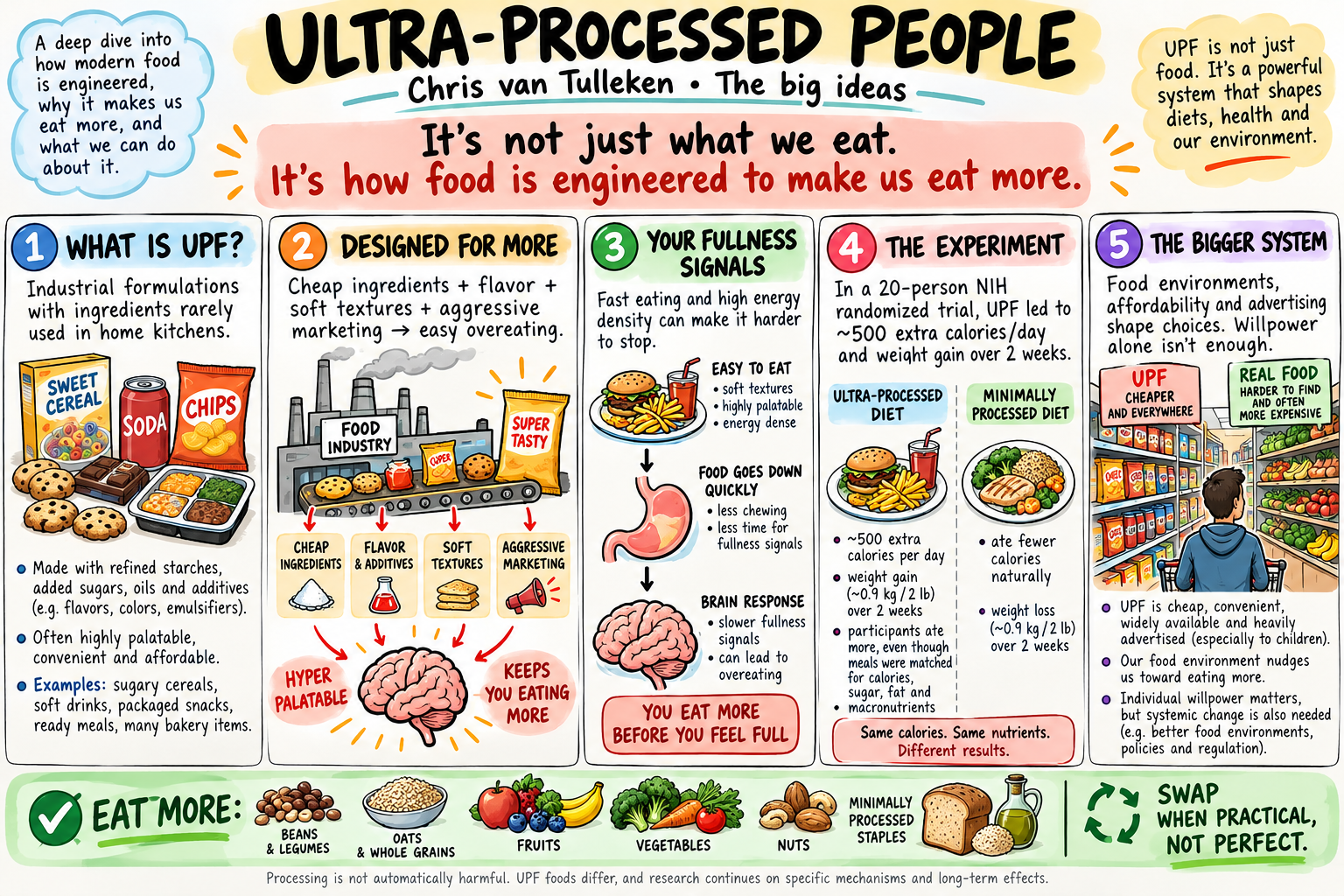
“Ultra-processing is entirely different to processing.”
The short answer: Ultra-Processed People (2023) is by Chris van Tulleken, a UCL doctor and BBC presenter. He argues ultra-processed food is industrial food built to be overeaten. His test: if it’s wrapped in plastic and lists an ingredient you wouldn’t find in a home kitchen, it’s almost certainly ultra-processed.
The evidence is strong on links and thinner on proof. You’ll get both.
You’ll learn how to spot ultra-processed food in 10 seconds, what the studies show, and where the book overreaches.
What Is Ultra-Processed People About?
Ultra-Processed People says the problem isn’t you. It’s a food system engineered for profit and overeating. It covers the history, the science, the money and the fixes.
It isn’t a diet book: the publisher’s description says there’s no diet plan. The U.S. paperback (W. W. Norton, 2025) runs 416 pages.
Van Tulleken is an associate professor at University College London and an infectious diseases doctor. He holds a virology PhD and a BAFTA for his BBC work.
My take: the “it’s not your fault” framing is the book’s secret weapon. Shame rarely helps anyone eat better. Blame the product, and you can change your kitchen instead of your character.
Action item: Count the plastic-wrapped items in your snack cupboard. No judging yet.
What Happened When the Author Ate Ultra-Processed Food for a Month?
He ate about 80% of his calories from ultra-processed food for one month and gained six kilos (about 13 pounds). He told WBUR he was the first patient in a pilot study, and the book’s description says colleagues at UCL supervised it.
The menu: chocolate cereal, soda, chips, microwave lasagna, fried chicken, pizza. A birthday party that never ends.
“I became very unwell very quickly,” he told NPR. He stopped sleeping, felt anxious, and his hunger hormones stayed high after meals.
Here’s the twist. By the end, he told WBUR, craving had flipped to disgust. He could barely finish a fried chicken takeout.
Fair warning: one man, one month, a sample size of one. It’s a story, not proof. The proof comes next.
Action item: Read the full ingredient list of one daily snack out loud. Notice how it feels.
What Counts as Ultra-Processed Food?
Ultra-processed food is group 4 of the NOVA system, made mostly from industrial ingredients and additives you rarely use at home. Brazilian researchers led by Carlos Monteiro built NOVA, and the book leans on it.
The 2019 paper that explains NOVA sorts all food into four groups:
- Group 1, unprocessed or minimally processed: fresh vegetables and fruit, pasteurized milk, plain oats, fresh meat.
- Group 2, cooking ingredients: oils, butter, sugar and salt.
- Group 3, processed foods: simple bread made from flour, water, salt and yeast, canned foods, some cheeses.
- Group 4, ultra-processed: soda, packaged snacks, candy, ice cream, mass-produced breads with additives, breakfast cereals, ready pizza, nuggets, sausages, instant noodles.
Notice: “processed” isn’t the villain. Canned beans and frozen peas are processed. The line is crossed when food is rebuilt from industrial parts.
Action item: Sort tonight’s dinner into the four groups.
How Do You Spot Ultra-Processed Food on a Label?
Read the ingredient list and look for two things: kitchen-rare substances and “cosmetic” additives. That’s the NOVA paper’s method, a grown-up version of the plastic-wrapper test.
- Kitchen-rare substances, usually near the start or middle: high-fructose corn syrup, maltodextrin, invert sugar, soy protein isolate, hydrolyzed proteins, hydrogenated oils.
- Cosmetic additives, usually near the end: flavors, flavor enhancers, colors, emulsifiers, sweeteners and thickeners.
One hit is enough.
A worked example (an illustration, not a real brand): Bread A lists flour, water, salt, yeast. That’s group 3. Bread B adds dextrose, an emulsifier, “flavoring” and a preservative. That’s group 4. Same aisle, different category.
Action item: Next time you shop, flip over your usual bread and run this check. It takes about 10 seconds.
Do Ultra-Processed Foods Make You Eat More?
Yes, in the best-known controlled trial: people ate about 500 more calories a day on an ultra-processed diet. In this 2019 NIH study, 20 adults spent two weeks on each diet at the NIH Clinical Center. They ate as much as they wanted.
Meals offered had matching calories, sugars, fiber, fat and carbs. On the ultra-processed diet, people gained about 0.9 kg (2 pounds). On the unprocessed diet, they lost about the same.
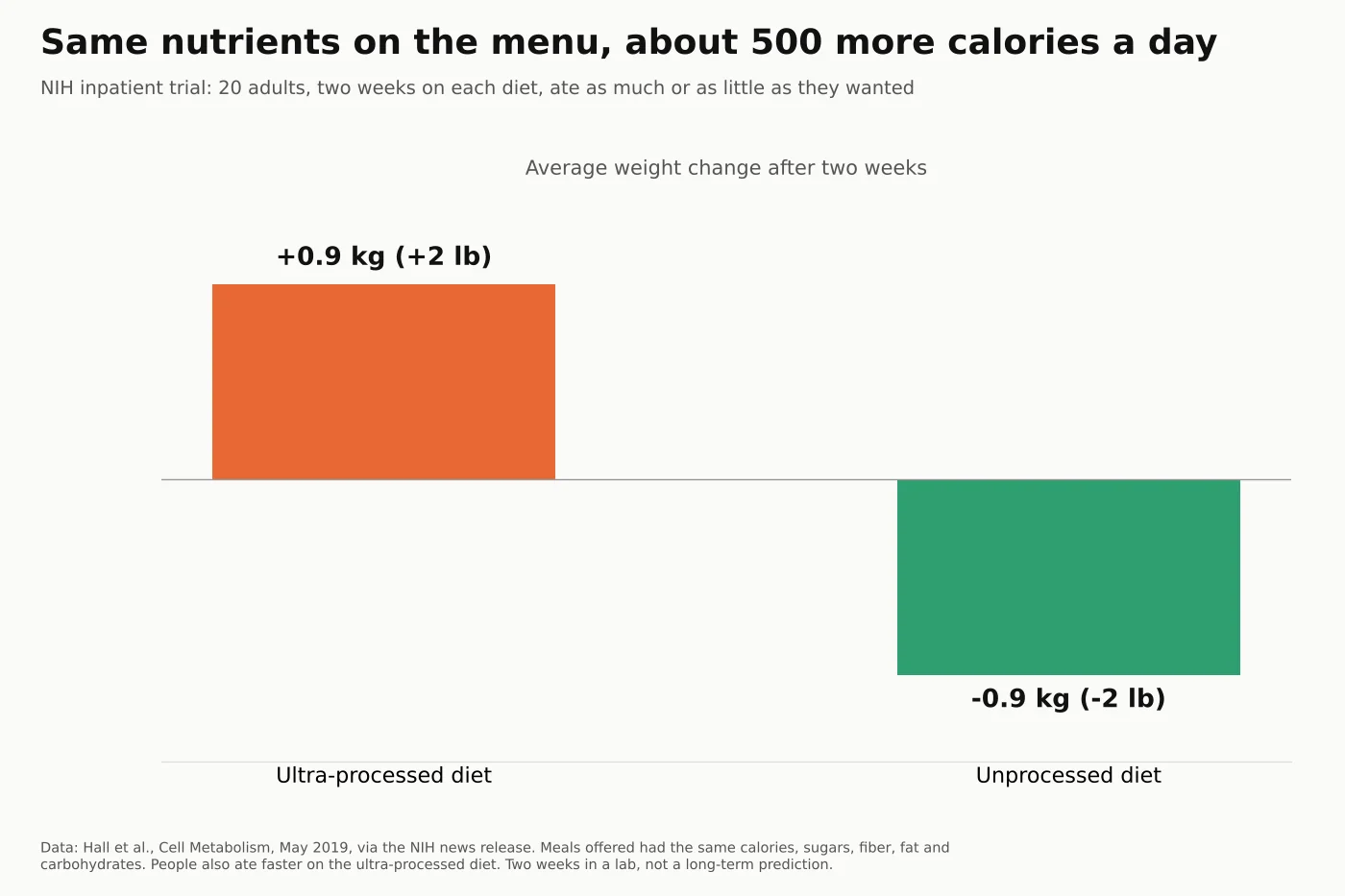
“This is the first study to demonstrate causality,” lead researcher Kevin Hall said. Caveats: it was short and small, and protein differences could explain up to half the gap, the NIH notes.
The detail I love: people ate faster on the ultra-processed diet. Maybe soft food goes down before fullness catches up; the trial didn’t test that. Still, it’s why pace matters, as we explain in how to stop eating too fast.
Action item: At one meal today, put your fork down between bites. See if you notice fullness sooner.
How Much Ultra-Processed Food Do Americans Eat?
About 55% of calories for Americans aged 1 and older come from ultra-processed foods. That’s from the CDC’s August 2025 data brief, covering August 2021 to August 2023. Children and teens (ages 1 to 18) got 61.9% of their calories this way, and adults 53.0%.
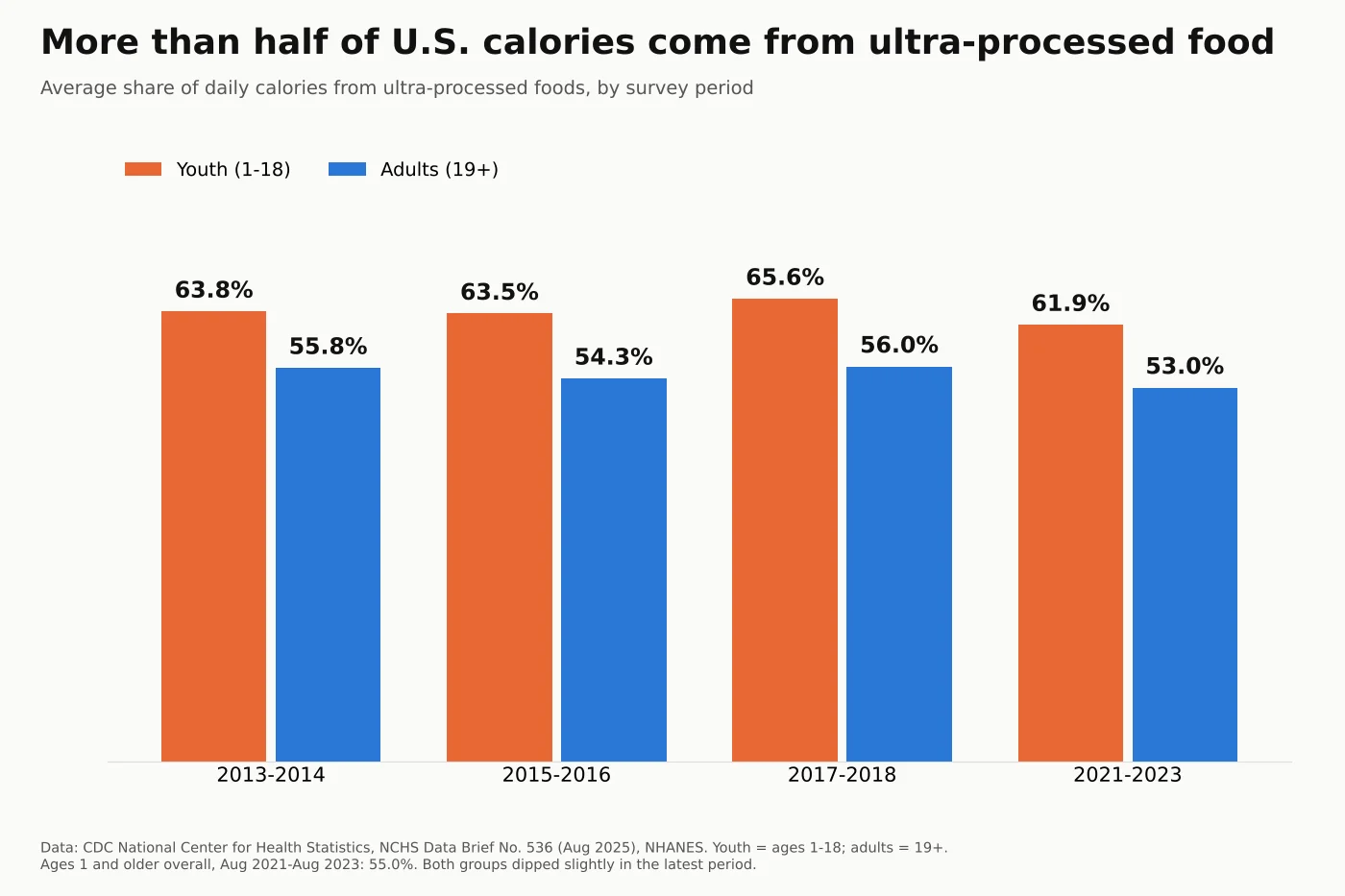
For adults, the top sources were sandwiches and burgers (8.6% of calories), sweet bakery goods (5.2%), sweet drinks (4.4%), savory snacks (3.4%) and breads (3.1%).
Those five add up to almost half of it. A few targeted swaps go a long way.
Action item: Circle the one on that list you eat most. That’s your first target.
Are Ultra-Processed Foods Bad for You?
Diets high in ultra-processed food are consistently linked to worse health, but most of that evidence shows links, not cause. A 2024 BMJ umbrella review pooled 45 analyses covering almost 9.9 million people and found higher risk with more ultra-processed food for 32 of them.
The strongest grades went to type 2 diabetes, anxiety, common mental disorders and death from cardiovascular disease. But most findings (41 of 45) were rated low or very low quality.
In November 2025, The Lancet published a three-paper series by 43 experts. Its review found 92 of 104 long-term studies reported higher risk of a chronic disease, per the Otago Daily Times. Most show associations, the authors admitted.
The food industry pushed back. The International Food and Beverage Alliance said the series’ policy recommendations “go far beyond the available evidence.”
Action item: Aim for less, not zero. Swap one ultra-processed snack a day for fruit, plain unsalted nuts or plain yogurt.
Where Ultra-Processed People Falls Short
The big picture holds up, but the book sometimes reaches past its evidence. Registered dietitian Abby Langer agrees ultra-processed-heavy diets are linked to poorer health. She still wrote: “There’s a lot of reaching, anecdotes, and unsubstantiated claims in the book.”
- NOVA is fuzzy. Critics, Langer included, say it rests partly on subjective judgment. A nutritious whole-grain loaf with one emulsifier lands in the same group as candy.
- Some mechanisms are early. Langer says there’s no persuasive research behind ideas like emulsifiers harming gut bacteria.
- Cost and time are real. Sometimes a cheap ready meal is the only option.
My take: it’s a sharp argument, not a final verdict.
Action item: Keep the ultra-processed foods that make life work, like a frozen meal on a busy night. Cut the autopilot ones.
Why Is Everyone Talking About Ultra-Processed Food Now?
Because governments are starting to act. In July 2025, the FDA and USDA asked how “ultra-processed foods” should be defined, per Morrison Foerster. In January 2026, the new Dietary Guidelines for Americans told people to avoid highly processed salty or sweet foods.
The guidelines never say “ultra-processed,” though. In August 2026, HHS and USDA sent a proposed definition to the White House budget office for review. As of mid-October 2026, its text still hadn’t been released, per Greenberg Traurig. Until then, you’re the one reading the label.
For how flavor and craving got engineered, pair this with our summaries of Hooked and The Dorito Effect.
Action item: Pick one packaged food you buy weekly and find a group 1 to 3 version of it.
Quick Answers
What are ultra-processed foods? Foods made mostly from industrial ingredients and additives rarely used in home kitchens, like soda, packaged snacks, breakfast cereals and instant noodles. They’re group 4 of the NOVA system.
What foods are ultra-processed? Is there a list? Common examples from the NOVA paper: soft drinks, chips, candy, cookies, cereals, ready pizza, nuggets, sausages and instant soups. Breads with additives count too. Check the label to be sure.
Is all processed food bad? No. Canned beans, frozen vegetables and simple bread are processed but not ultra-processed.
Is Ultra-Processed People worth reading? Yes, if you want to know why these foods are hard to resist. Skip it if you want a meal plan.
The 5-Minute Version (Screenshot This)
- The claim: ultra-processed food is engineered to be overeaten, not a willpower failure.
- The test: plastic wrapper plus an ingredient you wouldn’t cook with means almost certainly ultra-processed.
- The label check: kitchen-rare substances (maltodextrin, corn syrup) or cosmetic additives (flavors, colors, emulsifiers).
- The trial: about 500 more calories a day, eaten faster, on an ultra-processed diet.
- The scale: about 55% of U.S. calories come from ultra-processed foods.
- The catch: most harm evidence shows links, not proof.
Conclusion
Ultra-Processed People won’t hand you a diet. It hands you new glasses. Once you see the gap between food and an industrial product dressed as food, you can’t unsee it.
The science isn’t finished, and the book sometimes runs ahead of it. But the core advice is cheap and hard to argue with. Cook more from groups 1 to 3, read labels, and eat slowly enough to notice fullness.
Your one step this week: run the 10-second label check on the three packaged foods you buy most.
So tell me: which ultra-processed food would be hardest for you to give up?
This is a book summary, not medical advice. Managing diabetes, kidney or heart disease? Call your doctor or a registered dietitian before changing your eating plan.
Sources
- Harvard Book Store: Ultra-Processed People (W. W. Norton paperback, 2025), book and author details
- WBUR On Point: What the rise of ultra-processed foods means for our health (Oct 2023)
- NPR: An ultra-processed diet made this doctor sick (Jul 2023)
- Monteiro et al. (2019): Ultra-processed foods: what they are and how to identify them
- NIH: Heavily processed foods cause overeating and weight gain (Hall et al., Cell Metabolism, May 2019)
- CDC NCHS Data Brief No. 536: Ultra-processed food consumption, Aug 2021–Aug 2023 (Aug 2025)
- Lane et al., BMJ (2024): Ultra-processed food and adverse health outcomes, umbrella review
- Otago Daily Times: Lancet series on ultra-processed foods (Nov 2025)
- Abby Langer, RD: Ultra-Processed People review
- Morrison Foerster: New U.S. Dietary Guidelines released (Jan 2026)
- Greenberg Traurig: The coming federal definition of ultra-processed foods (Oct 2026)
 MealCoach