
“ORION-4 provides evidence that inclisiran is well tolerated…”
The short answer: on November 23, 2026, Novartis said Leqvio (inclisiran), its twice-yearly cholesterol shot, lowered the risk of major heart events in ORION-4, a trial of more than 16,000 people with heart or artery disease. It called the drop significant but gave no numbers. Full results are due in the first half of 2027.
Until now, Leqvio was known for one thing: lowering LDL (“bad”) cholesterol by about half. ORION-4 is the first trial to show Leqvio lowers the risk of major heart events, a combined measure; which kinds of events fell hasn’t been released.
In this post you’ll learn what ORION-4 tested, what Novartis did and didn’t say, how Leqvio compares with the older PCSK9 shots, and what it means if you take Leqvio now. About 6 minutes.
What did Novartis announce about ORION-4?
Novartis announced that ORION-4 met its main goal: fewer major heart events on Leqvio than on placebo. The news came in a release dated November 23, 2026. Here are the key points the release gives about the result:
- The result: a statistically significant reduction, which Novartis calls clinically meaningful, in major adverse cardiovascular events (MACE).
- On top of what: Leqvio or placebo was added to standard-of-care cholesterol-lowering treatment; the release doesn’t say which medicines that included.
- What counted as MACE: death from coronary heart disease, heart attack, fatal or non-fatal ischemic stroke (the kind caused by a clot), or an urgent procedure to reopen a heart artery.
- Who ran it: the University of Oxford with the TIMI Study Group, co-sponsored by Oxford and Novartis.
- Where the result comes from: analyses by the University of Oxford presented to the trial’s steering committee.
The release gives no hazard ratio, no percentage drop, no event counts and no side-effect rates. It also doesn’t say how long people were followed or which analysis (counting everyone randomized, or only people who stayed on treatment) the result is based on.
Action item: When you see headlines today, look for a number. If an article quotes a percentage drop for ORION-4, check where it came from, because Novartis hasn’t published one.
Who was in the ORION-4 trial?
ORION-4 enrolled adults who already had heart or artery disease, so it tests Leqvio for preventing a second event, not a first one. Novartis says more than 16,000 people were randomly assigned to Leqvio or a placebo shot, given on day 1, at three months, and then every six months.
- Age and history: the University of Oxford’s trial page says participants were 55 or older and had already had a condition such as a heart attack or stroke, or a procedure to unblock their arteries.
- Length: the same page says people were expected to stay in the study for about 5 years.
- Design: double-blind, so neither participants nor their doctors knew who got the real drug. It is registered as NCT03705234.
The release doesn’t give the participants’ starting LDL levels or list their other cholesterol medicines. One of its planned secondary results looks at heart events in people who were already on high-intensity statins.
Action item: If you’ve never had a heart attack, stroke or artery procedure, note that ORION-4 doesn’t directly answer the question for you.
Why does this matter if Leqvio already lowers LDL?
Lowering LDL is a means to an end; the end is fewer heart events, and until today Leqvio had no trial showing that. The US prescribing information (revised August 2026) lists Leqvio’s use as lowering LDL cholesterol, alongside diet and exercise. It does not list reducing heart attacks or strokes.
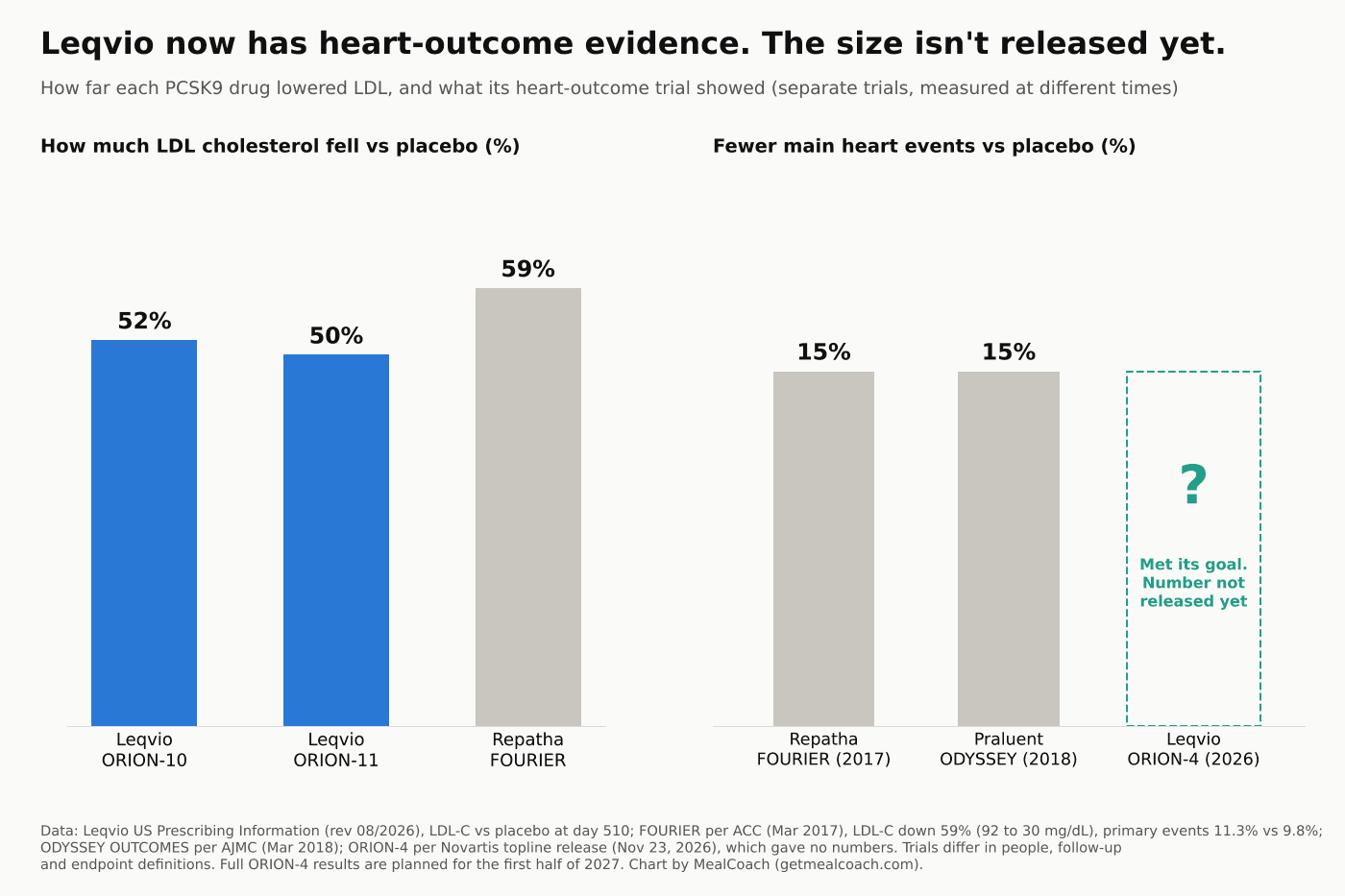
On LDL, Leqvio works well. In the two main trials behind its approval, LDL at day 510 was 52% lower than placebo in ORION-10 and 50% lower in ORION-11, per the label’s placebo-adjusted figures. (ACC’s trial summaries report a time-averaged measure, so their numbers differ slightly.)
Leqvio is a small interfering RNA (siRNA) drug that targets PCSK9, the same protein the older antibody shots block. Novartis calls ORION-4 the first outcomes study of an siRNA therapy in people with atherosclerotic heart and artery disease.
Action item: If you’ve wondered whether Leqvio does more than lower a number, this is the trial meant to answer that. Bring it up at your next lipid appointment.
How does Leqvio compare with Repatha and Praluent?
Repatha (evolocumab) and Praluent (alirocumab) are antibody shots that block PCSK9 directly, and both have had positive heart-outcome trials since 2017–2018. Leqvio reaches the same target a different way. These are separate trials in different people, so they can’t be ranked against each other.
- Repatha, FOURIER: 27,564 people with heart or artery disease on statins. LDL fell 59% (median 92 to 30 mg/dL). Over a median 26 months, the main endpoint occurred in 9.8% on Repatha vs 11.3% on placebo, a 15% relative drop, per the American College of Cardiology.
- Praluent, ODYSSEY OUTCOMES: 18,924 people who had had an acute coronary syndrome (a heart attack or unstable angina). Major heart events were 15% lower than placebo, per AJMC’s report from ACC 2018.
- Leqvio, ORION-4: more than 16,000 people with heart or artery disease. Lower risk of major heart events; size not yet released.
In absolute terms, FOURIER’s 15% relative drop meant about 1.5 fewer people in every 100 having an event over about two years. ORION-4’s absolute numbers will matter just as much when they come out.
The other practical difference is the schedule. Per its label, Leqvio is given by a healthcare professional as one shot, another at three months, then every six months.
Action item: If you’re choosing between these, ask your doctor how each one is given, how often, and what your insurance covers. Those practical details often decide which one people stay on.
What does this mean if you take Leqvio now?
This news doesn’t change Leqvio’s label, dose or schedule. What has changed is the evidence behind it.
The US label was already broadened in July 2025, when the FDA removed the requirement to use Leqvio on top of a statin, per HCPLive. Novartis hasn’t said whether it will ask regulators to add a heart-event claim to the label. Any such change would come after the full results.
The label lists the most common side effects as injection-site reactions (8% vs 2% on placebo), joint pain (5% vs 4%) and bronchitis (4% vs 3%). Bowman said ORION-4 shows Leqvio is well tolerated, but no ORION-4 safety numbers have been released.
Action item: Write down any questions about this news for your next appointment. Decisions about your doses are for you and your doctor.
When to call your doctor or 911
The Leqvio label warns about serious allergic reactions, including anaphylaxis (a severe, whole-body allergic reaction) and angioedema (swelling under the skin), and says to get medical help promptly for signs of one. Treat these as emergencies and call 911 (or your local emergency number):
- Trouble breathing or wheezing
- Swelling of the face, lips, tongue or throat
- Fainting or feeling suddenly very dizzy
Call your doctor for a rash or hives, or an injection site that stays painful, red or swollen.
What we don’t know yet
The size of the benefit is the biggest unknown, and it’s the number that decides how much ORION-4 changes care. Until the full results are out, these questions are open:
- How big was the drop? No hazard ratio, percentages or event counts yet.
- Which parts moved? The release lists secondary results (heart death or heart attack; cardiovascular death; results in people on high-intensity statins) but gives none of them.
- Side effects over years: no safety numbers from the trial yet.
- A second trial: VICTORION-2 PREVENT (NCT05030428), also in people who already have heart or artery disease, is ongoing, with results expected in 2027. Novartis says the two trials together include more than 33,000 people.
- People without heart disease: Novartis describes both trials as secondary prevention (people who already have the disease), so neither answers whether Leqvio prevents a first heart attack or stroke.
Novartis says full ORION-4 results are planned for publication in the first half of 2027.
Action item: Treat any number you see before 2027 as unconfirmed unless it links to the published paper or a congress presentation.
Quick Answers
Does Leqvio prevent heart attacks? Novartis says ORION-4 showed fewer major heart events (a composite that includes heart attack) on Leqvio than placebo in people with heart or artery disease. It hasn’t said by how much, or whether heart attacks alone fell.
What is ORION-4? A double-blind trial of Leqvio (inclisiran) vs placebo in more than 16,000 people with heart or artery disease, led by the University of Oxford with Novartis. Topline results were announced November 23, 2026.
When will the full ORION-4 results come out? Novartis says they are planned for publication in the first half of 2027.
Is Leqvio approved? Yes, for lowering LDL cholesterol, in more than 100 countries including the US, EU, Japan and China, per Novartis. As of November 23, 2026, its US label doesn’t include a heart-event claim.
How often is Leqvio given? As one shot from a healthcare professional, another at three months, then every six months, per the US label.
What This Means for You
✅ You know ORION-4 is the first trial to link Leqvio to fewer heart events
✅ You know Novartis hasn’t released any numbers, so the size of the benefit is unknown
✅ You know the trial studied people who already had heart or artery disease
✅ You know Repatha and Praluent each cut main heart events by about 15% in their own trials
✅ You won’t change any medicine without talking to your doctor
The 5-Minute Version (Screenshot This)
- The news: Novartis says Leqvio (inclisiran) cut major heart events vs placebo in ORION-4 (announced Nov 23, 2026).
- The trial: more than 16,000 people with heart or artery disease; shots on day 1, at 3 months, then every 6 months.
- The catch: no numbers yet. Full results are planned for the first half of 2027.
- Context: Leqvio cut LDL by about 50% vs placebo in earlier trials; Repatha and Praluent cut main heart events by 15% in theirs.
- Next: VICTORION-2 PREVENT, a second trial in people with heart or artery disease, reports in 2027.
Conclusion
ORION-4 answers the question Leqvio has carried since its approval: does lowering LDL this way, twice a year, mean fewer major heart events? Novartis says yes, though it hasn’t said which kinds. How big the benefit is, we’ll only learn from the full ORION-4 results in 2027.
Until then, the useful move is the same as before: know your LDL, know your goal, and talk with your doctor about the options that fit you.
For why relative and absolute numbers tell such different stories, see our summary of How to Lie with Statistics. For a cholesterol drug that lowered its target but not heart events, read our Lp(a)HORIZON explainer. And if statin side effects are why you’re looking at shots, see what the blinded trials say about statin muscle pain.
So tell me: would a twice-yearly shot change how you feel about cholesterol treatment?
Sources
- Novartis: Twice-yearly Leqvio (inclisiran) reduced cardiovascular event risk in first outcomes study of an siRNA therapy in ASCVD (Nov 23, 2026)
- University of Oxford, Clinical Trial Service Unit: ORION-4 study page
- ClinicalTrials.gov: ORION-4 (NCT03705234)
- ClinicalTrials.gov: VICTORION-2 PREVENT (NCT05030428)
- Leqvio (inclisiran) US Prescribing Information (revised 08/2026)
- HCPLive: FDA approves Leqvio label update for first-line use (Jul 31, 2025)
- American College of Cardiology: Evolocumab significantly reduces risk of cardiovascular events (FOURIER, Mar 2017)
- AJMC: ODYSSEY OUTCOMES at ACC 2018 (Mar 2018)
- American College of Cardiology: ORION-10 trial summary
- American College of Cardiology: ORION-11 trial summary
 MealCoach