
“I cannot avoid the disappointing conclusion – it didn’t work.”
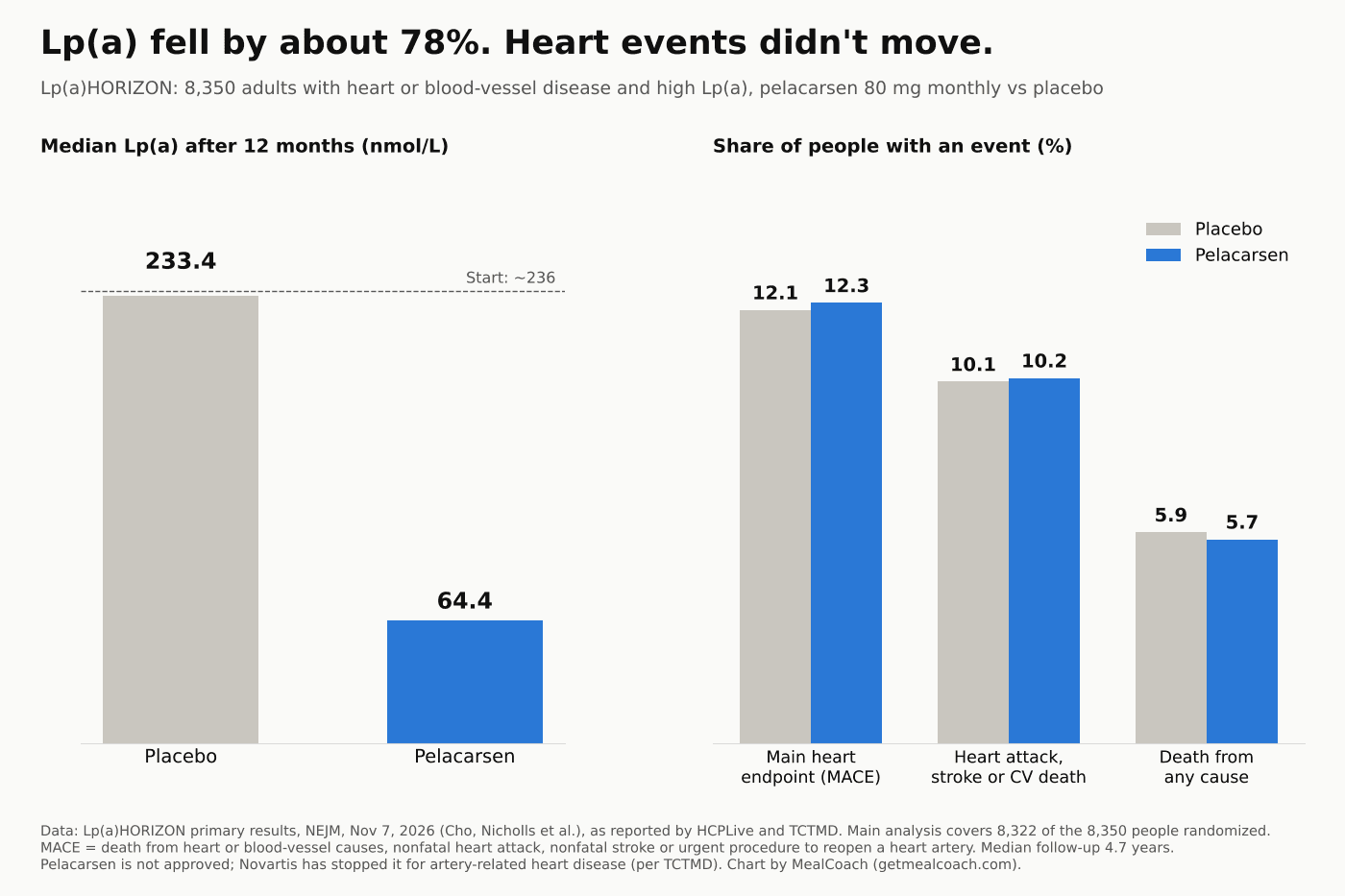
The short answer: pelacarsen, Novartis’s monthly Lp(a)-lowering shot, cut lipoprotein(a) by about 78% but did not prevent heart attacks, strokes or heart deaths. In the Lp(a)HORIZON trial (New England Journal of Medicine, November 7, 2026), 12.3% of people on pelacarsen and 12.1% on placebo had a major heart event over about 4.7 years.
That’s a clear miss, not a near miss. But it doesn’t mean high Lp(a) is harmless, and it doesn’t settle the question for the other Lp(a) drugs still in trials.
In this post you’ll learn what Lp(a)HORIZON tested, what the numbers mean in plain terms, why experts think it failed, and what it means if you have high Lp(a) today. About 6 minutes.
What is Lp(a), and why were people hoping for this drug?
Lipoprotein(a), or Lp(a), is a cholesterol-carrying particle in the blood that looks a lot like LDL (“bad” cholesterol) with an extra protein attached. High levels are linked with heart attacks and strokes, and the level is largely set by your genes.
That last part is why this trial mattered so much. Diet, exercise and statins have little effect on Lp(a).
And no FDA-approved drug specifically lowers it, per the American Heart Association.
The National Lipid Association’s 2024 statement calls 125 nmol/L (50 mg/dL) or higher “high risk” and supports testing every adult at least once, per its focused update in the Journal of Clinical Lipidology.
Lp(a)HORIZON was the first large trial to test whether lowering Lp(a) actually prevents heart attacks and strokes, per TCTMD, rather than just lowering a blood level.
Action item: If you’ve never had your Lp(a) measured, ask your doctor whether it’s worth checking once. It’s a single blood test.
What did the Lp(a)HORIZON trial test?
Lp(a)HORIZON tested whether lowering Lp(a) with pelacarsen prevents heart attacks and strokes in people who have already had heart or blood-vessel disease. It randomly assigned 8,350 adults at 797 sites in 42 countries to pelacarsen 80 mg or a placebo, each given as a monthly shot under the skin.
That’s per TCTMD. Baseline details below are from HCPLive’s summary of the paper.
- Who: average age about 60, 27% women, and most (about 77%) had had a heart attack. Everyone had Lp(a) of at least 70 mg/dL; the median was about 236 nmol/L.
- Already well treated: median LDL cholesterol was about 65 mg/dL, and about 78% took a high-intensity statin.
- Main goal: fewer “major adverse cardiovascular events” (MACE), defined as death from heart or blood-vessel causes, nonfatal heart attack, nonfatal stroke, or urgent hospital procedure to reopen a heart artery.
The results were presented at the American Heart Association’s Scientific Sessions in Chicago and published the same day in NEJM, with extra analyses in NEJM Evidence. Novartis had already said in September that the trial missed its main goal.
Action item: Notice who was studied: people who had already had a heart attack, stroke or similar problem. If you haven’t, this trial doesn’t directly answer your question.
What did the trial show?
Pelacarsen lowered Lp(a) a lot but did not lower heart events at all. After 12 months, Lp(a) had fallen 78.4% on pelacarsen and 3.2% on placebo (median 64.4 vs 233.4 nmol/L), per HCPLive’s summary of the NEJM paper.
Over a median of 4.7 years, here’s how many people had an event:
- Main goal (MACE, four parts): 12.3% on pelacarsen vs 12.1% on placebo (hazard ratio 1.02; 95% CI 0.90 to 1.15).
- Heart attack, stroke or heart death (three parts): 10.2% vs 10.1%.
- A composite that includes death from coronary heart disease: 9.4% vs 9.7%.
- Death from any cause: 5.7% vs 5.9%.
- People with the highest Lp(a) (90 mg/dL or more): no difference either (hazard ratio 1.00).
In absolute terms, that’s about 12 people in every 100 having an event in each group. A hazard ratio of 1.02 means no meaningful difference.
These main numbers include nearly everyone randomized (8,322 of 8,350), and TCTMD reports that the exploratory analyses in NEJM Evidence (which, per the ACC summary, included analyses of people while they were on treatment) bolstered the lack of benefit.
Action item: When you see “Lp(a) fell 78%,” look for the event numbers next to it. A blood test moving isn’t the same as fewer heart attacks.
How safe was pelacarsen?
Pelacarsen caused more nuisance side effects and some allergic reactions, though serious adverse events overall were not higher than placebo. Per HCPLive’s summary of the paper (pelacarsen vs placebo):
- Flu-like reactions: 31.9% vs 5.8%
- Injection-site reactions: 25.6% vs 2.9%
- Stopped for side effects: 20.6% vs 7.5%
- Anaphylaxis (a severe allergic reaction, confirmed by a review panel): 19 people vs 0; no deaths from these reactions were reported
- Any serious adverse event: 37.3% vs 41.1%
More than a third of people on pelacarsen (35.1%) stopped the shots early, versus 18.3% on placebo. That can dilute a drug’s effect in the main analysis, which is one reason the researchers also looked at people who stayed on treatment.
Action item: If you’re weighing any new shot in a trial, ask the study team how often people stopped it and why. Tolerability decides whether a drug can help.
Why didn’t it work?
Nobody knows yet, and experts offered several possible reasons rather than one answer. TCTMD reports these ideas from the presenters and panelists:
- Little room left to help: LDL cholesterol and blood pressure were already very well controlled, among the lowest of any heart outcomes trial, Dr. Nissen said.
- Too late in the disease: Dr. Donald Lloyd-Jones, a discussant, asked whether people with advanced artery disease are too far along for Lp(a) lowering to reverse it.
- Not enough lowering, or the wrong kind: newer drugs (small interfering RNA, or siRNA, shots) cut Lp(a) by more, and may be easier to tolerate and dosed less often.
- Too short: high Lp(a) is a lifelong exposure; about 5 years of treatment may not undo that.
“A single trial does not provide definitive evidence of a lack of benefit…”
Novartis has discontinued pelacarsen for artery-related (atherosclerotic) heart disease, including its ongoing studies in that area and its managed access program, per TCTMD.
My take: this is a hit to the “lower Lp(a), prevent heart attacks” idea, but not the final word. It tested one drug, one way of lowering Lp(a), in one group of very well-treated patients.
Action item: Be wary of anyone who says this trial proves Lp(a) “doesn’t matter.” The investigators themselves didn’t say that.
What about the other Lp(a) drugs in trials?
Four other large Lp(a) outcome trials are still running, and none of these drugs is approved as of November 8, 2026. Olpasiran is Amgen’s; lepodisiran and muvalaplin are Lilly’s. Here’s what the Family Heart Foundation’s trial list (updated March 2026) shows:
- Olpasiran, OCEAN(a)-Outcomes: people with a prior heart attack or artery procedure and Lp(a) of 200 nmol/L or more; listed completion March 2028.
- Olpasiran, OCEAN(a)-PreEvent: people with no prior heart attack or stroke; listed completion October 2031.
- Lepodisiran, ACCLAIM-Lp(a): more than 17,300 people; listed completion March 2029.
- Muvalaplin, MOVE-Lp(a): a pill taken by mouth; listed completion March 2031.
Those are trial registry completion dates, not approval dates. HCPLive notes olpasiran has cut Lp(a) by more than 90% and muvalaplin by about 85% in earlier studies, but lower numbers on a blood test are exactly what pelacarsen had too. Only outcome results will tell.
Action item: If you have high Lp(a) and want to help answer this, ask your cardiologist whether you might qualify for one of these trials.
What does this mean if you have high Lp(a) now?
For now, high Lp(a) is still treated as a reason to manage your other heart risks more carefully, because no drug has yet been shown to cut heart events by lowering Lp(a).
The National Lipid Association’s statement calls for early, more intensive risk-factor management in people with high Lp(a), including lowering LDL cholesterol with medicine for those at high risk.
Dr. Nissen also said measuring Lp(a) is still worthwhile, per the AHA newsroom. Your number helps your doctor judge how hard to push on the things that do have outcome evidence: LDL cholesterol, blood pressure, smoking and diabetes.
A high Lp(a) can also run in families. The NLA statement recommends testing first-degree relatives of people with high levels.
Action item: If your Lp(a) is high, ask your doctor two questions: “What should my LDL goal be?” and “Should my parents, siblings or children get tested?”
If you were in a pelacarsen study
Novartis has stopped its ongoing pelacarsen studies in artery-related heart disease, per TCTMD. If you haven’t heard from your study team, contact them about next steps. Severe allergic reactions were seen in the trial, so treat these as emergencies and call 911 (or your local emergency number):
- Trouble breathing, wheezing, or throat or tongue swelling
- Fainting or feeling suddenly very dizzy
- Widespread hives with any of the above
Call your study doctor for anything else that worries you, such as flu-like symptoms that don’t settle or a painful injection site.
Quick Answers
Did pelacarsen work in Lp(a)HORIZON? No. It cut Lp(a) by about 78%, but major heart events were 12.3% vs 12.1% on placebo over about 4.7 years (NEJM, November 7, 2026).
Is pelacarsen approved? No. It isn’t approved anywhere, and Novartis has discontinued it for artery-related heart disease, per TCTMD.
Does this mean high Lp(a) doesn’t matter? No. The investigators said Lp(a) is still worth measuring; the trial shows this drug, in this group, didn’t prevent events.
Is there any medicine for high Lp(a) now? No drug has been shown to prevent heart events by lowering Lp(a). Doctors focus on LDL cholesterol and other risk factors instead.
When will we know about olpasiran or lepodisiran? Their outcome trials are listed to complete between 2028 and 2031, per the Family Heart Foundation; results usually come months after that.
What This Means for You
✅ You know pelacarsen lowered Lp(a) by about 78% but didn’t lower heart events
✅ You know the trial studied people who already had heart or blood-vessel disease
✅ You know four other Lp(a) outcome trials are still running
✅ You know a single Lp(a) test is still recommended by the National Lipid Association
✅ You won’t change any medicine without talking to your doctor
The 5-Minute Version (Screenshot This)
- The trial: Lp(a)HORIZON, 8,350 adults with prior heart or blood-vessel disease and high Lp(a), pelacarsen 80 mg monthly vs placebo, NEJM, Nov 7, 2026.
- Lp(a): down about 78% at 12 months.
- Heart events: 12.3% vs 12.1% over about 4.7 years. No benefit, even at the highest Lp(a) levels.
- Side effects: flu-like reactions 31.9% vs 5.8%; 19 cases of anaphylaxis vs 0.
- Next: Novartis stopped pelacarsen for artery-related heart disease; olpasiran, lepodisiran and muvalaplin outcome trials run to 2028–2031.
Conclusion
Lp(a)HORIZON is a sobering result: pelacarsen did exactly what it was meant to do to the blood test, and nothing measurable to heart attacks, strokes or deaths. It’s a reminder that a lower number on a lab report is a promise, not a proof.
If you have high Lp(a), the useful move hasn’t changed: know your number, and work with your doctor on the risks that do have outcome evidence.
I explain why “relative” and “absolute” numbers matter so much in news like this in our summary of How to Lie with Statistics. For more on inherited heart risk, see our summaries of Beat the Heart Attack Gene and Outlive.
So tell me: if you’ve had your Lp(a) tested, did this result change how you think about your number?
Sources
- NEJM: Cho L, Nicholls SJ, et al. Pelacarsen and cardiovascular outcomes in patients with high lipoprotein(a) (Nov 7, 2026)
- American Heart Association newsroom: Lp(a) HORIZON trial results (Nov 7, 2026)
- HCPLive: Lp(a) HORIZON shows pelacarsen lowers Lp(a) 78% but not cardiovascular events (Nov 7, 2026)
- TCTMD: Full Lp(a)HORIZON results affirm lack of pelacarsen benefit (Nov 7, 2026)
- American College of Cardiology: Lp(a) HORIZON trial summary (AHA 2026)
- Novartis: Lp(a)HORIZON topline results (Sep 4, 2026)
- National Lipid Association: focused update on Lp(a) in clinical practice (J Clin Lipidol, 2024)
- Family Heart Foundation: ongoing Lp(a) clinical trials (updated Mar 2026)
 MealCoach