
“…we don’t want to just compete with just another obesity agent…”
The short answer: the Regeneron Q3 2026 earnings report, out October 30, 2026, showed revenue up 36% to $5.1 billion, none of it from weight-loss drugs. On the call, Regeneron said it won’t chase the biggest number on the scale.
Instead it’s betting on two add-ons: a weight-loss shot paired with its cholesterol drug Praluent, and a muscle-saving antibody called trevogrumab. Neither will reach US pharmacies for years.
In this post you’ll learn what Regeneron’s third-quarter 2026 report said, what olatorepatide and trevogrumab are, how Regeneron plans to compete in obesity, and what it means if you’re on a GLP-1 today. About 6 minutes.
What Was in the Regeneron Q3 2026 Earnings Report?
Regeneron’s total revenue rose 36% to $5.1 billion in July to September 2026, driven by eczema, eye and cancer drugs, not obesity. That’s per its October 30, 2026 results release.
- Dupixent (dupilumab, for eczema, asthma and more): $6.5 billion in global sales, up 35%. Sanofi books these sales and shares the profit with Regeneron.
- EYLEA HD (aflibercept, for eye disease): $699 million in the US, up 62%.
- Libtayo (cemiplimab, for cancer): $550 million worldwide, up 51%.
- Praluent (alirocumab, a PCSK9 cholesterol drug): $81 million in the US, up 21%. Keep this one in mind.
Adjusted earnings per share rose 70% to $20.07. On obesity, the release said only two things. New COURAGE data on trevogrumab were shown at the EASD diabetes meeting. And CEO Leonard Schleifer said its Phase 3 obesity programs “continue to advance.”
Action item: If you came here for a new weight-loss drug you can ask for, there isn’t one yet. Everything below is pipeline.
What Is Olatorepatide?
Olatorepatide is a once-weekly shot that acts on two gut hormones, GLP-1 and GIP, the same pair tirzepatide (Zepbound, Mounjaro) targets. China’s Hansoh Pharma developed it as HS-20094. Regeneron licensed rights outside Greater China in June 2025 for $80 million upfront and up to $1.93 billion in milestones, BioSpace reported.
In Hansoh’s Phase 3 trial of 604 adults in China, people lost up to 19% of their body weight on average after 48 weeks, per Regeneron’s March 9, 2026 release.
- Doses tested: 5, 10 or 15 mg a week, or placebo.
- Response: up to 97% lost at least 5% of their weight.
- Stomach side effects: nausea averaged under 10% and vomiting under 5%.
The release didn’t give per-dose results, the placebo group’s weight loss, or say whether people who stopped the drug were counted. Fierce Biotech noted that Lilly reported up to 20.9% weight loss with tirzepatide at 72 weeks in a trial in a similar population. Different trials can’t be compared directly.
Action item: Treat “up to 19%” as the best dose’s average in one trial in China, not a promise for anyone. Regeneron hasn’t given a start date for global trials.
Why Is Regeneron Pairing a Weight-Loss Drug With a Cholesterol Drug?
Regeneron plans to combine olatorepatide with Praluent in one shot, for people with obesity or type 2 diabetes who also have high cholesterol and higher heart risk. Yancopoulos said on the call that registrational studies of this combination should begin next year, meaning 2027.
His pitch: a weight-loss drug that also lowers blood fats through a different route, sold through specialists Regeneron already serves. Asked how much Regeneron would invest in obesity, he said it doesn’t want a me-too drug with only a small edge in weight loss.
Regeneron said in March that a global Phase 3 program would begin later in 2026. On the call, Yancopoulos said Regeneron looks forward to starting it, and gave no start date.
Action item: Today, no single shot treats both high LDL cholesterol and obesity. Ask your doctor whether your LDL is at goal, and see how one PCSK9 story played out in Beat the Heart Attack Gene.
What Did the COURAGE Trial Show About Muscle Loss on Semaglutide?
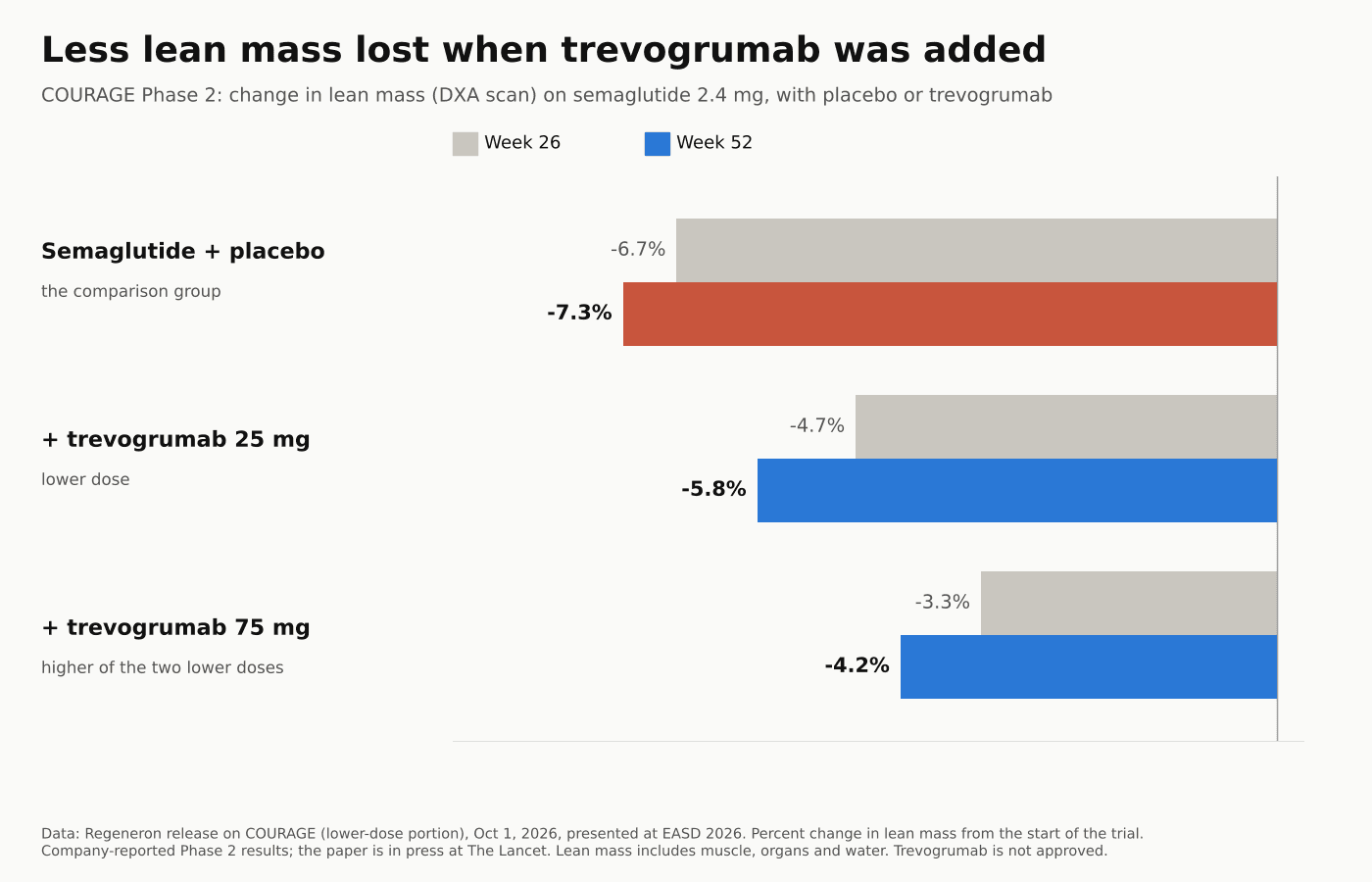
In COURAGE, adding trevogrumab to semaglutide (Wegovy) cut the lean mass people lost by 42.5% at 52 weeks at the 75 mg dose. Trevogrumab blocks myostatin, a protein that limits muscle growth, per Regeneron’s October 1, 2026 release.
In the lower-dose part of the trial, everyone took semaglutide 2.4 mg for 52 weeks, plus placebo or trevogrumab 25 or 75 mg. Lean mass, measured by DXA scan, changed like this:
| Group | Week 26 | Week 52 |
|---|---|---|
| Semaglutide + placebo | −6.7% | −7.3% |
| + trevogrumab 25 mg | −4.7% | −5.8% |
| + trevogrumab 75 mg | −3.3% | −4.2% |
On MRI, the trevogrumab groups kept about 69% to 72% of the thigh muscle that semaglutide alone lost at week 52. Lower-dose trevogrumab didn’t meaningfully add to the weight lost, and 77% of people on the lower doses reported at least one adverse event, versus 82% on placebo.
Boaz Hirshberg, who heads internal medicine clinical development at Regeneron, framed it as being about “not the quantity, but rather the quality, of weight loss.” The paper is in press at The Lancet.
Action item: You don’t need an experimental antibody to protect muscle now. Ask your care team about protein at each meal and strength training, and see our guide on how to eat on a GLP-1.
When Could These Regeneron Obesity Drugs Be Available?
Not soon. On October 30, 2026, Regeneron said it still looks forward to starting olatorepatide’s global Phase 3 program, and trevogrumab is still in Phase 2. Here’s where each stands:
- Olatorepatide alone: global Phase 3 program still to start, with no date given. Hansoh holds the rights in China.
- Olatorepatide plus Praluent: registrational studies planned for 2027, per Yancopoulos.
- Trevogrumab: next is a Phase 2 trial in older adults with obesity and low muscle mass or strength. Regeneron named no Phase 3 plan.
Obesity Phase 3 trials usually run more than a year, and an FDA review often takes about another year. So we’d be surprised to see olatorepatide in US pharmacies before 2029. That’s our estimate, not Regeneron’s.
Action item: Don’t wait on a pipeline drug if you need treatment now. Compare what’s already approved in Foundayo vs Zepbound.
How Does Regeneron Fit in the Weight-Loss Drug Race?
Regeneron is a late entrant betting on what comes with the weight loss, not on more of it. Lilly and Novo Nordisk sell the drugs people use today, and the next wave is chasing bigger numbers, as in our retatrutide vs EloraTZP breakdown.
Regeneron’s answer is different. Keep more muscle, treat cholesterol in the same shot, and sell through specialists it already knows. Its finance chief, Christopher Fenimore, listed obesity among the large registrational programs Regeneron expects to advance in 2027.
Whether that wins depends on data nobody has yet: whether saving lean mass helps people stay strong and keep weight off, and whether a combined shot beats taking two drugs.
Action item: When you read about a new obesity drug, ask two questions beyond the weight number: how much muscle was lost, and what else does it treat?
What We Don’t Know Yet
Several answers patients care about weren’t in the report or on the call. As of October 30, 2026:
- Olatorepatide’s full results: per-dose weight loss, the placebo result, and how dropouts were handled.
- When global trials start, and how large they will be.
- Whether keeping lean mass matters for health, such as strength, falls or keeping weight off. COURAGE measured body composition, not those outcomes.
- Price and coverage for any of these drugs, which is years away.
Action item: Treat call comments as plans. Look for the published papers and trial registrations before counting on any date.
Quick Answers
What did Regeneron report in its Q3 2026 earnings? Revenue of $5.1 billion, up 36%, on October 30, 2026. Dupixent, EYLEA HD and Libtayo set sales records. None of the revenue came from obesity drugs.
Does Regeneron have a weight-loss drug? Not on sale. Its lead obesity drug, olatorepatide, is licensed from Hansoh and finished Phase 3 in China. Regeneron hasn’t given a start date for global trials.
What is trevogrumab? An experimental antibody that blocks myostatin. In the COURAGE Phase 2 trial, adding it to semaglutide reduced lean mass loss by up to about half.
Will olatorepatide be combined with Praluent? That’s the plan. Regeneron said registrational studies of the combined shot should start in 2027.
Does Regeneron’s news change my GLP-1 treatment? No. Nothing here is approved, and no prices or launches were announced.
What This Means for You
✅ You know Regeneron’s Q3 2026 growth came from non-obesity drugs
✅ You know olatorepatide’s China results and what they leave out
✅ You know why Regeneron wants to pair it with Praluent
✅ You know what COURAGE showed about muscle on semaglutide
✅ You know none of this reaches pharmacies soon
The 5-Minute Version (Screenshot This)
- News: Regeneron reported Q3 2026 results and held its earnings call on October 30, 2026.
- Sales: revenue $5.1 billion, up 36%, led by Dupixent, EYLEA HD and Libtayo. No obesity sales.
- Olatorepatide: up to 19% average weight loss at 48 weeks in a Phase 3 trial in China; global Phase 3 has no start date yet.
- Combination: olatorepatide plus Praluent in one shot, with registrational studies planned for 2027.
- Muscle: trevogrumab cut lean mass loss on semaglutide by 42.5% at 52 weeks (75 mg) in Phase 2.
Conclusion
The Regeneron Q3 2026 earnings call made one thing clear. Regeneron isn’t trying to out-shrink Lilly and Novo. It wants weight loss that keeps more muscle and treats cholesterol along the way. That’s a smart pitch, but it rests on trials that haven’t started or finished.
Your one action today: if you’re losing weight on a GLP-1, ask your care team how you’re protecting your muscle.
So tell me: would you pick a weight-loss drug that keeps more muscle over one that takes off a few more pounds?
Sources
- Regeneron: third-quarter 2026 financial and operating results (Oct 30, 2026)
- Regeneron Q3 2026 earnings call transcript (Gloom, Oct 30, 2026)
- Regeneron: Phase 2 COURAGE trial confirms trevogrumab prevents lean mass and muscle loss (Oct 1, 2026)
- Regeneron: olatorepatide Phase 3 results in Chinese patients (Mar 9, 2026)
- Fierce Biotech: Regeneron’s obesity drug shows Zepbound-like efficacy in Phase 3 (2026)
- BioSpace: Regeneron puts nearly $2B on the line for Chinese obesity drug (Jun 2, 2025)
 MealCoach