“It is your detox center.”
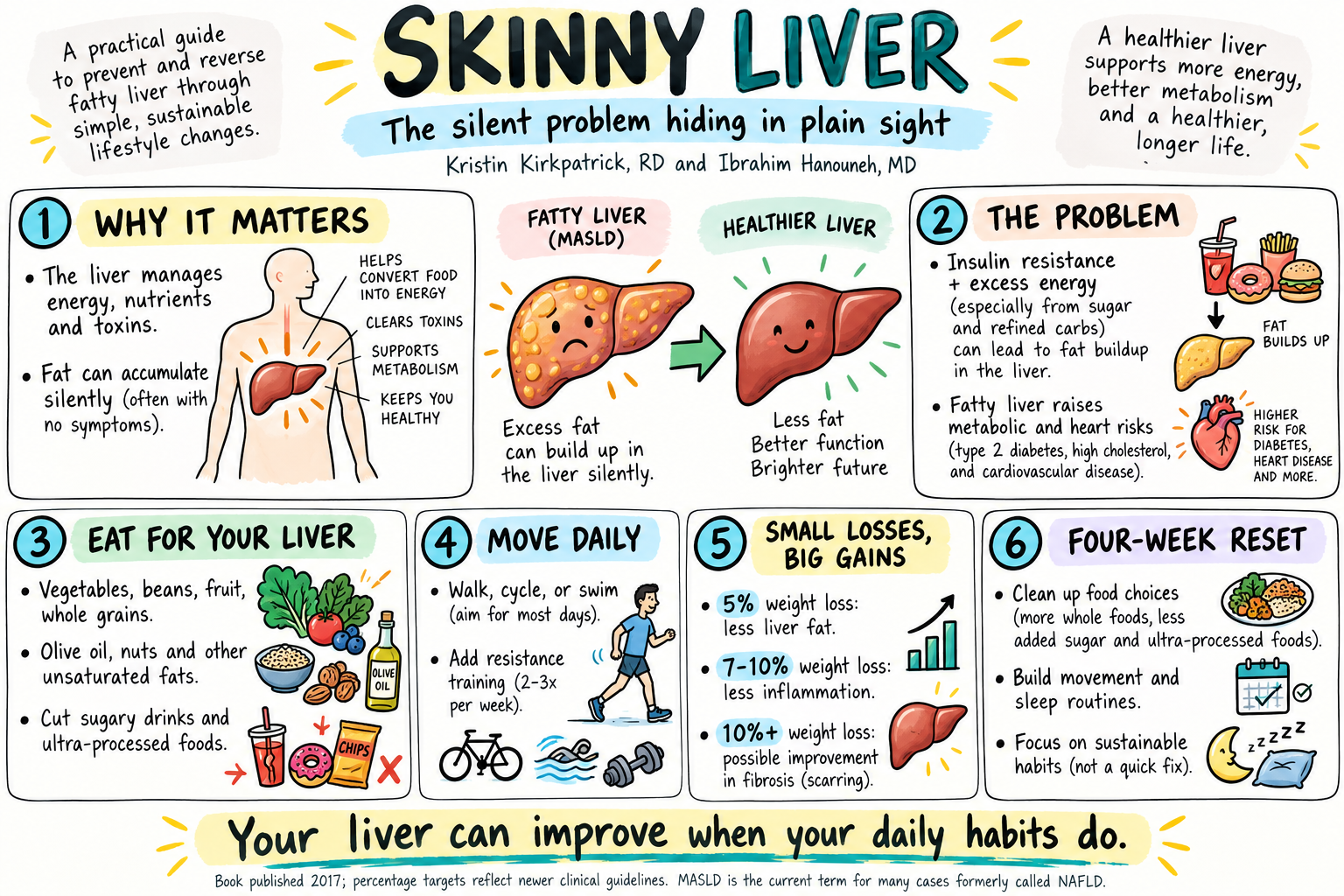
The short answer: Skinny Liver (2017) is by dietitian Kristin Kirkpatrick and liver doctor Ibrahim Hanouneh. It says fatty liver is common, silent and driven mostly by daily habits. Its four-week plan: whole foods, less sugar and refined carbs, little or no alcohol, more movement.
Newer research backs that core. And two medicines now exist for the serious form.
You’ll learn the plan in plain English, what holds up, where the book falls short, and one change to make this week.
What Is Skinny Liver About?
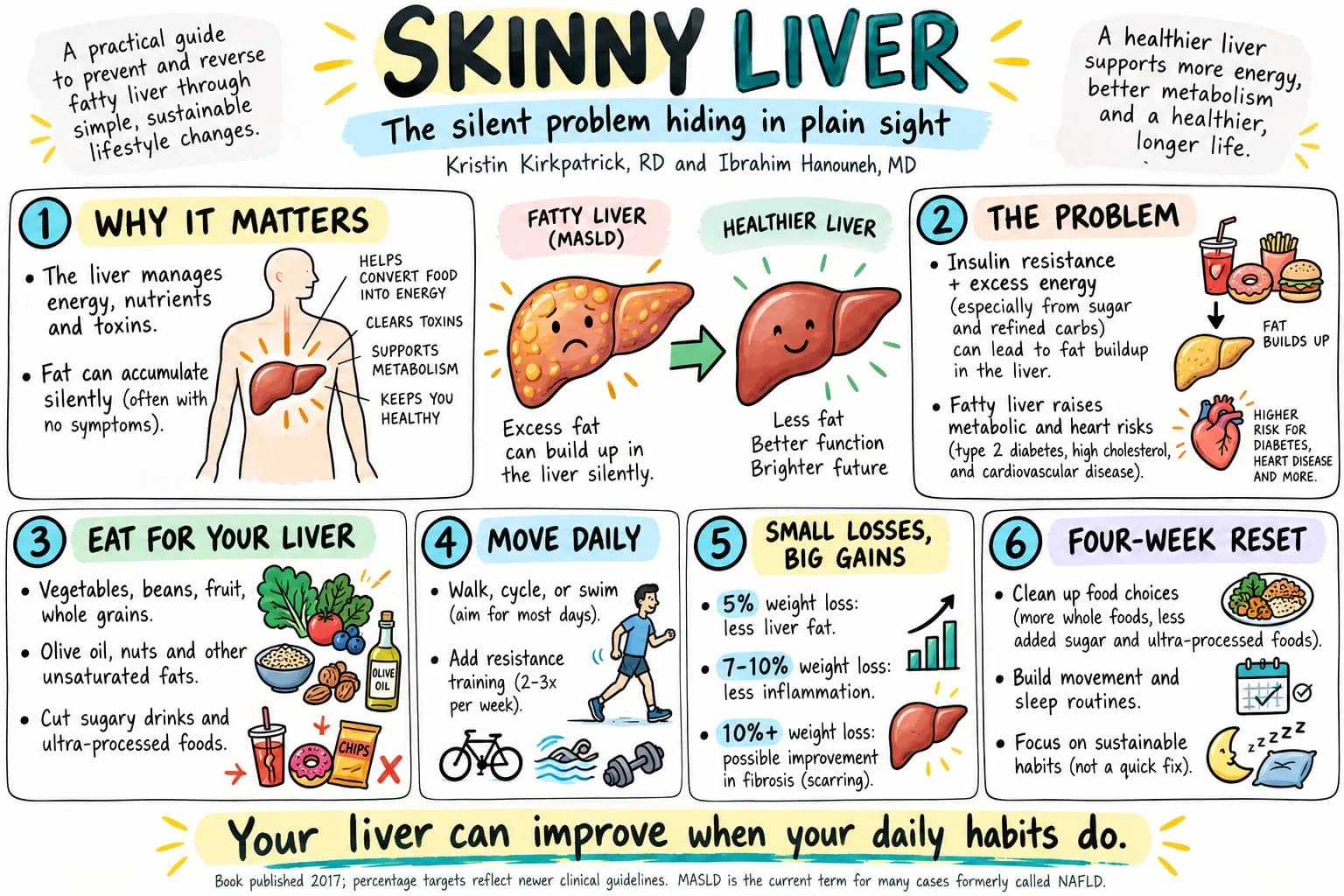
Skinny Liver is a 304-page guide to preventing and reversing fatty liver through daily habits, built around a four-week program. It comes with recipes. The publisher, Hachette, released it in January 2017.
The pairing is the selling point. Kirkpatrick managed wellness nutrition services at the Cleveland Clinic. Hanouneh is a hepatologist (a liver specialist) who has held liver faculty roles at the Cleveland Clinic and the Mayo Clinic.
It moves in three steps: what the liver does, what loads it up (poor eating, sitting, everyday exposures), and the plan. Reviewers on Goodreads describe two four-week eating plans, one for weight loss and one for upkeep, plus exercise schedules and a stress tracker.
Picture this (an illustration, not a real patient): a routine blood test, one liver number a little high, and a doctor who shrugs, “a bit of fat on your liver.” No pain. No symptoms. The book is written against that shrug.
Action item: Find your last blood test and look for ALT and AST, two common liver numbers. Not sure what yours mean? Ask at your next visit.
How Common Is Fatty Liver?
Fatty liver is the most common chronic liver disease in the world, and about 38% of U.S. adults may have it. That’s from a 2024 analysis of U.S. survey data from 2017 to 2020.
Worldwide, about 1.3 billion people had it in 2023, and that could reach 1.8 billion by 2050. That’s from a Global Burden of Disease study in The Lancet Gastroenterology & Hepatology, reported by AJMC in April 2026.
It also has a new name. In 2023, 236 experts from 56 countries renamed nonalcoholic fatty liver disease (NAFLD) to MASLD, per a consensus statement in the Journal of Hepatology. Most felt “fatty” and “nonalcoholic” could be stigmatizing.
The inflamed form, NASH, is now MASH. The book uses the old names.
Action item: If a report says MASLD or MASH, read it as the new name for fatty liver.
What Does the Skinny Liver Diet Say to Eat?
The Skinny Liver diet is a low-sugar, whole-food way of eating. Think colorful vegetables and fruit, beans, fish and whole grains. Less red meat, and far less sugar, refined carbs and fried food. That’s how reviewers describe it, and some call it Mediterranean-style.
Here the book and the government agree. The NIDDK, part of the National Institutes of Health, says to avoid simple sugars, especially fructose (soda, sports drinks, sweet tea, juice).
It also says to swap saturated and trans fats for unsaturated ones, and to choose low-glycemic foods, which raise blood sugar slowly.
My take: none of this is new. The difference is the reason. “Eat better” is easy to ignore. “Your liver is quietly storing the soda” is harder to forget.
If sweet drinks are your weak spot, our summary of Salt Sugar Fat explains why they’re so easy to overdo.
Action item: For one week, swap one sugary drink a day for water, sparkling water or unsweetened tea.
Is Coffee Good for a Fatty Liver?
Coffee drinkers tend to have less fatty liver and less scarring, though the evidence is observational. A 2017 meta-analysis of five studies found a 29% lower risk of fatty liver in coffee drinkers.
Among people who already had it, coffee drinkers had a 30% lower risk of liver scarring (fibrosis).
The authors praised coffee on a 2024 podcast, and the Cleveland Clinic article above links coffee and green tea to liver benefits.
Two catches. “Linked to” isn’t proof that coffee caused the difference. And a big sweetened coffee drink can undo the point.
Action item: If coffee already suits you, keep it plain or lightly sweetened. Check the sugar on your usual order once.
How Much Weight Loss Helps a Fatty Liver?
Losing 3% to 5% of body weight can reduce liver fat. Losing 7% to 10% may be needed to calm inflammation and scarring. That’s per the NIDDK, citing liver-specialist guidance. For someone at 200 pounds, 5% is 10 pounds.
The strongest numbers come from a 2015 study in Gastroenterology. It followed 293 adults with NASH through a year of diet and exercise advice, most with liver biopsies before and after.
Overall, NASH went away in 25%. Among those who lost 10% or more of their weight, it went away in 90%, and scarring improved in 45%.
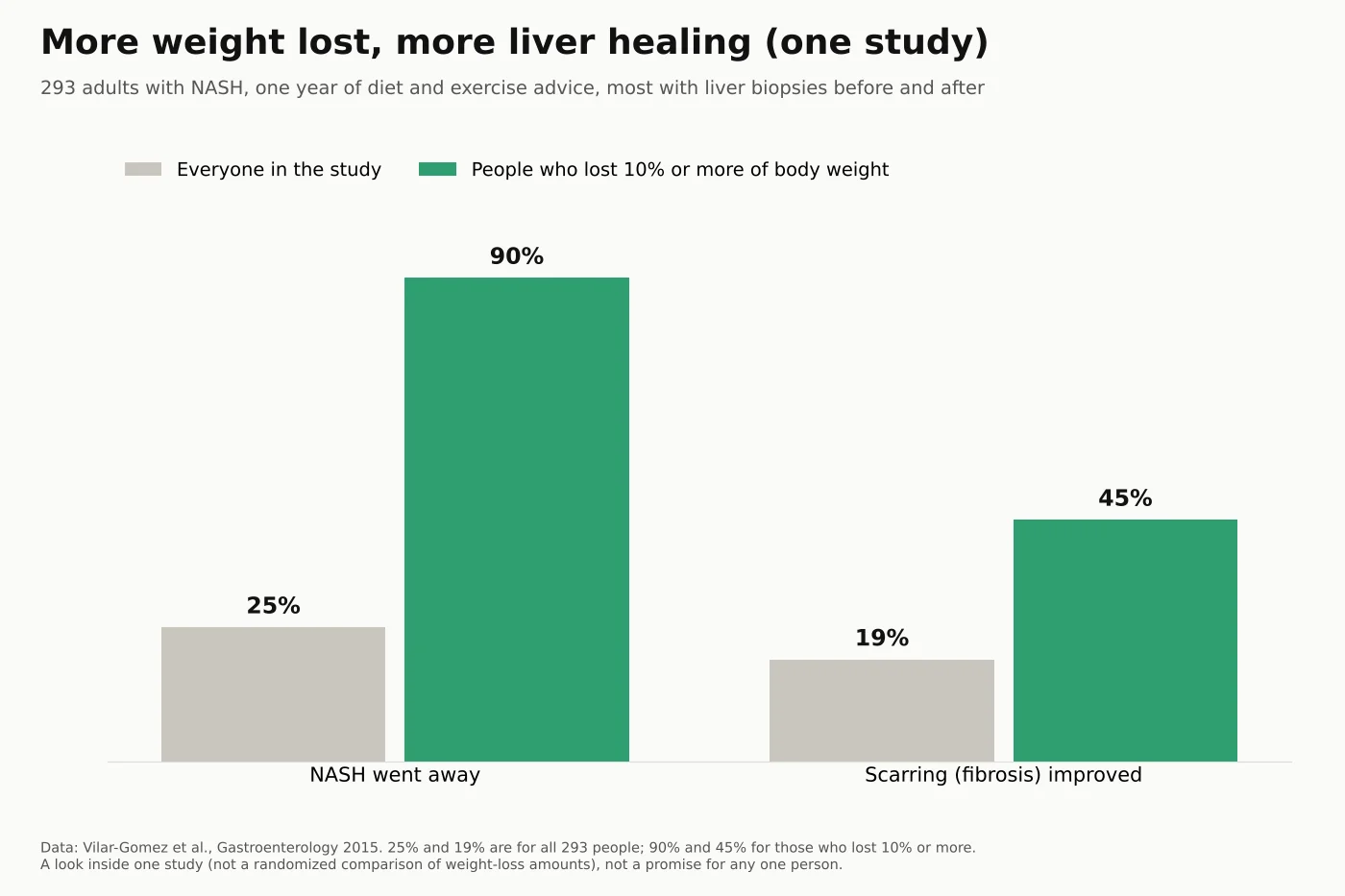
That’s one study, not a promise. And the book adds a twist: it isn’t only about the scale.
As the authors put it on a 2024 podcast, “waist size is a great indicator,” because it hints at the kind of fat you carry.
They also described four metabolic profiles, split partly by whether your waist is lean. So a normal weight doesn’t let you off the hook.
Action item: Measure your waist this week, just above your hip bones, and write it down. It’s a useful clue alongside your weight.
Does Alcohol Matter if It’s Called “Nonalcoholic”?
Yes. The NIDDK says people with fatty liver should minimize alcohol, which can further damage the liver. Reviewers say the book tells readers to limit or avoid it. Kirkpatrick’s 2026 message is that alcohol has no health benefits.
The book’s boldest pitch, as the American Liver Foundation summarizes it, is that “fat is as dangerous as alcohol to the liver.” That’s a slogan, not a measurement. But the point lands: you don’t need to drink to hurt your liver.
Action item: Count your drinks for one normal week, honestly. If you drink heavily, get medical advice before cutting back suddenly.
Where Skinny Liver Falls Short
The core advice holds up, but the book is dated in places, heavy on weight and light on new ideas. It averages 3.78 out of 5 from 471 Goodreads ratings.
- Familiar advice. Reviewers call much of it generic and repetitive.
- Weight focus. Some readers felt it leans too hard on weight loss. The title doesn’t help.
- Lots of recipes. Much of it is recipes and appendices. Great if you want meals, thin if you want depth.
- Old news on treatment. In 2017 there was no approved medicine for NASH. That has changed twice.
Action item: Read the food and exercise chapters closely, and use the recipes as a starting menu.
What Has Changed Since the Book Came Out?
Two medicines are now approved in the U.S. for MASH with moderate to advanced scarring, in people without cirrhosis, alongside diet and exercise. Both are accelerated or conditional approvals. Resmetirom (Rezdiffra) was first, in March 2024. Semaglutide (Wegovy), a GLP-1 drug, followed in August 2025.
Wegovy’s approval rests on the ESSENCE trial. After 72 weeks, liver inflammation resolved in 62.9% on semaglutide versus 34.3% on placebo. Scarring improved in 36.8% versus 22.4%, per Drug Topics and King’s College London.
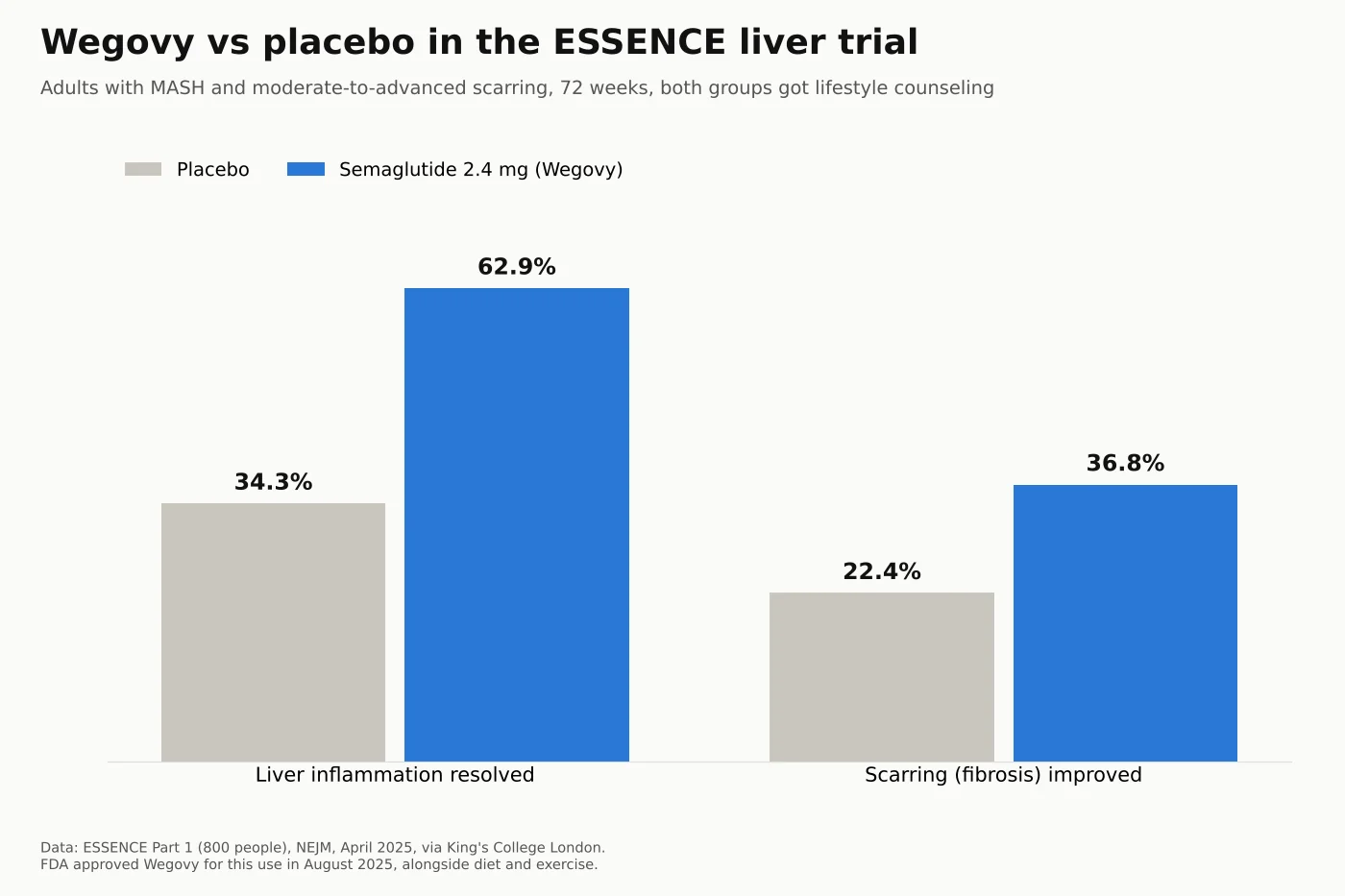
One of the trial’s chief investigators, Professor Philip Newsome, said “these results must be treated with caution,” while also calling semaglutide a potentially effective tool.
My take: the drugs don’t make the book obsolete. Diet and activity are still part of both approvals. For what these drugs can and can’t do, read our Magic Pill summary.
Action item: If you’ve been told you have MASH with scarring, ask your liver doctor whether either approved medicine is relevant to you.
A Sample Liver-Friendly Day
This is an illustration built from the book’s principles, not a prescription:
- Breakfast: plain yogurt with berries and chia seeds. Coffee, if you drink it.
- Lunch: a big salad with chickpeas, olive oil and lemon, plus a slice of whole-grain bread.
- Snack: a small handful of almonds and an apple.
- Dinner: baked salmon, brown rice and roasted broccoli.
- Drinks: water or unsweetened tea. No soda, no juice, no nightcap.
- Movement: a 20-minute walk after dinner.
Miss half of it? Fine. Pick the drink swap and start there.
Quick Answers
What is the best diet for fatty liver? The common advice, from Skinny Liver and the NIDDK alike, is to cut added sugar (especially sweet drinks), refined carbs and alcohol. Eat more unsaturated fats and low-glycemic whole foods instead. Your doctor or a dietitian can tailor it.
Can fatty liver be reversed? Often, liver fat can go down. Losing 3% to 5% of body weight can reduce it, and larger losses were linked to more healing in studies. How far it reverses depends on the stage.
Is coffee good for a fatty liver? Coffee drinkers have lower rates of fatty liver and scarring in observational studies. That suggests a benefit but doesn’t prove one.
What is MASLD? It’s the 2023 name for nonalcoholic fatty liver disease (NAFLD). MASH is the new name for its inflamed form, NASH.
Is Skinny Liver worth reading? Yes, if you were just told you have fatty liver and want a plain, practical plan. Skip it if you want the latest drug news.
The 5-Minute Version (Screenshot This)
- Fatty liver is common and silent: about 38% of U.S. adults may have it, usually with no symptoms.
- New names: NAFLD is now MASLD, and NASH is now MASH.
- The plan: whole foods, less sugar (especially sweet drinks) and refined carbs, little or no alcohol, more movement.
- Weight and waist: 3% to 5% weight loss can cut liver fat; your waist is a useful clue.
- Coffee: linked to less liver fat and scarring, if you skip the sugar.
- Since the book: Rezdiffra (2024) and Wegovy (2025) are approved for MASH with scarring (without cirrhosis), alongside lifestyle changes.
Conclusion
Skinny Liver isn’t a revolutionary book. It’s a useful one. Its core message has aged well: fatty liver is common, you usually can’t feel it, and ordinary habits push it either way.
Newer science adds medicines for serious cases, but it hasn’t replaced the basics. For the blood-sugar side, read our Good Energy summary.
Your one step this week: swap one sugary drink a day for water, and measure your waist on Sunday.
So tell me: which would be harder for you to give up, the sweet drink or the nightcap?
This is a book summary, not medical advice. Fatty liver is usually silent. If you feel unusually tired, have discomfort in the upper right of your belly, or get abnormal liver tests, call your doctor (symptoms per the NIDDK).
Sources
- Hachette Book Group: Skinny Liver (2017), book and author details
- American Liver Foundation: Skinny Liver book page
- Goodreads: Skinny Liver ratings and reviews
- Cleveland Clinic Newsroom: Do you need to detox your liver? (Aug 2026)
- The High Performance LIFE podcast: Fatty Liver Disease, the Silent Epidemic (Mar 2024)
- Frontiers in Nutrition (2024): NAFLD and MASLD prevalence in U.S. adults, NHANES 2017–2020
- AJMC: Fatty liver disease could affect 1.8 billion people by 2050 (Apr 2026)
- Journal of Hepatology (2023): Delphi consensus on new fatty liver nomenclature
- NIDDK: Eating, diet and nutrition for NAFLD and NASH
- NIDDK: Treatment for NAFLD and NASH
- European Journal of Gastroenterology & Hepatology (2017): Coffee and fatty liver meta-analysis
- Vilar-Gomez et al., Gastroenterology (2015): Weight loss and NASH
- AJMC: FDA approves resmetirom (Mar 2024)
- Drug Topics: FDA approves semaglutide for MASH (Aug 2025)
- King’s College London: ESSENCE trial results (Apr 2025)
 MealCoach