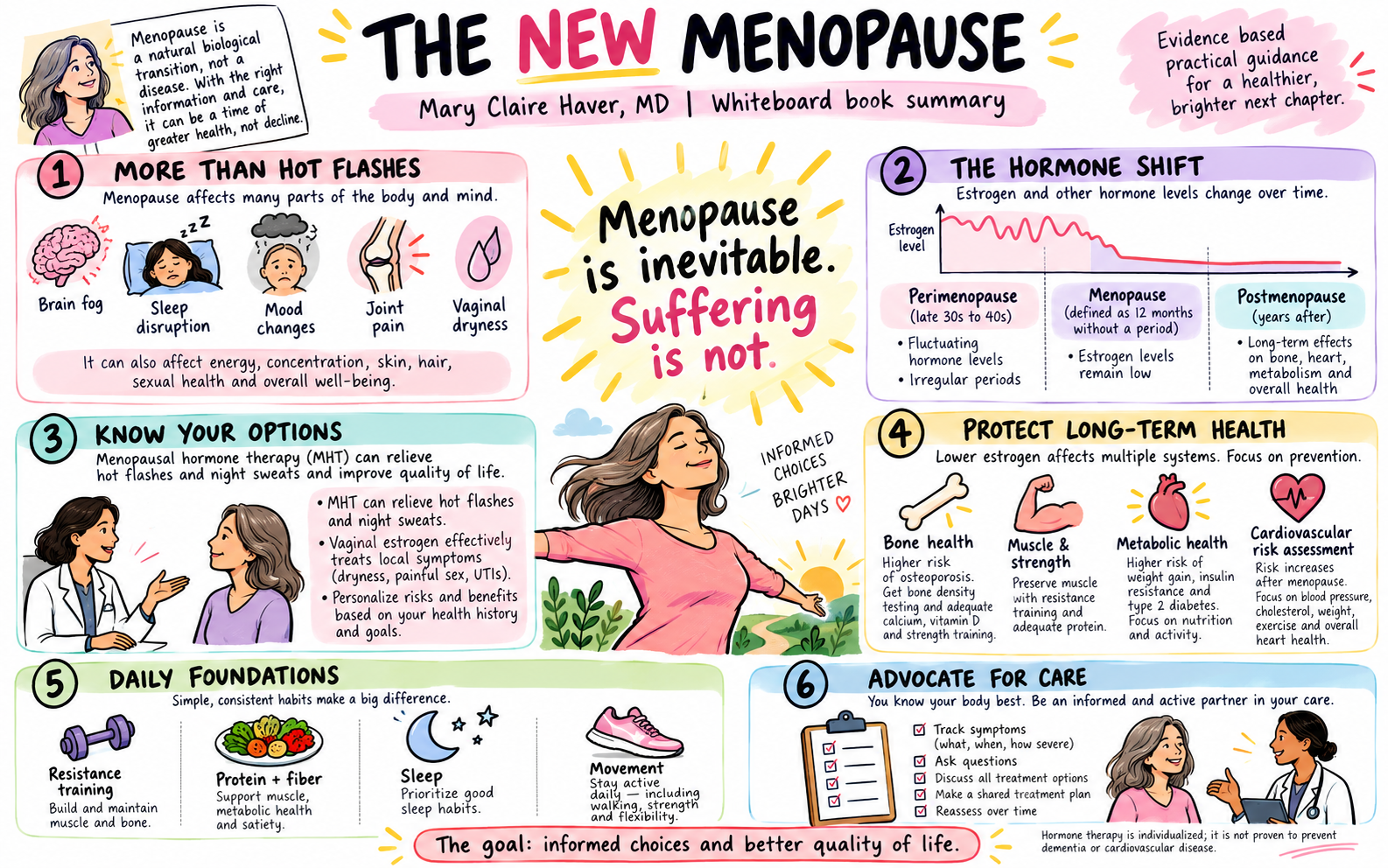
“Menopause is inevitable. Suffering through it is not.”
The short answer: Here’s The New Menopause summary in brief. In this 2024 book, OB-GYN Dr. Mary Claire Haver argues women were told to tough out menopause for 20 years after one study scared many doctors off hormone therapy. Her fix is information: know your symptoms, know your options, and bring a plan to your appointment.
You’ll learn how long hot flashes last, what changed on hormone therapy, and why midlife bodies change shape. Plus how to use her toolkit.
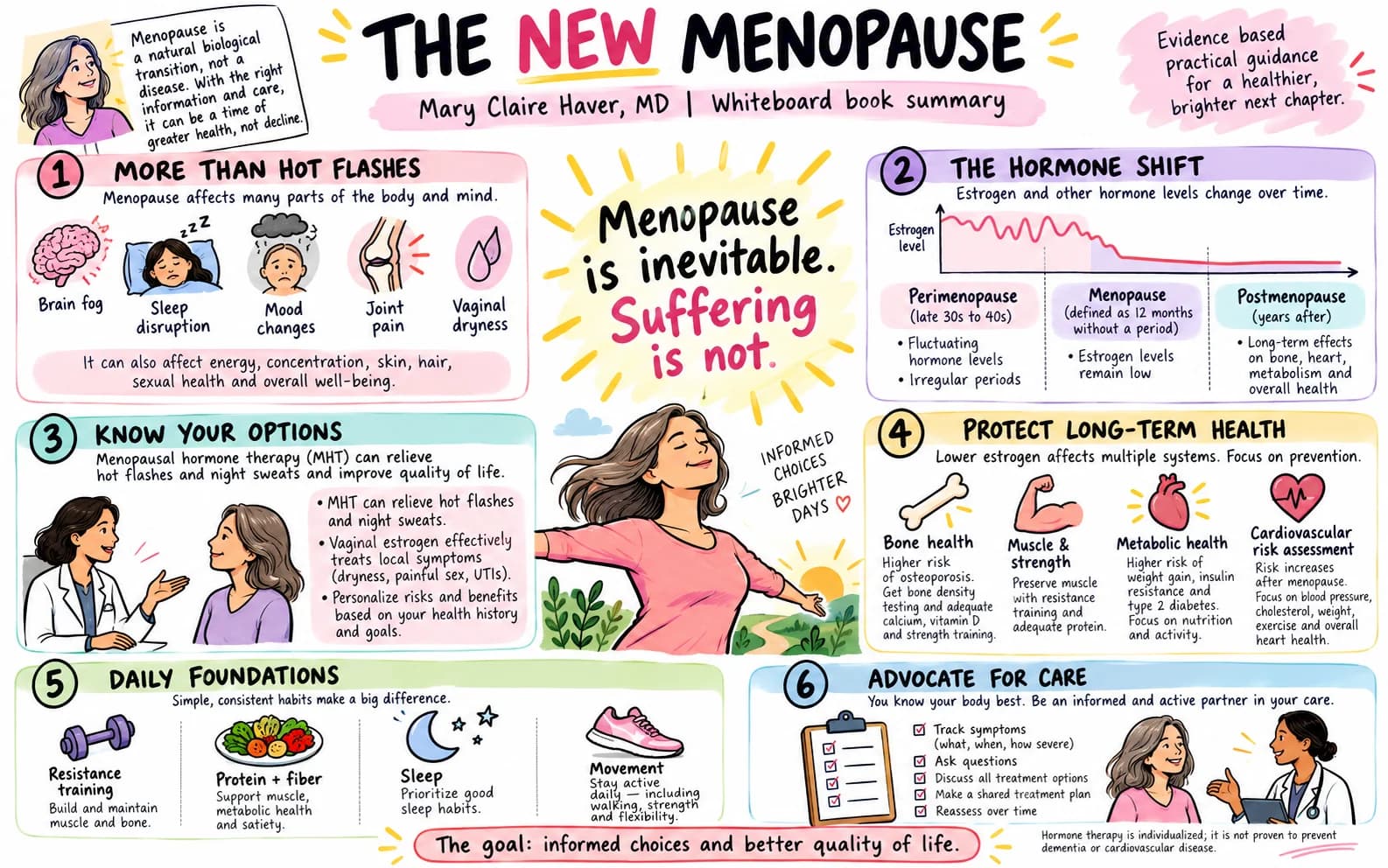
What Is The New Menopause About?
The New Menopause is a 320-page field guide to the hormone shift most women face in their 40s and 50s, written by a board-certified OB-GYN. Rodale published it in April 2024, per Publishers Weekly. It became a #1 New York Times bestseller, per Penguin.
Haver is also a certified menopause practitioner in Galveston, Texas, per Wikipedia. Her TikTok following grew fast, per Texas Monthly.
First comes the science: what estrogen does, and what happens when it drops. Then a toolkit: an A-to-Z guide to more than 70 symptoms, a symptom scoring sheet, and a hot flash diary.
Action item: Write down every change you’ve noticed in the last year, even the odd ones. Achy joints count.
Why Were Women Told to Tough It Out?
Because in 2002, one big study made doctors afraid of hormone therapy, and many backed away from treating menopause. Haver had a front-row seat.
She was finishing her residency in Galveston that year. She overheard professors talking about a new study linking hormone therapy to breast cancer and other risks, per Texas Monthly. It was the Women’s Health Initiative (WHI).
The fallout was fast. Prescriptions for Prempro, the pill the WHI tested, fell 66% in early 2003 versus a year before, per a 2004 JAMA study.
Early in her career, women came to her with weight gain and low desire. Her boss’s advice: pat them on the knee and suggest wine, she told The Sunday Paper. Then her own perimenopause hit, and with it, weight gain. “I couldn’t get rid of it,” she said.
That’s the turning point. A gynecologist who couldn’t fix her own symptoms started digging. And she wasn’t the only one untrained. In a survey of 177 US residents in family medicine, internal medicine and OB-GYN, only 6.8% felt ready to manage menopause.
Action item: Ask your doctor one plain question: “How much of your practice is menopause care?” The answer tells you a lot.
How Long Do Menopause Symptoms Last?
Longer than most people expect: frequent hot flashes and night sweats lasted a median of 7.4 years in the SWAN study of US women. They kept going a median of 4.5 years after the final period, per MDedge’s report on the 2015 JAMA Internal Medicine paper.
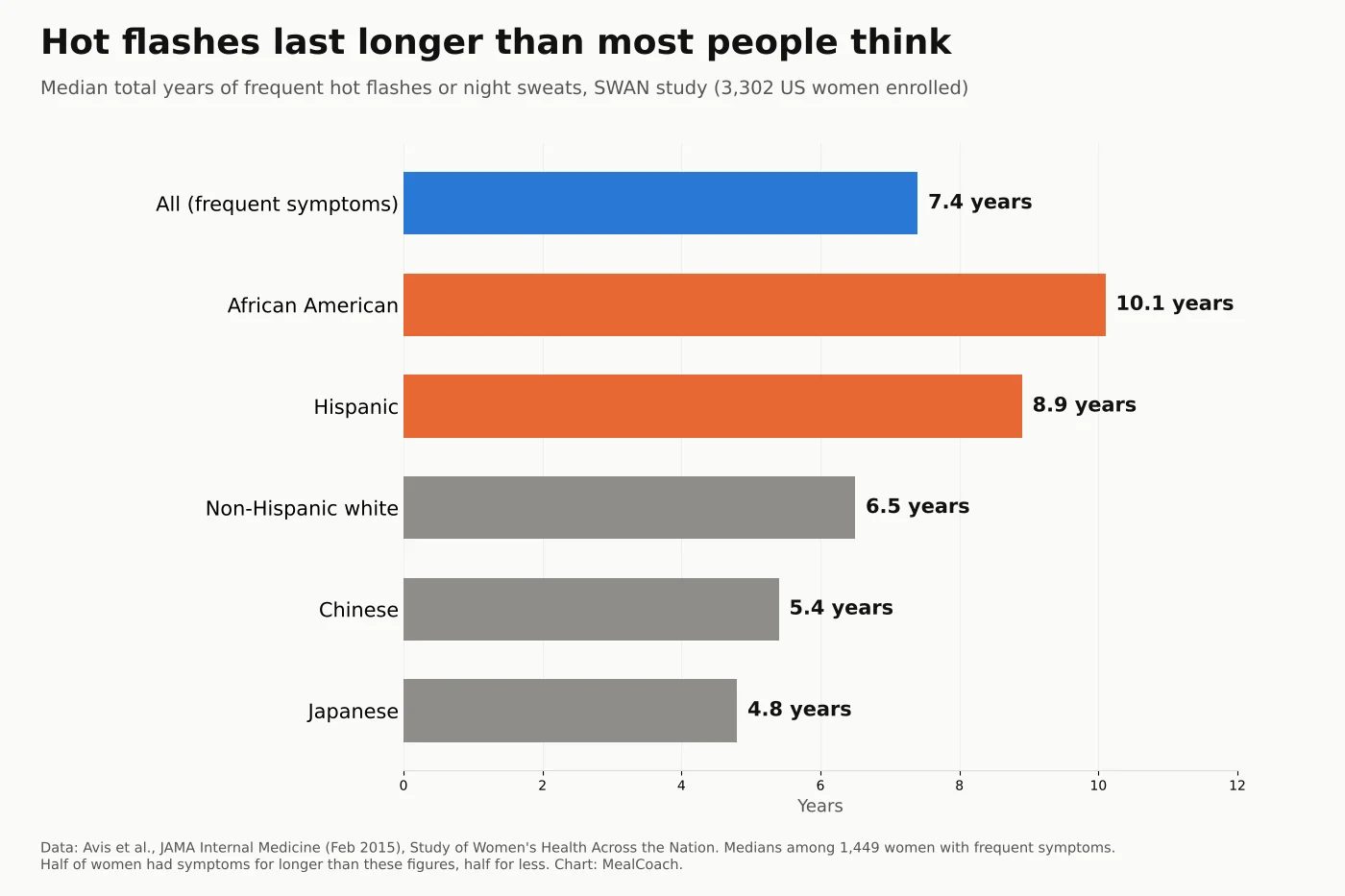
That’s not a rough season. That’s nearly two presidential terms.
And hot flashes are only the famous symptom. The book’s toolkit also covers brain fog, skin and hair changes, and gut trouble. One definition to keep straight: you reach menopause after 12 months in a row with no period, per UT Southwestern. Perimenopause is the bumpy stretch before that.
Action item: Start a two-week symptom log tonight: what happened, when, and how much it got in your way, from 0 to 3.
What Does The New Menopause Say About Hormone Therapy?
Haver argues the WHI fallout overstated hormone therapy’s risks and hid its benefits. Every woman, she says, deserves a personal risk-benefit talk. Not a blanket yes. “I don’t think every woman is going to choose hormone therapy,” she told The Sunday Paper.
Mainstream guidance has moved her way. The Menopause Society’s 2022 position statement says hormone therapy is the most effective treatment for hot flashes. For most healthy women with symptoms under 60, or within 10 years of menopause, benefits outweigh risks (see the full abstract).
On November 10, 2025, the FDA said it would remove the “black box” warning from more than 20 menopause hormone products, AP reported. One boxed warning stays: estrogen alone raises uterine cancer risk in women who still have a uterus.
“Women and their physicians should make decisions based on data, not fear,” FDA Commissioner Marty Makary said, per Urology Times.
Action item: Don’t decide anything today. Bring your symptom log and ask: “What are my personal risks and benefits for each option, with and without hormones?”
Why Does Your Body Shape Change in Menopause?
Because the menopause transition speeds up fat gain and starts muscle loss, even when the scale barely moves. In a 2019 JCI Insight paper using SWAN data, the rate of fat gain roughly doubled as the transition began, and lean mass started falling.
Those changes kept going until about two years after the final period, then leveled off. The team drew on 18 years of SWAN data, per UCLA Health. So “I eat the same and my jeans don’t fit” isn’t in your head.
The book’s plan: anti-inflammatory eating, strength plus cardio, sleep, stress relief, and nutrients like omega-3s and vitamin D, per SuperSummary. Her newer guidance adds numbers. Eat at least 25 grams of fiber a day. Lift weights two days a week. That’s per her challenge on Katie Couric Media.
One habit nobody sells you: slow down, so fullness signals have time to land. Our guide on how to stop eating too fast covers the basics.
Action item: Add one fiber food to dinner tonight: beans, lentils, berries or a big pile of vegetables.
How Do You Use the Menopause Toolkit at an Appointment?
Track, score, then ask: the book wants you to arrive with data, not a vague “I don’t feel like myself.” Use its scoring sheet, hot flash diary and question list.
A worked example (an illustration, not a case from the book): a 49-year-old logs two weeks of symptoms.
- Night sweats: 9 nights out of 14, woke up each time. Score 3.
- Brain fog: lost words in meetings twice a week. Score 2.
- Joint aches: stiff knees most mornings. Score 1.
- Periods: 52 days since the last one.
Now the visit starts with facts. Her clinician can weigh every option, hormonal or not, for what bothers her most.
Action item: Pick your top two symptoms. Those are the first thing you say when the doctor walks in.
When Should You Call a Doctor Right Away?
Any bleeding or spotting after menopause should be checked by a doctor soon, because it’s never considered normal. For about 10% of women with it, the cause is uterine cancer, per UT Southwestern.
Also call your doctor if symptoms are wrecking your sleep, work or mood. Don’t wait for a yearly visit.
Action item: Save your doctor’s number under “call if spotting.” Future you will thank you.
Where The New Menopause Falls Short
The book is strong on hormones and weaker on daily habits, and some hormone claims around it go further than the evidence.
- Thin lifestyle detail. Publishers Weekly noted it recommends antioxidant-rich foods without naming them. It advises resistance training without naming exercises.
- Prevention is still unproven. The US Preventive Services Task Force advised against hormone therapy to prevent chronic disease after menopause in 2022. Harvard’s JoAnn Manson backed the label change but said the evidence for broad benefits isn’t that conclusive, per AP.
- She sells products. Haver runs a supplement line for midlife women, per Wikipedia. Supplements in the book deserve the same skepticism you’d give any brand.
My take: the book’s best gift isn’t any single treatment. It’s permission to stop being polite about your symptoms.
Action item: Before buying any menopause supplement, ask your clinician or pharmacist whether it has trial evidence and whether it mixes with your other medicines.
Why Is Everyone Talking About The New Menopause Now?
Because the FDA’s 2025 label change put hormone therapy back on the table, and Haver followed with a second book. The New Perimenopause came out on April 7, 2026.
In Google Trends (US, past 12 months, checked Oct 27, 2026), “the new menopause” averaged 53 out of 100. A rising related search: “what signals the end of menopause.”
New weight drugs are being tested in women around menopause too: see CagriSema in women and menopause. If night sweats steal your sleep, our Why We Sleep summary explains what that costs you.
Action item: Share this with one friend over 40. Odds are she has a symptom she hasn’t named yet.
Quick Answers
What is The New Menopause about? It’s Dr. Mary Claire Haver’s 2024 guide to perimenopause and menopause. It explains the biology, argues for informed choices on hormone therapy, and offers a toolkit for 70+ symptoms.
What signals the end of menopause? Menopause itself is one point in time: 12 months in a row with no period. After that you’re postmenopausal, though hot flashes often continue for years.
Does The New Menopause recommend hormone therapy? It argues hormone therapy is safer than many women were told and works best for hot flashes. But the choice is personal, made with a clinician.
What is the difference between The New Menopause and The New Perimenopause? The New Menopause (2024) covers the whole transition and beyond. The New Perimenopause (2026) focuses on the years before periods stop.
Is The New Menopause worth reading? Yes, if you want to understand your symptoms and talk to your doctor with confidence. Pair it with a clinician’s advice, and treat its supplement suggestions with caution.
The 5-Minute Version: The New Menopause Summary (Screenshot This)
- The claim: menopause is inevitable, but suffering through it isn’t.
- The history: after the 2002 WHI study, Prempro prescriptions fell 66% within a year.
- The length: frequent hot flashes lasted a median of 7.4 years in SWAN.
- The body: fat gain speeds up and muscle loss starts during the transition.
- Hormones: most effective for hot flashes; benefits outweigh risks for most healthy women with symptoms under 60. The FDA moved to drop most boxed warnings in 2025.
- The toolkit: a symptom scoring sheet and hot flash diary. Our tip: bring your top two symptoms.
- The catch: thin on daily habits, and a US task force advises against hormone therapy just to prevent chronic disease.
Conclusion
The New Menopause doesn’t hand you a cure. It hands you a vocabulary. Night sweats, brain fog and a waistline that moved without asking are real, common and worth raising.
My take: the best appointments start with notes, not a shrug.
Your one step this week: start the two-week symptom log, then book the appointment.
So tell me: which menopause symptom surprised you most?
This is a book summary, not medical advice. Talk to your doctor about any symptom, treatment or supplement before you make a change.
Sources
- Penguin: The New Menopause by Dr Mary Claire Haver (320 pages; toolkit for more than 70 symptoms)
- Publishers Weekly: review of The New Menopause (Rodale, April 2024)
- Wikipedia: Mary Claire Haver (credentials, books, supplement line)
- Texas Monthly: Q&A with Mary Claire Haver
- The Sunday Paper: Menopause is having a moment
- The Sunday Paper: Dr. Mary Claire Haver on The New Menopause
- SuperSummary: The New Menopause summary (book structure and lifestyle chapters)
- Hersh, Stefanick and Stafford, JAMA (2004): National use of postmenopausal hormone therapy
- The Hospitalist: resident survey on menopause training (Kling et al., Mayo Clinic Proceedings, 2019)
- MDedge: Seven years of hot flashes common (Avis et al., JAMA Internal Medicine, Feb 2015)
- Let’s Talk Menopause: highlights of The Menopause Society’s 2022 hormone therapy position statement
- The 2022 hormone therapy position statement of The North American Menopause Society (abstract)
- USPSTF: Hormone therapy for the primary prevention of chronic conditions (Nov 1, 2022)
- AP via National Center for Health Research: FDA removes long-standing warning from menopause drugs (Nov 10, 2025)
- Urology Times: FDA removes warning labels on hormone replacement therapy
- UCLA Health: Study links perimenopause to accelerated fat mass gains, lean mass losses (Mar 2019)
- Greendale et al., JCI Insight (2019): Changes in body composition and weight during the menopause transition
- Katie Couric Media: Dr. Mary Claire Haver’s guide to a healthier year
- UT Southwestern Medical Center: Postmenopausal bleeding
- Penguin Random House: The New Perimenopause (April 7, 2026)
 MealCoach