
“…a very clear opportunity for first-choice therapy…”
The short answer: in its Zealand Pharma Q3 2026 report on November 12, 2026, the Danish company said it had started Phase 3 trials of petrelintide, the weekly amylin shot it develops with Roche, planned to enroll about 7,000 people. Its partner Boehringer Ingelheim plans to file its other obesity shot, survodutide, in 2027.
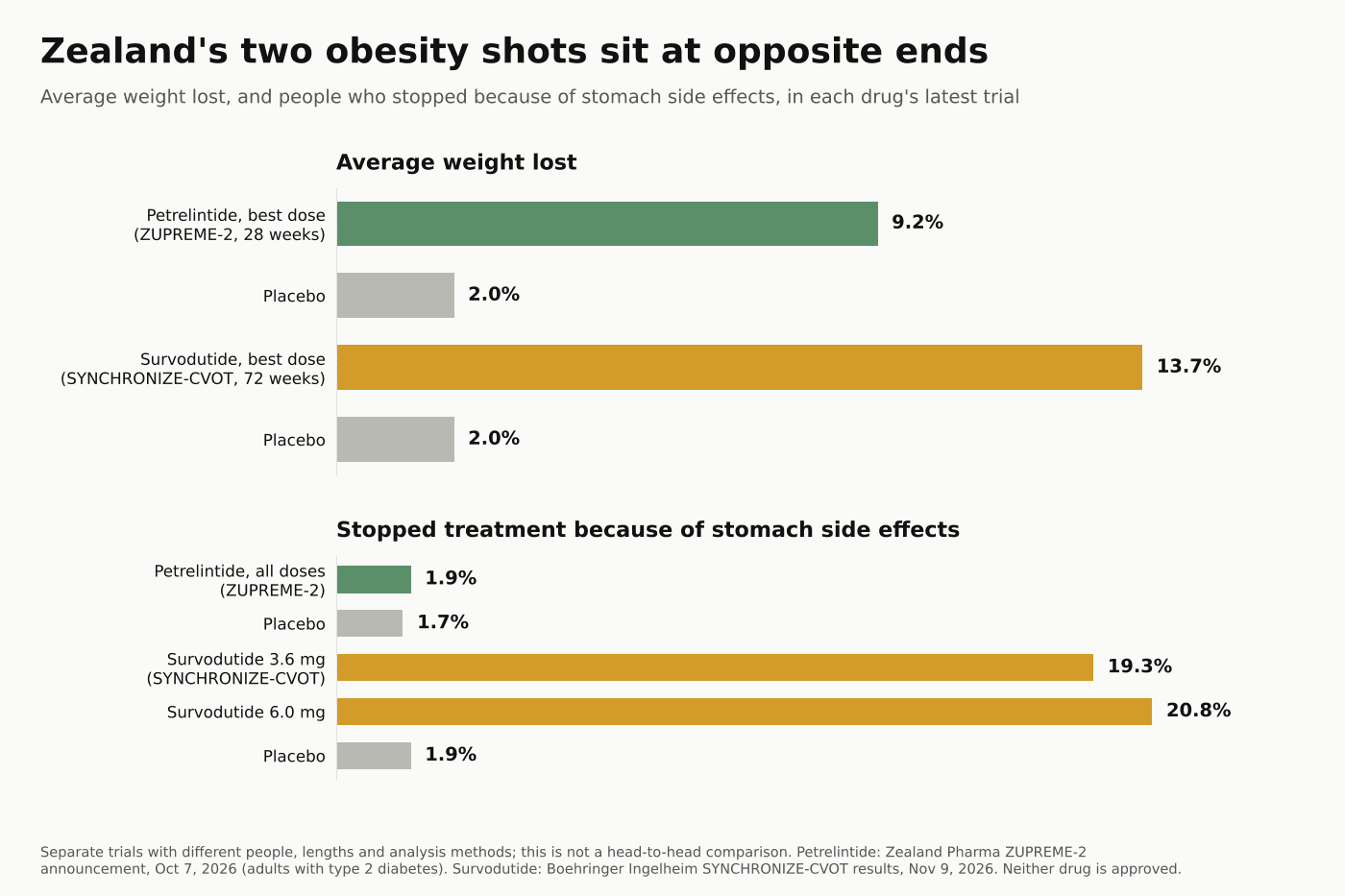
The two drugs sit at opposite ends of the same trade-off. Petrelintide loses less weight but almost nobody quits it over stomach side effects. Survodutide loses more, but about one in five people in its biggest trial stopped because of them.
In this post you’ll learn what Zealand reported for the first nine months of 2026, what petrelintide is and how it did, why investors were cool on it, where survodutide stands, and when either drug could reach pharmacies. About 7 minutes.
What Was in the Zealand Pharma Q3 2026 Report?
Zealand has no obesity drug on sale, so its profit this year comes from Roche partnership payments, not sales. It made DKK 3.5 billion (Danish kroner) in profit in January to September 2026, on DKK 4.5 billion of revenue. That’s per its November 12, 2026 results release.
- Where the revenue came from: a DKK 3.7 billion payment from Roche for starting Phase 3, and a DKK 798 million first-anniversary payment, per the finance chief on the call.
- Research spending: DKK 1.6 billion, largely reflecting the petrelintide program.
- Cash: DKK 13.5 billion in cash and securities on September 30, 2026, down from DKK 15.1 billion at the end of 2025, after research spending and a share buyback.
- 2026 outlook: about DKK 4.5 billion of partnership revenue, unchanged, with day-to-day costs narrowed to DKK 2.7 to 3.0 billion, from up to DKK 3.3 billion.
Revenue was about half of the same period in 2025, when Zealand booked the $1.4 billion Roche paid at closing of the petrelintide deal. Neither year’s profit says anything about how many people would use the drugs.
Action item: For a drug developer without sales, the trial timelines matter more than the profit line. Those are below.
What Is Petrelintide?
Petrelintide is an experimental once-weekly shot that copies amylin, a hormone your pancreas releases with insulin after you eat. Amylin helps signal that you’re full. Zealand and Roche are testing it alone and alongside Roche’s GLP-1/GIP shot, enicepatide.
GLP-1 drugs like Wegovy and Zepbound work on a different hormone system. The hope for amylin drugs is that they curb appetite with fewer stomach side effects. Lilly’s eloralintide and Novo Nordisk’s cagrilintide are in the same class; our cagrilintide vs eloralintide guide covers them.
Zealand pitches petrelintide as a first drug for people starting out, rather than a maximum-strength option. The combination with enicepatide is the version aimed at people who need to lose more.
Action item: If you already feel full faster on a GLP-1, that signal is worth listening to today. Our post on why you feel full faster on Zepbound explains it.
How Much Weight Did People Lose on Petrelintide?
In Phase 2, people lost up to 10.7% of their body weight at 42 weeks without diabetes, and up to 9.2% at 28 weeks with type 2 diabetes. Placebo groups lost 1.7% and 2.0%. Both figures assume people kept taking the drug as planned.
- ZUPREME-1 (March 2026): nearly 500 adults with obesity or overweight and a weight-related health problem, five dose groups, 42 weeks. People who stopped because of side effects: 4.8% on petrelintide vs 4.9% on placebo, Healio reported.
- ZUPREME-2 (October 2026): 220 adults with type 2 diabetes on metformin, three doses, 28 weeks. Weight loss was 7.4% to 9.2% across doses. Stomach side effects led 1.9% to stop, vs 1.7% on placebo, per Zealand’s October 7, 2026 announcement.
- Blood sugar in ZUPREME-2: HbA1c fell by up to 0.65 points on petrelintide and rose 0.23 points on placebo, a gap of 0.61 to 0.88 points.
Most side effects were stomach-related and mild, and came mainly while doses were being raised. Zealand hasn’t published the dose sizes.
Action item: When you compare weight-loss drugs, check the trial length. A 28-week number and a 72-week number aren’t measuring the same thing.
Why Were Investors Unimpressed?
The weight loss came in below what many investors hoped for. Zealand’s market value fell by more than a third the day ZUPREME-1 came out, BioPharma Dive reported.
The yardstick was Lilly’s eloralintide, which cut weight by 20.1% at 48 weeks in its own Phase 2 trial, versus 0.4% on placebo, per Lilly’s November 2025 release. A Cantor Fitzgerald analyst called petrelintide’s results “undifferentiated,” noting rival amylin drugs also report gentle side effects. Analysts at William Blair and Jefferies also noted it fell short of eloralintide’s Phase 2 numbers, though comparing separate trials is error-prone.
The other side has a case too. Obesity specialist Donna Ryan, writing in Healio, said the tolerability appeared to be the best seen so far and called the weight loss “respectable,” while adding that longer, larger studies are needed.
Zealand adds that weight loss with GLP-1-type drugs usually shrinks in people with diabetes, and that amylin drugs may hold up better there. On the November 12 call, its medical chief called ZUPREME-2 “a hopeful sign” that needs Phase 3 to confirm.
The blood sugar numbers drew questions too. Part of the placebo-adjusted gap came from the placebo group’s HbA1c rising, which a William Blair note called unusual, per Life Science Daily News. On the November 12 call, Zealand’s medical chief pointed out that amylin drugs don’t push the pancreas to release insulin, as GLP-1-type drugs do.
Action item: “Gentler” only matters if it keeps people on a drug long enough to work. Phase 3 will show whether that holds over 64 weeks.
Where Does Survodutide Stand?
Survodutide, a weekly shot that acts on both the glucagon and GLP-1 hormone systems, completed a large Phase 3 heart-safety trial this month. Zealand says Boehringer Ingelheim plans global obesity filings in 2027. Boehringer runs and pays for it; Zealand invented it and is owed milestones and royalties.
That trial, SYNCHRONIZE-CVOT, followed 5,530 adults at raised heart risk. Major heart events such as heart attack and stroke were no more common than on placebo, the safety bar it had to clear, per Boehringer’s November 9, 2026 results.
- Weight loss: up to 13.7% at 72 weeks vs 2.0% on placebo, counting people while they stayed on treatment.
- Stopped for stomach side effects: 19.3% on 3.6 mg and 20.8% on 6.0 mg, vs 1.9% on placebo, mostly while doses were raised. Boehringer says the trial’s fixed dose-raising schedule played a part, and newer trials use a more flexible one.
- With diabetes: up to 13.1% weight loss in SYNCHRONIZE-2, per Zealand’s report.
Action item: If stomach side effects make your GLP-1 hard to stay on, tell your doctor rather than quitting on your own. Our guide on how to eat on a GLP-1 covers the food side.
When Could Petrelintide Be Available?
Zealand hasn’t given a filing or launch date. It announced the start of three Phase 3 trials in September 2026, each measuring its main result at week 64. Per its September 22, 2026 Phase 3 release:
- ZUPREME-3: about 3,900 adults with overweight or obesity, without type 2 diabetes.
- ZUPREME-4: about 600 adults with type 2 diabetes.
- ZUPREME-5: about 2,500 adults with heart disease, running up to three years.
Enrolling thousands of people and treating each for 64 weeks takes time, and an FDA review usually adds about a year. So we’d be surprised to see petrelintide in US pharmacies before 2029. That’s our estimate, not Zealand’s.
Survodutide is nearer. If filings go in during 2027, a decision would typically follow about a year later, but no regulator has accepted a filing yet.
Action item: Don’t put off treatment you need while waiting for a pipeline drug. Ask your doctor about what’s approved today.
What We Don’t Know Yet
Several answers patients care about weren’t in the report. As of November 12, 2026:
- Petrelintide’s doses: Zealand hasn’t named them.
- Phase 3 timing: no date for the first results.
- The combination: the ZYNERGY trial with enicepatide is due to start in Q4 2026, and Zealand declined to give a weight-loss target.
- Head-to-head data: no trial has tested petrelintide against another amylin drug or survodutide.
- Price and coverage: nothing announced for either drug.
Action item: Watch for full ZUPREME-2 results at a medical meeting, then ZYNERGY’s start. Those are the next real signals.
Quick Answers
What did Zealand Pharma report in Q3 2026? Nine-month profit of DKK 3.5 billion from Roche payments, DKK 13.5 billion in cash, Phase 3 trials of petrelintide under way, and survodutide filings planned for 2027.
Is petrelintide approved? No. It’s in Phase 3 trials and isn’t approved anywhere as of November 2026.
How much weight did people lose on petrelintide? Up to 10.7% at 42 weeks in people without diabetes, and up to 9.2% at 28 weeks in people with type 2 diabetes, in Phase 2.
Is petrelintide easier to tolerate than GLP-1 drugs? In Phase 2, people quit over side effects about as often as on placebo. No trial has compared it directly with a GLP-1 drug.
Does this news change my GLP-1 treatment? No. Neither drug is approved, and no prices or launch dates were announced.
What This Means for You
✅ You know petrelintide is in Phase 3, with no launch date
✅ You know its best Phase 2 weight loss was 9% to 11%, with very few people quitting
✅ You know why investors wanted more
✅ You know survodutide filings are planned for 2027
✅ You know Zealand’s profit came from partner payments, not sales
The 5-Minute Version (Screenshot This)
- News: Zealand Pharma reported nine-month 2026 results on November 12, 2026.
- Money: DKK 3.5 billion profit, mostly from Roche milestone payments; DKK 13.5 billion in cash.
- Petrelintide: Phase 3 started, planned for about 7,000 people; Phase 2 weight loss up to 10.7%, with placebo-like quit rates.
- Survodutide: up to 13.7% weight loss and heart safety shown; about 1 in 5 stopped for stomach side effects; filings planned for 2027.
- Next: the petrelintide plus enicepatide trial is due to start in Q4 2026.
Conclusion
The Zealand Pharma Q3 2026 report showed a company betting on two different answers to the same question: how much side effect is worth how much weight loss. Petrelintide is the gentle option, and Phase 3 will test whether gentle is enough. Survodutide is the stronger one, and it’s closer to a filing.
Your one action today: if side effects are making your current treatment hard, tell your doctor instead of stopping on your own.
So tell me: would you trade some weight loss for a shot with fewer stomach side effects?
Sources
- Zealand Pharma: financial results for the first nine months of 2026 (GlobeNewswire, Nov 12, 2026)
- Investing.com: Zealand Pharma Q3 2026 earnings call transcript (Nov 12, 2026)
- Zealand Pharma: positive Phase 2 ZUPREME-2 results for petrelintide (company announcement No. 54/2026, Oct 7, 2026)
- Zealand Pharma: start of the Phase 3 ZUPREME program of petrelintide (Sep 22, 2026)
- Healio: amylin analog induces up to 10.7% weight loss at 42 weeks (Mar 10, 2026)
- Life Science Daily News: petrelintide in type 2 diabetes, how does it compare? (Oct 9, 2026)
- BioPharma Dive: Roche and Zealand amylin obesity drug results (Mar 6, 2026)
- Eli Lilly: eloralintide Phase 2 results (PR Newswire, Nov 6, 2025)
- Boehringer Ingelheim: SYNCHRONIZE-CVOT results presented at AHA (Nov 9, 2026)
 MealCoach