
“…more than half no longer meeting the BMI criteria for obesity…”
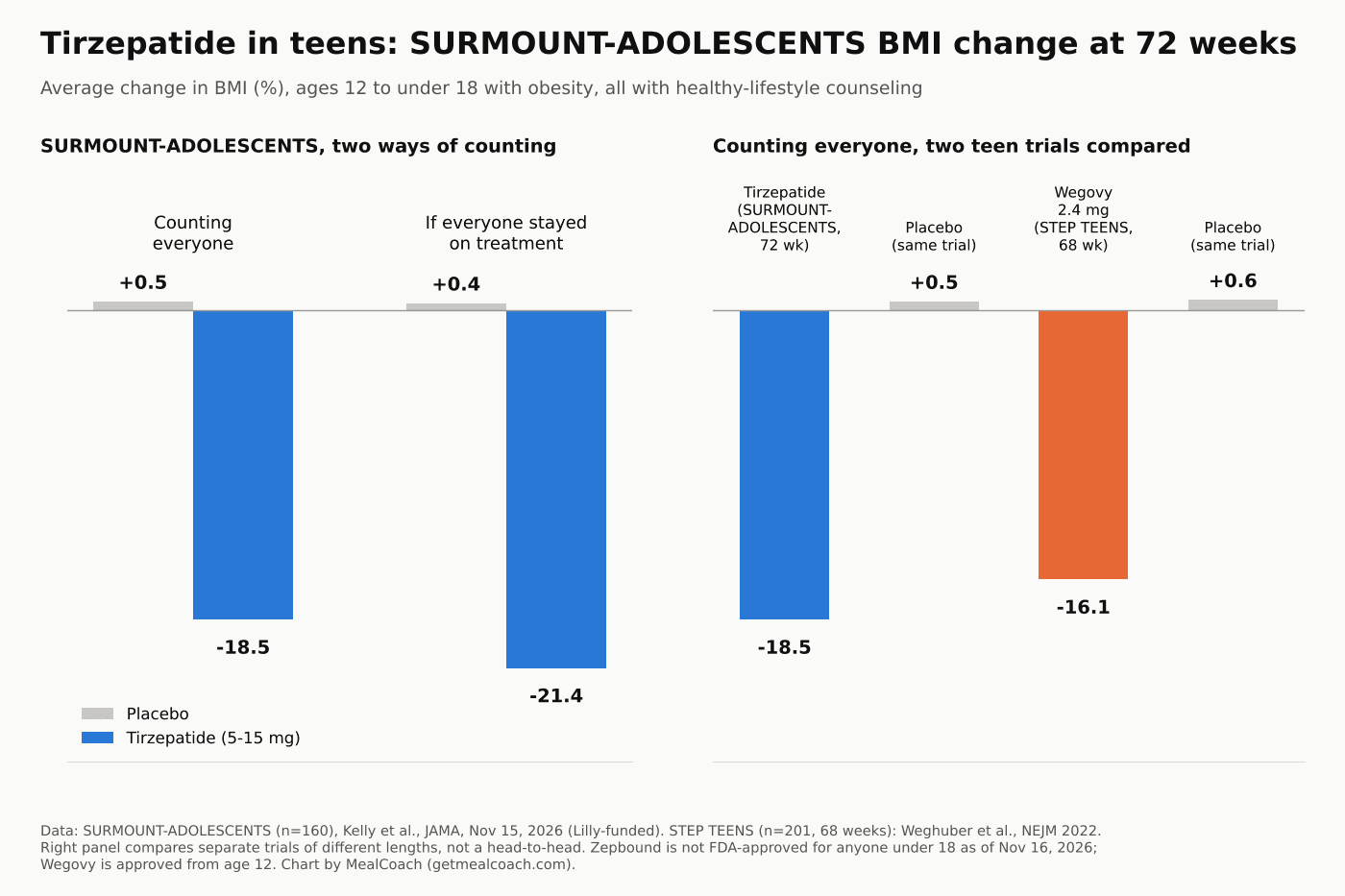
The short answer: Zepbound for teens now has a full trial result, and it worked. In SURMOUNT-ADOLESCENTS, published in JAMA on November 15, 2026, BMI fell 18.5% in 72 weeks on tirzepatide versus a 0.5% rise on placebo, counting everyone.
About half of the teens on tirzepatide ended below the obesity cutoff. Stomach side effects were common: half had vomiting. Zepbound still isn’t approved for anyone under 18.
In this post you’ll learn what the trial tested, why there are two sets of numbers, how it compares with Wegovy in teens, what the side effects looked like, and what parents can do with this news today. About 7 minutes.
What Did SURMOUNT-ADOLESCENTS Test?
SURMOUNT-ADOLESCENTS compared weekly tirzepatide shots with placebo for 72 weeks in 160 teens aged 12 to 17 with obesity, all with healthy-lifestyle counseling. Tirzepatide is the drug in Zepbound and Mounjaro.
- Who joined: teens with obesity, or with overweight plus a weight-related health problem. Average age was 14.6, and 62% were girls.
- Groups: 109 on tirzepatide and 51 on placebo (a 2:1 split), at 31 sites in the US, Canada and four other countries.
- Doses: each teen went up step by step to the highest dose they tolerated, 5, 10 or 15 mg. Among teens who finished, 62% ended on 15 mg.
- Who ran it: Eli Lilly funded the trial and helped design and analyze it, per the JAMA paper (Kelly et al.).
The results were also presented at ObesityWeek 2026 in Washington, D.C., on November 15.
Action item: When you see a headline about this trial, check the age range and length: 12 to 17, 72 weeks. Results don’t automatically carry over to younger kids.
How Much Did BMI Drop on Zepbound in Teens?
Counting everyone, BMI fell 18.5% on tirzepatide and rose 0.5% on placebo, a gap of 19.0 percentage points at 72 weeks. “Counting everyone” (the paper calls it the treatment-regimen estimand) includes teens who stopped the drug.
Lilly’s 21.4% headline matches a second way of counting in the paper, “if everyone stayed on treatment” (the efficacy estimand). On that basis placebo was +0.4%. JAMA ran an editor’s note on the two numbers, titled “Tale of Two Estimands.”
Why BMI and not weight? Teens are still growing, so doctors track BMI. For teens, obesity is defined by BMI percentile for age and sex, and the trial’s cutoff was the 95th percentile.
Here’s what else moved, counting everyone:
- Below the obesity cutoff at 72 weeks: 53.5% on tirzepatide vs 7.1% on placebo.
- BMI down at least 20%: 48.1% vs 7.9%.
- Body weight: down 17.8 kg (about 39 lb) vs up 2.3 kg (about 5 lb).
- Waist: down 15.7 cm (about 6 inches) vs up 0.7 cm.
- Quality of life: teens reported better weight-related quality of life, mostly physical comfort and body esteem.
Action item: If you’re reading coverage, note which number it uses. 18.5% counts every teen; 21.4% assumes they all stayed on the drug.
How Does It Compare With Wegovy in Teens?
Counting everyone, tirzepatide’s 18.5% BMI drop at 72 weeks sits a little above Wegovy’s 16.1% at 68 weeks in its own teen trial, STEP TEENS. These are separate trials of different lengths, not a head-to-head.
- Wegovy (semaglutide 2.4 mg), STEP TEENS: BMI −16.1% vs +0.6% on placebo in 201 teens, using the treatment-policy estimand (also “counting everyone”), per the NEJM paper (2022).
- Tirzepatide, SURMOUNT-ADOLESCENTS: BMI −18.5% vs +0.5% on placebo in 160 teens.
The JAMA authors cite STEP TEENS themselves, and say the types of side effects were generally consistent with those seen in adults. With only 160 and 201 teens in these trials, a gap of about 2 points between separate trials is a rough guide, not proof one drug is better.
My take: the bigger news is another strong trial of a GLP-1-class drug in teens, not a winner. If it’s approved, families and doctors would have one more option to weigh.
Action item: If someone tells you one drug “beats” the other in teens, ask whether it came from a head-to-head trial. For teens, we found none that has reported.
What About Side Effects in Teens?
Stomach side effects were the most common, mostly mild to moderate, and 9.3% of teens on tirzepatide stopped it because of a side effect, versus none on placebo. Here’s what the paper reports for tirzepatide vs placebo:
- Any stomach side effect: 81.5% vs 54.9%.
- Vomiting: 50.9% vs 13.7%. Nausea: 50.0% vs 23.5%. Diarrhea: 45.4% vs 25.5%.
- Serious side effects: 7.4% vs 3.9%. No deaths. Gallstones and gallbladder removal were among the serious events judged related to the drug.
- Mood: depression or suicidal-thought events were reported in 4.6% vs 2.0%. None was serious, no one stopped because of suicidal thoughts, and the paper says every teen who reported suicidal thoughts had a psychiatric history.
- Growth: height stayed on track and puberty progressed similarly in both groups. More than half the teens were already at the last puberty stage, so the authors call for continued monitoring.
For context, 62% of teens on Wegovy had a stomach side effect in STEP TEENS, versus 42% on placebo. If constipation is the question in your house, see GLP-1 constipation: why it happens and what experts advise.
Action item: If your teen is on any GLP-1 now, keep a simple log of vomiting, mood changes and missed meals to bring to appointments.
When Should You Call Your Teen’s Doctor?
If a teen is on any GLP-1 medicine, call their doctor promptly if any of these happen:
- Vomiting or diarrhea they can’t keep up with, or signs of dehydration such as dizziness or very little urine.
- Severe stomach pain that won’t go away, with or without vomiting.
- Pain in the upper right belly, fever, or yellow skin or eyes.
- New or worse low mood, or any talk of self-harm. If they are in danger, call 911; in the US, call or text 988 for crisis support.
- Sudden vision loss or blurring in one eye; see the FDA’s GLP-1 vision warning.
Zepbound’s label warns about pancreatitis, gallbladder problems and dehydration, per Lilly’s November 14 release.
In an emergency, call 911.
Action item: Save this list in your phone’s notes, next to your teen’s medicine list.
Is Zepbound for Teens FDA-Approved?
No. As of November 16, 2026, Zepbound is approved only for adults, and its label says it isn’t known whether it’s safe and effective in children. That’s per the safety summary in Lilly’s release.
Wegovy has been FDA-approved for teens aged 12 and older with obesity since December 23, 2022, per Drugs.com’s approval history.
Lilly’s November 14 release doesn’t mention an FDA filing for teens, and we found no announced date. Any timeline you see is a guess until Lilly or the FDA says otherwise.
Action item: If you’re exploring options for a teen, ask their doctor what’s approved for their age today, and why it would or wouldn’t fit.
What Does This Mean If Your Teen Is on Wegovy Now?
Nothing changes today: Zepbound isn’t approved for teens, and this trial didn’t test switching from Wegovy. It compared tirzepatide with placebo; no one in it switched over from Wegovy.
What it gives you is a better question for later. If Zepbound gets a teen label, the choice will turn on side effects, cost and coverage as much as on a 2-point gap between separate trials.
It also helps to know that weight often returns after these drugs stop, in adults at least; see what happens when you stop a GLP-1. This trial ended at 72 weeks and didn’t report what happened after.
Action item: Keep a record of your teen’s BMI percentile and side effects over time. It makes any future conversation about options faster.
What We Don’t Know Yet
The big gaps are life after 72 weeks, younger and more diverse groups, and what the FDA will do.
- Durability: the trial stopped at 72 weeks. The authors say longer follow-up is needed.
- Who was studied: racial and ethnic diversity was limited, and only one teen had type 2 diabetes.
- Growth through puberty: more than half the teens (most girls, under half of boys) were already at the last puberty stage, so effects during earlier stages are less clear.
- Younger kids: Novo’s STEP Young trial of semaglutide in children 6 to under 12 reported topline results on September 7, 2026, with full data due at ObesityWeek. We found no reported tirzepatide results in that age group.
- The label: whether, and when, Lilly files for teens.
Action item: Treat any claim about long-term safety in teens with caution. This trial can’t answer it yet.
Quick Answers
Does Zepbound work in teens? In SURMOUNT-ADOLESCENTS, yes. BMI fell 18.5% in 72 weeks versus a 0.5% rise on placebo, counting everyone, in teens aged 12 to 17 with obesity.
Is Zepbound approved for teenagers? No, not as of November 16, 2026. It’s approved only for adults. Wegovy is approved from age 12.
Where does the “21.4%” come from? It’s the BMI drop if every teen had stayed on treatment. Counting everyone, it was 18.5%.
Is tirzepatide better than Wegovy for teens? We found no head-to-head trial. In separate trials, counting everyone, BMI fell 18.5% on tirzepatide at 72 weeks and 16.1% on Wegovy at 68 weeks.
What were the main side effects? Stomach problems: about half the teens on tirzepatide had vomiting and half had nausea, and 9.3% stopped because of a side effect.
What This Means for You
✅ You know tirzepatide cut teens’ BMI 18.5% in 72 weeks, counting everyone
✅ You know the 21.4% headline is the best-case way of counting
✅ You know about half the teens on it ended below the obesity cutoff
✅ You know vomiting and nausea were common, and 9.3% stopped for side effects
✅ You know Zepbound isn’t approved for teens, and no filing date has been announced
The 5-Minute Version (Screenshot This)
- The news: SURMOUNT-ADOLESCENTS, tirzepatide vs placebo for 72 weeks in 160 teens aged 12 to 17 with obesity, JAMA and ObesityWeek, November 15, 2026.
- Counting everyone: BMI −18.5% vs +0.5% on placebo; if everyone stayed on treatment, −21.4% vs +0.4%.
- Below the obesity cutoff: 53.5% vs 7.1%.
- Side effects: vomiting 50.9% vs 13.7%; 9.3% stopped for a side effect vs 0%.
- Status: Zepbound is adults-only; Wegovy is approved from age 12. No teen filing date announced.
Conclusion
Zepbound for teens now has a solid trial behind it: an 18.5% BMI drop in 72 weeks, counting everyone, and about half the teens below the obesity cutoff. The price was a lot of nausea and vomiting, and the open questions are life after 72 weeks and what the FDA will do.
Your one action today: if you’re a parent weighing options, bring this post to your teen’s next appointment and ask what’s approved and right for them now.
So tell me: what would you want to know before a teen in your family started a weight-loss medicine?
Sources
- Kelly AS et al. Tirzepatide in Adolescents With Obesity: The SURMOUNT-ADOLESCENTS Randomized Clinical Trial. JAMA, published online Nov 15, 2026. doi:10.1001/jama.2026.23420
- Eli Lilly release: new data at ObesityWeek 2026, including SURMOUNT-ADOLESCENTS and Zepbound safety information (Nov 14, 2026)
- Weghuber D et al. Once-Weekly Semaglutide in Adolescents with Obesity (STEP TEENS). NEJM 2022;387:2245–2257
- Drugs.com: Wegovy FDA approval history
- Novo Nordisk release: STEP Young topline results in children 6 to under 12 (Sep 7, 2026)
 MealCoach